


- Posted on 25 Nov 2025
- 4-minute read
Australia’s bargaining system for essential workers – denied the right to strike yet lacking timely arbitration – is broken.
UTS research proposes a novel arbitration model to solve the stalemate, improve morale and safeguard crucial public services.
When an emergency unfolds, we depend on our essential service workers - police, firefighters and nurses - to be there.
Yet behind these critical services lies a broken system for negotiating fair working conditions that leaves dedicated professionals feeling unheard and communities at risk.
Australia's model for collective bargaining in police and essential services is in radical need of reshaping.
Essential workers are effectively denied the right to strike under the Fair Work Act.
Without the traditional leverage of industrial action or a swift, independent arbitrator, disputes can drag on for extraordinary lengths of time. A recent Victorian police dispute, for example, took some 16 months to resolve.
Described by UTS Associate Professor Giuseppe Carabetta as a system "not fit for purpose", this frustrating stalemate can have damaging consequences for workplace culture and, ultimately, the delivery of crucial public services.
The current Fair Work model typically requires a dispute to reach a "crisis threshold" before the Fair Work Commission (FWC) can intervene. This bar is dangerously high, often only met if community safety is significantly threatened.
Crucially, even with the FWC’s new power to arbitrate "intractable" disputes, a recent decision involving Victoria Police demonstrated that extensive deadlocked bargaining did not meet the strict requirements for intervention.
Professor Carabetta argues Australia simply cannot afford to wait for a crisis to force a resolution within its police and other essential services.
As Emeritus Professor Ron McCallum AO explains, “Dr Giuseppe Carabetta has undertaken groundbreaking research into the manner of resolving industrial disputes in Australia’s Federal, State and Territory police forces."
The culmination of a six-to-seven-year deep dive into international systems, Carabetta’s research proposes a powerful solution: a modified arbitration system designed to incentivise genuine negotiation.
He presents empirical evidence from Canada and New Zealand demonstrating that the presence of a carefully calibrated arbitration option acts as a "shadow effect."
Knowing that an external arbitrator could impose a settlement encourages both parties to negotiate their own, mutually agreeable deal.

“The central argument is that the Australian system must move beyond a simple binary of ‘bargaining or arbitration’ to a more balanced approach where both can coexist.”
Associate Professor Giuseppe Carabetta
UTS Business School
This innovative thinking aims to avoid situations where essential workers feel compelled to consider disruptive industrial action simply to break a deadlock.
The proposed model isn't just theoretical; it includes practical, built-in mechanisms to guarantee resolution. These feature strict time limits for negotiation phases, ensuring disputes don't linger indefinitely. If a deadline isn't met, the process automatically moves to the next phase. Stronger triggers for breaching good faith bargaining are also included, allowing for intervention if one party consistently refuses to negotiate reasonably.
Identifying as an "academic practitioner", Professor Carabetta’s motivation is to conduct research that directly influences the real world.
Over the past two decades, he has worked closely with the Australian Federal Police Association (AFPA), Police Federation of Australia (PFA) and all police associations.
The AFPA has officially backed the model, citing Carabetta's research in submissions to government inquiries.
“Professor Carabetta has appeared with us and for us in numerous Parliamentary and other inquiries as well meetings at the state, territory and federal level with relevant Ministers and senior bureaucrats. We very much value our relationship with Professor Carabetta and look forward to continuing to work with him and UTS into the future,” explains current PFA CEO Scott Weber and his predecessor Mark Burgess.
The influence of the research is affirmed by industry experts. Samantha Hinderling, a specialist in legal and policy publications, noted that Professor Carabetta’s 2025 book Collective Bargaining for Police and Other Essential Services is already highly influential both in Australia and internationally, offering a "timely and insightful examination of dispute resolution models in essential services" and "a compelling case for a more inclusive and flexible model".
“As a world-renowned expert in employment law for essential services workers Professor Carabetta has contributed significantly to policy development and creates positive social change," academic publications specialist Fiona Crawford said.
Professor Carabetta’s journey of impact began after his 2003 paper gained traction with the PFA around 2005.
The ultimate validation for his research came with judicial citation by the Supreme Court, alongside its continuous use in Senate inquiries and meetings with Government Ministers, confirming its legitimacy.
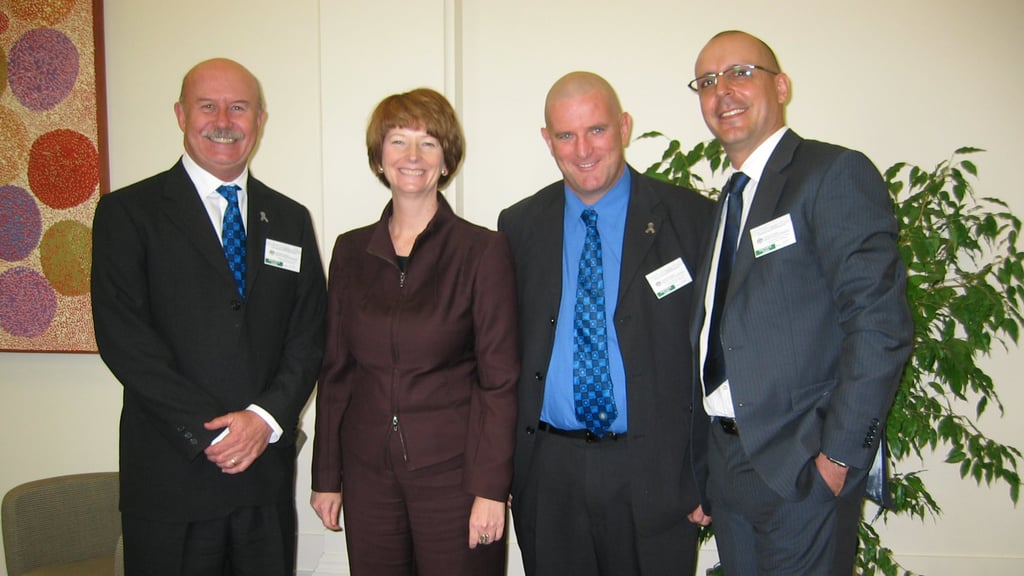
Carabetta’s international influence is also profound, particularly in Canada.
“Professor Carabetta continues to be a key authority in the field in Canada. His research articles are widely shared and vigorously debated in the professional community; they always contain research findings and policy pointers critical for devising successful reforms of the existing legislative frameworks,” said Senior Policy Advisor at the Ontario Ministry of Labour, Jonathan Eaton.
This critical research exemplifies the unique role academia plays in addressing complex societal challenges.
As Carabetta highlights, only an independent body like UTS possesses the objectivity and global perspective to develop credible, evidence-based solutions for policy reform.
The strength of this research lies in its rigorous methodology, which included 33 in-depth, semi-structured interviews across Canada and New Zealand.
The ultimate measure of success for this work is the implementation of the reform model.
The true goal is to see legislative and industrial change, ensuring that when political will emerges, the government has a robust, research-backed solution ready to protect our core public services.
Researcher

Associate Professor, Business School

Webpage
My voice, your words: AI helps NDIS participants speak up
Artificial intelligence tools are transforming communication between National Disability Insurance Scheme participants and providers.

Webpage
Remembering disability institutions
UTS research seeks to put Australia’s disability history at the centre of government planning processes.

Webpage
Shedding light on the traces of illicit drugs
Australian-first testing technology and surveillance research is helping reduce the harm associated with injecting drug use.
Webpage
My voice, your words: AI helps NDIS participants speak up
Artificial intelligence tools are transforming communication between National Disability Insurance Scheme participants and providers.
Webpage
Remembering disability institutions
UTS research seeks to put Australia’s disability history at the centre of government planning processes.
Webpage
Shedding light on the traces of illicit drugs
Australian-first testing technology and surveillance research is helping reduce the harm associated with injecting drug use.