


- Posted on 28 Oct 2025
- 4-minute read
Artificial intelligence tools are transforming communication between National Disability Insurance Scheme participants and providers.
Just a few short years ago, the AI tools that are now ubiquitous in workplaces were yet to go mainstream.
In this environment, devoid of exemplar technologies, researchers at the UTS Data Science Institute produced something remarkable. They built a two-sided large language model (LLM) that is now transforming communication between National Disability Insurance Scheme (NDIS) participants and providers.
The platform was developed as part of an industry research project commissioned by nTrustus, a leader in digital complaints resolution, and supported by grant funding from the Australian Government’s NDIS Quality and Safeguards Commission.
One side of the platform, My Complaint Assistant, supports NDIS participants to make complaints or to provide feedback directly to their providers about issues affecting their service.
The other, My Response Assistant, coaches NDIS providers to deliver compassionate, comprehensive and solution-oriented responses.
When we started this project, it was among the first generation of generative AI projects in Australia. It was very new.
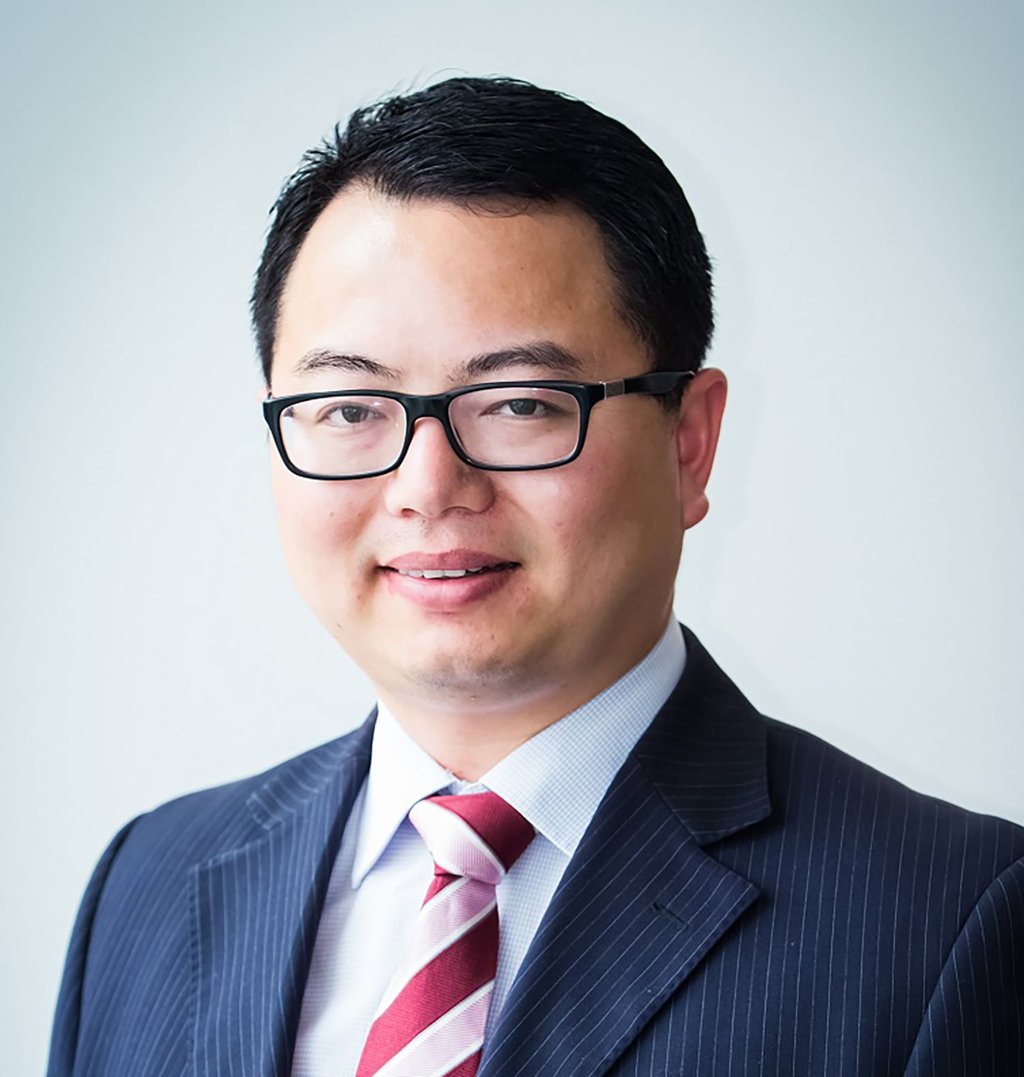
“It’s now a case study for other researchers who are developing their own generative AI solutions,” says UTS Data Science Institute researcher Dr Yifei Dong, who led the development of My Complaint Assistant.
To make a complaint, an NDIS participant logs into the nTrustus dashboard and provides the details of their issue in a free-text field. They can then opt to have their content rewritten in clear, plain language by an AI assistant.
This process overcomes a range of barriers—emotion, uncertainty about how to write an effective complaint, cognitive or physical challenges—that can prevent users from expressing themselves clearly.
Once the complaint is submitted, the NDIS provider receives it in their own nTrustus dashboard.
Complaints that show the hallmarks of exploitation, neglect and abuse, known as ‘reportable incidents’, are flagged for urgent action with the provider. The rest are classified in one of numerous categories, such as communication, quality of support or accounts and billing.
The provider then drafts a response and the My Response Assistant grades it against the four As of complaint resolution: acknowledgement, answer, action and apology.
Unlike My Complaint Assistant, My Response Assistant doesn’t provide rewriting assistance. Instead, it offers feedback to help providers refine and improve what they’ve written.
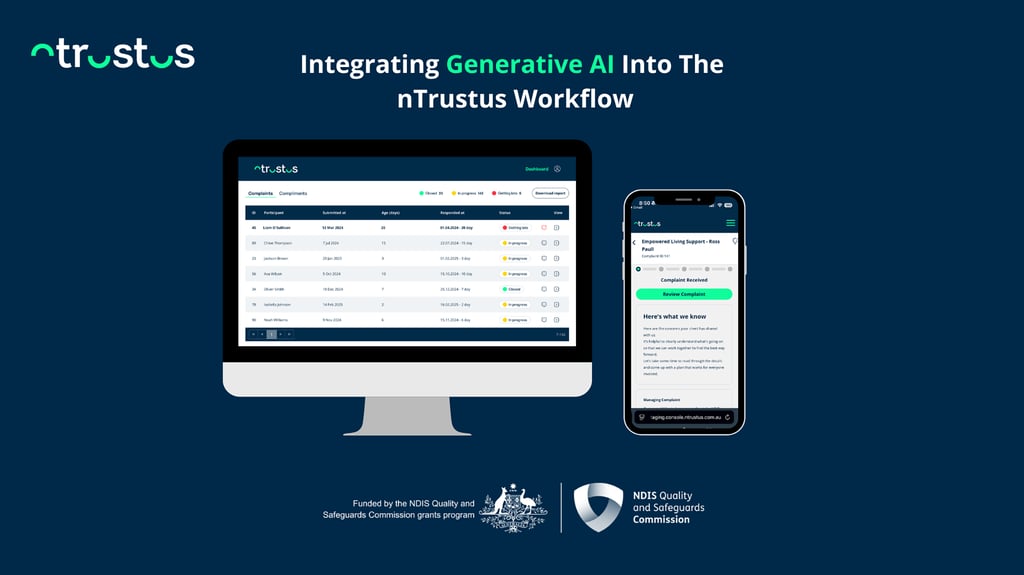
“Previously, complaints systems often relied on dropdowns and checkboxes that put the burden on participants to do the work of categorising their own complaints,” says Ross Paull, nTrustus founder and chief executive officer.
“We wanted something intuitive and human centred; AI that assists rather than decides. This way, participants are heard and providers improve through practise.”
AI-facilitated communication continues until the two sides reach an agreed outcome.
By helping participants speak up against daily injustices and pursue meaningful solutions, this system is shifting the power dynamics within the NDIS system for a historically marginalised community.
The My Complaint Assistant/My Response Assistant platform was built to alleviate pressure on the NDIS Quality and Safeguards Commission, which received more than 110,000 complaints in the 2023-24 financial year.
Of these, 82,000 were reportable incidents that required urgent investigation.
For nTrustus, taking charge of lower-level complaints seemed like a simple way to free up Commission staff to deal with more serious issues.
But the technology they wanted to use didn’t yet exist—or at least not in the form they were imagining.
Our challenge was to harness generative AI to solve a complex, human problem. We weren’t after a quick add-on but a bespoke solution to rebuild trust and shift power to people with disability. Partnering with UTS made that vision possible.
Through an existing relationship with the UTS Disability Research Network, nTrustus engaged the Data Science Institute, known as a leader in data science innovation for business and government applications.
Paull and his team needed a world-class, AI-driven complaints ecosystem. The DSI team had the skills to deliver it.
“The true achievement of this project is its three dimensions of innovation,” says Dr Dong.
“The first is the development of a customised LLM and the first-ever application to a high-stakes project.
The second is the combination of user experience with human computer interaction theory in a single project.
“And the third is our use of what we call trustworthy AI. We needed to improve people’s trust in AI systems by producing something that acted in the best interests of its intended user base."
"We combined our systems expertise with our partner’s domain knowledge to produce a working, trustworthy AI system.”
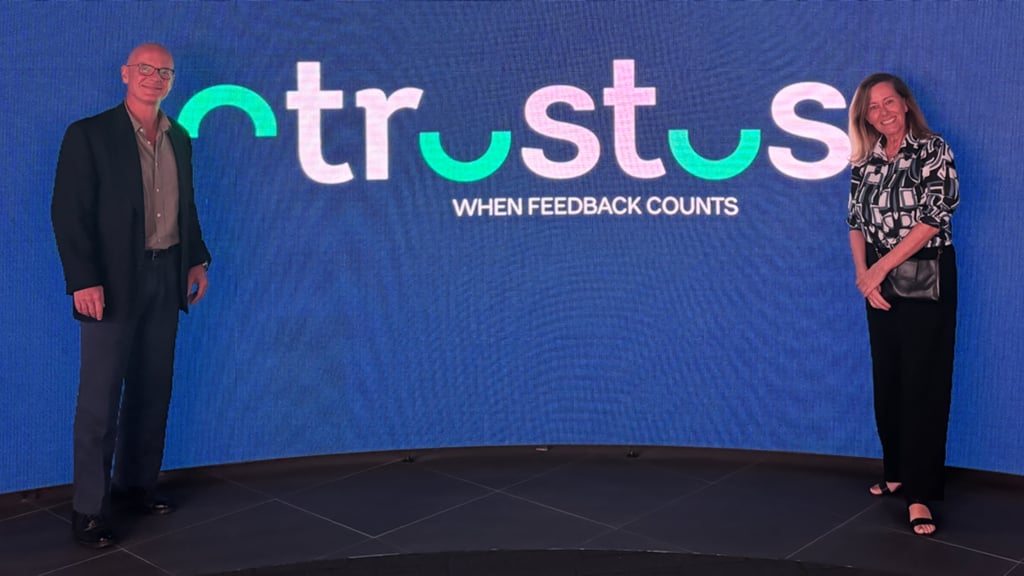
At face value, My Complaint Assistant and My Response Assistant address a practical issue: streamlining the complaints process of a major government agency to deliver fast and effective outcomes.
But they’re also an important demonstration of technology as a tool for justice—an increasingly urgent challenge in a rapidly digitising world.
The platform is now publicly available and can be bolted on to existing websites, white labelled and/or customised for any government department or organisation.
“We hear a lot of negative stories about the use of emerging technology, but all technologies are really a product of their design. You need to understand what sort of outcomes you want to achieve,” says Distinguished Professor Fang Chen, who leads the Data Science Institute.
“In this case, our platform is a really great demonstration of how technology can be designed for the social good.”
Research leads
Research Fellow
UTS Data Science Institute

CEO and founder
nTrustus

Webpage
Benefits flow from AI-driven water quality forecasts
When Sydney faced torrential rain in 2022, water infrastructure copped a hammering. At Warragamba Dam in the western suburbs, only around 10 percent of water...

Webpage
AI partnership yields bumper harvest
Artificial intelligence is giving fruit and vegetable growers more accurate predictions on the best time to harvest
Webpage
Artificial intelligence ushers in new era of personalised medicine
Biomedical startup 23Strands is working with UTS Professor Jie Lu to use artificial intelligence to revolutionise personalised medicine.
Webpage
Benefits flow from AI-driven water quality forecasts
When Sydney faced torrential rain in 2022, water infrastructure copped a hammering. At Warragamba Dam in the western suburbs, only around 10 percent of water...
Webpage
AI partnership yields bumper harvest
Artificial intelligence is giving fruit and vegetable growers more accurate predictions on the best time to harvest
Webpage
Artificial intelligence ushers in new era of personalised medicine
Biomedical startup 23Strands is working with UTS Professor Jie Lu to use artificial intelligence to revolutionise personalised medicine.