


- Posted on 9 Nov 2020
- 5-minute read
Think of a vertical garden and you might picture something like Central Park in Sydney – a multimillion-dollar project where a 150-metre high living wall containing 250 species of plants, flowers and vines marks the entrance to the CBD.
Vertical gardens are made up of plants growing either directly on a wall or on adjacent supporting structures. Studies have shown these green walls remove pollution from the air, promote biodiversity and naturally control the temperature inside buildings. They can also help with noise reduction.
Now, a collaboration between researchers at the University of Technology Sydney (UTS) and the horticultural industry is seeking to encourage wider take-up of ‘do-it-yourself’ green walls at the community level, particularly in space-constrained urban areas.
“When you think of green walls at the moment, you think of projects like Central Park,” says Dr Peter Irga, a postdoctoral Research Fellow in air quality research with the School of Civil and Environmental Engineering at the University of Technology Sydney (UTS).
“But for the person at home thinking about how to increase greenery – whether that’s in their local area, in their courtyard or on their balcony – this is the way to go.”
A multidisciplinary team of researchers from UTS, in science, engineering and design, have worked with horticultural industry group Hort Innovation to develop a free, science-based online resource to give individuals and communities the confidence to install their own living walls.
The natural air cleaning ability of this biological system leads to improved air quality.
The ‘It’s time to grow up’ digital resource simplify the process of vertical gardening for individuals and local communities, covering topics such as choice of structure and plants, irrigation and maintenance. Various design options are star-rated in areas such as ease of construction and cost.
Hort Innovation Head of Research and Development, Byron De Kock, says the aim of the project is to simplify vertical greening at a community level.
“Green walls allow plants to be grown in dense urban areas where spatial constraints may limit the presence of traditional urban forestry, such as parks and street trees,” he says. “They provide a modern approach to urban greening … they not only enable the presence of nature but also allow people to connect with nature as they build, plant and maintain these living systems.”
The roots of the DIY vertical gardens project are in ongoing research by the UTS Plants and Environment Quality Research Group into the health and social benefits of plants, including from breathing walls.
Researchers including Dr Irga also studied government policy internationally on green walls, and surveyed every local government area in each of Australia’s major cities to ascertain what sort of support was being provided locally.
The research highlighted lack of knowledge as a curb on wider take-up in Australia, identifying the need to get communities involved and leading to the Hort Frontiers Green Cities funded project.
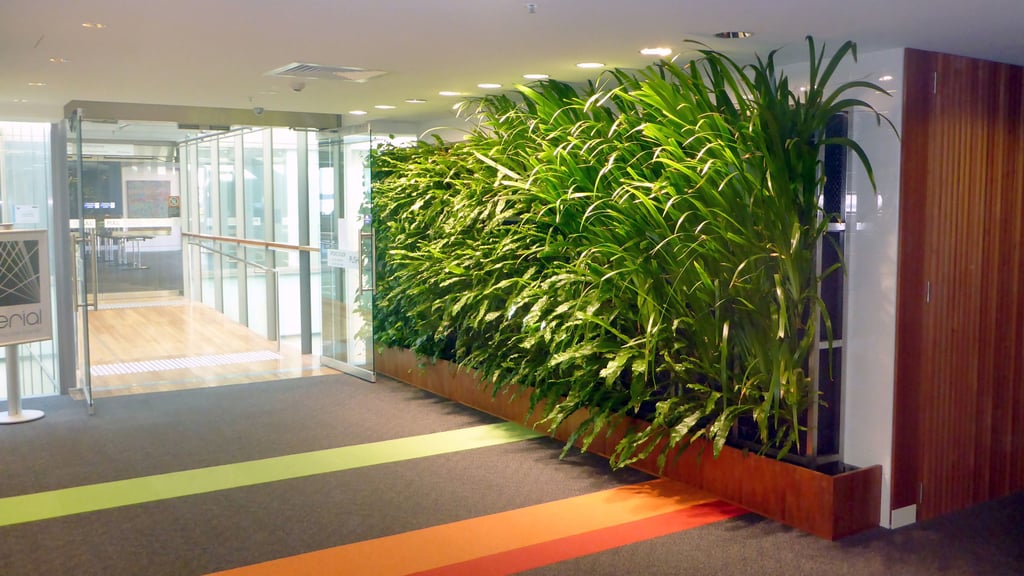
“Thermal regulation is one of the most researched benefits of green walls,” explains Dr Irga. “This means green walls can reduce high temperatures within buildings by intercepting solar radiation and through evaporative cooling.” Conversely, green walls have been shown to have insulation benefits in cold climates.
“These mechanisms enable less reliance upon heaters and air conditioners and allow reductions in energy consumption.
“Most exciting, though, is that green walls are able to remove pollution from the air,” he says. The plants can capture airborne particles on their foliage and, with the associated microbial community, degrade a range of gaseous pollutants, including volatile organic compounds (VOCs).
VOCs are given off by motor vehicles, fires, industrial processes and consumer products like paint. Some are highly toxic and prolonged exposure may increase the risk of health problems.
“The natural air cleaning ability of this biological system leads to improved air quality in the home and in urban settings,” Dr Irga says.
CO2-absorbing vertical gardens are one tangible way for individuals to help mitigate climate change, he says. “But, climate change aside, if I said: ‘What if we just make this community a better place?’ – everyone would be on board with that.
“There's a known association between increased biodiversity and increased personal health and happiness. When people live in a more diverse area, with people, plants and animals, they are happier in general.”
Report
P.J. Irga, et al, The distribution of green walls and green roofs throughout Australia: Do policy instruments influence the frequency of projects?, Urban Forestry & Urban Greening, 24, 2017, 164-174
Benefits of green walls
The benefits of green walls extend beyond just creating a beautiful space. Green walls and their plants can help to:
- connect with nature
- improve wellbeing
- boost community engagement
- reduce temperatures
- insulate buildings
- increase energy efficiency
- aid in thermal control
- filter air pollutants
- create eco-friendly habitats for birds and insects.
Research team

Associate Professor, Faculty of Engineering & Information Technology

Professor, Faculty of Design and Society

Associate Professor, Faculty of Science

Adjunct Professor, Faculty of Design and Society

Julia Yeo
Research Engineer, Faculty of Engineering and Information Technology

Casual Academic, Faculty of Science

Thomas Pettit
Research Engineer, Faculty of Engineering and Information Technology
Faculty and research centre
- Faculty of Science
- Faculty of Engineering and Information Technology
- Faculty of Design, Architecture and Building
- UTS Plants and Environment Quality Research Group
Funded by
- Hort Innovation
Contact us

Webpage
Olympic Legacies & Urban Futures
Translating three decades of Australian major-event legacy into frameworks for India's 2036 Olympic and Paralympic ambitions.

Webpage
Bringing their own power? Options for data centres and renewable energy
Australia is experiencing a wave of investment in data centres. The emergence of data centres arrives at a pivotal moment in Australia’s energy transition. The...

Webpage
Primary Exploration, Mining and Metal Supply Scenario (PEMMSS)
The energy transition is driving demand for many mineral commodities, but where will this mineral supply come from?

Webpage
Salmon farming disclosures
We examined climate-related disclosures for Tassal, Huon and Petuna and identified four key gaps between disclosures and existing climate science and other...
Webpage
Olympic Legacies & Urban Futures
Translating three decades of Australian major-event legacy into frameworks for India's 2036 Olympic and Paralympic ambitions.
Webpage
Bringing their own power? Options for data centres and renewable energy
Australia is experiencing a wave of investment in data centres. The emergence of data centres arrives at a pivotal moment in Australia’s energy transition. The...
Webpage
Primary Exploration, Mining and Metal Supply Scenario (PEMMSS)
The energy transition is driving demand for many mineral commodities, but where will this mineral supply come from?
Webpage
Salmon farming disclosures
We examined climate-related disclosures for Tassal, Huon and Petuna and identified four key gaps between disclosures and existing climate science and other...