


- Posted on 1 Oct 2024
EMISI project in Indonesia, an initiative of Ministry of Public Works and Housing, supported through DFAT’s Indonesia Australia Partnership for Infrastructure.
The Emissions Measurement to Improve Sanitation in Indonesia (EMISI) project was an initiative of the Ministry of Public Works, supported by the Australian Government, through the Indonesia Australia Partnership for Infrastructure (KIAT).
EMISI was led by the University of Technology Sydney (UTS) in partnership with Universitas Indonesia (UI), Centre for Regulation, Policy and Governance (CRPG), the University of Leeds, and the University of New South Wales (UNSW) in 2024-2026
EMISI measured greenhouse gas (GHG) emissions from diverse sanitation systems, developed the first detailed national estimate of sanitation emissions, and worked with government stakeholders to identify strategies to improve sanitation while reducing emissions. Read the project overview here.
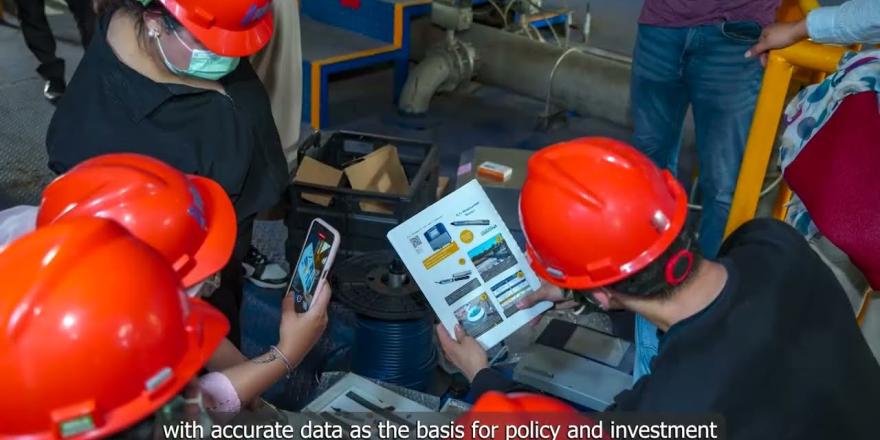
Why measure emissions from sanitation?
Wastewater is estimated to contribute approximately 5% of global methane emissions as well as contributing nitrous oxide emissions. Methane and nitrous oxide are greenhouse gases (GHGs) with significant global warming potential, 28 and 265 times more than carbon dioxide respectively.
Additionally, poorly managed sanitation particularly contributes to emissions, and global estimates do not fully consider non-sewered sanitation systems prevalent in rapidly growing cities and rural areas in low-and middle-income countries such as Indonesia.
Research outputs
Policy brief – English | Bahasa Indonesia
Priority actions for government of Indonesia and partners.
Findings and recommendations report – Achieving safely managed services and climate mitigation in the sanitation sector in Indonesia
Key findings from the EMISI project, including emissions measurements, modelling, and policy and regulatory review. Recommendations including technical guidance, policy recommendations for sanitation governance, GHG accounting and foundations for climate finance.
Technical note – Methods for measuring sanitation emissions and developing city- and national-level estimates
Learn about EMISI’s field methods to measure methane and nitrous oxide emissions as well as a modelling approach to develop sanitation emissions estimates.
Instructional video – Methane emissions measurement
Direct emission measurement using a flux chamber.
EMISI Dissemination webinar
Recording – entire webinar (90 min)
Recording – direct emissions measurement (10 min)
EMISI Sanitation emission datasets
Access the datasets for emissions measurement from multiple sanitation systems:
- Methane emissions from onsite systems
- Methane emissions from FSTPs
- Nitrous oxide emissions from WWTPs and FSTPs
- Laboratory data for offsite systems
- Laboratory data for onsite systems
Media
Tackling wastewater emissions: collaborative research to improve sanitation in Indonesia - Australian Water Association, September 30 2024
Project teams:
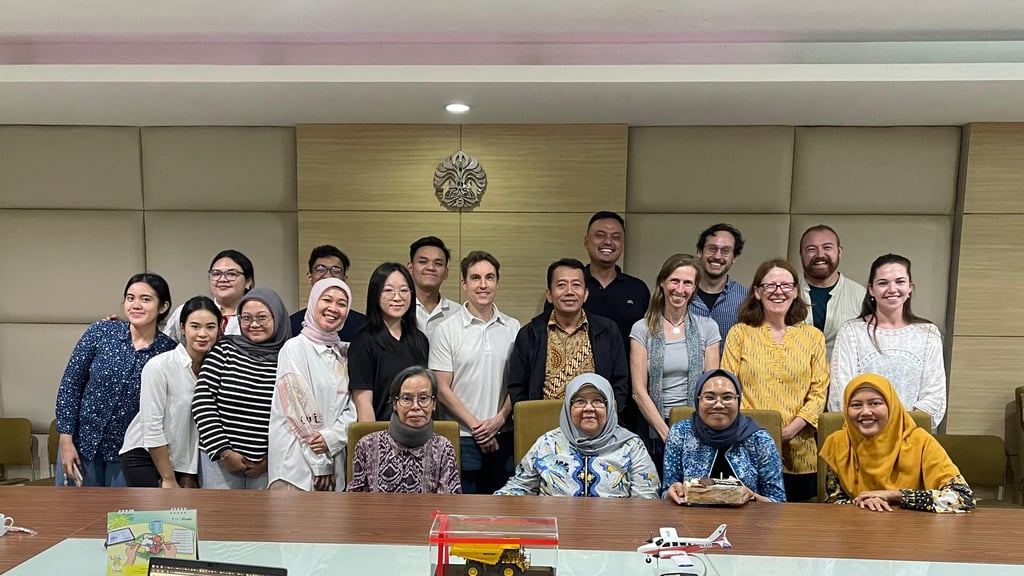
Universitas Indonesia (UI) team members
Lead: Cindy Priadi
| Adelia Tsaltsani Bilqis | Akna Mumtaz Ilmi | Andryansya Putra Abinda | Astryd Viandila Dahlan |
| Carissa Eukairin | Danisha | Dinda Fauzani | Farah Raihana |
| Fathia Rania | Fayza Ardani | Fhandy Pandey | Gabriel Andari Kristanto |
| Iftita Rahmatika | Iman Utomo | Immanuela Karina | Isravani Valencia |
| Karina Rizky Aulia | Mullah Barokah | Nopa Dwi Maulidiany | Nurannisa Shaleha |
| Rudy Wahyu | Septania Widya | Trimo Pamudji |
CRPG (Centre for Regulation, Policy and Governance)
Lead: Mohamad Mova Al’Alfghani
| Chenny Wongkar | Nishrin Qowamuna |
University of Leeds (UoL)
Lead: Barbara Evans
| Ben Smeaton‑Russell | Carolina Montoya Pachongo | Jack Dalton | Miller Camargo Valero |
UNSW
| Haoran Duan | Mudi Zhai |
Institute of Technology Bandung (ITB) (Consultants)
| Prayatni Soewondo |
Client
- KIAT - Australia Indonesia Infrastructure Partnership
Location
- Indonesia
Partners
- Centre for Policy Regulation and Governance (CRPG)
- Universitas Indonesia
- University of Leeds
- University of New South Wales
Researchers

Professor, DVC (Research)

Research Consultant, DVC (Research)

Research Director, DVC (Research)

Research Assistant, Data Science Researcher, DVC (Research)

Contractor, DVC (Research)

MekongELEVATE Research Partnership
MekongElevate is a four-year, multi-country initiative under the Mekong–Australia Partnership that seeks to strengthen the climate resilience of marginalised...
Operationalising the WEFE Nexus in Agricultural Water Systems
Addressing water scarcity and navigating Water-Energy-Food-Ecosystem (WEFE) trade-offs in agriculture.

International EV Policy Research
A synthesis of global EV policy lessons across six key domains to inform Australia’s next phase of electric vehicle market growth.

Victorian Energy Workforce Projections
The study includes projections for the electricity sector (generation and storage, transmission line construction), an estimate of the overall energy...
MekongELEVATE Research Partnership
MekongElevate is a four-year, multi-country initiative under the Mekong–Australia Partnership that seeks to strengthen the climate resilience of marginalised...
Operationalising the WEFE Nexus in Agricultural Water Systems
Addressing water scarcity and navigating Water-Energy-Food-Ecosystem (WEFE) trade-offs in agriculture.
International EV Policy Research
A synthesis of global EV policy lessons across six key domains to inform Australia’s next phase of electric vehicle market growth.
Victorian Energy Workforce Projections
The study includes projections for the electricity sector (generation and storage, transmission line construction), an estimate of the overall energy...