


- Posted on 2 Apr 2026
- 4-minute read
UTS researcher Dr Jess Gifkins is leading a body of work to recognise queer persecution in the face of mass atrocity crimes.
When Russia invaded Ukraine in 2022, reports of LGBTIQ+ people being targeted by the Russian regime were quick to emerge.
According to Dr Jess Gifkins, a researcher in the Faculty of Design and Society at UTS, this was just one example of the distinct threats that queer people face during conflicts and mass atrocity crimes (genocide, war crimes, crimes against humanity, and ethnic cleansing).
Until recently, these risks have been overlooked by the agencies designed to protect people and communities from the worst forms of violence and persecution.
Through the Queering Atrocity Prevention programme, Dr Gifkins is reshaping the landscape of mass atrocity prevention as it relates to the queer experience.
Now, the international humanitarian sector is listening.
“Mass atrocity crimes like genocide are necessarily about some form of identity-based violence, so the connections between these crimes and queer people have always been intrinsic,” says Dr Gifkins, pointing to targeting of gay and trans people during the Holocaust, alongside Jewish people and other minority groups, as an example of the risks queer communities face.
“In part, these connections have been overlooked because of the stigma that exists around queer identities, as well as criminalisation in about one in three countries worldwide.”
A research and policy first
The Queering Atrocity Prevention programme was developed in partnership with Protection Approaches, a UK-based charity working towards the prevention of identity-based violence.
It is the first research and policy initiative in the world to produce community-informed, evidence-based and practical tools for state and non-state actors to prevent, monitor and respond to distinct LGBTQI+ atrocity risks.
The programme sits within the Responsibility to Protect (R2P) space. R2P is global commitment endorsed by the United Nations in 2005 in which states are responsible for protecting their people from the threat of mass atrocity crimes.
As part of an ongoing partnership with Protection Approaches, and during her tenure at the University of Manchester, Dr Gifkins developed a Queering Atrocity Prevention report in collaboration with Assistant Professor Dean Cooper-Cunningham from the University of Copenhagen.
This paper illuminates queer perspectives and experiences of mass atrocity crimes, interrogating the ways in which structures of power and oppression shape queer people’s lived experience.
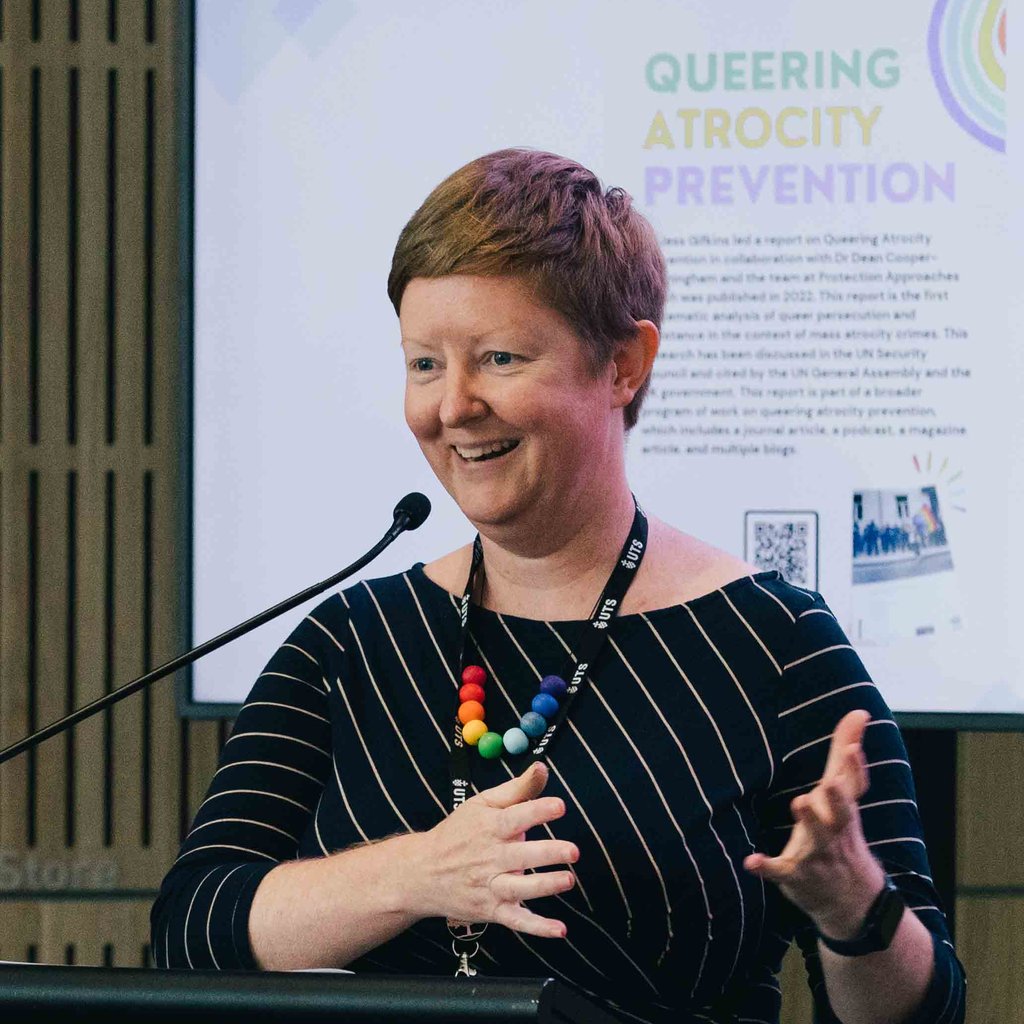
“Mass atrocity crimes like genocide are necessarily about some form of identity-based violence, so the connections between these crimes and queer people have always been intrinsic.”
Dr Jess Gifkins
The findings of this work are shaping global R2P activities. In the UK, Protection Approaches appointed Gifkins as a Queering Atrocity Senior Research Fellow and later hired a staff member to work full-time on integrating queer experiences into the prevention of mass atrocity crimes.
In 2022, Protection Approaches developed a Sector Statement that asks organisations and individuals to enact the research findings in their policy and practice activities; to date, it has been signed by 23 organisations and 45 individuals, including the former United Nations Independent Expert on Sexual Orientation and Gender Identity, Victor Madrigal-Borloz.
“When we first started this program, there was a lot of momentum from civil society, academia and even our donors in terms of people agreeing that this was indeed a gap that needed to be remedied,” says Protection Approaches’ Communities Research and Policy Manager, Farida Akram Mostafa.
“The Sector Statement came about as a collective effort to acknowledge that gap and the need to work towards addressing it, and at the same time, consider what some practical options might look like to actually begin that work.”
In New York, the Global Center for the Responsibility to Protect is now more deliberately integrating queer persecution considerations into their regularly issued atrocity alerts, as well as into their recommendations to the United Nations. The Center is the peak policy body for the global R2P sector.
“After the release of the Queering Atrocity Prevention report, we thought more seriously about the risks, or how queer persecution may signal wider societal risks, in our country assessments,” says the Center’s Deputy Executive Director, Jaclyn Streitfeld-Hall.
“Notably, we started to incorporate a queer persecution lens within our discussion of the role of gender in risks to particular groups within a population. Instead of looking at gender through a binary of risks to women vs risks to men, we now caution states to assess situations through a lens that accounts for non-binary genders, sexual orientation and more.”
From global to local: queering R2P in Australia
Now based at UTS, Dr Gifkins has big plans to advance the Queering Atrocity Prevention agenda in Australian research and policy circles. She has promoted the work through Australian Outlook, an online publication from the Australian Institute of International Affairs, and has presented on Pride panels at UTS. She is also part of an LGBTQ+ Local Democracy Group for the Inner West Council in Sydney.
Elsewhere, she is integrating the findings of her research into a new Master of International Relations at UTS, for which she was the founding Course Coordinator. Adapting her research for the Australian context will help localise an important global issue.
“The US and the UK are examples of how support for queer politics and queer rights can erode over time," Dr Gifkins says.
"We’re seeing an increase in the criminalisation of homosexuality around the world, as well LGBTQI+ rights being framed as a Western imposition, which is setting the queer rights agenda back by decades."
“The aim is to stop Australia from going down the same path as other Anglosphere countries.”
Researchers
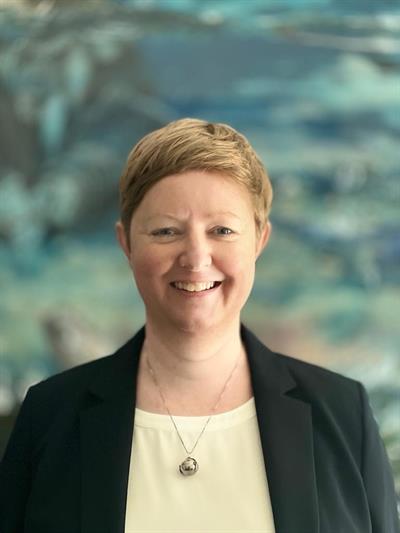
Associate Professor, Faculty of Design and Society

Salmon farming disclosures
We examined climate-related disclosures for Tassal, Huon and Petuna and identified four key gaps between disclosures and existing climate science and other...

Building a research legacy inside elite sport
Since 2017, the University of Technology Sydney (UTS) and the Oklahoma City Thunder, of the NBA, have worked together to better understand what drives...

MekongELEVATE Research Partnership
MekongElevate is a four-year, multi-country initiative under the Mekong–Australia Partnership that seeks to strengthen the climate resilience of marginalised...

Bioengineering Protein Nanocages into Multi-target Vaccines for Alzheimer’s Disease
Alzheimer's disease (AD) is characterised by the clumping of abnormal proteins in the brain, which increases over time and leads to worsening cognitive...
Salmon farming disclosures
We examined climate-related disclosures for Tassal, Huon and Petuna and identified four key gaps between disclosures and existing climate science and other...
Building a research legacy inside elite sport
Since 2017, the University of Technology Sydney (UTS) and the Oklahoma City Thunder, of the NBA, have worked together to better understand what drives...
MekongELEVATE Research Partnership
MekongElevate is a four-year, multi-country initiative under the Mekong–Australia Partnership that seeks to strengthen the climate resilience of marginalised...
Bioengineering Protein Nanocages into Multi-target Vaccines for Alzheimer’s Disease
Alzheimer's disease (AD) is characterised by the clumping of abnormal proteins in the brain, which increases over time and leads to worsening cognitive...