
  • University of Technology Sydney home
  • Home

    Home
  • For students

  • For industry

  • Research

Explore

  • Courses
  • Events
  • News
  • Stories
  • People

For you

  • Libraryarrow_right_alt
  • Staffarrow_right_alt
  • Alumniarrow_right_alt
  • Current studentsarrow_right_alt
  • Study at UTS

    • arrow_right_alt Find a course
    • arrow_right_alt Course areas
    • arrow_right_alt Undergraduate students
    • arrow_right_alt Postgraduate students
    • arrow_right_alt Research Masters and PhD
    • arrow_right_alt Online study and short courses
  • Student information

    • arrow_right_alt Current students
    • arrow_right_alt New UTS students
    • arrow_right_alt Graduates (Alumni)
    • arrow_right_alt High school students
    • arrow_right_alt Indigenous students
    • arrow_right_alt International students
  • Admissions

    • arrow_right_alt How to apply
    • arrow_right_alt Entry pathways
    • arrow_right_alt Eligibility
arrow_right_altVisit our hub for students

For you

  • Libraryarrow_right_alt
  • Staffarrow_right_alt
  • Alumniarrow_right_alt
  • Current studentsarrow_right_alt

POPULAR LINKS

  • Apply for a coursearrow_right_alt
  • Current studentsarrow_right_alt
  • Scholarshipsarrow_right_alt
  • Featured industries

    • arrow_right_alt Agriculture and food
    • arrow_right_alt Defence and space
    • arrow_right_alt Energy and transport
    • arrow_right_alt Government and policy
    • arrow_right_alt Health and medical
    • arrow_right_alt Corporate training
  • Explore

    • arrow_right_alt Tech Central
    • arrow_right_alt Case studies
    • arrow_right_alt Research
arrow_right_altVisit our hub for industry

For you

  • Libraryarrow_right_alt
  • Staffarrow_right_alt
  • Alumniarrow_right_alt
  • Current studentsarrow_right_alt

POPULAR LINKS

  • Find a UTS expertarrow_right_alt
  • Partner with usarrow_right_alt
  • Explore

    • arrow_right_alt Explore our research
    • arrow_right_alt Research centres and institutes
    • arrow_right_alt Graduate research
    • arrow_right_alt Research partnerships
arrow_right_altVisit our hub for research

For you

  • Libraryarrow_right_alt
  • Staffarrow_right_alt
  • Alumniarrow_right_alt
  • Current studentsarrow_right_alt

POPULAR LINKS

  • Find a UTS expertarrow_right_alt
  • Research centres and institutesarrow_right_alt
  • University of Technology Sydney home
University of Technology Sydney home University of Technology Sydney home
  1. ... About UTS
  2. ... Information on Faculties...
  3. ... Transdisciplinary School
  4. ... Transdisciplinary resear...
  5. Centre for Compassionate...
  6. Our research

Our research

explore
  • Transdisciplinary research
    • arrow_forward About TD research
    • Centre for Compassionate Conservation
      • arrow_forward About the Centre for Compassionate Conservation
      • arrow_forward Our purpose
      • arrow_forward Our people
      • arrow_forward Our research
      • arrow_forward Our affiliates
      • arrow_forward Our students and graduates
    • Our research themes
      • arrow_forward Health and wellbeing
      • arrow_forward Innovation and change
      • arrow_forward Multispecies societies
      • arrow_forward Responsible technology
      • arrow_forward Sustainable societies
      • arrow_forward Transformative learning
    • Postgraduate research degrees
      • arrow_forward Our current HDR students
    • TD centres and collaboratives
      • arrow_forward ARC Training Centre for Automated Vehicles in Rural and Remote Regions
      • arrow_forward Centre for Compassionate Conservation
      • arrow_forward Innovation and Entrepreneurship Collaborative
    • arrow_forward TD researchers
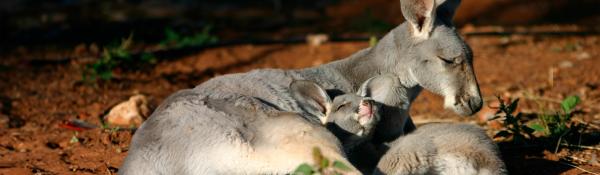
Kangaroos parent and joey lying in the sun

The UTS Centre for Compassionate Conservation (CfCC) strives to bring together the theoretical and philosophical underpinnings of inclusion, with practical and scientific approaches for solving complex real-world problems.
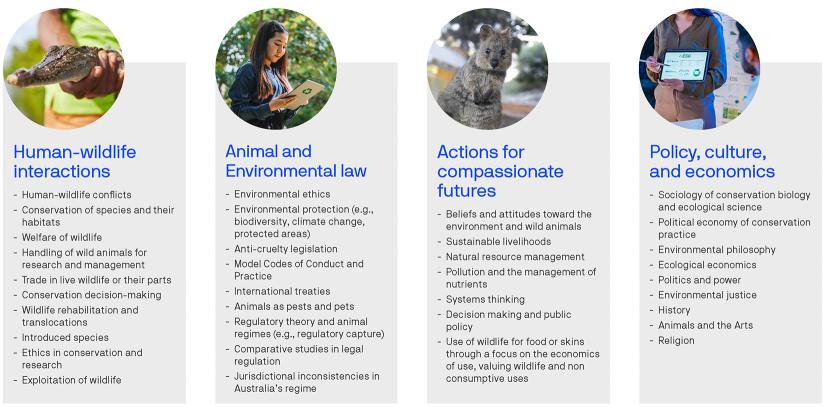
  • Our research themes
  • Featured projects

Our research themes 

Diagram lists research themes

Human-wildlife relationships

  • Human-wildlife conflict resolution
  • Wild animal behaviour and welfare
  • Animal cultures
  • Cohabitation and coexistence
  • Illegal wildlife trade
  • Wildlife rehabilitation and translocation
  • Wildlife handling for research and management

Conservation initiatives

  • Global species reshuffling
  • Planning and management
  • Protected areas
  • Rewilding

Animal and environmental law and policy

  • Environmental policy and legislation
  • International treaties and conventions
  • Codes of conduct
  • Non-human ethics and rights

Natural resource management

  • Wildlife-friendly farming
  • Socio-ecological sustainability and environmental resilience
  • Habitat restoration, rewilding, and species reintroductions

Featured projects and research impact 

Reimagining Conservation Through Indigenous Leadership

This global initiative explores bold, transformative approaches to conservation that center justice, equity, and care. and incorporates a key area of our research, which is listening to and respecting voices of First Nations peoples, including the use of decolonial methodologies.

The article co-authored by Dr. Rosalie Chapple contributes to a movement that challenges business-as-usual models and asks: What would it take to move beyond inherited paradigms toward conservation that truly serves both people and planet?

Through four key themes—leadership and justice, money and power, relationships, and conservation action—the research calls for paradigm shifts that dismantle inequities, amplify diverse voices, and foster collaboration across cultures and sectors. It emphasizes listening deeply to communities, integrating Indigenous knowledge systems, and building governance models rooted in reciprocity and shared responsibility.

This work is part of a broader partnership under the IUCN Commission on Environmental, Economic and Social Policy (CEESP), engaging experts worldwide to rethink conservation policy and practice. The initiative emerged from global dialogues and is shaping strategies for a future where biodiversity and social justice are inseparable.

CfCC Contributor: Dr. Rosalie Chapple
Collaborators: IUCN CEESP and international conservation leaders
Publication: Policy Matters Issue 24 – Reimagining Conservation

Find out more: IUCN COMMISSION ON ENVIRONMENTAL, ECONOMIC AND SOCIAL POLICY


Remaking One Health: Decolonial Approaches to Street Dogs and Rabies in India

This multidisciplinary and international project investigates the historical, everyday, institutional, psycho-social, and ecological aspects of rabies and the people-dog-health interface in India. Through the lens of a One Health paradigm that recognises the interconnected nature of humans, animals and our shared environment, the research is delivering new insights into effective, ethical, and socio-culturally appropriate ways of caring for street dogs and preventing rabies. 

The CfCC team is part of a large international collaboration that includes researchers from India, the United Kingdom, and Australia. Founding universities include the University of Edinburgh, Liverpool University, the University of Western Australia, and UTS.

Through this project, the CfCC has established partnerships with the Nature Conservation Foundation India, Socratus, Ambedkar University, the Humane Society International India, Welfare of Stray Dogs, Help in Suffering, and Working for Animals.

  • CfCC Chief Investigators: Associate Professor Daniel Ramp, Dr Rosalie Chapple
  • CfCC postgraduate students (PhD candidates): Nynke Kooistra, Prativa Bomzon, Rashmi Singh Rana
  • Funder: The Wellcome Trust 

Find out more: ROH Indies


Foragecaster: Agricultural remote sensing for sustainable agricultural landscapes

In this large collaborative project, researchers are developing artificial intelligence (AI) and machine learning forecasting tools to help farmers predict and improve pasture quality, resilience, and biodiversity in the face of climate change.

Digital transformation paves the way for transformative approaches to challenging norms. In a conservation context, this includes the unnecessary exclusion of wildlife, the establishment of intensive monocultures, and unsustainable management practices. Using farmers’ own data, our goal is to show that more inclusive approaches to farm and environmental sustainability are better for people, the environment, and non-human beings who coexist in food production landscapes.

  • CfCC investigators: Associate Professor Daniel Ramp, Dr Abolfazl Abdollahi
  • CfCC postgraduate students (PhD candidates): Alex Trobec (National Industry PhD Scholarship)
  • Funder: Food Agility CRC, AgriWebb

Find out more: Foragecaster 

Find out more

  • About CfCC
  • How we work
  • Our people
  • TD Research

Acknowledgement of Country

UTS acknowledges the Gadigal people of the Eora Nation, the Boorooberongal people of the Dharug Nation, the Bidiagal people and the Gamaygal people upon whose ancestral lands our university stands. We would also like to pay respect to the Elders both past and present, acknowledging them as the traditional custodians of knowledge for these lands.

University of Technology Sydney

City Campus

15 Broadway, Ultimo, NSW 2007

Get in touch with UTS

Follow us

  • Instagram
  • LinkedIn
  • YouTube
  • TikTok
  • Facebook
  • WeChat

A member of

  • Australian Technology Network
Use arrow keys to navigate within each column of links. Press Tab to move between columns.

Study

  • Find a course
  • Undergraduate
  • Postgraduate
  • How to apply
  • Scholarships and prizes
  • International students
  • Campus maps
  • Accommodation

Engage

  • Find an expert
  • Industry
  • News
  • Events
  • Experience UTS
  • Research
  • Stories
  • Alumni

About

  • Who we are
  • Faculties
  • Learning and teaching
  • Sustainability
  • Initiatives
  • Equity, diversity and inclusion
  • Campus and locations
  • Awards and rankings
  • Leadership and governance

Staff and students

  • Current students
  • Help and support
  • Library
  • Policies
  • StaffConnect
  • Working at UTS
  • UTS Handbook
  • Contact us
  • Copyright © 2025
  • ABN: 77 257 686 961
  • CRICOS provider number: 00099F
  • TEQSA provider number: PRV12060
  • TEQSA category: Australian University
  • Privacy
  • Copyright
  • Disclaimer
  • Accessibility