


Confocal specifications
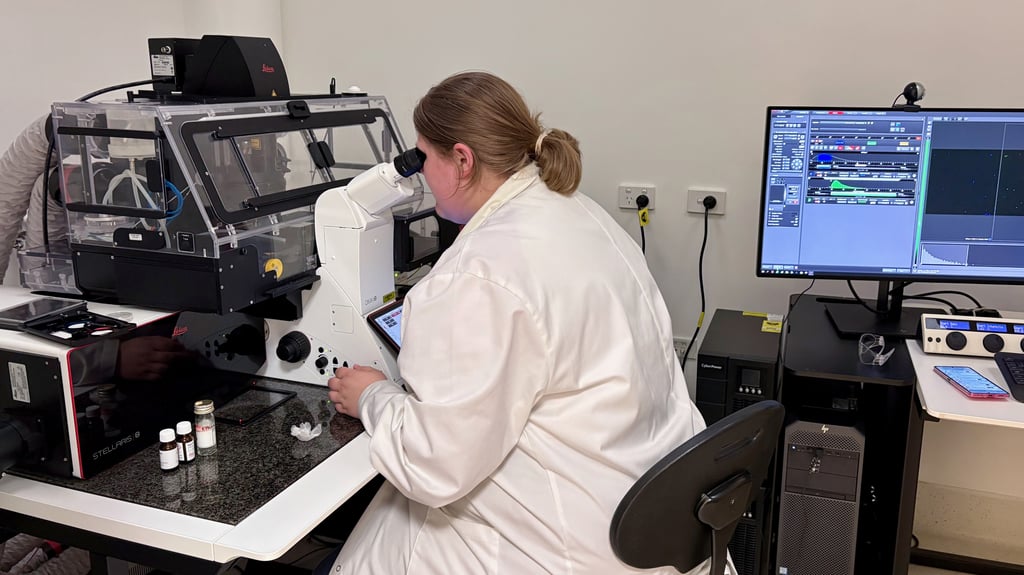
Leica STELLARIS 8 is a confocal point scanning system, including a White Light Laser, an Acousto Optical Beam Splitter (AOBS) and a highly sensitive, prism-based spectral detection design with computer controlled adjustable bandwidth for all internal detection channels.
The extended detection range up to 850 nm plus the expanded excitation range of the White Light Laser in the visible from 440 nm up to 790 nm allow the application and separation of an extended range of spectrally overlapping fluorophores (up to the NIR). The combination of Field-of-View (FOV) with Dynamic Signal Enhancement and LIGHTNING delivers superb image quality at full speed and in super-resolution.
In combination with the Power HyD detector family, STELLARIS 8 offers enhanced detection efficiency and photon counting. Including TauSense, STELLARIS offers a lifetime-based tool set that provides additional information in qualitative or semi-quantitative manner; using gate-based technology and mean average arrival time.
STELLARIS 8 White light laser (WLL)
- Allows a perfect match to peak excitation of fluorophores to ensure lowest laser exposure, optimal signal yield and emission separation of multi-labelled samples.
- Enables TauSense functionality: TauGating, TauContrast, TauSeparation, TauScan, GateScan.
- Allows recording of two-dimensional excitation-emission spectra supported by software for setup and display of 2D spectra.
- Pulsed excitation light source from 440 to 790 nm, up 8 single lines can be freely selected and used simultaneously.
- Freely tunable in steps of 1 nm.
- Laser power per line: 440 nm > 1.1 mW; 488 nm > 1.6 mW; 560 nm > 2.0 mW; 630 nm > 2.6 mW; 790 nm > 3.5 mW.
- Pulse frequency 78 MHZ.
- 8 channel AOTF (Acousto-Optical-Tunable-Filter) for rapid modulation of laser intensity, particularly for ROI (region-of-interest) illumination and excitation scans.
Additional fixed laser lines 405 and 488 nm.
Power Hybrid Detector HyD S
All-round detector for high performance detection throughout the spectrum. Two times increased photon detection efficiency in the blue-green range compared to standard multi-alkaline photomultiplier. Leica Si-based technology.
- Typical photon detection efficiency > 58% @ 500nm.
- Multi-pixel silicon photo-multiplier array.
- Extended dynamic range for maximal contrast and flexibility
- Analog, reflection and photon counting detection modes
- Power counting: 0,1,2 (double) photons can be identified
- TauSense capabilities : TauGating (up to 16 tunable timegates, simultaneously). TauContrast (mean photon arrival time). TauSeparation (lifetime based component separation).
Power Hybrid Detector HyD X
Leica GaAsp-based technology.
- Typical photon detection efficiency > 46% @ 500nm.
- Hybrid detection technology including GaAsp photocathode.
- Very low dark noise.
- Excellent dynamic range for maximal contrast and flexibility.
- Digital and photon counting detection modes.
- Power counting: 0,1,2 (double) photons can be identified.
- TauSense capabilities: TauGating (up to 16 tunable timegates, simultaneousely).
- TauContrast (mean photon arrival time). TauSeparation (lifetime-based component separation).
Power Hybrid Detector HyD R
The new specialist for near infrared detection. Leica proprietary GaAsp-based technology.
- Hybrid detection technology including special GaAsp photocathode.
- Very low dark noise.
- Excellent dynamic range for maximal contrast and flexibility.
- Digital and photon counting detection modes.
- Power counting: 0,1,2 (double) photons can be identified
- TauSense capabilities: TauGating (up to 16 tunable timegates, simultaneousely).
- TauContrast (mean photon arrival time). TauSeparation (lifetime based component separation).
Tandem scanning system for STELLARIS 8
Highest axial resolution with galvanometric scanner, switchable between resonant and non-resonant mode. Point scanning facilitates applications at high speed without compromising z-resolution or multi-parametric fluorescence as with other high-speed scanning systems.
Optical sections by point scanning, compatible with AOBS® and SP® detection.
Using resonant scanning, a higher fluorescence quantum yield and reduced photobleaching are achieved. Thanks to short pixel dwell times fewer molecular darks states are populated (anti-triplet synchronisation). In combination with Dynamic Signal Enhancement and LIGHTNING you achieve superb image quality at highest frame rates.
Performance in non-resonant mode
- Confocal point scanner for highest axial image resolution
- User adjustable speed 1 - 2600 Hz in steps of 1 Hz
- X2Y-Scanner design for homogeneous illumination in a large field of view
- Feedback monitoring of the scanner for constant image quality
- Up to 10 frames / second , 512 x 512
- Up to 131 frames / second , 512 x 16
- Max. Image resolution 8192 x 8192 or 64 Mpixels
- Line frequency up to 5200 Lines / second
- Very large scanfield with 22 mm (FOV) diagonal in the intermediate image plane
- Hardware zoom, stepless 0.75x - 48x
Performance in resonant mode
- Feedback monitoring of the scanner for constant image quality
- Line frequency 16000 Hz (bidirectional)
- Up to 28 frames / second at 512 x 512 (full frame)
- Up to 290 frames / second at 512 x 16
- Scan format max.: 2496 x 2496 pixels with up to 3 channels simultaneously
- Scan format min.: 16 x 16 pixels
- Continuous zoom range: 1.25x - 48x
- Zoom-, Pan- and Zoom-In function
- Very large scan field with 13 mm diagonal
This high-speed raster scanning system is particularly well suited to live samples and physiological measurements, but it works just as well with fixed samples.
Inverted research microscope based on the DMi8 series, with motorized nosepiece.
Universal mounting frame
Frame to fix different cultivation vessels (petri dishes with 24-68 mm diameter) and glass slides (with 24-120 mm length) with two moveable brackets with a variable clamping range. Outer dimension: 160x110 mm.
Water Immersion Micro Dispenser
Okolab On Stage Incubator
Objective lenses
- Obj. HC PL APO 10x/0.40 CS2 (#15506407)
- Obj. HC PL APO 20x/0.75 CS2 (#15506517)
- Obj. HC PL APO 63x/1.40 OIL CS2 (#15506350)
- Obj. HC PL APO 40x/1.1 .10 W CORR (#15506357)
- Obj. PL APO 100x/1.40 OIL CS2 (#15506372)
- Obj. HC PL APO 20x/0.75 IMM CORR CS2 (#15506343)
- This objective provides versatile immersion options (water, glycerine, and oil) on the same objective. The adjustable correction collar on this objective will enable you to achieve optimal imaging results both with and without a cover glass.
- HC PL APO 40x/1.25 GLYC CORR CS2 (#15506422)
- The high numerical aperture (1.25) of this objective is optimised for high resolution confocal scanning microscopy and live cell imaging within the temperature range 23 – 37ºC.
LAS X STELLARIS Control Software
Core software functionalities:
Image Compass
Simplistic user interface, even for complex experiments. Set up of multi-color experiment with one click per fluorophore. Maximal signal yield through optimal acquisition settings selected automatically. Multidimensional acquisition, full control of motorized hardware. GUI optimized for dark rooms and image processing.
TauSense
Instant access to average arrival time and intensity information (TauContrast). Differentiate between desired and unwanted fluorescence signal (TauGating, GateScan). Separate fluorophores using lifetime-based information (TauSeparation, TauScan).
Dynamic Signal Enhancement
Preserving temporal resolution while maintaining an optimal signal-to-noise ratio.
LIGHTNING
LIGHTNING basic detection package:
- Super-resolution down to 120 nm in x and y, 200 nm in z.
- Wizard for online data acquisition.
- Fully automated "One-Click" functionality.
- Additional detection strategies for Low SNR & High SNR.
- Adaptive image quality determination and adaptive reconstruction in automatic mode.
- Elimination of border effects.
- 2D reconstruction.
- Time series.
- Channel-independent image reconstruction.
- High-performance GPU-based processing.
Navigator
Navigator basic package (including ‘LAS X Stitching’ and ‘LAS X Mark & Find’):
- Spiral scan to easily generate an overview of your specimen.
- Overview images of any shape can be generated with a user defined region.
- Includes a choice of predefined sample carrier formats such as slides, petri dishes, chambered slides and well plates from different suppliers.
- Images can be added to the overview regardless of magnification, camera, detector or contrasting method used.
- Regions and positions can be defined for high resolution scans and multi-well plates.
Lambda scan
Acquisition of emission spectrum using spectral detectors. Acquisition of excitation spectrum using white light laser.
Lambda-lambda scan
Acquisition of full excitation-emission spectrum.
Z intensity compensation
Laser power and/or detector gain adjustments withinz-stacks.
LAS X 3D Visualisation
A software module for the reconstruction and processing of 3D data:
- Fast motion and processing by GPU-based algorithms
- Various projection modes: Transparent, Maximum Intensity, and Depth Coding.
- Individual settings for intensity, minimum and maximum grey level, gamma and opacity for each channel.
- User defined interactive shadow projection to emphasize three dimensional structures.
- Auto motion function to emphasize the spatial effect of the 3D volume.
- Powerful clipping tool for channel specific user defined segmentations.
- Sophisticated Movie Editor for the generation of complex 3D animations.
- Orthogonal Sectioning tool, including rotatable section planes and 3D cropping capabilities.
- Annotation tool to add comments to a 3D volume that are saved with the data set.
- Stereo images (cyan / magenta, horizontal and vertical shutter, quad- based).
LAS X Dye Finder
A software module for the separation of different fluorescence signals:
- Automatic, channel and spectral mode.
- Online dye separation during image acquisition.
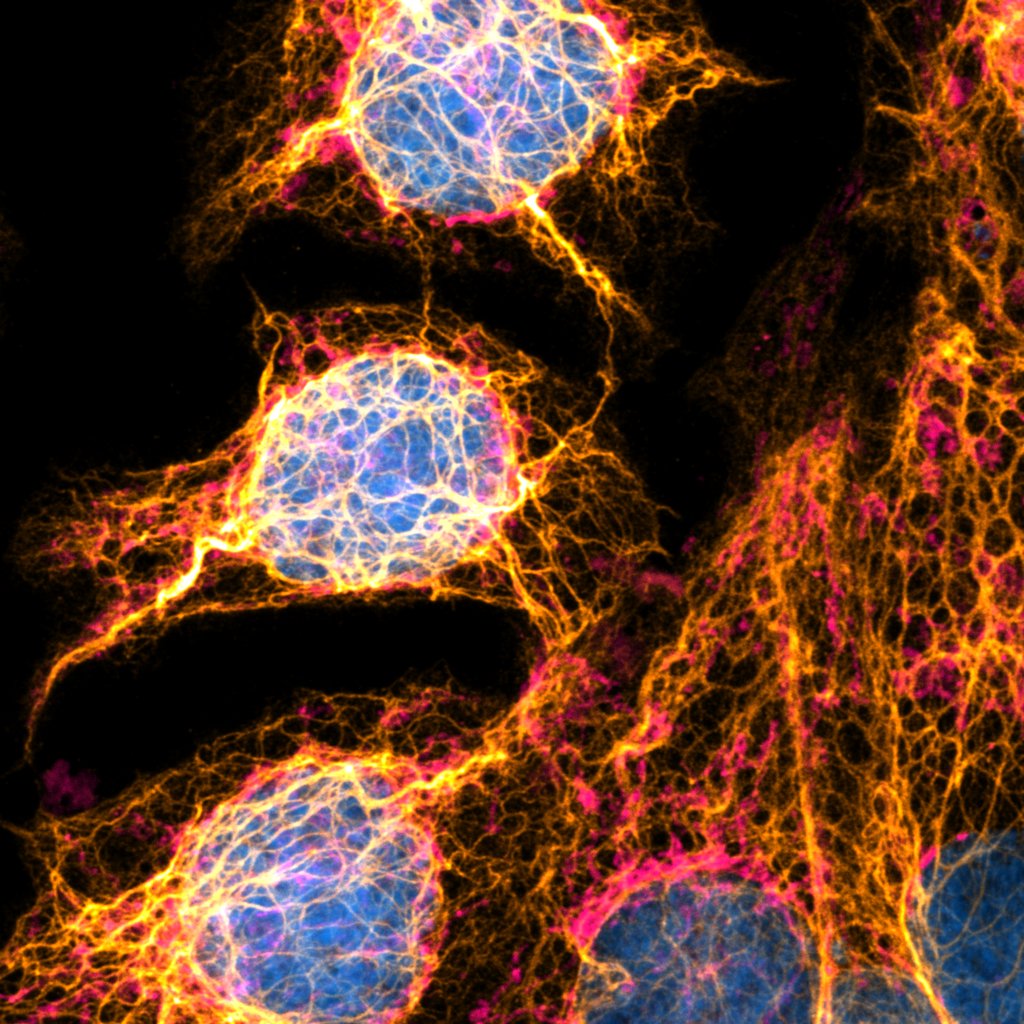
*Journey to the Centre of the Placenta
Placental spheroids generated from FKBPL knockdown trophoblast cells were maintained for 10 days. Spheroids were harvested, fixed then immunolabelled for anti-angiogenic protein FKBPL (cyan hot), syncytiotrophoblast lineage marker b-HCG (orange hot) and counterstained with DAPI to visualise nuclei (violet). Spheroids were imaged on a Leica Stellaris 8 confocal microscope using an HC Fluotar L Visir 25X (NA=0.95) water immersion objective. A Z-stack of 370µm was acquired at 2µm step size.