

2TlK-kIwIS4

Transcript

In 1927, a young Aboriginal girl who had been sexually abused at her place of employment was sent to Sydney after she became pregnant. Her child died. She was then sent back to the place of employment where the assaults on her had taken place. Her plight came to the attention of an Aboriginal man, Fred Maynard. He wrote her a letter:

"My heart is filled with regret and disgust, first because you were taken down by those who were supposed to be your help and guide through life. What a wicked conception. What a fallacy."

The man who wrote this letter was my grandfather, Fred Maynard. It was 1927 and it took a lot of courage to stand up and speak out if you were black. Aboriginal people were under tight control on government reserves. Not only was Fred Maynard fighting for the rights of Aboriginal people, but he was fighting a David and Goliath battle with the New South Wales Aborigines Protection Board. He would also establish and lead the Australian Aboriginal Progressive Association, the AAPA. It's a story that's been lost to history, but certainly now needs to be reclaimed.

[Visual: Melville House near Maitland appears on screen.]

My great-grandmother Mary, a Wonnarua woman, worked here as a domestic servant. Her husband, William Maynard, worked as a labourer on the property. On the 4th of July, 1879, she gave birth to my grandfather, Fred Maynard, one of six children. Mary died when Fred was five and his brother Arthur was four. The kids were then abandoned by their white father and life was about to become very, very tough for the boys.

My grandfather and his brother were brought here to Dungog, where they came under the charge of a strict Christian minister and his wife. They meted out a harsh, Protestant discipline to the boys. My grandfather would later tell his children that the minister was the cruelest man that ever walked the planet. Fred and Arthur were treated like animals and forced to live in a stable. They did tedious, menial jobs around the small dairy attached to the presbytery and took a beating if they did not perform their tasks to perfection. They had to get up with the cows at first light. Even in the height of winter, Fred and his brother had to go barefoot through the paddocks covered in heavy frost.

By the time Fred was eight, he'd read everything he could lay his hands on in the minister's library. By the time he was 12, he'd educated himself in philosophy and biology. The boys fled the minister's clutches in their early teens.

About a hundred kilometres from here is the site of the St Clair Aboriginal Mission and Fred's uncle, Tom Phillips, had a farm there. That reserve was one of the first to be taken over by the Aborigines Protection Board in 1916. The reserve, including the farm, was taken off Aboriginal people altogether in 1923. What happened there to Fred's uncle would help shape his views of the world.

[Archival voiceover:] "The only chance these children have is to be taken away from their present environment and properly trained. Before being apprenticed out, once having left the Aborigines reserves, they should never be allowed to return to them permanently. The whole object of the board was to put things into train on lines that would eventually lead to the camps being depleted of their population and finally the closing of the reserves and camps altogether. It has been the policy of the board not to allow children, many of whom are almost white, who have been removed from camp life to return there too, but to eventually merge themselves in the white population."

[Visual: Industrial wharf appears.]

It's hard to imagine looking here now that this was once a busy industrial wharf with the most appalling working conditions. Fred and his brother Arthur would come to work here in 1907 when Fred was 28 years of age. But before he got here he travelled widely and did a range of things. He'd worked as a timber getter, a bullock team driver, a photographer; he even ran a nursery in Sydney at one point.

The horror workplace here on the wharf was known as the Hungry Mile. Men were pushed to ensure that they worked to move 100 tonnes of lead an hour, 1,800 to 2,000 bales of wool per gang for eight hours, 80 tonnes of bagged sugar to be uploaded every hour. There was a long history of militancy on the Australian wharves. Clearly Fred Maynard was influenced by the trade union movement, but the single biggest impact on his political ideology would come through connections with visiting black seamen from overseas. Through these connections he realised that there were similar struggles for equality taking place all over the world.

One of the earliest international organisations to form in Australia was the Coloured Progressive Association, mainly comprised of African Americans, West Indians and Africans, but Aboriginal people were also a part of this group. In the same year that Fred Maynard started work on the Sydney docks, African American boxer Jack Johnson visited Australia. Jack Johnson was an inspiring figure for black and oppressed people around the world. He was charismatic, articulate and heavily politicised. At the end of his visit to Australia he was given a farewell by the Coloured Progressive Association and present was one Fred Maynard.

Jack Johnson returned to Australia the following year, 1908, where he finally managed to get world champion Tommy Burns into the ring here at Rushcutters Bay in the newly constructed Sydney Stadium. It was, up until the 1956 Olympic Games, the biggest sporting event that Australia had hosted. The beating Johnson gave Burns was so savage that the police had to jump in to stop the match. Aboriginal and Islander communities around the country were overjoyed and in jubilation at Johnson's victory. But many white commentators noted with concern the message that the victory would send to black men around the world.

[Archival quote:] "Already the insolent blacks' victory causes skin troubles in Woolloomooloo, an hour after I heard Alaska laying down the law of Queensberry to two whites, and they listened humbly. It is a bad day for Australia."

In the wake of World War One, revolution was in the air. There had been uprisings in India, Egypt, Ireland and of course the Russian Revolution. In the United States, masses of black people had begun moving from the rural area to the cities in search of better working opportunities. Much was the same in Australia and the key players in the AAPA, Fred Maynard, Tom Lacey, Sid Ridgeway and Dick Johnson, were also working in the city, not living on reserves. Many Aboriginal people were now refugees in their own country, having had their successful farms torn away, or attempting to escape the clutches of the New South Wales Aborigines Protection Board.

Through their contacts with African American sailors on the waterfront, men like Fred came to know the works of W.E.B. Du Bois, Frederick Douglass, Booker T. Washington and most importantly of all, the father of black nationalism, Marcus Garvey. Most people haven't heard of Marcus Garvey, but in his day he was world famous. He arrived in the United States from Jamaica in 1916 and established the Universal Negro Improvement Association, the UNIA. The following year Garvey established The Negro World, a newspaper with a massive international audience, and it also covered the shocking conditions of Aboriginal people in Australia. Martin Luther King once said that Garvey was the first man of colour in the United States to start a mass movement. At its height in the mid-1920s, it had chapters in 41 countries, including one in Australia.

Around 2000 I was working at the Schomburg Library in Harlem where I uncovered a letter from future AAPA Secretary, Tom Lacey, pledging the support of 10,000 Aboriginal people in New South Wales and also 60,000 Aboriginal people nationally to Garvey in his fight for self-determination. The Negro World was so successful that the white authorities attempted to stamp out its circulation, particularly the governments of France, England and the United States. He became a target for J. Edgar Hoover and the Bureau of Investigation. He was jailed in 1923 and deported in 1927 with no opportunity to return. Without his leadership, the UNIA collapsed.

Marcus Garvey was an important influence on Fred Maynard and the other Aboriginal political leaders of the Australian Aboriginal Progressive Association. But Fred Maynard's story wasn't just influenced by a black man in the United States. Elizabeth Mackenzie Hatton, affectionately known as Mrs Mack, also played a leading role in the rise of the early Aboriginal political movement.

Mackenzie Hatton had an extraordinary life. Her first husband was taken by a shark, her young daughter died just before her second marriage, and her young son was killed in the war. Despite all of her misfortunes, Mackenzie Hatton was one who wanted to change the world. She joined forces with the Australian Inland Mission, the AIM, to set up an Aboriginal girls' home in Sydney for girls who were classified as incorrigible by the Aborigines Protection Board and had run away from white employment.

"I have found that the half-caste girl is the most neglected, degraded type I have ever encountered in my mission work. About seven years ago, the Aborigines Protection Board in New South Wales, with the idea of protecting native girls, had an Act passed to the effect that every native girl over 14 years of age should be brought into the cities and indentured under a specially selected secretary whose task was to find them situations in homes where they would be protected and cared for. For various reasons, the scheme has not proved satisfactory. It frequently happens that the girls, tired of having been made judges, have run away from foster homes and are now adrift in the cities."

Mackenzie Hatton pushed on with her vision of a safe haven for Aboriginal girls without the endorsement of the Aborigines Protection Board. The home, Rearboth, was established at Homebush in Sydney in 1924. The opening of the home was attended by Cora Robertson, Fred Maynard's cousin and also later Sid Ridgeway's wife. It was the start of what was to become a great alliance.

Mackenzie Hatton started to listen to the Aboriginal people she was coming into contact with. She made visits to La Perouse where people certainly put across that they were well capable of looking after their own affairs and they were sick and tired of being treated like children. Mackenzie Hatton wanted to take this message to a wider audience.

But AIM director L.W. Long was unhappy with this alliance between Mackenzie Hatton and an emerging Aboriginal political leadership. The board complained to the AIM about Mackenzie Hatton and they eventually withdrew their support. Mackenzie Hatton was affronted that the church and mission groups were siding with the Protection Board. The home was subject to constant police surveillance, interference and threat. They even started an investigation of Mackenzie Hatton herself. They wanted to make life as hard and difficult as they possibly could for her.

In 1923 and 1924 a series of articles appeared in the Sydney Morning Herald which exposed the shocking treatment of Aboriginal girls under the care of the Aborigines Protection Board and the living conditions of Aboriginal people on Aboriginal reserves. Increased press coverage of the plight of Aboriginal people in New South Wales motivated Fred Maynard and others to form the Australian Aboriginal Progressive Association. It was incorporated in 1925 despite attempts by the board to stop it.

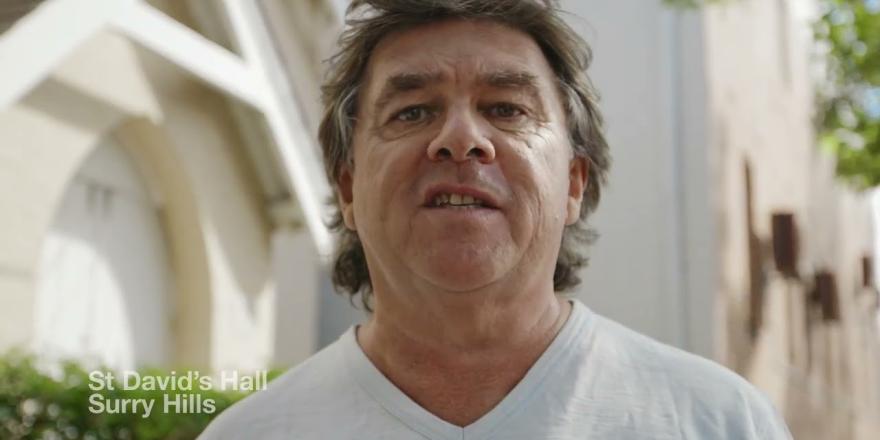
[Visual: St David's Church and Hall appears.]

I'm standing in front of St David's Church and Hall, the site of the AAPA's first conference and significantly the first Aboriginal civil rights convention ever held in this country. Over 200 Aboriginal people were in attendance.

"We aim at the spiritual, political, industrial and social. We want to work out our own destiny. Our people have not had the courage to stand together in the past, but now we are united and determined to work for the preservation for all those interests which are near and dear to us."

No wonder Aboriginal people were fired up. They were front page news in the press of the day. The old and young were there. The well-dressed matronly woman and the shingle girl of 19, the old man of 60 and the young man of athletic build, all are fighting for the preservation of the rights of Aborigines for self-determination.

Within six months the AAPA had 13 branches and over 600 members. The second conference held at Kempsey Showground had over 700 Aboriginal attendees. Across the state Aboriginal people had been thrown out of their homes and fenced off from the land that had been their livelihood for decades with no support, no compensation and no opportunity to challenge the consequences.

The AAPA stood in total opposition to the policies of the New South Wales Aborigines Protection Board. It offered a genuine alternative and it offered hope.

Dick Johnson and other members of the AAPA had gone to fight overseas in Gallipoli, Belgium and France. They returned to find out that the newly introduced soldier resettlement scheme didn't apply to them. They also discovered that much of the land being handed over to white soldiers was in fact the independent Aboriginal reserves. Some men returned to find that their children had also been removed from their wives' care and they threw their weight behind the fight that the AAPA was putting up to the New South Wales State Aborigines Protection Board.

But the AAPA wasn't a boys' own club. Jane Durenne, a member of the Australian Aboriginal Progressive Association, was from Merilia on the south coast of New South Wales. This is a copy of the letter she wrote to King George V. It's stamped by the private secretary's office at Buckingham Palace on the 27th of July 1926. She wrote complaining about the exclusion of Aboriginal kids from the public school at Batemans Bay. She pointed out that she'd written to the Aborigines Protection Board, the Department of Education and even the sitting member. Durenne did not receive a reply to her letter. The correspondence was sent back to the Governor General by Buckingham Palace and he forwarded it on to the Aborigines Protection Board and nothing was done.

1927 was the year the AAPA reached its peak. It mounted an appeal on a petition to New South Wales Premier Jack Lang and published widely across the state through the press its Manifesto of Demands for Aboriginal Rights.

"That the family life of the Aboriginal people shall be held sacred and free from invasion and that the children shall be left in the control of their parents. That the control of Aboriginal affairs, apart from common law rights, shall be vested in a board of management comprised of capable, educated Aboriginals under a chairman to be appointed by the government."

On the 23rd of August 1927, the AAPA received a reply from the New South Wales State Government and the Aborigines Protection Board that was a gentle rebuke of their demands on Aboriginal people in general. It inspired Fred Maynard to write a powerful and inspirational reply.

"I wish to make it perfectly clear on behalf of our people, we accept no condition of inferiority as compared with the European people. That the European people, by the arts of war, destroyed our more ancient civilisation is freely admitted and that by their vices and diseases our people have been decimated is also patent. But neither of these facts are evidence of superiority, quite the contrary is the case. We called no man master and we had no king."

Maynard's letter was received by Lang's successor Thomas Bavin, who was warned about this troublemaker Fred Maynard.

"Mr Maynard, who was not altogether a disinterested party, should not be allowed to unduly occupy the Premier's time. He is a full-blooded black whose voluble manner and illogical views are more likely to disturb the Australian Aborigines than achieve for them improvement of conditions."

[Archival voiceover:] "Your case is one of dozens with our girls. More is the pity. God forbid those white robbers of our women's virtues seem to do just as they like with downright impunity. And mind you dear girl, the law stands for it."

This was the poor young Aboriginal girl who had been sexually abused at her place of employment and sent to Sydney when she became pregnant. She was then sent back to where she was being assaulted. Fred was clearly angered by what had happened to this young girl, but his letter never reached her.

"Dear Sir, The attached letter was received by tonight's mail addressed to one of my Aboriginal servant girls. It bore the Sydney postmark so I opened it, intending to refer it back to sender, stating that that girl was not now here. When I saw the heading on the paper I glanced through it. I then considered it my duty to send it on to you to let you see what is doing."

That letter was written to the Aborigines Protection Board in 1927. Clearly Fred Maynard was never to know that his intentions to help this vulnerable young Aboriginal girl would intensify the Aborigines Protection Board's hostility towards him.

When I was researching my grandfather I had the privilege to interview Uncle Reuben Kelly, a Dungutti man, and there was an image of my grandfather sitting on his mantelpiece and he said, that's a picture of the great man. He wasn't allowed on the reserves, but us kids would run messages to him and from him. Last time I heard him speak was at Sydney University. He was on a soapbox.

On the 14th of June 1928, Fred Maynard married Minnie Critchley, a white woman. She was a single mother who worked in a coffee shop at Central Station in Sydney. My grandfather met her on a late night train. Her marriage saw Minnie ostracised by my own family, but she certainly idolised my grandfather Fred. The subsequent arrival of children opened another avenue for the Aborigines Protection Board to threaten the high-ranking officials of the AAPA. And the hard economic times of the Great Depression took their toll on the ability of the AAPA to maintain its momentum.

[Visual: Stables in family backyard.]

I'm in the stables in my family's backyard. My father was a very prominent Aboriginal jockey of the 1950s and 1960s. Life was very difficult growing up for my father and his brothers and sisters. They were on hand-me-downs. Shoes didn't fit. There were no toys. After my grandfather's accident, they were on two pounds a fortnight from St Vincent de Paul. Life was very hard for my grandfather on the wharf, and he seemed to be overlooked for working opportunities. And there was the thought that that had to do with his political outspokenness on Aboriginal issues.

In 1944, Maynard suffered from a serious accident. His leg was broken in six places, and he spent nearly 12 months in and out of hospital. I can remember the day back in the 1990s coming up to these stables, and my father was in this horse box, haying up with this pitchfork. I'd been looking for a man, Kevin Ridgeway. He was the son of Sid and Cora Ridgeway, Cora, my grandfather's cousin. I'd been driving up the coast, and I got a call from someone, and they said, you've been looking for Kevin Ridgeway. And I said, that's right. Been looking for him for a long time, and hadn't been able to find him. And they said, he's at a place called Woolgoolga. At that very point of time, I was 10 kilometres just outside of Woolgoolga. So I drove in, found a telephone box, looked up Kevin Ridgeway, and gave him a call. He said, oh, John, God, it's good to hear from you. He said, how's your dad going? I followed his riding career. What a great career he had. Come around, he said. We'll have some lunch. I'd love to catch up with you.

So I went round and knocked on the door. I hadn't even said anything about what I was doing there, what I was researching or anything like that. And he said, come in, sit down. Before he started, he said, look, there's just one thing I want to tell you. Dear old mum said, to the day she died, what happened with Frederick was no accident. It was all very fishy, all hushed up, no investigation and no inquiry. She said, they shut him up, and that's what they did.

My father actually said, at that particular point in time, when I interrupted him, hang up the horse box, he said, oh, well, we probably knew that all along. He then opened up on another story, I guess, which had twigged his memory. He said, when I was about five or six in Canterbury in Sydney, me and another young Aboriginal kid were picked up by the police and taken to Canterbury Police Station, he said, and they terrorised us. When he was eventually released, he ran back home and he never said a word to his father or his mother. But on reflection in this horse box, he said to me, it was quite clear what that message was. We can pick up your kids any time we like, and there's not a damn thing you can do about it.

Eventually, Fred would have his leg amputated after it was infected. He also suffered from diabetes. He died in 1946 after a slow but steady decline in his health.

Extraordinarily, the head of the New South Wales Aborigines Protection Board was also the chair of the New South Wales Police, so it was little surprise that police intimidation would force the Aboriginal leadership and the AAPA underground. This led to the eventual disintegration of the AAPA altogether. It abruptly ceased public operations in 1928.

As we head into the late 1920s and early 1930s, the impact and arrival on the scene of white academics began to push the Aboriginal leadership to the side. They were far more concerned with building their own profiles and took the floor on Aboriginal issues.

Fred Maynard spoke of things that white people did not know, weren't aware of, and simply did not want to know. The power of the message that Fred Maynard expressed so defiantly nine decades ago has not been diminished by the passage of time.

"We accept no condition of inferiority as compared with the European people. Quite the contrary is the case. We called no man master, and we had no king."

[Visual: Text on screen.] We called no man master, and we had no king.

[Visual: Text on screen.] We called no man master, and we had no king.

Writer / Director Larissa Behrendt

Producer Craig Longman

Narrator John Maynard

Fred Maynard (1879-1946) was an Aboriginal activist and rights campaigner who, in 1925 Maynard launched the Australian Aboriginal Progressive Association. Initially, its office-bearers were all men from the mid-north coast, except for McKenzie-Hatton who was organizing secretary. The group protested against the revocation of north-coast farming reserves; they also demanded that children no longer be separated from their families, or indentured as domestics and menial labourers. The A.A.P.A. advocated that all Aboriginal families should receive inalienable grants of farming land within their traditional country, that their children should have free entry to public schools, and that Aborigines should control any administrative body affecting their lives.

This film will focus on the family memories of Fred Maynard through his grandson, Aboriginal historian John Maynard. It will also look at Maynard’s intellectual influences to show the deep philosophies that underlined this early protest movement. Reflection will also be given to how this movement in the 1920 and 1930s influenced the political activism and thought of the 1970s since people like Gary Foley and Gary Williams had their family roots in the same communities that Maynard was most active in.

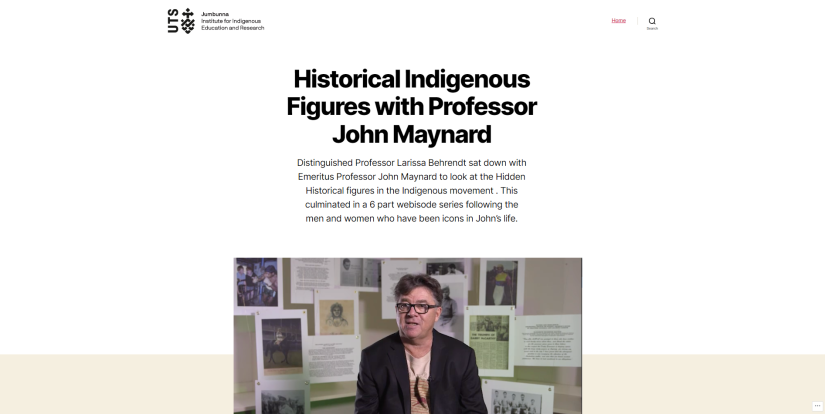
Historical Indigenous Figures with Professor John Maynard

Distinguished Professor Larissa Behrendt sat down with Emeritus Professor John Maynard to look at the Hidden Historical figures in the Indigenous movement . This culminated in a 6 part webisode series following the men and women who have been icons in John’s life.
Historical Indigenous Figures with Professor John Maynard