

In the future of work - set to be upon us in the next 10 to 30 years, depending on what your core skills and capabilities are - mathematics is going to be key. Love it or hate it, LearnEd founder and CEO Mahya Mirzaei explains why - and how she’s upskilling thousands of high school students across Australia with a single platform.
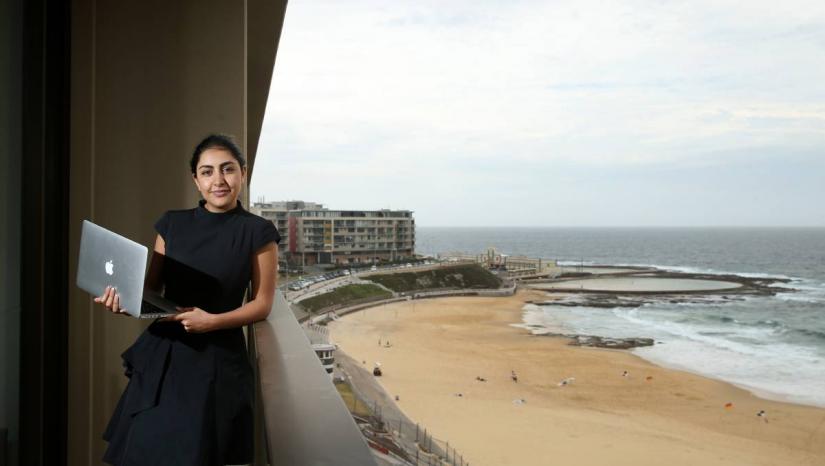
Photo: Mahya Mirzaei
"The world is going towards the world of AI. In that world, knowing mathematics is going to be able to help define the course of the future. Areas like data analytics are heavily reliant on maths and if you’re not competent in that, you can’t contribute."
- Entrepreneur and PhD holder Mahya Mirzaei.
At just 27 years old, the list of reasons that make Mahya a qualified commentator are a combination of mind boggling and envy inducing. Not only does she have a degree in aeronautical space engineering, plus a PhD from UTS in Engineering and IT (Data Analytics for Innovation), she also launched her own virtual maths tutoring startup, LearnEd, in 2016 after completing the Hatchery Accelerate program (now UTS Startups).
LearnedHub has been particularly successful in the past six months: it was awarded ‘Best for Profit Venture’ at UTS Venture Day in February, as well as the IBISWorld 3P Innovation Competition, alongside fellow UTS Hatchery Accelerate startup alumni Tekuma.
Maths in the mainstream
You might be doing the maths (pun intended) and be thinking that Mahya has an agenda to push, using maths in the future of work as a marketing message. But despite her level of skin in the game, you have to admit, she makes a sound argument for why maths going mainstream is more than just a fad.
“Mathematics is also a language of logical thinking as it teaches us problem solving. So even if you don’t directly go into a field where you have to use hard mathematics, just knowing mathematics will help. What we see is when our students get really good at maths, they also get better at their science courses, because mathematics is fundamental to those too,” Mahya elaborates.
Mahya gives an industry example of mathematics and its role in the future of work: in the field of medicine, specifically the Garvan Institute of Medical Research, which is using data analytics and machine learning on genomes and genomics.
“One of the problems they have is looking for people with medical or biology degrees to join the team and do some of this via machine learning, but very few people from those degrees have the mathematical and technical backgrounds to do that.
“Many of the things doctors do will be replaced by robots pretty soon. Whether that is a good or bad thing may be up for debate. But if that’s going to happen, then the degrees that educate those doctors are going to be very different from what’s on offer now, and are going to be more data-driven and more mathematics-based.”
From maths whizz to new mindsets

Photo: Mahya Mirzaei
But a degree, whether it’s maths-focused or otherwise, is just the beginning of building the type of mindset and skillset that will see graduates add value in the future of work. The most important mindsets for success, according to Mahya? The desire to keep learning, and confidence in your abilities.
“I’m a true believer in self-learning. University is great in terms of giving people the core skills of an industry. But one of the main things that a degree should do for you is enable you to understand your own capabilities and realise that you can learn anything, and that you can do things independently,” she explains.
Mahya likens this to her own experiences launching and building her startup. “As a startup founder, or someone that works in a startup, you need to be willing to always challenge yourself and learn new skills. It is extremely important to have the confidence to believe you can learn something new.”
That confidence and adaptability has certainly paid off, as it will for many others in the future. In just two years since launching, the business has expanded across Australia, and setting up shop in Asia is now on the horizon. More than 2000 students have now used LearnedHub’s online courses, and tutoring scholarships have been awarded to nearly 500 more. The startup is now part of the latest Startmate accelerator cohort, which is supported by Sydney-based VC firm Blackbird Ventures.

Alongside her educational grounding in mathematics, Mahya credits being open to change and perseverance as being particularly crucial to the traction LearnedHub has experienced.
“It’s the fact that we’ve really been passionate about the problem space itself. We’ve never really been married to the solution we’ve had. We’ve always been open to changing it to make it better for our customers,” she acknowledges.
“That’s the main difference between us and others, who have been really sure about their solution and wanted to make that work.”
Perseverance can be easier said than done, especially during times when you’re the only one that believes in your vision.
“Getting customers to understand has sometimes been difficult,” Mahya admits. “We could have given up on it a while ago, but we believed in it and persevered to get parents to try it. Once they did, they loved it. If we’d gone off the initial feedback, it would have never worked, because people don’t know what they want until they see it.”
Keeping it real with industry
Instrumental to Mahya’s journey as an entrepreneur were the real-life industry collaborations on offer through her PhD, namely with IBM, CBA and EY.
Under the tutelage of IBM Research Australia’s associate director, Mahya traveled to Melbourne to collaborate on live projects. CBA opened the doors to its Innovation Labs, including its famed social robotics initiative. The work with EY, meanwhile, was focused on leveraging data analytics to help organisations innovate, diving deep over several months and working directly with some of the firm’s partners.
“These have been chances that not every university provides students with,” she reflects, giving a nod to her UTS PhD supervisor’s ability to open up valuable new industry opportunities for her.
“My supervisor was a great role model, stretching all her students to see the world in a different way. The people that she connected me with - like Steve Wozniak - changed my perspective on things quite a lot. Even the Vice Chancellor of UTS, Attila Brungs - how many universities in the world allow students to receive mentorship directly from the VC? He’s been so active in all the entrepreneurship endeavours at UTS and helping students.”
Of all the qualities, knowledge and skills Mahya has tapped into to get to where she is today, perhaps it’s something as simple as seeing things from a different perspective that is really the key to making a difference in the future of work. Can robots and AI do that as well as an empathetic and creative human innovator can? Only time will tell.
By MaryLou Costa, UTS Innovation & Entrepreneurship.
Hear more from Mahya and other education disruptors at the 'Future and Disruption of Education' event in Sydney on November 28 - register here. Click here to find out more about entrepreneurship opportunities for UTS PhD students.