

Four robotics labs showcase our depth of resources and skillsets to work on many industrial and fundamental research work.
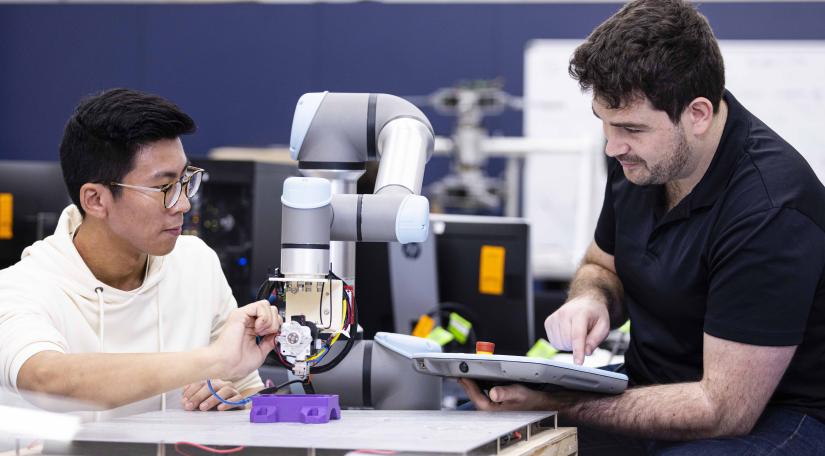
Our labs are located in UTS Building 1, UTS Building 2 and UTS Techlab
Use the buttons to expand or collapse the section.
-

Lab located at UTS Tower building 1, level 2, room 082 (CB01.02.082) - image supplied
Driving the systems innovations by incorporating human centred approach in designing biologically inspired robots, underwater robots, aerial drones, and soft robotic systems to tackle unique challenges across a variety of domains.
Lab Lead: Professor Sarath Kodagoda
Associated industry partners: Transport for NSW, Sydney Water, Meat and Lifestock Australia, Tokyo Electric Power Company (TEPCO), Junglefy, city of Sydney Council
The Robotics Systems Lab is where state of the art robotics research and development for the inspection and maintenance of civil structures takes place.
The goal of the research in the Robotics Systems Lab is to reduce the risk to workers by taking them out of hazardous environments and allowing them to remotely collect data and perform maintenance remotely.
Collaborating with industry partners both locally and internationally, the UTS Robotics Institute has produced a long list of robotic workers designed to endure harsh conditions such as the dusty and claustrophobic interiors of the Sydney Harbour Bridge, the corrosive waters of Sydney’s water distribution systems and the high altitudes of Japan’s power transmission towers.
Replicas of the civil structures are constructed in the Infrastructure Lab so that research and development on the robot’s sensors, control algorithms and data processing can continue whilst our industry partners deploy our robots in the field, creating a virtuous cycle.
The Robotics Systems Lab also houses a 45kL water tank which is used in the development and deployment of floating and underwater robots. As the largest water tank in the university, it also sees use from other research centers from the university as well as the Faculty of Engineering and IT in undergraduate coursework.
-

Lab located at UTS Tower building 2, level 11, room 101 (CB02.11.101) - image supplied
Advancing fundamental and applied research on sensing, perception, and estimation as well as control, planning, and coordination to develop systems that understands and carry out tasks with precision.
Lab Lead:Professor Shoudong Huang
Associated industry partners: Sydney Water, Tianfu, Burwell Technology, Tokyo Electric Power Company, Ausdrill (Perenti Group), Meat and Livestock Australia
The Robotics Discovery Lab hosts variety of robotic research work including robots working in tandem with humans to complete a given task. As such, the robots focus on identifying and responding appropriately to their human co-worker’s intentions. In this way, the robots can keep the human in control of the operation whilst providing assistance to their human co-worker in the form of physical support, monitoring the safety of the human and updating the human about changes in the task to make the operation both mentally and physically less straining.
As the human and robot work collaboratively, both the human and robot are often in close proximity or in contact with each other as they work which emphasises the importance of the human operator’s safety in these interactions. In response, UTS:RI has developed and incorporated a multitude of software and hardware features to ensure the safety of the human, the robot and the environment.
Examples of robotic co-workers developed by UTS:RI which can be found in this lab include the ANBOT (an assistive grit-blasting robot) and the Smart Hoist (an intelligent patient lifter) which were developed collaboratively with industry partners and have been tested extensively in the workplace.
Some other projects in the lab includes:
- Smart Hoist – which is a powered hoist with the capability of intension recognition of the user
- Smart Wheel Chair – which can drive less mobile people safely
- Mobility Scooter – which can drive the less mobile people in outdoors
- Robotic platforms such as Hip Replacement Robot
- JeXo
- Sawyer Robot arms
- Fetch Robot
- Surgical Robot
-
Lab located in UTS Building 2, Level 12, Room 143 (CB02.12.143)
At the heart of the Robotics for Good lab is a mission to harness technology for positive change and meaningful human benefit
Lab Lead:Associate Professor Marc Carmichael
Associated industry partners: Guide Dogs NSW/ACT, Sydney Water, Tianfu, Burwell Technology, Tokyo Electric Power Company, Ausdrill (Perenti Group), Meat and Livestock AustraliaThe Robotics for Good Lab is focusing on solving the challenges in robots interacting with humans including social robotics.
Social robotics is the study of taking robots out of the more industrial settings associated with robotics and into the hands of the general public. Robots are not yet commonly available in general spaces and some may not feel comfortable around or interacting with robots. Social robotics explores the human reaction to robots and how robots can be made more approachable and intuitive to interact with. This is where humanoid robots or service robotics come in to bridge the gap between robotics and the wary end user.
The Robotics for Good Lab houses the first PR2 robot (high-end humanoid) in Australia as well as a number of Pepper Robots from SoftBank Robotics. These robots are able to move around and communicate with humans through gestures and speech and are able to perceive humans through their array of sensors. By interpreting the human’s gestures and speech, these robots are able to converse with humans and perform simple interactions. Other robots such as the Therabot, an animal shaped robot designed to provide companionship by mimicking animal behaviour. Other robotic platforms available in the lab: NAO, Aibo robot dogs.
-
Lab located in UTS Building 11, Level 9, Room 404 (CB11.09.404)
The Robotics Studio is a dynamic hub for undergraduate students to explore real-world robotics through hands-on projects, mentorship, and research, empowering the next generation of innovators and researchers.
Lab Lead:Associate Professor Marc Carmichael -
Lab located at TechLab in Building 1, Ground Level, Room 327 (BP01.00.327)
Driving the theory and practice of coordinated autonomy for high-impact applications in remote, dynamic, and uncertain outdoor environments including land, sea, air, and space.
Lab Lead:Professor Robert Fitch
Associated Industry Partners: Navantia Australia, Marintec
-
Lab located in UTS Building 2, Level 11, Room 101 (CB02.11.101)
Aiming to transform the construction sector through cutting-edge robotics, AI, and automation, driving safer, more efficient, and sustainable infrastructure delivery in Australia.
Lab Lead: Distinguished Professor Dikai Liu