


- Posted on 11 Nov 2026
Three entries, three finalists, one winner – and a first for Australian universities.
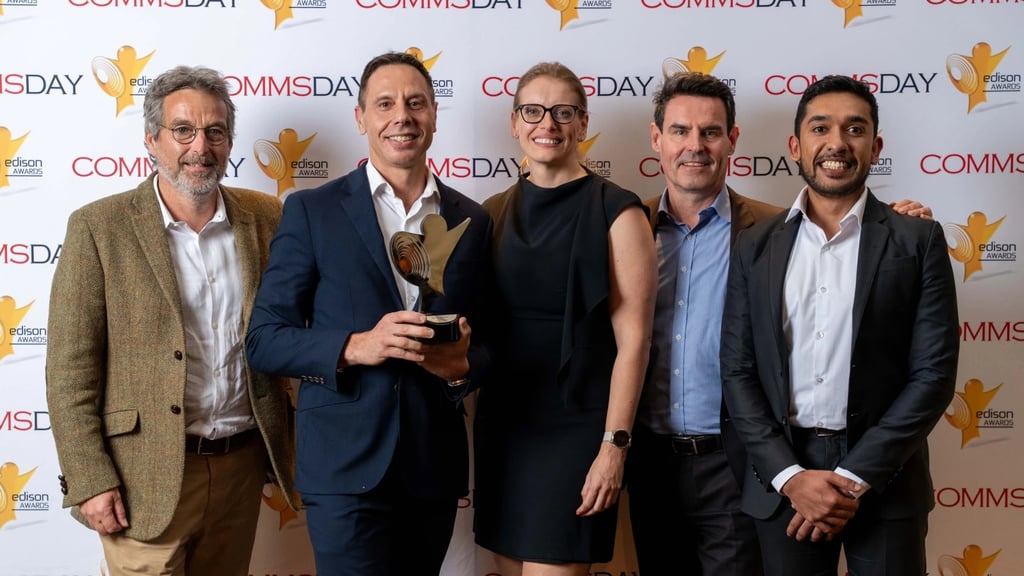
UTS research partnerships with Amplitel, nbn and Australia’s major telecommunications operators have achieved a first for any university at the CommsDay Edison Awards – securing three finalists from three entries, with Amplitel-UTS collaboration, Project SMaRTER, winning the sector’s top AI award.
The CommsDay Edison Awards are widely regarded as the telecommunications sector’s most prestigious annual recognition of innovation and partnership excellence. Held as part of the CommsDay 2026 Summit in Sydney, the awards draw hundreds of submissions across nine categories from across the industry each year.
This year, three UTS collaborative research programs were entered and all three were named as finalists – an unprecedented result for a university at these awards. One of those programs went on to win: Project SMaRTER received the Best Telco AI Initiative award, submitted and won by Amplitel in collaboration with UTS.
The three finalist projects reflect the breadth of UTS’s partnerships across the Australian telecommunications sector. Together, these projects highlight UTS’s role as a pre-competitive, industry-facing research partner working alongside leading operators and infrastructure providers to address shared challenges that no single organisation could tackle alone.
2026 CommsDay Edison Awards
Finalist #1: ASTRID (nbn, UTS, RMIT)
A flagship program using AI and advanced analytics to improve how the national broadband network is planned and managed.
Finalist #2: Project SMaRTER (Amplitel, UTS)
An AI-driven approach to improve how telecommunications towers are maintained in Australia. Recognised as a category winner.
Finalist #3: Emergency Call Testing Facility (Telstra, Optus, TPG, UTS)
A unique national capability that tests how emergency calls perform under degraded or failed network conditions, driving improvements across operators and device manufacturers.
AI-driven infrastructure delivering real-world impact
Project SMaRTER is a five-year research collaboration between UTS and Amplitel, Australia’s largest telecom tower infrastructure company, focused on improving how telecommunications towers are inspected, monitored and maintained.
Using AI and machine learning, the project enables a data driven approach for safer and more cost-effective assessment of tower infrastructure. In practical terms, it reduces the need for manual inspection, lowers operational risks and supports more efficient management of the physical assets that underpin Australia’s mobile networks.
The results speak directly to the kinds of problems operators face every day - how to keep critical infrastructure healthy, cost-effective and resilient at scale. Amplitel’s decision to submit this work to the Edison Awards reflects the confidence both partners have in the real-world impact of the collaboration.
UTS presence at the CommsDay Summit
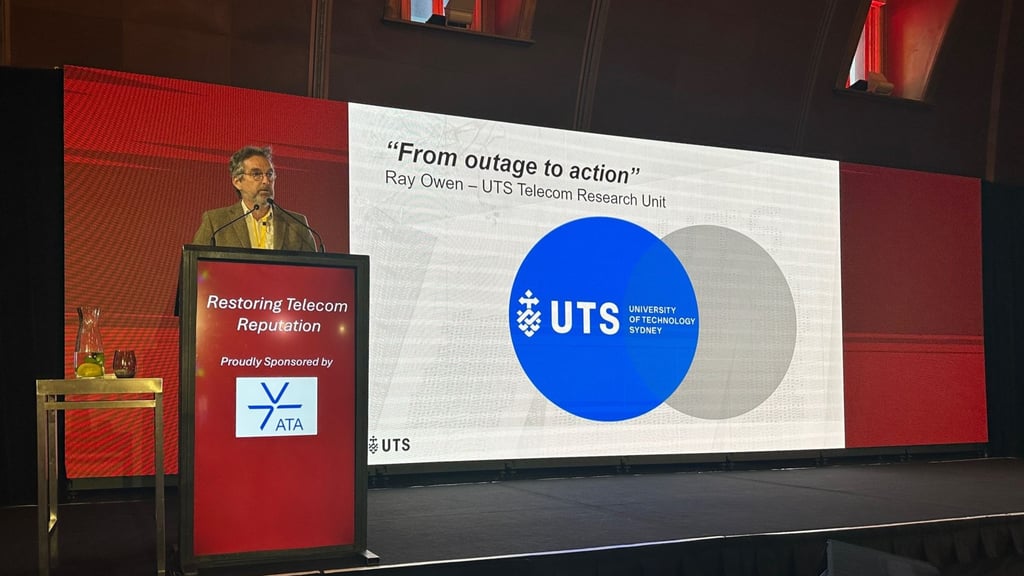
UTS’s engagement at the annual CommsDay Summit extended beyond the awards ceremony. Professor Ray Owen, Director of the UTS Telecom Research Institute (TRI) and National Telecom Resilience Centre (NTRC), was an invited speaker at the Summit, presenting on telecommunications resilience and the industry’s response to major network outages.
Drawing on the “From Outage to Action” research narrative, Professor Owen explored how large-scale disruptions, including recent national outages, have driven coordinated action across industry, government and research to improve emergency call reliability and network resilience.
Central to this work is the Controlled Test Facility at UTS – a world-first environment where major operators collaborate to test real telecommunications networks and devices under simulated failure conditions, allowing the industry to identify risks and validate solutions before they are needed in the field.
The TRI team were also invited to join the Amplitel exhibition stand throughout the Summit, engaging directly with the wider telecommunications community. The team demonstrated how AI and robotics can transform telecom infrastructure management, explaining how researchers at UTS are developing advanced capabilities to support Amplitel in improving maintenance operations through the application of AI and machine learning, enabling more proactive and data-driven asset management.
In parallel, the team highlighted ongoing work exploring the feasibility of integrating robotics to reduce operational risk and improve the effectiveness of maintenance and remediation activities, particularly in complex or hazardous environments.
Partnership-driven research with national impact
UTS’s engagement at CommsDay Summit 2026 reflects the depth of its collaborative model, with active research partnerships spanning Amplitel, nbn, Telstra, Optus and TPG. This approach enables research to move beyond theory into real-world application, delivering outcomes that directly improve how networks are built, maintained and protected.
Professor Kate McGrath, Deputy Vice-Chancellor (Research), attended the awards as part of the UTS delegation, a reflection of the university’s commitment to industry-facing research.
This year’s Edison Awards recognition reflects not only the impact of individual projects, but also the growing role of UTS as a trusted partner in shaping the future of Australia’s telecommunications sector.

News
Schoolies starts this week – six things young people can get wrong about safety
While Schoolies can be great fun, it’s also a time of increased risk.

News
The Carbon Bubble Question: How Much Are Fossil-Fuel Companies Really at Risk?
New research challenges assumptions about the financial risks of the energy transition and offers important lessons for policymakers, companies and investors.
News
Rethinking wellbeing: Coaching for collective and ecological flourishing
A new approach to coaching looks beyond personal wellbeing to consider how collective and ecological flourishing can become part of what it means to thrive.

News
Women behind bars are giving birth in shackles and handcuffs
Shackling women during childbirth is a violation of human rights, but it is not banned in Australia.
News
Schoolies starts this week – six things young people can get wrong about safety
While Schoolies can be great fun, it’s also a time of increased risk.
News
The Carbon Bubble Question: How Much Are Fossil-Fuel Companies Really at Risk?
New research challenges assumptions about the financial risks of the energy transition and offers important lessons for policymakers, companies and investors.
News
Rethinking wellbeing: Coaching for collective and ecological flourishing
A new approach to coaching looks beyond personal wellbeing to consider how collective and ecological flourishing can become part of what it means to thrive.
News
Women behind bars are giving birth in shackles and handcuffs
Shackling women during childbirth is a violation of human rights, but it is not banned in Australia.