


- Posted on 29 Oct 2026
Thought leaders and emerging voices recently gathered at the UTS to explore how to foster a more inventive Australia.
Key takeaways
- Australia needs fundamental research and policy reform to strengthen its invention culture.
- Institutions must create space for curiosity, experimentation and the unexpected encounters that spark breakthroughs.
- Breaking down traditional silos and connecting people, disciplines and sectors is essential to fostering invention.
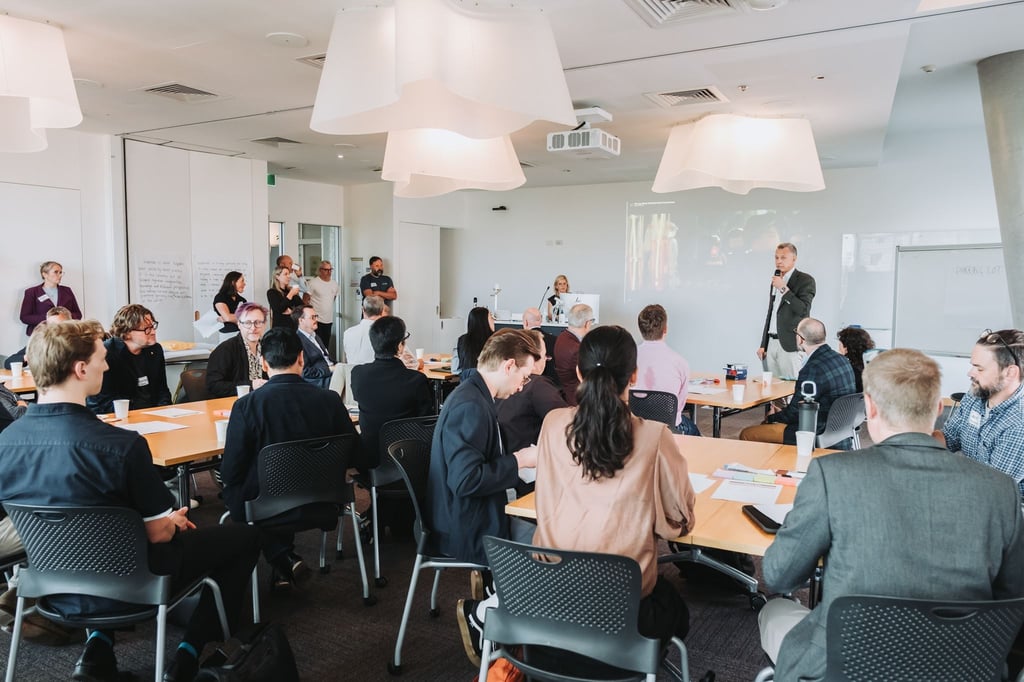
Participants from diverse backgrounds across government, research institutions, philanthropy and industry, including emerging generations and Indigenous voices, gathered to address Australia’s invention challenges at the Inventive Australia Symposium, held at UTS Business School.
“Productivity is what drives living standards, and underpinning it is invention, research, and innovation,” said UTS special innovation advisor, Emeritus Professor Roy Green. “What we’re seeing now in Australia is the lowest level of productivity in 60 years.”
The Symposium was led by UTS Business School Adjunct Fellows Dr Katrina Skellern, Dr Leanne Sobel and UTS TD School Adjunct Professor Dr Christian Bason, who are conducting a UTS Business School supported research project, Enabling a Flourishing Invention Culture for a 21st Century Innovation Ecosystem.
“It's not just about invention, innovation and commercial potential. It's about our society and the hopes and desires we have for our future… how culture shapes invention,” said Dr Sobel.
“An inventive Australia will not emerge from traditional silos. We need institutions designed to connect people, disciplines and sectors in new ways – creating space for curiosity, experimentation and the serendipitous encounters that often spark breakthrough ideas and innovations,” said Dr Skellern.
Former Chief Scientist Dr Cathy Foley, President of the Australian Academy of Technological Sciences and Engineering, UTS Associate Professor Susan Moylan-Coombs, and UTS Associate Professor Jochen Schweitzer are also leading the project.
Dr Foley argued that the Australian research system needs fundamental change, beyond process improvements or new funding programs, to foster genuine invention.
“We don’t just need more invention coming out of our research system. We need to invent a completely different research system,” Dr Foley said. She discussed the need for a connected, long-term research and policy system that views research as an investment rather than a cost.
Dr Foley highlighted how current structures are characterised by risk aversion, short funding cycles and fragmented discipline areas that prioritise predictable outcomes over transformative breakthroughs and said a radical rethink is needed.
Transforming institutions into collaborative, human-centred systems capable of solving complex societal challenges, is a key focus for Dr Bason, a leading Danish author, researcher and global advisor on transformative design and societal innovation.
He recently provided guidance on scaling up health innovations for the World Health Organisation, and said thriving innovation ecosystems combine culture, policy, place, and strong institutions to support the adoption and spread of innovative solutions.
“Scaling has to happen in a way that reaches the people who need it the most. You really think about people first, not product first. A piece that is important as well, is connecting invention to real need, not just commercial interests,” he said.
Associate Professor Moylan-Coombs, a proud Gurindji and Woolwonga woman, outlined three foundational principles to integrate First Nations knowledge and cultural responsibility into Australia’s inventive capacity; country first, belonging that carries responsibility and legacies.
“Every idea takes shape somewhere. Every product requires material. Every technology uses resources, and every system affects relationships. Putting country first asks us to understand those connections from the beginning,” said Associate Professor Moylan-Coombs.
We need institutions designed to connect people, disciplines and sectors in new ways
Students from the UTS Transdisciplinary (TD) School discussed the challenges and opportunities facing young innovators. They highlighted how social media creates unrealistic expectations through curated success, potentially discouraging risk-taking.
“Our generation has unprecedented access to the digital world. We’re on TikTok or Instagram or videos from around the world seeing people doing incredible things, which makes the possibilities feel endless… but also exposes us to comparison,” said TD student Aya Mizukami.
Aya argued that even failure is curated, with setbacks and failures shown retrospectively, with a successful outcome attached. She warned that consuming the achievements of others can leave young people reluctant to create and experiment.
“I think it's super important as a young generation that we get out there and create things even if they're not perfect,” said Aya.
TD student Maya Bienstock advocated for more “slow time” including offline events and experiencing life in regional communities, as a way to allow curiosity and creativity to flourish.
“We have digital information overload…Young people need time and space to be able to do nothing. The risk of not having these spaces and options to slow down is that we risk running on autopilot and our ideas become stagnant,” she said.
Professor Green emphasised the need for a coordinated government innovation and industrial policy to rebuild high-value manufacturing supply chains and harness “industrial AI” to mitigate the economic risks associated with declining raw material exports.
“The opportunity for Australia is to apply AI to physical products and systems in manufacturing, energy, defence, agriculture, so that we can grow all of those areas of our economy where we have current or future competitive advantage in global markets.”
The Symposium focused on identifying essential elements for fostering invention and systemic change. Participants highlighted the importance of enhanced collaboration to achieve impactful, large-scale transformation to allow future generations to thrive.
For more information visit the Inventive Australia LinkedIn page or email InventiveAustralia@uts.edu.au.
News by topic

News
Climate change is killing the plants of Uluṟu‑Kata Tjuṯa. Aṉangu traditional owners are concerned
Extreme temperatures combined with withering drought mean plants and animals on Aṉangu land are struggling to bounce back.

News
Exempting pensioners from private health rebate changes won’t make it fairer. Here’s what would
A pensioner carve-out would mostly protect comfortable part-pensioners, while missing younger families who are struggling most.

News
Home energy upgrades get a boost with new national resource
A new digital platform has been launched to support councils and community organisations deliver home energy upgrades.
News
‘To solve the world’s problems, put a plant on it’
UTS Plants and Environmental Research Group bring home two World Green Infrastructure Awards for demonstrating the power of plants to clear the air and power...
News
Climate change is killing the plants of Uluṟu‑Kata Tjuṯa. Aṉangu traditional owners are concerned
Extreme temperatures combined with withering drought mean plants and animals on Aṉangu land are struggling to bounce back.
News
Exempting pensioners from private health rebate changes won’t make it fairer. Here’s what would
A pensioner carve-out would mostly protect comfortable part-pensioners, while missing younger families who are struggling most.
News
Home energy upgrades get a boost with new national resource
A new digital platform has been launched to support councils and community organisations deliver home energy upgrades.
News
‘To solve the world’s problems, put a plant on it’
UTS Plants and Environmental Research Group bring home two World Green Infrastructure Awards for demonstrating the power of plants to clear the air and power...