


- Posted on 2 Sep 2026
- 3-minute read
An innovative pilot program helps refugees and migrants turn existing trade skills into local construction careers.
Key takeaways
- UTS-led pilot connects refugees and migrants with construction careers.
- The pilot is a part of the NSW Government’s Housing Policy Program Construction Workforce Package, boosting the number of tradies on job sites and accelerating the delivery of much-needed homes.
- A cross-industry collaboration model builds confidence, readiness and job pathways.
A new Australian Workplace Readiness Program led by the University of Technology Sydney (UTS) with industry, government, education providers, community organisations and employment services, is helping refugees and migrants with construction/trades experience prepare for work in the Australian construction industry.
The pilot was developed by Dr Suhair Zaid Alkilani, UTS senior lecturer in Construction Management and Distinguished Professor Martin Loosemore utilising the successful Multiplex Connectivity Centre collaborative model project managed by Jo Osborne.
“At a time when Australia is facing significant skills shortages and housing pressures, we need to look at the talent that is already here and find practical ways to connect people with meaningful, sustainable employment,” said Dr Alkilani.
The funding for the pilot is a part of the NSW Government’s $13.8 million Housing Policy Program Construction Workforce Package, designed to upskill and support 4,800 workers into residential construction jobs between 2025 and 2027 – boosting the number of tradies on job sites and accelerating the delivery of much-needed homes.
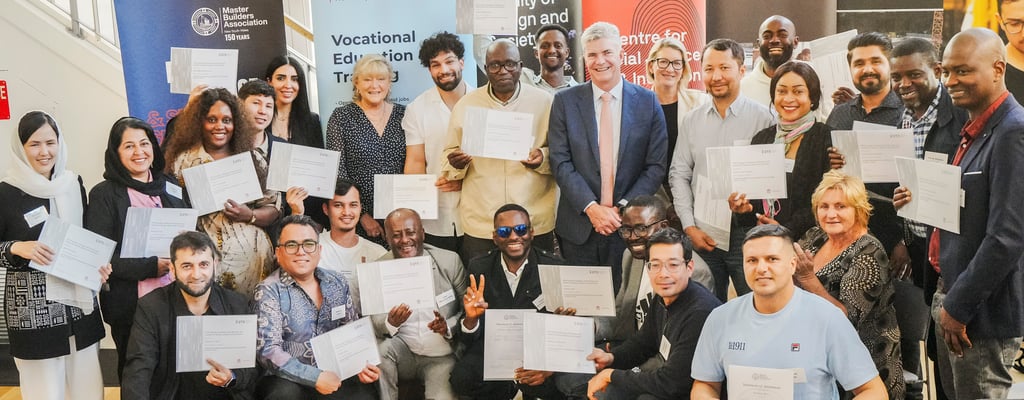
Attending the graduation ceremony for the first 21 pilot participants on Tuesday 1 September, NSW Minister for Skills, TAFE and Tertiary Education, Steve Whan MP said:
This pilot is helping turn talent into opportunity, giving participants the confidence, local industry knowledge and connections they need to build successful, long-term careers in construction and trades.
“The Minns Labor Government is determined to strengthen the workforce needed to build more homes across NSW. That's why we’re investing a record $3.46 billion in skills, training and TAFE NSW – backing programs like this to connect skilled people with the opportunities our industries are crying out for while helping deliver the homes and communities our state need.”
The program responds to two linked issues: construction skills shortages and the underuse of refugees’ and migrants’ existing skills and experience.
“Many refugees and migrants arrive in Australia with valuable qualifications, trade skills and work experience, but too often those skills remain underused,” said Dr Alkilani. “This pilot helps bridge that gap by giving participants the local knowledge, confidence, industry exposure and workplace readiness they need to take the next step.”
Dr Alkilani said the strength of the model was its cross-sector collaborative approach, which brings together the Master Builders Association NSW, Multiplex, the NSW Department of Education, TAFE NSW and Settlement Services International.
When talking about the pilot, Multiplex employee relations manager, Dave Higgon, said the company has been involved in many employment programs over the past two decades, primarily directed towards people with disadvantage seeking work in the industry.
“What has been particularly unique about this program has been the many insights we have gained through understanding the distinct barriers this group of candidates face,” said Mr Higgon. “By virtue of the right industry partners, our long-standing relationships with UTS, significant research, and through this program experience, we now know we have the solutions required to support motivated migrant and refugees to pursue a career in the construction industry.”
“No single organisation, government or sector can address these barriers alone,” said Dr Alkilani. “By working across sectors, we can create clearer and more practical pathways into education, training and employment.”
The pilot ran over three months and included screening, training and evaluation.
“We wanted participants to build confidence in a practical way, through training, mock interviews, site visits and exposure to real industry environments,” said Dr Alkilani.
“The readiness program is an important first step, but there’s also a need for continued pathways into work placements and employment.”
Amy Persson, Pro Vice-Chancellor (Social Justice and Inclusion) at UTS, said the model had the potential to be scaled, adapted and applied in other sectors where there were skills shortages and untapped talent.
“This pilot is a powerful example of how UTS works with government, industry and community partners to address complex social and economic challenges,” Ms Persson said.
“By helping refugees and migrants translate their existing skills into local opportunities, the program reflects UTS’s commitment to practical, inclusive solutions with real-world impact.”
Academics

Senior Lecturer, Faculty of Design and Society

Distinguished Professor, Faculty of Design and Society
News by topic

News
Professor Catherine Kelly appointed Dean of Law
UTS is delighted to welcome Professor Catherine Kelly as our new Dean of the Faculty of Law.

News
AI improves long-term flood forecasting
Through the power of advanced artificial intelligence, UTS research could help communities get warnings weeks ahead of floods.

News
What can free‑living Indian street dogs teach us about how to care for pet dogs?
A study of how Indian street dogs live raises questions about what it means to care for pet dogs.

News
La Bola Negra is about the Spanish Civil War – but is unmistakably about our present moment
Set across 1932, 1937 and 2017, new Spanish film La Bola Negra follows three gay men whose lives become connected across generations.
News
Professor Catherine Kelly appointed Dean of Law
UTS is delighted to welcome Professor Catherine Kelly as our new Dean of the Faculty of Law.
News
AI improves long-term flood forecasting
Through the power of advanced artificial intelligence, UTS research could help communities get warnings weeks ahead of floods.
News
What can free‑living Indian street dogs teach us about how to care for pet dogs?
A study of how Indian street dogs live raises questions about what it means to care for pet dogs.
News
La Bola Negra is about the Spanish Civil War – but is unmistakably about our present moment
Set across 1932, 1937 and 2017, new Spanish film La Bola Negra follows three gay men whose lives become connected across generations.