


- Posted on 22 Sep 2026
The University of Technology Sydney (UTS) has built the only facility in the world where a country’s major mobile network operators collaborate to test and strengthen emergency calling. Last week, The Hon Anika Wells MP came to see it.
When a major Optus outage in November 2023 left more than 10 million customers without service – and 2145 emergency calls failed to connect – the Australian Government needed an answer. An independent review, led by former ACMA Acting Chairman Richard Bean, recommended that an independent facility be established where emergency calling could be tested across all of Australia’s mobile networks.
UTS built that facility.
What UTS has built
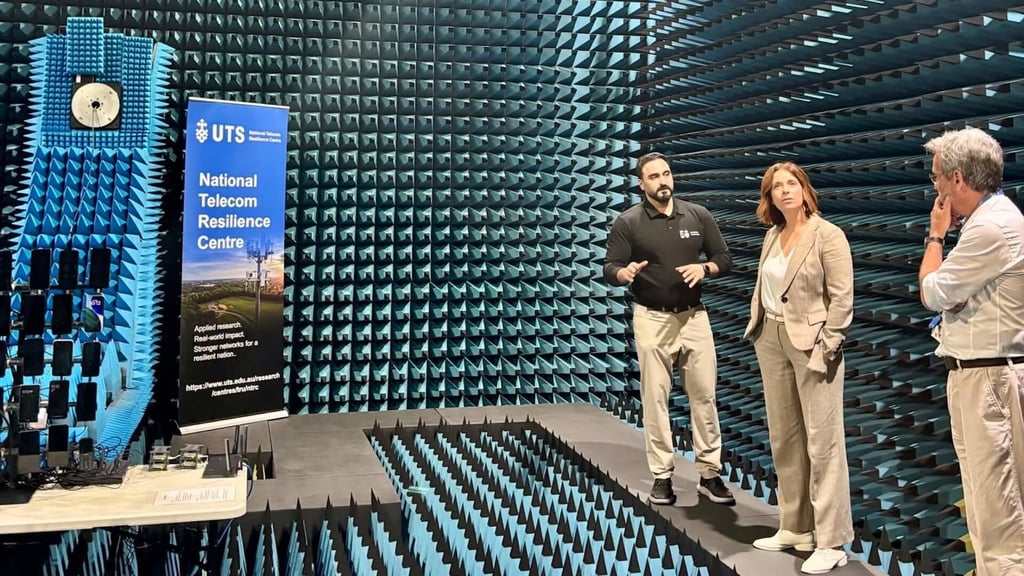
The Controlled Test Facility (CTF) at UTS Tech Lab is a purpose‑built testing environment where Telstra, Optus and TPG Telecom (Australia’s three mobile network operators), work together in a single, neutral space for the first time to test emergency calling. Each operator has installed its own equipment inside a shielded chamber, allowing researchers to safely recreate and study the kinds of extremely rare but serious network failures that can prevent emergency calls from getting through.
It is the first facility of its kind anywhere in the world.
The CTF sits within the National Telecom Resilience Centre (NTRC), part of UTS’s broader Telecom Research Institute (TRI) in the Faculty of Engineering and IT, which undertakes ongoing research into network resilience, emergency communications and related technologies. Earlier this year, the NTRC secured a further $5.5 million in funding to expand this work, supporting research into outage recovery, BGP anomaly detection, power–telecommunications interdependencies, satellite‑enabled service continuity and advanced radio‑frequency prediction for emergency calling.
This funding also supports the development of a fully independent, end‑to‑end testbed within the NTRC, enabling UTS researchers to validate new approaches to detecting, managing and recovering from major communications failures before they are deployed in live operational networks.
Why it matters
Most people assume major network outages are caused by cyberattacks or equipment failures. UTS research, published in IEEE, found the real cause is usually more mundane: misconfigurations in behind-the-scenes systems like the digital signposts that direct internet traffic or the address books that match website names to locations. When these systems fail, even a phone with full signal can’t complete an emergency call.
More than half of the major outages studied worldwide between 2020 and 2025 disrupted emergency calling. And with older 2G and 3G networks, which previously provided a fall-back path for emergency calls, now being switched off, the problem is becoming more pressing.
Australia’s CTF is one of the first independent facilities in the world able to study this at a system level and now supports testing obligations under Industry Code C674:2025, making Australia the first country to formalise cross-network emergency calling testing and research through an industry code.
Already driving global impact
The research is already producing real safety outcomes. By recreating critical failure scenarios that are unsafe to study on live networks, UTS researchers identified specific handset behaviours that prevented emergency calls from completing. These issues were invisible under standard testing.
That evidence directly prompted engagement with device manufacturers and led to targeted software updates, including Apple’s iOS 26 release late last year addressing iPhone 12 models. Together, these updates improved the reliability of emergency calling across global device fleets, delivering better public safety outcomes for everyday mobile users worldwide.
Findings are now feeding into international standards work, including UTS contributions at EENA 2026 in Riga and through 3GPP and GSMA channels.
“The CTF strips the end-to-end network down to one question – does the call get through? Having all three networks in one chamber, with operators able to inject sovereign-function failures on cue, gives Australia an independent answer to that question,” said Professor Ray Owen, Director of the NTRC and TRI.
The Minister’s visit
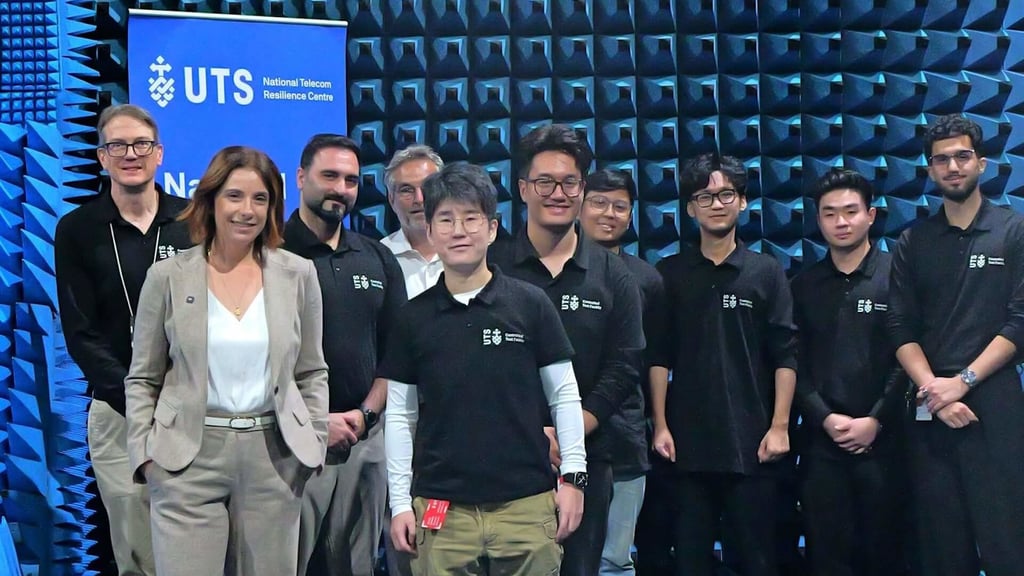
On 5 May, Communications Minister The Hon Anika Wells MP visited UTS Tech Lab to see the CTF and meet the team. During the visit, the Minister observed live cross-network emergency call testing, inspected the NTRC shielded test chamber, and was briefed on the research programme by the engineering team and student researchers.
Professor Andrew Parfitt, Vice-Chancellor and President of UTS, praised the significance of the facility.
“This is exactly the kind of work a university of technology should be doing – research that addresses a real national need, conducted independently and trusted by industry and government alike,” he said.
“I’m proud that UTS is the home of this capability and that our researchers and students are contributing to something that directly protects public safety.”

News
Schoolies starts this week – six things young people can get wrong about safety
While Schoolies can be great fun, it’s also a time of increased risk.

News
The Carbon Bubble Question: How Much Are Fossil-Fuel Companies Really at Risk?
New research challenges assumptions about the financial risks of the energy transition and offers important lessons for policymakers, companies and investors.
News
Rethinking wellbeing: Coaching for collective and ecological flourishing
A new approach to coaching looks beyond personal wellbeing to consider how collective and ecological flourishing can become part of what it means to thrive.

News
Women behind bars are giving birth in shackles and handcuffs
Shackling women during childbirth is a violation of human rights, but it is not banned in Australia.
News
Schoolies starts this week – six things young people can get wrong about safety
While Schoolies can be great fun, it’s also a time of increased risk.
News
The Carbon Bubble Question: How Much Are Fossil-Fuel Companies Really at Risk?
New research challenges assumptions about the financial risks of the energy transition and offers important lessons for policymakers, companies and investors.
News
Rethinking wellbeing: Coaching for collective and ecological flourishing
A new approach to coaching looks beyond personal wellbeing to consider how collective and ecological flourishing can become part of what it means to thrive.
News
Women behind bars are giving birth in shackles and handcuffs
Shackling women during childbirth is a violation of human rights, but it is not banned in Australia.