


- Posted on 25 Sep 2026
- 3-minute read
Recent strong flows in the Murray River may look like good news, but UTS researchers warn they mask a much deeper and long-running decline.
Key takeaways
- Recent strong flows after rain mask a long-term decline in Murray River health.
- Climate change is already reducing Upper Murray water levels before extraction pressures downstream.
- Declining flows threaten food, water security and communities, which should be reviewed with the upcoming Murray-Darling Basin Plan.
The Murray River is Australia’s most important river. Its water is shared by NSW, Victoria and South Australia for agriculture and horticulture, town water, recreation, environment, domestic and livestock, and hydroelectricity.
While recent strong flows in the Murray look like positive news for the river, new research (currently in preprint) by Dr Milton Speer and Professor Lance Leslie from the University of Technology Sydney (UTS) shows they mask a longer-term decline in river health and water availability.
“The Murray River may appear to be flowing strongly after recent rain, but the long-term picture is far more worrying,” said Dr Speer. “Our research shows climate change is already reducing river levels in the Upper Murray before the water even reaches the heavily managed and extracted sections downstream, with river levels not reaching the minimum level of 6 metres needed to allow water to flow beyond Waikerie.
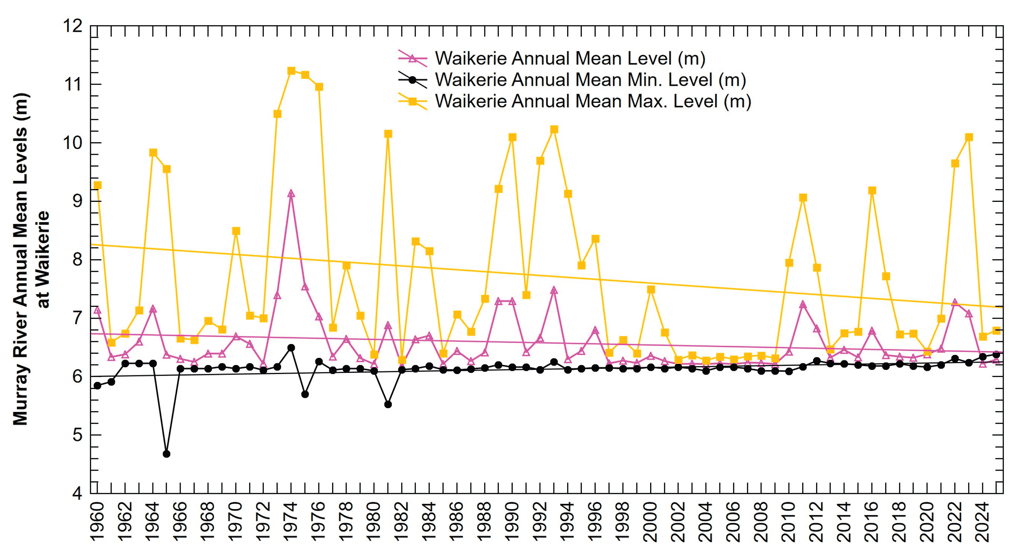
“This is not just a river management problem. The climate signal is clear in the Upper Murray, where there is little or no water extraction.”
The arid and semi-arid reaches of the Murray River produce almost 40% of Australia’s food. So declining river levels are not just an environmental issue, they are a food security and economic concern.
“The Lower Murray is particularly vulnerable because it sits at the end of the system, where climate change, water extraction and management pressures all converge,” said Professor Leslie. “Recent flows are welcome, but they do not reverse more than three decades of declining river levels.
“Our analysis points to a significant decline in Upper Murray River levels since the early 1990s, consistent with reduced rainfall,” he said.
“We need to stop thinking of dry years as isolated events. In the Murray system, climate change is reshaping the baseline.”
Maintaining river health while meeting growing water demand will require more effective and cost-efficient management practices.
As water demand grows – from irrigation, population growth and water-intensive facilities such as AI data centres – the pressure on the Murray system will only increase. While this is an issue that affects all of Australia, the immediate threat is to the local communities who depend on river water for drinking, irrigation, industry and local economies.
“This is also a water security issue for towns, farmers, Traditional Owners and industries that depend on the Murray River,” said Dr Speer.
The researchers say pressure is increasing on federal, state, and local government authorities to provide adequate environmental flows that can continue to meet supply demands.
“The upcoming review of the Murray-Darling Basin Plan is a critical opportunity to bring water policy into line with what is happening with our climate,” said Professor Leslie.
“Current water management arrangements are not delivering the environmental flows needed to keep the Murray River healthy.
“Maintaining river health while meeting growing water demand will require more effective and cost-efficient management practices.”
Researchers

Visiting Fellow, Faculty of Science

Visiting Fellow, Faculty of Science
News by topic

News
National First Nations College update
UTS has been working towards building a National First Nations College, an Indigenous-designed, culturally responsive residential community where students can...

News
Professor Catherine Kelly appointed Dean of Law
UTS is delighted to welcome Professor Catherine Kelly as our new Dean of the Faculty of Law.
News
AI improves long-term flood forecasting
Through the power of advanced artificial intelligence, UTS research could help communities get warnings weeks ahead of floods.

News
What can free‑living Indian street dogs teach us about how to care for pet dogs?
A study of how Indian street dogs live raises questions about what it means to care for pet dogs.
News
National First Nations College update
UTS has been working towards building a National First Nations College, an Indigenous-designed, culturally responsive residential community where students can...
News
Professor Catherine Kelly appointed Dean of Law
UTS is delighted to welcome Professor Catherine Kelly as our new Dean of the Faculty of Law.
News
AI improves long-term flood forecasting
Through the power of advanced artificial intelligence, UTS research could help communities get warnings weeks ahead of floods.
News
What can free‑living Indian street dogs teach us about how to care for pet dogs?
A study of how Indian street dogs live raises questions about what it means to care for pet dogs.