


- Posted on 28 Sep 2026
- 4-minute read
Even accounting for differences in hours worked, occupational choice, age and education, a substantial Indigenous pay gap remains.
Indigenous workers in Australia earn an average of 15.9% less per hour than all workers on average – or 84 cents for every $1 earned by non-Indigenous people – our research has found.
That’s equivalent to working almost two months of the year for free, or like losing more than all your employer’s compulsory superannuation contributions (typically 12% of people’s income).
Looking at average annual incomes, Aboriginal and Torres Strait Islander workers earn around $15,040 less per year than all Australian workers.
Our analysis of 227 occupations revealed where the Indigenous pay gap is greatest, what lies behind it, and what more can be done to close it.
Indigenous women pay the price twice
The Towards Indigenous Pay Parity study drew on data of about 10 million Australian workers from Jobs and Skills Australia’s Gender Economic Equality Study. The dataset covered more than 80% of both Indigenous and non-Indigenous workers in 2022-23.
The widest pay gap we found was between Aboriginal and Torres Strait Islander women and all men, where there was a 21% difference in hourly average pay.
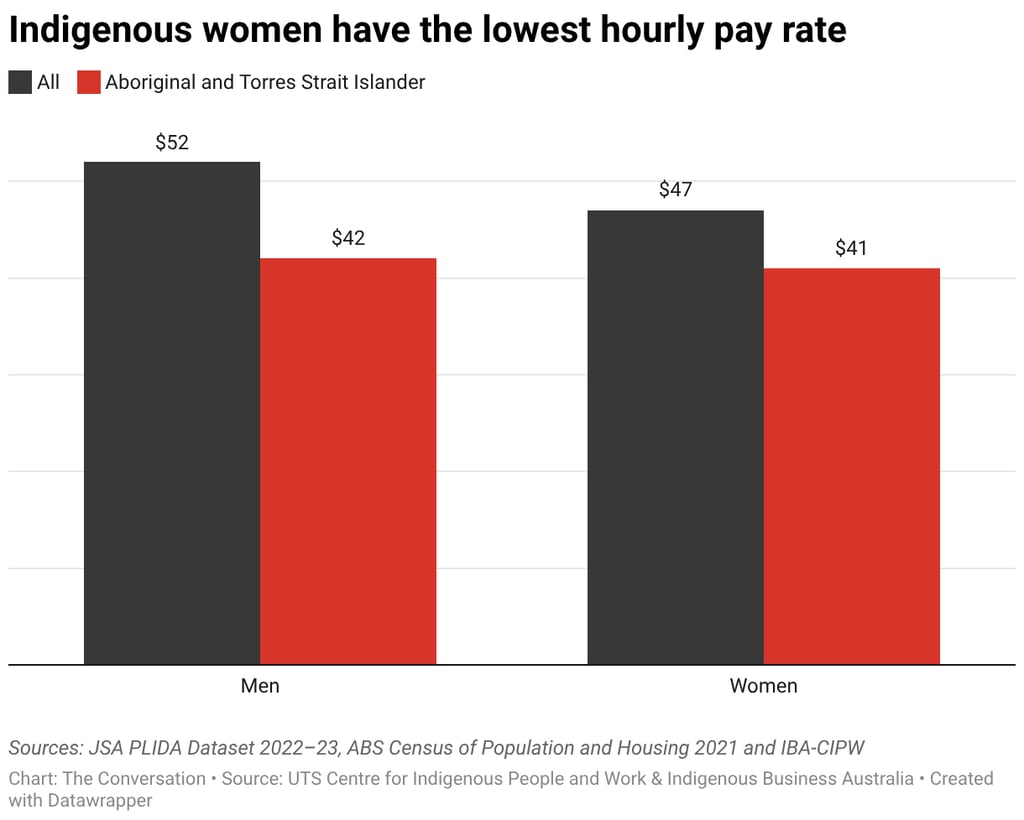
Aboriginal and Torres Strait Islander women face compounding pay disadvantages: lower hourly wages, less representation in higher-paying jobs, and fewer working hours.
The pay gap between Aboriginal and Torres Strait Islander men and all men (18.4%) exceeds that between Aboriginal and Torres Strait Islander women and all women (12.5%). This suggests that Indigenous identity is a proportionately greater source of the gap than gender alone.
Who else faces big pay gaps?
The largest pay gaps are found in higher-skilled occupations, particularly among professionals and managers.
Indigenous professionals, including tech sales professionals and pharmacists, earned about 80 cents for every $1 earned by all workers, on an average hourly wage basis.
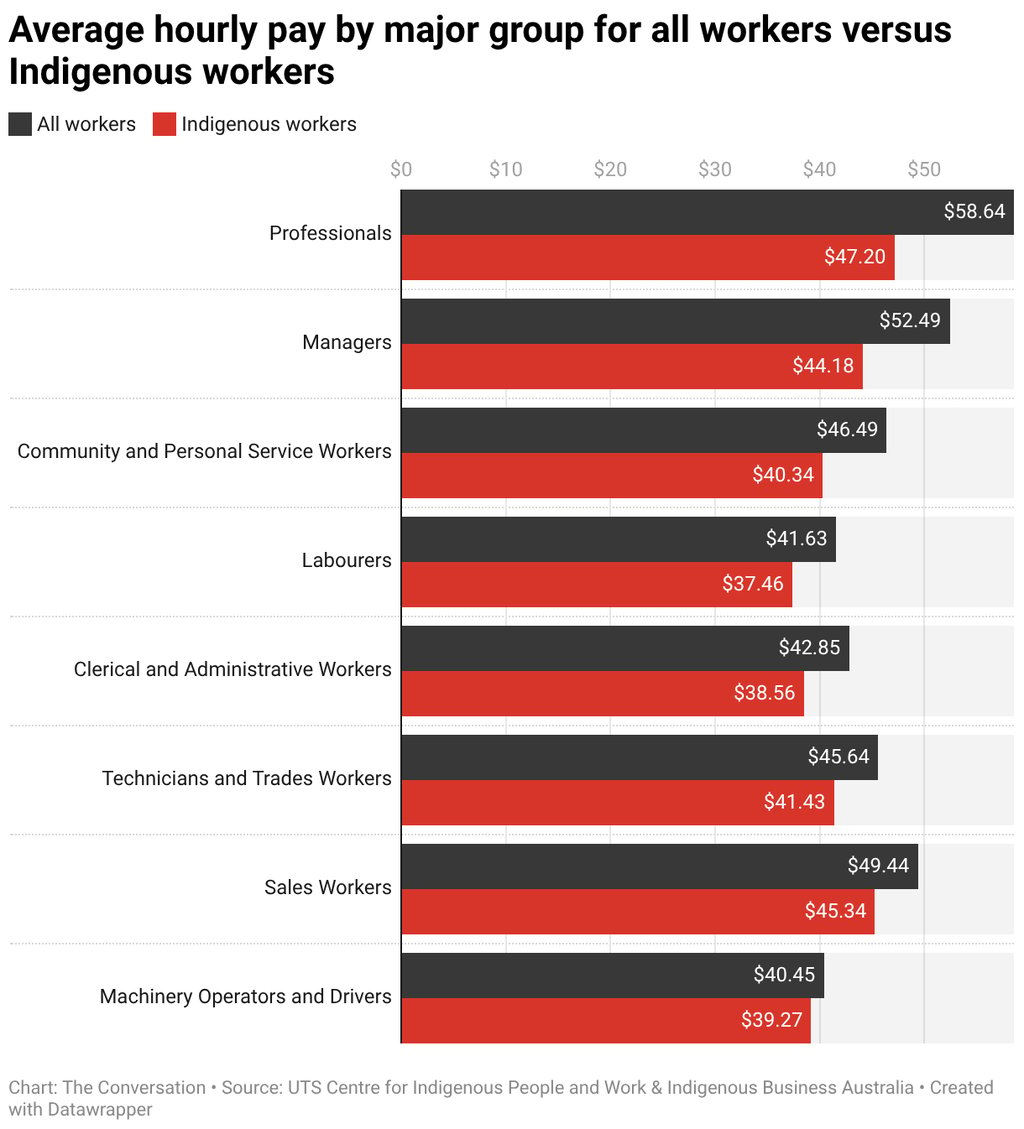
For example, Aboriginal and Torres Strait Islander professionals earn $83,847 a year on average, compared with $106,911 for professionals overall. That’s despite working almost the same hours (34.2 average weekly hours versus 35.1 hours).
This is particularly concerning, as professional and management roles are projected to account for almost 41% of all jobs by 2033.
And it matters most to women, with 17% of Aboriginal and Torres Strait Islander women workers in professional occupations.
Five recommendations for change
Even after we took into account differences in hours worked, occupational choice, age and education, a substantial Indigenous pay gap still remained.
Only 27% of the average hourly pay gap was due to Aboriginal and Torres Strait Islander workers being concentrated in lower paid jobs. And hours worked account for just 2%.
We concluded the majority (about 70%) of the pay gap likely reflected other structural factors, including racial bias in human resource practices, unpaid cultural work and inflexible workplace practices.
Structural problems require structural solutions. Our findings point to five recommendations for change.
1. Treat racism at work like sexism
Australia’s racial discrimination laws mostly rely on workers speaking up after racism has happened. That puts the burden on individuals and does little to stop problems before they occur.
Employers should be required to take active steps to prevent racism. This “positive duty” already exists to prevent sexism. The federal race discrimination commissioner recommended this reform two years ago.
In the case of addressing racism at work, this would mean regularly reviewing recruitment, pay and promotion practices, and fixing unfair outcomes early.
2. Publicly report job and pay outcomes
Since 2024, Australia’s Workplace Gender Equality Agency reporting framework has helped shine a light on inequality between men’s and women’s pay, and driven crucial change.
The latest 2026 report showed the gender pay gap is closing, down to about 12.7% in 2024-25 – and the public spotlight seems to be helping.
Yet, there is no comparable national reporting of Indigenous employment and pay outcomes.
3: Pay for workers’ time and expertise
Many Indigenous employees contribute valuable cultural expertise by mentoring colleagues, advising leaders, supporting reconciliation and building community relationships.
Yet, this work often sits outside job descriptions and goes unpaid. Employers should recognise cultural responsibilities in workloads, roles and remuneration, just like any other workplace skill.
4: Focus on career progression and leadership
Creating Indigenous pay parity requires ensuring Aboriginal and Torres Strait Islander workers have access to more senior, better-paid roles – not just entry-level employment.
5: Make work and leave more flexible
Many flexible workplace policies are built around non-Indigenous ideas of family and care, which don’t reflect the realities of many Aboriginal and Torres Strait Islander peoples’ lives.
Designing flexible work and leave arrangements for Indigenous employees, including recognising responsibilities such as kinship care and Sorry Business, will mean Indigenous employees aren’t forced to cut back their hours, pass up promotion opportunities or leave jobs altogether.
Surveys of Indigenous workers consistently show they want workplaces where they can contribute, advance their careers and thrive.
They should not have to spend their careers navigating barriers others don’t face – including earning less on average for every hour of work than other Australians.
The authors would like to thank Dr Siddharth Shirodkar and Ian Krakouer from Indigenous Business Australia as co-authors on this research.
Authored by

Associate Dean (Indigenous Leadership And Engagement), Business School

Professor, Deputy Vice-Chancellor (Education and Students)

Researcher (Indigenous Policy), Deputy Vice-Chancellor (Education and Students)
The Conversation
This article is republished from The Conversation under a Creative Commons license.
News by topic
News
Research puts resilient infrastructure on solid ground
Groundbreaking $24 million research centre will develop sustainable technologies that stabilise the foundations underpinning major infrastructure.

News
UTS researchers develop new AI tool to better predict stroke risk
New AI model analyses DNA to identify genetic risk factors for stroke, paving the way for more personalised prevention and treatment.

News
National First Nations College update
UTS has been working towards building a National First Nations College, an Indigenous-designed, culturally responsive residential community where students can...
News
After neoliberalism – what comes next?
A Trump-led post-neoliberal world order, dominated by four or five powerful nations, could dismantle decades of international cooperation in favour of...
News
Research puts resilient infrastructure on solid ground
Groundbreaking $24 million research centre will develop sustainable technologies that stabilise the foundations underpinning major infrastructure.
News
UTS researchers develop new AI tool to better predict stroke risk
New AI model analyses DNA to identify genetic risk factors for stroke, paving the way for more personalised prevention and treatment.
News
National First Nations College update
UTS has been working towards building a National First Nations College, an Indigenous-designed, culturally responsive residential community where students can...
News
After neoliberalism – what comes next?
A Trump-led post-neoliberal world order, dominated by four or five powerful nations, could dismantle decades of international cooperation in favour of...