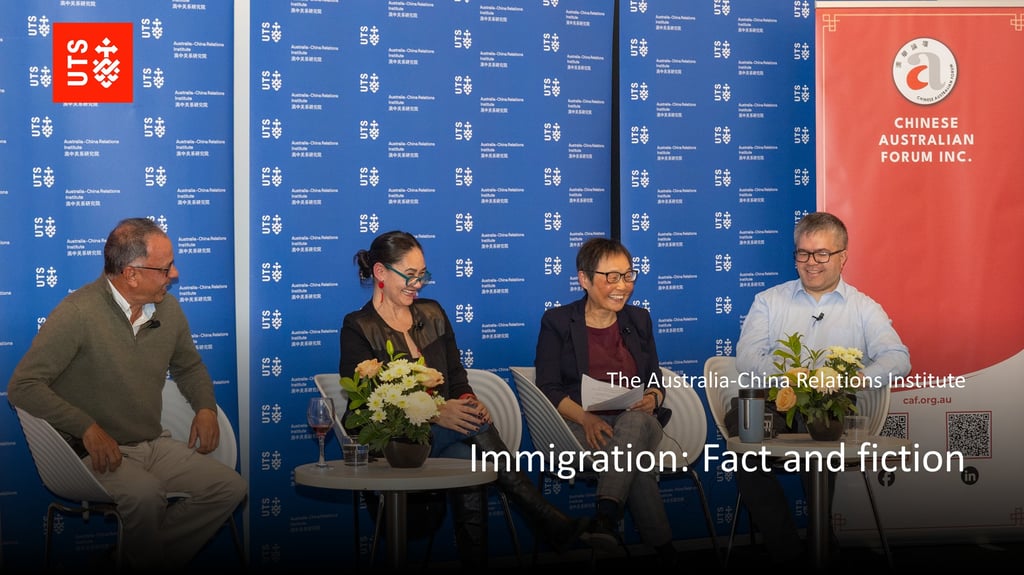
Video thumbnail - immigration fact and fiction
(01:15:49)

Immigration: Fact and fiction

August 18 2026

UTS Business School

E&OE | Check against delivery


Associate Professor Vanessa Chan:
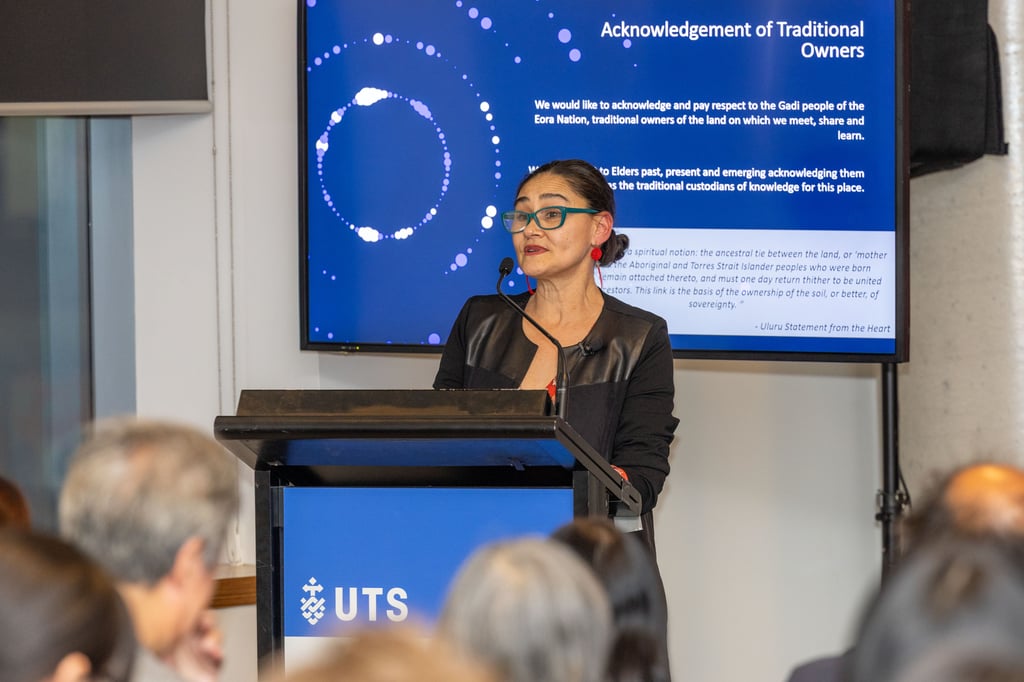
Thank you all for coming out on this wintry, cold, crisp evening. We are delighted to see so many people here with us. I'd like to begin by acknowledging that we are meeting here today on the lands of the Gadi people of the Eora Nation. I pay my respect to elders of yesterday, today, and tomorrow, and to all First Nations people who are joining us. In any discussion about culture, community, place, and belonging, it's really important for us to lean into the experience and knowledge of our First Nations peoples. We recognize that this land, Australia, was never ceded.

Thank you for joining CAF, the Chinese Australian Forum this evening to talk about immigration, the facts, the fictions. My name is Vanessa Chan. I am the president of the Chinese Australian Forum. Our organization is over 40 years old and works to promote the active engagement of Chinese Australians in political and public life. We've been active on issues impacting and of interest to our communities, and joined up with others in promoting and nurturing multiculturalism. We are delighted to be partnering with ACRI, the Australia-China Relations Institute here at UTS, to explore the current immigration debate.

I would like to extend a welcome to the leaders from the very many Chinese Australian community organizations that are here with us tonight. I would like to acknowledge Jason Yat-Sen Li, MP, the member of Strathfield, who is joining us. He is also a former president of Chinese Australian Forum.

I would like also to welcome Nancy Gordon and Nahoom. Nancy is the new CEO of the National Foundation for Australia-China Relations. Welcome, welcome. I would like to welcome Simon Chan, who is the interim chair of the Australian Multicultural Council and chair of the New South Wales Multicultural Advisory Board. I want to say... I would like to actually also acknowledge that we have with us tonight, Philip Ruddock, who is a former and the longest-serving immigration minister in Australia. We've got Benjamin Chow and I didn't see Helen, but I know that she had booked to come in, two of the founding members of CAF. And I wanted to acknowledge them, as I do also want to acknowledge the wonderful Daphne, who is the president of the Museum of Chinese in Australia, MOCA, a wonderful asset to our community and a fabulous meeting space. So welcome, welcome.

And of course we will be having James. I want to say thank you to James Laurenceson, the Director of ACRI, the Australian-China Relations Institute, but he'll be joining us up on stage a little bit later.

The Chinese Australian Forum was established in the mid-1980s and was established in direct response to the Blainey Debates. The claims that immigration was leading to our Asianisation, turning the former White Australia policy inside out. So for those of us who remember these times and experience the very real impacts at the neighborhood level, it's all feeling unnervingly familiar at the moment. Australia has grown and changed since the Blainey Debates. The targets for now, for just now, might be different, but we have been here before.

So tonight we're going to explore the current immigration debate, one of the most significant political and public policy issues facing Australia. As net oversees migration, housing pressure, and the questions of social cohesion continue to dominate our headlines and our discussions around the dinner table, how much of the rhetoric is actually borne out by experience and the data? And how are we as Chinese Australians in our community represented within this debate?

So to help us with this very ambitious task, I'd like to introduce you to three fabulous people. Dr Abul Rizvi is an independent Australian columnist and the former Deputy Secretary of the Department of Immigration. He was awarded the Public Service Medal and the Centenary Medal for Services to the Development and Implementation of Immigration Policy. In particular, the reshaping of Australia's intake to focus on skilled migration.

My dear friend, Professor Wanning Sun is the Deputy Director at UTS ACRI, the Australia-China Relations Institute, and a Professor of Media and Communication Studies here at UTS. Wanning has been a fellow of the Australian Academy of Humanities since 2016, has been a member of the Australian Research Council's College of Experts, and pretty much most of us follow her on Crikey.

Osmond Chiu is a Research Fellow at the Per Capita think tank. He's worked in policy roles for over a decade and has written for The Guardian Australia, Sydney Morning Herald, The Canberra Times. He's served as a reference group member for the Commonwealth Government's Multicultural Framework Review, and has previously been recognised as one of the 40 most influential Asian Australians under 40 for his work in the public sector and government. Would you join with me in welcoming them?

Associate Professor Vanessa Chan:
Abul has beaten me to the punch. We're going to start the session today. I'm going to ask each of the panel panelists for some opening remarks. And those opening remarks I thought we might frame around why should the Australian Chinese community, the Australian community more broadly, be awake to the current immigration debate? And Abul, I'm going to start with you and that means going forth.

Dr Abul Rizvi:
Great. Thank you. Okay. I'm fairly accustomed to public speaking. I've done a lot. But this is unique for me. I have never spoken from the stage whilst my former minister is in the audience. It's always been the other way around. So forgive my nervousness about the current situation. It's not easy speaking when he's in the audience. He will correct me as he frequently did.

So the topic I want to address is very much linked to what Vanessa said, which is why has anti-immigration sentiment in Australia increased so significantly? And Vanessa pointed to many instances in our past when anti-immigration sentiment has increased. But what we're experiencing today is quite unlike the Blainey Debates. It's very, very different. The level of anti-immigration sentiment is nothing like we have ever had before. And we need to understand why before we can answer the question, what are we going to do about it?

My hypothesis is that the anti-immigration sentiment has been driven by three factors. The first is that there is a perception, whether it is an accurate perception, whether it's factually based or not, really doesn't matter, but there is a perception that the government has lost control of the intake. And that is unusual in our history. It is very rare that the Australian public has had the view that we've lost control of the intake. There may have been views about the intake and about how we were managing it, but we've never or very rarely been in a situation where the Australian public has felt the government has lost control of the intake.

The second reason I think the anti-immigration sentiment has increased is because the Labor government, and to some degree the coalition government before it, had ceased explaining to the Australian public why we have a migration program. Why it is good or bad. Why should we have it? What are the merits of it? What are we trying to achieve?

Very rare now to have an immigration minister stand up, as Philip Ruddock used to do, and explain immigration policy. Now, you may have agreed with him or not agreed with him, but every year he'd travel around the country for three months in town hall meetings and explain immigration policy to anyone and everyone who wanted to come. And anyone could ask a question. Not just journalists, anyone could ask a question. We don't do that anymore. In fact, it was only a couple of weeks ago that Tony Burke was scheduled to speak at the National Press Club to explain immigration policy to us, which I thought, "Well, that's a fantastic development. It is great that the minister will explain immigration policy to us." Sadly, that thing's went awry and he postponed. Not a great outcome. Not a great look. But apparently he will at some stage explain immigration policy to us, which will be a good thing. But up till now, certainly for the last decade, we've had a vacuum. Immigration ministers don't speak to us about the merits of immigration.

The political strategy apparently is, the less you say about immigration, the better. And that way no one will ask us a question about it. In my view, that is a fundamentally flawed strategy. We are a multicultural nation. If you are not going to explain immigration to the Australian public, we're just headed down the wrong road.

The third problem is that having left that vacuum, any number of people are happy to fill that vacuum. Sometimes with facts, often with myths, conspiracy theories, all sorts of rubbish. I don't want to make this into a party political thing, especially as the former minister's here. But a few months ago, the Liberal Party put out a press release saying net migration was around 500,000 and rising rapidly. That's just a few months ago. The Liberal Party put out such a press release. It was wrong as much as you could imagine. It was complete rubbish.

In my day, a minister would've come out and said, "That's complete rubbish. That's not true. The Australian Bureau of Statistics data does not say that." Did the government do that? No. Quiet as a church mouse. Not a thing to be said. No, no. Just a Liberal Party press release that's completely wrong. What's the problem there? No, that's not how we should be working. We have, as I said, had many periods in the past when anti-immigration sentiment could have taken off. And I should have added the Blainey Debates there, but I forgot that one. But there have been many. But never, never has anti-immigration sentiment increased like it has.

The other thing that's increased is anti-student sentiment, anti-overseas student sentiment. And you can see students contribute a very substantial portion to net overseas migration. There is nothing wrong with that. In my view, that's a good thing, but it does have to be managed. And as you can see, in '22, '23, it increased to a level that was quite astonishing. And there were questions about, well, how do you manage the flow-on consequences of that? And we had no one in government explaining that. In fact, when the Treasurer was asked the question, "What has happened with this massive explosion in net overseas migration?" He said, "Oh, we don't have a target for net overseas migration. Net overseas migration, we don't have a policy on that." And I thought, "Well, if the government doesn't have a policy on it, who's managing it?" The answer it turned out to be, nobody.

Labor's position on managing net migration has not been good. It started with in '22, '23, we don't have a policy on that. I can tell you, my former minister would never have said that. In '24, '25, they started tightening policy on overseas students in particular to bring net migration down, but they did not say we have a target for net migration. They did not say our objective is to reduce net migration. They just started a haphazard array of policy tightening, which brought net migration down. Then in 2025, the current minister said, "There is no magic number for net migration." That means there's nothing to manage if you've got no number. He said, "We have no long-term plan for migration because that would reduce the government's flexibility." Well, you could say that about any long-term plan. I mean, why would you bother having a long-term plan at all if you thought it reduced your flexibility?

In 2026, the Prime Minister at last made a public commitment to a net migration target of 225,000. Now, whether you agree with the target or not is, in my view, irrelevant. The fact is he came out with a target. That is a first step towards actually managing to the target. If you don't have a target, there's nothing to manage to.

The government introduced a plethora of changes to reduce student numbers. Some of the ideas were good, some of them were not so good. The current situation is the government is trying to manage the number of students through the application of a highly subjective criteria called the Genuine Student requirement. And it has massively increased the refusal rate as a means of managing the numbers. That is an unsustainable way of managing the numbers. You cannot do that. You cannot have huge refusal rates on subjective criteria and expect the system to keep working.

So Labor now has a target, which is good, but it won't explain why the 225,000 is the right number. We don't know. I don't have a problem with the number, but it would be good if the government said, "And here is why the number is the right number." But at least they have a number. They won't explain how they'll get to that number. Mr Burke threatened to do that at the National Press Club, but has now declined. And hopefully someday he will. They won't explain how they will deal with massive backlogs, including in the partner visas, bridging visas. They won't explain what they're going to do about a huge backlog of unsuccessful asylum seekers. And they won't explain what they'll do about the massive bridging visa backlog. I'm hoping one or two of those things may be explained by Mr Burke when he attends the National Press Club. I don't set a very high bar. One or two I would be happy with.

From a student visa policy perspective, and student visas are important. We are in a place where students are important. They are 40% of net overseas migration. They are important. Don't let anybody tell you they're not. They haven't explained what their plans are for student visa policy, and they continue to make haphazard ad hoc policy changes that don't help us.

Coalition policy. Well, the coalition policy is we'll wait and see how many houses are built and then we'll tell you what net migration should be. Imagine being in the building industry and you're told, "Look, you just go and build as many houses as you can, and then we'll let you know how many potential buyers for those houses there might be." I think someone might say you've got the cart before the horse, haven't you? We should have a net migration target that is based on our long-term future and how it is good for Australia, why that target is good for Australia. You then let the building industry, infrastructure, service delivery, and all of those people, including businesses, plan to that target. You don't say to them, "Do what you like and we'll tell you the target afterwards." Just bizarre.

We have One Nation policies. Well, I'm only going to talk about this week's policies because they're different to last week's policies, and they could well be different to next week's policies. But let's just talk about this week's policies. So they have an infatuation with a particular number, and that's 130,000. In their website, if you went and visited their website, it would say, "We're going to limit visas, undefined, to 130,000." When I read that, I thought to myself, "Well, we issue about eight million visas a year. Which visas are we talking about?" There is zero...

Dr Abul Rizvi:
... which visas are we talking about? There is zero explanation of that on the website. Okay. I encouraged a few journalists to ask some questions and eventually Pauline's media advisor said, "Oh no, the 130,000 relates to permanent migration visas," which currently add up to a bit over 200,000. So this has all got to fit within 130,000. "They relate to skilled temporary visas and all student visas. If you added all those up, you come close to six or 700,000. So they're going to squeeze 130,000 into 600,000." I thought, "Oh gee, it's not easy. We'll see how that works." Anyway, that was where it was.

A week later, Pauline was interviewed on the media and she said her target is yes, 130,000 visas undefined, but net migration of negative, negative 100,000. I thought, "Gee, how are you going to get to that? That won't be easy."

Eventually, a bit later, she said, "No, no, no. The 130,000 relates to permanent migration." I thought, "That's easy. That's interesting. How do you reconcile that with your negative 100,000 net overseas migration? The two don't reconcile. They don't come anywhere near each other."

So this week she said, "No, no, no. It relates to 130,000 net migration." So we've now had four different interpretations of the one number. They like 130,000, but they just won't say 130,000 what? But it doesn't really matter because next week will probably be different anyway.

130,000 visa cap would be just a disaster. I won't go through that. There are some basic questions on immigration that you should ask any politician who talks on immigration. First, what's your long-term net migration target? Why did you select that target? Did you just pull it out of thin air? 130,000 is a good number. Let's have that one. How will you deliver that target? Which visa policies will you change? Do you know what a visa is? Listening to Pauline, I'm not quite sure.

What are the consequences? And what are the consequences for a range of things? The next time a politician stands up and tells you that they have an immigration plan, just ask some of those questions. And if they answer just one of them, you'll have been very lucky. Thank you.

Associate Professor Vanessa Chan:
I'm going to head over to Wanning for some opening remarks and talk to us about why we should be caring about this right now.

Professor Wanning Sun:
I was going to say that we need to be awake to this issue because it's extremely demolishly complicated. But after Abul's talk, and I think we can just all go home now. There's really not much else to say. I think you did really well, even though your boss was in the audience. My boss was in the audience too, and I'm just as nervous as you are. But you mentioned three points, so I better mirror that three points. And basically what I'm going to say is really a roundabout way of reinforcing what you're going to say, except that I use probably different language.

The first thing I want to say is this whole discourse or the rhetoric about debate on immigration. I think that the debate has become so much more complex than say 1990s. Look, immigration is never off the table. It's always on the table. But if you look at each decade, it's different circumstances. If you look at the 1990s, that was because when the unemployment rate was really, really high. But now unemployment is not an issue.

So yet, as you said, immigration debate has become much more sort of complex and evolving than before. Why? And how? First of all, let's look at the rhetoric of it. Abul, you talked a lot about numbers. And you're obviously a facts man, a figures man. But it seems to me that the whole debate about immigration has gone through a very interesting trajectory. For the people who really care about facts, and you talk about numbers, and you talk about just how many, in which categories, it was an economic kind of argument about whether it's good for the Australia's economy or not and in what category people come and what kind of visa it is. But then it didn't take long for the economic argument to move on, to morphed into a debate about housing or about cost of living. So before we know that, we know the rhetoric about the more migrants coming in, they're taking up our housing. Renting has become a lot more expensive and they're competing for our public service provisions, so on and so forth. So that kind of changed into a housing kind of cost of living issue.

But it didn't stop there. And then he wanted to morphed into something else about what kind of migrants should we let in. So it's really, then you hear Angus Taylor, for instance, talking about, "Oh, we should really only letting migrants from good countries." It's about now we're making a judgment about the quality of migrants. And then for instance, the one who was speaking to the media and he was asked, "Which country are bad countries? Is China a bad country? Is China a bad country?" David Spear asked him four times. He just didn't want to sort of mention the word. But obviously in his mind, there are good countries that have good migrants and they're bad countries and we shouldn't let the migrants come in. So it becomes a debate about values.

And then again, morphed into a debate about is multiculturalism still working or not in Australia? As Pauline Hanson is saying, multiculturalism hasn't worked and we should have monoculturalism. So we have too many migrants. It's not working. And finally we are going up to another level that we're asking questions as to who is an Australian? Are migrants here Australian or not? So it becomes a question about national identity. What does it mean to be an Australian? What about someone from Muslim countries? Because Pauline Hanson keeps telling us there's no good Muslim, right?

So obviously you can see this layers of layers of rhetoric and discourse overlapping with each other, informing each other. And as a result of that, it just become an issue that is so complex and so multifaceted and so dynamic. And depending on where you stand and who you are, you think you have an opinion on this. So that's the first point.

The second point I want to look at is the politics of the debate. As Abul mentioned that a lot about it is not just about facts, it's about perception, right? So again, as I said, sure, immigration is never off the agenda. It's always a hot debate. But you look at the current sort of situation, if you got to ask, is this just an Australian situation? No, of course it is not. It has a lot to do with the ascent of the right wing populism. You have the Trump factor. Trump got elected based on his anti-immigration sort of platform and policy. And in UK, you've got Farage who also sort of made a big deal about immigration. And Australia is really not immune from this global right word shift, if you like. Lurch, the right word lurch, if you like. And then we have Pauline Hanson. And then she and her One Nation Party obviously quite rightly sort of figure out immigration is a hot button to press. It's something that's worth exploring in order to get support.

So as a result of that, you have what I call a daisy chain of reactions from different parties. Because of Pauline Hanson's retched up rhetoric, then the coalition had to think, "Oh, we have to think about how we're going to position ourself." First of all, to differentiate ourself from the One nation. And then to think, "Oh, maybe if we can't beat them, we should join them. Or maybe we should actually just use their language instead." So the coalition had to somehow adjust its policy, its rhetoric, and sort of in response to the increasing popularity of One Nation.

And Labor is not outside its daisy chain because Labor has to consider we want to continue to have a big majority mandate. We don't want to lose votes to Pauline Hanson, but we've got to address the public grievances and discontent. And so if we actually continue with our immigration policy, that's probably not going to go down well for us. So we've got to adjust as well in relation to what One Nation has saying, in relation to what the coalitions are saying, but at the same time, achieve policy differentiation, so to speak. So can you see this is kind of a chain of reaction, if you like? So that's the second thing. That is the politics of it.

The third point I want to talk about is the public perception of it as Abul just talked about. There's a lot about it. It's the perception and the role of the media in shaping the public opinion in this debate. Lowy Institute regularly puts out data regarding the level of support, Australian public's level of support for immigration. And their data have consistently told us that the people who tend to be more supportive of immigration tend to be people who are younger or younger, better educated and live in urban areas. And those who are critical of migration or worried about do we have too much migration tend to be in a regional area, less educated, and older in age. Which I think is kind of ironic because in regional areas, it is the migrants, the skilled migrants that propped up our medical service. And it is also ironic because in a nursing home and aged care, it's staffed by migrants.

And it's interestingly also quite ironic that the urban young people who are much more relaxed about migration. In fact, if you buy into the rhetoric of they're taking up our housing, they're competing for urban resources. They are the one that actually stand to... You think they would be more worried about it. No, they're much less worried about it. So it is really, really interesting.

So you've got to ask why? Why despite all these sort of contradicting factors that is continued to be such a sort of a salient sort of topic? Well, one of the reasons I would say is media. Because media is not just there to reflect the facts and numbers. I know, Abul you've done your very level best to educate the media and give them something to think about and some questions to ask. But at the end of the day, for different reasons, our media across the spectrum have not really played a leadership role in shaping the debate. Rather, it's actually following and chasing the culture movement and trying to find quotes from the politician that put more sensational bits of it into a headline, looking for a headline that have some joking sort of words in it.

So as a result of that, you have more and more kind of become more hysterical and the facts just become less and less relevant and the popular sense of the anxiety and the fear start to take hold. So almost become pathological. When a fear of something become pathological, they will stop listening to reason. So even if you have the numbers and the facts put in front of them, they're too historical to actually face it and actually be persuaded by it. So I think that kind of feedback loop between public opinion and the media and the politicians hasn't been a very good feedback loop. It's a vicious feedback loop. And that explains, I think, some of the problems that you have identified.

Associate Professor Vanessa Chan:
On that pleasant note, Wanning.

Osmond, why should we care about this issue?

Mr Osmond Chiu:
Yeah. Thanks Vanessa. I think at least for me, why this issue matters is because for me, my sense of political consciousness really started in the 1990s. So during the rise of One Nation the first time around. So to me, seeing Pauline Hanson reshaping the national conversation again is disheartening. These debates can shift what is considered acceptable in public discourse. And at least for me, knowing that history and seeing how it impacted on my own sense of self and belonging in Australia has made me think that this is a debate that we really have to grapple with. The subtext to it is the rise of One Nation, not just simply the rise in anti-immigration sentiment where there is a possibility that the party system in Australia that has existed for over a century may be overturned. So it's a complete rewriting of politics in Australia.

And for me, I think one of the real concerns I have is that these public discussions, particularly in an age where attention is the currency that politicians chase, you can see things shift really quickly. And for Chinese Australian communities, I think we saw how quickly things can change during the pandemic where it almost felt like overnight we became the targets. We experienced racism and exclusion and abuse. And it wasn't just something that happened in Australia either. The exact same thing was happening around the world, in the US, in Canada, New Zealand. Society's very similar to us. So for me, it just reinforces the importance of trying to understand what's really happening, the causes and not simply the symptoms.

And I think there is a danger whereby we respond to this migration debate by reacting because many of us who do support multiculturalism and support immigration sort of react almost innately to whatever Pauline Hanson has said. I think it's important to remember that a lot of people who are stating their intention to support One Nation, they're often doing it out of a protest, out of political dissatisfaction, not necessarily support for all of One Nation's views on immigration or race or multiculturalism. And it's problematic when we have these discussions to lump it all together, to lump in migration, multiculturalism and racism. And to respond effectively, we actually have to unpack where Australians actually stand. And those public attitudes are far more complex than the debate suggests. And I think you can have multiple views that some people in this room might find strange, but is the general view that many people in the community have that they both support far less migration as well as a multicultural society.

I think understanding those concerns are essential if we want to defend migration and multiculturalism, because I think the more you force people into very defensive positions, it's more likely they will double down even if they don't support everything entirely. So I think I wanted to put that context because I think that is the starting point for people who want to engage with this debate, who are concerned about the rise of anti-immigration sentiment and some of the attacks on multiculturalism.

Associate Professor Vanessa Chan:
Thank you. Thank you very much. Osmond, I'm going to stay with you and explore that a little bit more because we've talked about overseas students, housing, stress, cost of living. In fact, all three of you have talked about, the conflation of all of these issues into a package that then gets its own self-perpetuating momentum. Whether it's overseas students, housing, cost of living, infrastructure backlog, often these things, there's an underlying assumption around immigration. What are some of the other strategies that we can put in place to unpack that?

Mr Osmond Chiu:
I mean, I think it's important to understand that the reason why many people have that view, and understanding it doesn't necessarily come from racism. It comes from a story, a narrative that appeals to people's innate common sense, that people are experiencing real pressures and housing and cost of living. Having more people obviously increases demand, and that can be really hard to unpick. But I think we have to understand that not everyone who has reservations about migration levels are racist. Though, you can say that a lot of people who do like to talk and emphasize the problems of migration have another agenda, so I think making that distinction is really important.

Now, obviously migration adds to some demand, but it's not the main cause. There are a lot of structural drivers. We say with many of these issues that we're facing in Australia, you're seeing around the world right now with massive supply chain issues, the inflationary pressures that exist. So I think that is essential that we think about where people are at and use that as a starting point, if we want to have a genuine conversation about migration and to address those concerns.

Associate Professor Vanessa Chan:
A more sophisticated approach rather than the knee-jerk we're calling you out, we're calling you out, we're calling you out, an actual engagement and dialogue on the substance of the issues. Thank you.

Now, well, similar kind of discussion around complexity, but in a related area for Wanning, is COVID, overseas student numbers, the China threat, immigration, AUKUS. All of these issues, which also are hitting the headlines, which have huge currency in our political debate at the moment, puts China at center stage.

How is the Chinese-Australian diaspora placed and represented in the politics and media around these issues? We know we've currently got an open inquiry into AUKUS, a public inquiry into AUKUS.

Professor Wanning Sun:
Yeah. The Chinese-Australian communities are extremely diverse and complex. In terms of numbers, the latest, the last census tells us, and I suspect that that number might change a little bit when a new census comes out, is that we've got about 1.4 million people in Australia who identify themselves as having some kind of Chinese heritage.

Of course, there are different form of Chineseness. I mean, just looking at the three of us, we embody three forms or three kind of Chineseness. But having said that, on the whole, we do take up 5.5, I believe ... Abul, you are the numbers man. They're like 5.5% of the population, which is quite considerable. Given that Australia is one of the few democratic countries that actually have compulsory voting, the power of the Chinese voters is something that no political party, perhaps with the exception of One Nation, can afford to ignore. And so for that reason, it's important to look at the Chinese-Australian communities in the context of immigration.

But the Chinese Australians also face some very distinct issues that are not necessarily shared by other migrant communities. First of all is the geopolitical rivalry between the US and China, and the fact that Australia is caught in the middle. And then as a result of that, Chinese migrants, particularly the migrants from the PRC, and that they're quite considerable in number. We're looking at three-quarters of a million, right? In demographic terms, they are now a majority. They're caught in the middle. They're caught between China and Australia.

That geopolitical factor is something that other communities still face. Of course, other communities face other issues, geopolitical issues, but not this particular one. Australia is ... and China is Australia's biggest trading partner. A lot of Australia's economic prosperity relies on maintaining this stable economic relationship with China. At the same time, Australia is a staunch ally of the United States, which is at loggerhead with China. Can you see how delicate, what a tightrope that Australia is walking? The Australian-Chinese are caught in the middle of all these tensions.

China also happened to be one of the biggest source of migration to Australia, only overtaken by India in the last census. As a result of that, and also of the fact in eyes of a lot of public commentators and politicians, China is not necessarily the best good country for us to take migrants simply because they may not share our liberal democratic values because they come from authoritarian countries. Of course, China is also the largest, if not one of the largest, if not the largest, source of international students cohort. The temporary cohort. Is it 40% of the migration we're looking at? 

Dr Abul Rizvi:
Yeah. 40% migration. Yes.

Professor Wanning Sun:
See, I can do numbers too. And so international students, again, are almost always represented in our popular discourse as problematic. Problematic one way or another. There are either too many of them, which is a problem, or there are not enough of them, which is a problem too. Which is why recently you see all the number of Chinese international students dropped, causing problem to university's finance or our education export. But I just thought, "But hang on, but you are the same guys who actually complained there were too many."

So this, is it the number of the international students is always something for media to cover? Of course, they're also kind of discussed, international students discussed as, on one hand, a blessing because it's the largest source of revenue for Australian education export and to prop up the university's finance, so to speak, as the cash cows; the university's cash cows on one hand.

On the other hand, they are really, really making Australian universities vulnerable, making finance vulnerable, it makes its education quality vulnerable, and it's also letting a lot of students who don't share our democratic values, who are threatening our academic freedom, and who are causing problems in the classrooms. And they don't hang out with other people. They just stick together in groups. All this kind of narratives we see. Again, it's unique to the Chinese migrants, if you like.

I would say based on my own research, looking at the Chinese-Australian communities, particularly the first generation migrants from the PRC, I would say both the temporary migrants from China, like international students and the first generation migrants in Australia, have actually experienced a lot of political alienation, so to speak. Why? Because for the reason I've just outlined, the political atmosphere in which they find themself in.

In fact, you don't even have to be a mainland Chinese person to have your political loyalty called into question. Osmond's experience is a living example of that because he, together with other two Chinese Australians, was demanded by Eric Abetz to show your political loyalty by denouncing the Communist Party. That demand was not put to migrants of other communities. Right.

The Chinese-Australian community is also the cohort over which political parties tend to use to score political points, particularly during the election times. For instance, last time Labor did pretty well actually accessing, reaching out to the Chinese community, telling them how bad the coalitions have been, how racist they have been. But on the whole, I would say, some might say this is unfair, but my judgment is that the major political parties tend to see these communities as a community of voters or potential consumers, but not so much as rights-bearing citizens.

What do I mean by that? You mentioned AUKUS. Theoretically speaking, anybody who's got a problem with AUKUS and have a different dissenting view from the government of AUKUS can actually put in a submission, can write to the media and turn up in events like this and argue their case. But you will realize that the Chinese community has been very silent on this. Why is that? Because they have this worried about, "If I speak out and I look Chinese," and the government has already warned people that some diasporas may have been mobilized by foreign countries to push against argument against AUKUS. As a result of that, that has a very chilling silencing effect.

But that is really, really unfortunate because these Chinese Australians, like myself and a lot of people in this room, are Australian citizens. We have the right to participate in public debate. Just because my view may be different from the political parties doesn't mean that I'm working on behalf of some other country's. But that fear and anxiety is there. As a result of that, there is largely ... quite absent, and that's not really good for social cohesion. You mentioned social cohesion, if we use the word uncritically.

I just think that, yes, it is quite important to look at, to rethink about this community and less so from the national security lenses, and more so through the lenses of the citizenship and the public participation.

Associate Professor Vanessa Chan:
Thank you. Thank you. Osmond, in the current debate, and you referenced it was before we saw the intertwining particularly of discussions around immigration and multiculturalism. Can you talk to us a little bit about how we do that separation?

Mr Osmond Chiu:
Yeah.

Associate Professor Vanessa Chan:
The view with immigration is too high so multiculturalism isn't working.

Mr Osmond Chiu:
Yeah. I think that's an unfair conflation that has been happening in this migration debate. I think it does us a discredit to ignore the fact that most Australians have a more nuanced view about it. It may not be completely perfect, but it's far more nuanced, and it's shown up in some public polling. What I might do is I might actually just show you because I think it's important just to look at people's views over many years, so wanting to refer to Lowy Institute polling. I wanted to refer to ... There's three really great sets of public data on this issue from the Scanlon Foundation, from the Australian Election Study, as well as the Lowy Institute.

You can see that there has been growing concerns about immigration levels since 2022. But also, quite some time, there generally has been the view that there has been too much immigration in Australia. The view that migration has been too low has actually been a minority position for most of the time. You can see the Lowe Institute data that Wanning was referring to earlier. You see that uptick over the last few years.

But I think while there is this concern about migration levels and a belief that it's too high, there still is pretty broad support for multiculturalism and diversity. You can see that line up there, 80% plus, even if that's kind of ticked down. When you look at people's attitudes towards migration and immigrants, the idea that equal opportunity for migrants has gone too far, has gone down, as well as the idea that the number of migrants allowed into Australia has gone too far. These two beliefs that I think a lot of people see as contradictory are the common sense for a lot of Australians.

Now, the most recent Lowy Institute report suggested there was a downtick in support for cultural diversity. You can see that sort of big jump there. But even though there has been a decrease in people who think Australia's culturally diverse population has been really positive, it's still pretty big, 70% plus. I think if there's anything where you have 70% plus of the population believing this is a good thing, it's actually pretty rare. When you look into the data more deeply, that 20 to 26% who believe that it's been mostly or entirely negative, a lot of that cohort are the One Nation voters. Across all the other parties, there is majority support for a culturally diverse country now.

You have this situation where anxiety about migration levels can sit alongside positive views of diversity, that it's been a good thing. But I think one thing we have to be conscious of in this debate is that not all attitudes towards migrant groups and culturally diverse communities are the same. At an abstract level, while there might be support for cultural diversity, when you look at the Scanlon Foundation's data, you can see that migrant groups aren't viewed equally. I want to note that this is 2025 data, and I believe that the Scanlon Foundation's new report is coming out in the next few months, so I think we might see a bit of a deterioration.

When you look at it, you can see migrants from the United Kingdom, United States viewed pretty positively. And then if you go down, migrants from China, India, more likely to be viewed as negative than positive. And then migrants from Iraq or Sudan, fairly negative views. When you also look at attitudes towards people of different faiths, you have quite negative views towards people of the Muslim faith. I think that is the context to this debate as well that we have to be very mindful of. It's far more complex than a, while people may have a broad belief in a multicultural culturally diverse society, I think culturally diverse communities aren't all viewed equally.

Finally, I think we should also think about how this debate plays out internationally. We've alluded to the rise of far-right populism around the world. While we have those issues here as well, I think in a global context, particularly compared to Europe, we're still fairly pro-migration. I think that needs to be one thing that's kept in mind, that context that while we are facing problems, I don't think it's the same situation as in Europe. I think, at least in my mind, while we are having this debate and it is concerning, the evidence still points to a consensus, even though it is fracturing to an extent, for a diverse and multicultural Australia.

Associate Professor Vanessa Chan:
Yeah, agreed. Thank you. I've got an eye to time, so I think we'll just do ... I'm going to throw one more question to Abul. He can top and tail the panel discussion. I flicked it over him late this afternoon and said, "I'd just like you to solve it all for us." So the question for Abul is: What would a positive, sustainable, just, and future-focused Australian immigration policy look like?

Dr Abul Rizvi:
Well, I think Osmond has made clear that there is still substantial support in Australia for multiculturalism. I think with Mr. Ruddock in the room, we should also point out that my suspicion is, and whilst I have never seen data on this, I think most Australians still support a non-discriminatory migration program. I think that's right. Mr. Ruddock, of course, famously crossed the floor on that issue.

But it is not wrong for Australians to ask the question about levels. And I don't think it's wrong for Australia to ask questions about composition, not from a ethnicity perspective, not from a religious perspective, but in terms of what is good for Australia's long-term future. It's entirely appropriate for people to ask that question. And I think, ultimately, we need to have an immigration policy, whatever the targets are, are well-explained and that the government can demonstrably show that it is delivering according to its policy priorities. And it's a government that is prepared to explain those to Australians as if they are mature, intelligent adults.

Not, "What would you know? And we'll treat you like little children." I don't think Australians deserve that and I don't think that's what they want. One thing I did want to refer to, and part of that is also what we're seeing in the United States and in Europe. The reaction to immigration is partly related to that. But one thing we haven't mentioned here, and I'm sorry to get into economics, but many of you will have heard of the K-shaped economy. Think of a K on a graph and the upwards arm in the K are all those people who are doing wonderfully well in the stock market.

They're not as worried about immigration. There are then those people who are on the bottom arm of the K who are not so excited about immigration. Are they right to be concerned about immigration? Well, they're certainly told that the reason you're in the bottom part of that K is because of immigration. Is that true? There's actually very little evidence to support that view, even though the media will tell you every day of the week that it's immigration that's meant you're in the bottom part of that K-shaped economy. And I think the K-shaped economy is the big driver of anti-immigration sentiment, not just in the United States, but in Europe and in Australia. The question we've got to go to is, "What's creating the K-shaped economy?" Not, "Are immigrants good or bad?"

Associate Professor Vanessa Chan:
Thank you very much. Thank you very much. Mr. Ruddock, I'm about to open to questions and yours was the first hand up. Do we have some roaming microphones?

Philip Ruddock:
I'd like to ask Abul about the Australian position with migration in comparison to other countries. Our relative age, as I understand it, our average age is younger than most of the other countries that take migrants and most of the other countries in the region. And I understand that we are more prosperous because we have people coming with the skills that we need and that makes our economy stronger. Should we be arguing our comparative position with others having a larger immigration program that produces a younger population and a more prosperous population? I've got one mischievous question for you.

Professor Wanning Sun:
Is this for me?

Philip Ruddock:
Yes. I want to go to China. Can I take up Chinese citizenship? And would I have to forsake my Australian citizenship when I take up my Chinese citizenship?

Audience:
 Yes.

Philip Ruddock:
I'd just like to know.

Audience:
Yes.

Professor Wanning Sun:
Well, you got an answer. But that question he...

Dr Abul Rizvi:
Ah, the demographic question. I think Mr. Ruddock already knows the answer to this. But fundamentally, if you had net overseas migration of one person, just the one person, and the one person was the archetypal migrant, which is likely to be between the ages of 25 and 29, think about that one person and the age dependency ratio. The one young person effectively makes Australia younger. And so naturally the question becomes, "Well, why don't we have two?" And you can keep asking that question. Let's go to 3, 4, 5, 6, 8, 9, 10, and keep going. And you're right to say that makes Australia younger. Each additional migrant contributes to the younging of Australia's population by a marginally smaller amount.

So increasing net migration forever doesn't make you younger forever. There's actually a diminishing return. And so at some point, you will reach a level of net migration, which doesn't help you a great deal in terms of making us younger, but does put more pressure on infrastructure, service delivery, et cetera. And what you have to find is where the middle ground is, and that's the tricky bit. Professor Peter McDonald did some work about 15 years ago and suggested that middle ground was about 200,000. When he did that, our fertility rate was about 1.8, 1.9 children per woman.

Our fertility rate now is less than 1.5 children per woman. So I suspect if he did that work again, you'd end up with a number slightly higher than 200, but not a lot higher than 200. Because of a higher level of migration, since Mr. Ruddock was Immigration Minister, much of which was done because of a demographic dimension, Australia is amongst the youngest developed nations on the planet. And that's an advantage. Don't let anybody tell you-

Associate Professor Vanessa Chan:
Is an advantage.

Dr Abul Rizvi:
... young people aren't an advantage. As an old guy, I'm telling you, young people are good.

Associate Professor Vanessa Chan:
Do I have any other questions? 

Professor Wanning Sun:
Do you think I have a minute to answer Mr. Ruddock's question?

Associate Professor Vanessa Chan:
Oh, certainly.

Professor Wanning Sun:
Yes. I think it's a good question. Can you hear me?

Philip Ruddock:
I'm listening.

Professor Wanning Sun:
I'm sure you're doing that. I don't think China allows dual citizenship.

Philip Ruddock:
I expected that.

Professor Wanning Sun:
So a lot of Chinese people who come here and have forsaken their Chinese citizenship and become Australian citizens-

Philip Ruddock:
Many countries.

Professor Wanning Sun:
... as I have done more than three decades ago. And there are countries who allow dual citizenship. There are countries who don't allow. China is one of the country that don't allow. Whether you are going to be given Chinese citizenship if you go to China, I don't know. I suspect if you are willing to give up your Australian citizenship, I reckon you might have a go. Give it a try. But on a serious note, I would probably want to say that a lot of people who migrate from China, which is not a liberal democracy, and come to this country, one of the reasons they do that, of course, apart from admiring Australia's lifestyle and opportunities it offers, is the fact Australia offers political freedom and the rights in a way that they do not experience this at home.

So when they come here, they are fully ready and enthusiastic about participating in the democratic process. You would notice that if you see on election day, how proud and how enthusiastic these first-generation migrants participate as voters, as volunteers, and how enthusiastically they debated about the policies, pros and the cons of the party they prefer. And they really appreciated having these democratic rights and having this opportunity. I don't think you are suggesting, and I hope you're not, that just because they come from a country that's not liberal democracy, that they should be treated in a way in this country with less extent of rights. I don't think that's what you're suggesting, is it?

Dr Abul Rizvi:
No.

Professor Wanning Sun:
No.

Philip Ruddock:
I am responsible for Australians that have dual nationality.

Professor Wanning Sun:
Yeah. Well, I absolutely agree with you. Let's all lobby China to give dual citizenship.

Associate Professor Vanessa Chan:
Now, I'm actually only going to be able to take one more question and I apologise for that, but let's remember this debate is going to escalate. We are going to be having these conversations, all of us in our neighborhoods, in our families, in our communities over particularly the next two years in lead up to the federal election. So I'll take one more question and then I'm going to get James to wrap it up for us.

Speaker 1:
Thank you. I wanted to build on Vanessa's final question. And my question is, is there a sensible compromise to be had on immigration restrictions with opponents of high immigration numbers? Or would compromising itself play into the hands of opponents and thus not be a sensible course of action?

Associate Professor Vanessa Chan:
I'm going to let Osmond maybe speak about that.

Mr Osmond Chiu:
My personal view is that I think there is often an idea that we can have political consensus on a range of contentious policy issues. I think realistically, it's going to be messy and it's going to be shaped by a range of factors outside of people's control. And external events shape people's opinions all the time on a range of issues. My view is that if people have a sense of hope and security about the future, I think you can take some of the angst and some of the anger out of this debate. We're not all going to agree, but I think one thing that is lacking and that has driven a lot of this anti-immigration sentiment is this view that Australia's future won't be as good as its past.

Associate Professor Vanessa Chan:
Thank you. And I really do wish we could speak all night, but I'm going to have to get James to wrap it up for us. 

Professor James Laurenceson:
Thanks, Vanessa.

I'll just begin by saying it really is great to have the Honourable Philip Ruddock AO with us tonight because you probably know him as former Minister for Immigration, perhaps Attorney General, perhaps the Hornsby Shire Council up near where I live. But in fact, Philip had a far more important role after that. And that was for many years as the chair of the Australia-China Relations Institute Advisory Board. So a special welcome back to UTS, to you, Philip.

Look, it was really ACRI's pleasure to partner with the Chinese Australian Forum for this event tonight. I often tell people in shorthand terms, ACRI exists, our mission is to inject more facts and evidence into Australia's public discussion of relations with China. That includes the aspect of immigration, which of course extends back more than 200 years when the first Chinese migrant arrived in Sydney. Australia-China relations is about so much more than relations between Canberra and Beijing.

And I feel, after listening to that fabulous conversation tonight, we've well and truly injected more facts and evidence into the public conversation. And there needs to be, as you alluded to, Vanessa, more such conversations. At ACRI, we also do an annual poll of Australian public opinion. That's led by my colleague, Elena Collinson. And we put questions to the Australian public about the Chinese-Australian community. Some of their responses give me great encouragement. Others cause me great alarm. On the former, a super majority, 82%.

Osmond, you said 70% was good. I agree with you, but we've got 82% of Australians say that their views of Australians of Chinese origin and background are separate from their views about the Chinese government. Well, fabulous, they should be. On the other hand, our poll also finds that around 4 in 10 Australians agree with the statement that Australians of Chinese background can be mobilized by the Chinese government to undermine Australia's interests. Now that's despite Mike Burgess, the Director General of the Australian Security Intelligence Organization saying in 2021 that, quote, "99.9%," close quote, of our diaspora communities do not engage in foreign interference activities. So as I said, facts and evidence. We need more conversations like the one we've just had.

Let me finish by thanking Vanessa and our speakers, Abul, Osmond and Wanning. It's always a real pleasure to listen to experts and those with deep insights informed by extensive experience at the coalface. And thank you folks too for coming tonight. A particular thanks also to our people who put the logistics together. I'm thinking in particular of Shirley Gao from the Chinese Australian Forum. And just as importantly, Celia, my colleague from the Australia-China Relations Institute standing up there over at the back. And to our audience, on behalf of the Chinese Australian Forum and the Australia-China Relations Institute, thank you for coming. And we do hope you'll stay around and have another drink. Cheers.


Migration is once again at the centre of Australian political and public debate, but claims about migrant numbers, composition and impact are not always borne out by the data. As net overseas migration, housing pressures and questions of social cohesion continue to dominate headlines, how well does political and public discourse reflect the underlying facts? And how are Chinese-Australian communities, often a focal point in these debates, represented within it?

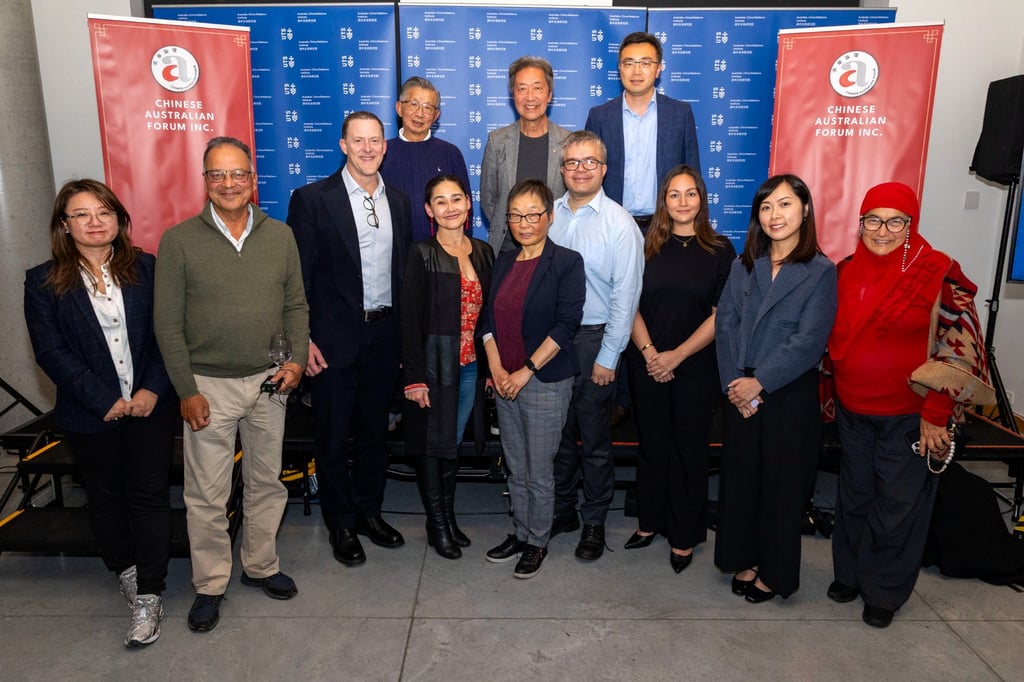
On August 18 2026, the Australia-China Relations Institute at the University of Technology Sydney (UTS:ACRI), in partnership with the Chinese Australian Forum (CAF) hosted an interactive forum exploring these questions. The discussion was followed by audience Q&A.

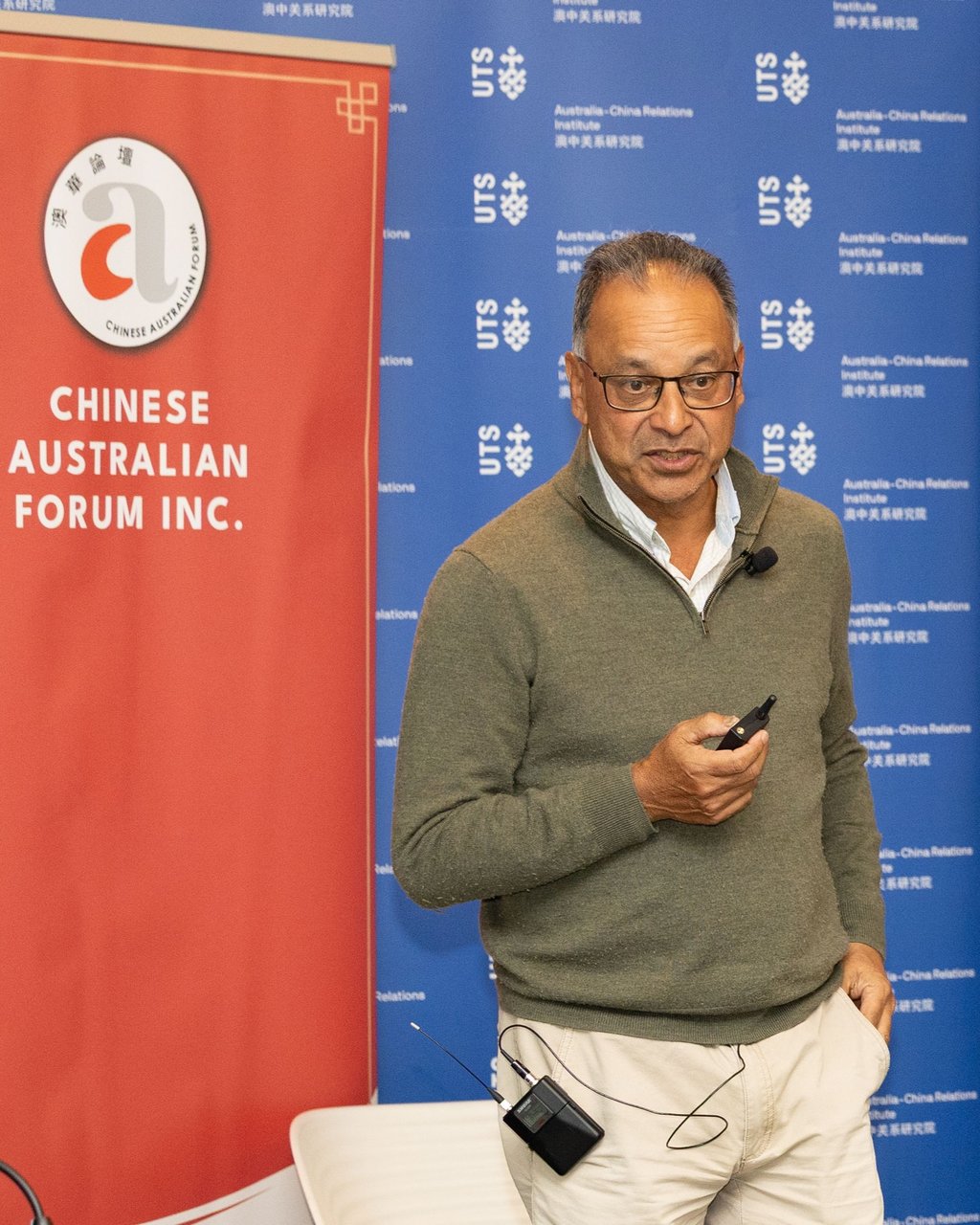
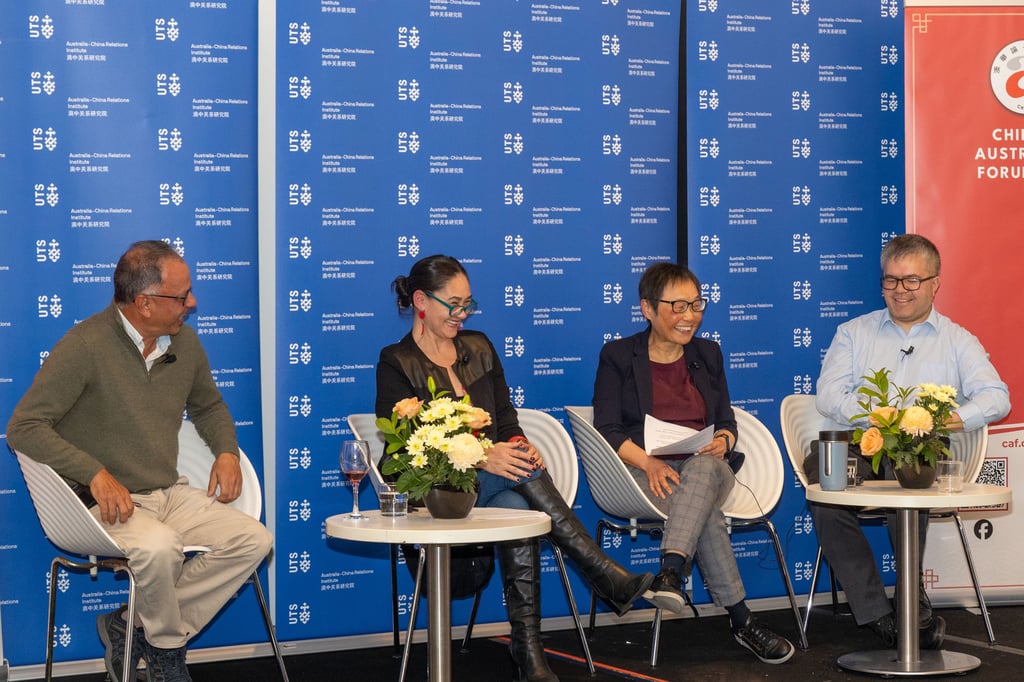
 Panellists included Professor Wanning Sun, Deputy Director of UTS:ACRI; Dr Abul Rizvi, former Deputy Secretary of the Department of Immigration; and Osmond Chiu, Research Fellow at Per Capita. The panel was chaired by Associate Professor Vanessa Chan, President of CAF.

calendar_month Date: Tuesday August 18 2026

schedule Time: 05.30 pm - 07.30 pm

location_on Venue: UTS Business School


About the speakers 

Professor Wanning Sun

Professor Wanning Sun is Deputy Director at UTS:ACRI and a Professor of Media and Communication Studies at UTS. A fellow of Australian Academy of the Humanities since 2016, she was a member of the Australian Research Council’s College of Experts (2020-2023). She writes a column for Crikey.

Dr Abul Rizvi

Dr Abul Rizvi is an Independent Australia columnist and former Deputy Secretary of the Department of Immigration. He was awarded the Public Service Medal and the Centenary Medal for services to the development and implementation of immigration policy, including in particular the reshaping of Australia’s intake to focus on skilled migration.

Mr Osmond Chiu

Mr Osmond Chiu is a Research Fellow at the Per Capita thinktank. He has worked in policy roles for over a decade and has written for Guardian Australia, Sydney Morning Herald and Canberra Times. He served as a Reference Group member for the Commonwealth Government’s Multicultural Framework Review and has previously been recognised as one of the 40 most influential Asian Australians under 40 for his work in the public sector/government category.

About the moderator

Associate Professor Vanessa Chan

Associate Professor Vanessa Chan is the President of CAF and an Associate Professor with UTS Institute of Public Policy and Governance. A leading expert in local government, strategy and public administration, she has a decade in executive management, including General Manager of Ashfield and Inner West Councils. Vanessa sits on Boards in both social enterprise and government sectors.
Share

Recent research and opinion

News

Australia-China Weekly Brief: August 2026 issues

The Australia-China Weekly Brief by the Australia-China Relations Institute at the University of Technology Sydney (UTS:ACRI) tracks key developments in...

News

If the US can’t afford to keep China out, can Australia?

If Australia truly is in a ‘global war for talent’, interventions in the university sector — similar to those made by America — are inflicting debilitating...

News

Physical AI is next – Australia can be the proving ground

The humanoid robotics race is a two-lane contest between China and America, and Australia doesn’t need to enter either lane to win.

News

Chinese Australians a largely silent constituency in the AUKUS Debate

In this abridged submission to the public inquiry into AUKUS, Wanning Sun warns that the pact’s securitisation of China is discouraging Chinese Australians...