• Posted on 3 Jun 2026
webinar

Video

(00:59:49)

Video transcript

E&OE | Check captions against delivery

Ms Celia Ngou: 

Good afternoon, members of the audience and special guests, before we begin the proceedings and on behalf of all those present, I would like to acknowledge that this webinar is hosted on the lands of the Gadigal People of the Eora Nation. I would also like to pay respects to the Elders past, present, and emerging, acknowledging them as the traditional custodians of knowledge for this land.

This session will now be recorded. We will record audio, screen share and our presenters. We will not be recording any video or audio input from the audience.

Welcome to all, students, staff and all friends of the Australia-China Relations Institute at the University of Technology Sydney. My name is Celia and I am the Events and Communications Officer at UTS:ACRI.

UTS:ACRI is an independent, non-partisan research institute established in 2014 by the University of Technology Sydney. UTS:ACRI is Australia’s first and only research institute devoted to studying the Australia-China bilateral relationship. UTS:ACRI seeks to inform Australia’s engagement with China through research, analysis and dialogue grounded in scholarly rigour. More details are available on uts.edu.au/acri.

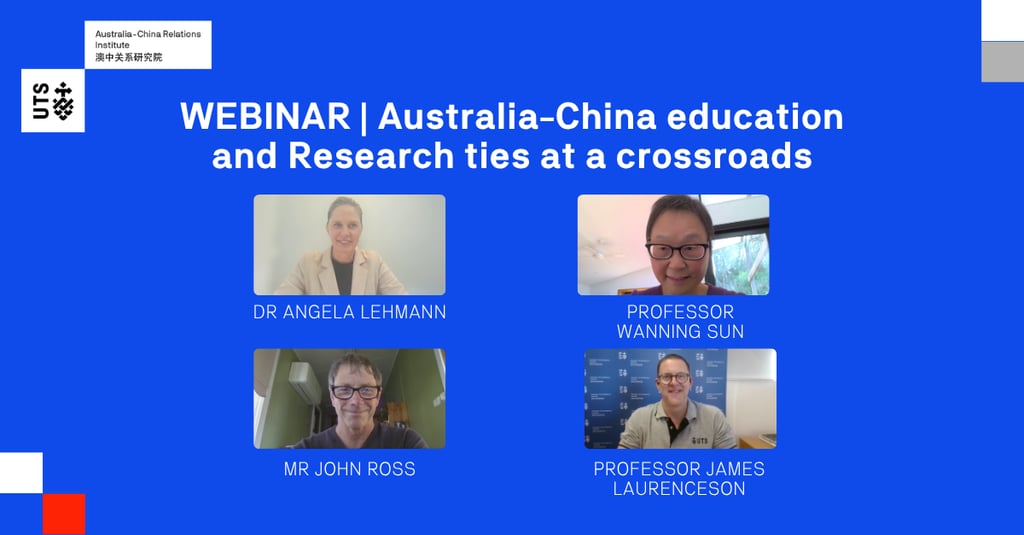
Today, UTS:ACRI brings together Dr Angela Lehmann, Mr John Ross and Professor Wanning Sun to discuss current challenges, policy shifts and future directions for Australia-China education and research collaboration.

UTS:ACRI Director, Professor James Laurenceson will be moderating this discussion. Audience questions are welcome at the end, so please remember to submit your questions using the Q&A tab along the bottom panel of this webinar.

Now, a little bit about our speakers.

Dr Angela Lehmann is Senior Director Global Engagement and Policy at Universities Australia. She is a leading voice in the Australia-China education and research relationship and has published widely on this topic. Dr Lehmann is the Chair of the Foundation for Australian Studies in China. She is also an Advisory Board member at UTS:ACRI.

Mr John Ross is Asia Pacific Editor with Times Higher Education since 2018. He was previously higher education and science correspondent with The Australian newspaper. He has won the National Press Club’s Higher Education Journalist of the Year award three times.  

Professor Wanning Sun is Deputy Director of UTS ACRI and Professor of Media and Communication Studies at UTS. A fellow of Australian Academy of the Humanities since 2016, she was a member of the Australian Research Council College of Experts (2020-2023).

Our moderator for today’s discussion is Professor James Laurenceson, Director of UTS:ACRI. His research interests relate to the Chinese economy and the Australia-China economic and broader relationship. I will now hand it over to Professor Laurenceson to begin today's discussion.

Professor James Laurenceson: 

Thanks very much, Celia. I hope I'm coming through loud and clear. Folks, we've just got a star panel to discuss this topic today. We've only got an hour, let's get straight into it. Look, when we talk about Australia-China engagement in the education space, I'm guessing that perhaps what most commonly comes to mind for many people is Chinese international students. And look, that's not without reason. It's been estimated that there are now, well over 750,000 Chinese alumni from Australian universities, possibly more than one million.

At some Australian universities, like the University of Sydney, Chinese international students today account for between one-quarter and one-third of the total student body and around one-third of the University's revenue.

But even Chinese students is just one element of Australia-China engagement in the education space. They are far from single-dimensional. Look, aside from filling lecture theatres and tutorial rooms, and from the contributions they make to university revenue, at a postgraduate level, they provide a good chunk of the talent, the brainpower, that Australian university research laboratories cannot function without. Let me just give you one example.

According to data collected by the US think tank MacroPolo, when you track top global AI talent, you find that of those who received a PhD in Australia, 57 percent were recruited from a Chinese undergraduate program. One more time, 57 percent were recruited from a Chinese undergraduate program. Just 13 percent were recruited from a domestic Australian program. Less than one in 10 were recruited from India, the second largest overseas source country. And of those who graduate from an Australian PhD program. Fifty-eight percent continue to work here.

Chinese students, of course, are also visited by family and friends, and so they're a boom for Australia's tourism industry. Some go on to become Australian permanent residents and citizens, and those that do, are frequently highly entrepreneurial, as research by the University of Sydney and KPMG, has documented.

So, let me start, Ange, with a question for you. Look, I just made a few remarks about Chinese international students in Australia, and the multi-dimensional way they contribute to the Australian economy and broader society. But I'm sure Australia-China engagement in the education space extends beyond Chinese international students. So, Ange, from your vantage point at Universities Australia, can you give us the lay of the land more broadly? What are some of the other significant touchpoints between Australia and China in the education space?

Dr Angela Lehmann:

Thanks, James, and you're spot on. I'm really glad to see this being raised in this forum, because I think it's true to say that most Australians, when they think of Australia's university engagement with China, think of students coming in to Australia to study in our institutions, and indeed, there are many of them, as you've highlighted. They're the largest source market of international students in Australia, followed very closely by India. But Australia's engagement between universities, between Australia and China, is very diverse, and it had a very long history, and this is something I think needs a little bit more understanding across maybe the general public and policy makers.

For example, yes, students come to Australia, but Australian students also go to China, and that's important, and that's a cohort that our government and the Chinese government are trying to encourage more of, this is usually through the New Colombo Plan, but just recently, the Chinese government are launching their own kind of way to facilitate and promote Australians spending some time in China. So there's that kind of mobility relationship that we have.

But there's a really significant other form of engagement with China, which is really important for our universities here in Australia, and that's transnational education. And that's where Australian universities partner with a Chinese university, and they deliver a joint program, or they build a joint institute where they can deliver a series of courses.

This is an initiative that Australia really leads on in terms of facilitating and building these joint ways of educating students on the ground in China. A lot of these programs are set up so that the student may, for example, start their degree in China and then come and finish the degree here, but there's been some really important changes in this space over the last year, where the Chinese government is really trying to encourage more quality transnational education partnerships, so there's a little bit more flexibility now, and we're getting some pilot zones around being able to deliver an entire degree, an Australian degree, offshore in China. So that's something we can come back to later.

But other forms of engagement, we have sector-level engagement. So, for example, Universities Australia, as representing Australia's 38 comprehensive research universities, we have a relationship with our counterpart in China, the Chinese Educational Association for International Exchange, and under that agreement, we've started holding… last year, we held a high-level dialogue where Australian Vice-Chancellors can speak with Chinese university presidents.

So there's that kind of sector-level engagement. Austrade does work, our state-level governments do work in this space. There are research partnerships, which obviously we'll speak about later on, too. I also want to raise alumni networks. Australia's universities do a lot of work with our alumni, which form a really important part of our relationship broadly with China, in terms of having a network of people in China who are familiar with and have a positive affiliation with Australia.

And then lastly, the last thing I think I'll mention are university-to-university memorandums of understanding. So, pretty much most of our universities in Australia maintain formal partnerships with multiple Chinese universities. At the moment, we have around 1,250 formal partnerships between Australian institutions and Chinese institutions.

But interestingly, for this conversation today, that number is declining. We've seen a significant decline in those agreements, and maybe we can talk about that later on. So, I guess my point here is that the Australia-China higher education relationship extends far beyond Chinese students coming in here. It is complex, it's diverse, and it has a history. So I'll finish there.

Professor James Laurenceson: 

Yeah, thanks, Ange, goodness me. I just took some notes while you were talking, so aside from Chinese international students coming, you've got outbound Australian students, you've got transnational education through those partnering arrangements, you've got peak body, dialogues, alumni networks, and I'm pretty sure the Australian Government's Department of Foreign Affairs and Trade is quite interested in those alumni networks for their own reasons, and Australia's, you know, soft power, to be frank.

And then you've also got research collaboration as well. So this is a very multi-dimensional space, the Australia-China education space. Ange, as a follow-up, you just laid out about six different touchpoints between Australia and China. Are you able to give our audience today a sense, you probably won't have time for each of them, but give us a sense of where does Australia lean in heavily into engagement with China, compared with those countries we usually compare ourselves to, like the US, UK, Canada and New Zealand. Similarly, are there touchpoints where Australia is less engaged with China than some of those other similar countries?

Dr Angela Lehmann: 

Yeah, sure, I think, firstly, overall, I'd start my response with, saying that Australia, and we do say this phrase a lot at Universities Australia, but I think it's true, and that is that Australia does punch well above its weight. And by saying that, I think we have maintained, a world-leading status as a destination for students relative to our size. So the United States, for example, does still attract, even now, more Chinese students than Australia and the UK, but their systems are much, much bigger. So I think, in terms of attracting onshore students, we've done particularly well.

America still has a brand, a heightened brand recognition in China, I suppose. They've kind of excelled there. But we've done remarkably well. The one place, I think, where we can notice a bit of a difference with our, kind of competitors would be the UK. The UK really still leads the pack, really, in terms of transnational education. They tend to get more approvals granted.

And they tend to have more, kind of, high-profile engagements. So you'll be aware of, for example, Nottingham Ningbo, for example. So this is an example of a joint institution. In China, you can't have an independent branch campus like you can in other countries. You must work together with a Chinese partner.

But the UK institutions, a few of them have done this. No Australian institution has done that, and that's for various reasons. It is high risk, it's high cost, but it's just a direction that Australia is chosen. I think I'd also raise that I think Australia performs relatively well globally in terms of managing risks and having a deep understanding of its engagement with China. Because we can see different countries looking now to mirror the way that our university sector works with government in relation to China.

Professor James Laurenceson: 

Yeah, okay, so that's interesting. So, when it comes to, you know, joint campuses, essentially in China, that's actually an area that Australia has stood a bit back from. I understand we've got joint programs, but we're not, to the same extent, on the ground as some of our UK counterparts. That's interesting.

John, can I go to you now? Ange just gave us a great overview of the many different ways that Australia and China are engaged in the education space. Now, in your reporting, and I've been following it for many years, you've covered a lot of these different touchpoints that Ange has laid out. When you speak with government officials, university administrators, think tank analysts, independent analysts, how do they describe the benefits and risks associated with each? For example, when it comes to Chinese international students, what's the upside? What's the downside?

And what about in the cases of some of those other touchpoints Ange mentioned? You probably won't have time to go through them all, but if you could give us a sense of the upside and downside of some of them, that'd be great.

Mr John Ross: 

So, publicly, certainly within the university lobby, they talk about the vibrancy students bring to the campus, the wonderful soft benefits of having all these people from China and so many other places coming here. They might acknowledge the economic benefits of having people here, but they'll also be very quick to talk about the 30-odd billion dollars that international students spend while they're in Australia, and the benefits of that for the broader economy. Privately, they're much more likely to talk about enrolment flows and the economic benefits. And you know, it'd be easy to kind of dismiss that as hypocrisy, but as you said, some universities get upwards of a third of their revenue, not from international students, but from Chinese students. Let's say UNSW and University of Sydney, particularly in that boat. So you can understand the interest in the economic aspect of all this.

And also, there's a level of hypocrisy in the way the government deals with all thess, because the government's very quick to chastise universities for wanting to bring in so many international students, but not so quick to acknowledge the 20-odd years of policy settings that have basically made it inevitable. The Australian universities can only fund a lot of the things that they do by bringing in a lot of international students.

On the downs, I mean, my personal view about international education is when it works, it's fantastic. You get four or five students around a table speaking five or six different languages and bringing their cultural perceptions into play. That's just magic. But there are a lot of legitimate downsides, and generally speaking, I'm again… privately, the lobbyists will acknowledge this. They don't talk about it publicly so much. Researchers do, and there's quite a lot. Obviously, language, so the great difficulties that a lot of Chinese students have in functioning in English well enough to really function properly at an academic level. The difficulty that poses for other students, particularly for local students, you know, particularly if they're in group work.

The near monoculture you get in some classes, so particularly probably business master's courses where you hear about 80-percent Chinese, sometimes so much dominated that Mandarin is actually spoken in class.

The effective ostracisation of many Chinese students on Australian campuses, they don't really mix that much with locals. Maybe they're shy, maybe the locals are too clicky, but that's definitely an issue. Serious mental health issues that these people have, the loneliness, the feeling of alienation in this big brown country. Suicide in some cases, so that's, you know, that's a real problem.

Exploitations by landlords, employers, maybe not so much employers with Chinese, because stereotypically they don't work that much in Australia compared to, say, South Asian students, but it's still an issue. Chinese extortion gangs who hoodwink Chinese students into thinking that the immigration authorities are out to get them to take their visa, and you know, staged kidnapping, all these sort of things. And students' impacts on infrastructure, particularly housing. I mean, I think that's been vastly exaggerated in the public discourse about this, but it would be disingenuous to imagine that international students, being roughly two to three percent of our population at any time, don't have any impact on housing and other infrastructure. Yeah, so there's a lot of downsides.

Professor James Laurenceson: 

Yeah, and that's just with respect to Chinese international students. I expect you've probably spoken to government officials and university administrators and analysts about other aspects as well, such as, you know, around research collaboration, transnational education. Did you want to make any comments about those other ones? You don't have to, but if you did, fire away.

Mr John Ross: 

Look, I think transnational education's a real sitter. There's probably this view that if it's over there rather than over here, we don't have to worry about it so much. I think that's naive, you know, as Ange was saying, that the Chinese are really pushing for various reasons to have a lot more joint ventures on Chinese soil, rather than having this sort of export-oriented sort of brand of international education that's happening now. I think that there're real issues, potentially. Australian universities will be tacitly pressured to accept limitations to academic freedom, for example, that just wouldn't fly in Australia.

And all those MOUs that Australian universities China signed with Chinese universities, Chinese institutions, other institutions. In fact, just about anybody try and find ones that's public, so we don't really know what's going on.

Professor James Laurenceson:

Yeah, okay, fair enough. It's good to have… I mean, let's just not talk about the upside. We all know there's challenges as well, so thanks, John, for going through some of those. Look, and I don't want to be accused of being a lobbyist for the university sector, but one thing you did say on the issue of Chinese international students is the fact that they do provide a lot of the necessary funding, and I was looking the other day, in the OECD, public funding of the university sector in Australia is the second lowest amongst the OECD. So if you look at all the funding of universities of that that comes from the public sector, the government, Australia is the second lowest in the OECD, so certainly universities have some reason, maybe they're going overboard, but they have some reason, to be, engaged in recruiting international students. John, just one more very quick follow-up. Are there some areas of Australia-China education engagement, where most people, agree is, you know, all good, versus other areas where most people really do think it's problematic? Or just across the board, are there just consistent upsides and downsides associated with all the touchpoints?

Mr John Ross:

Look, I'd say China is one of those issues where you're never going to get, you know, a universal view. It's a bit like Gaza or gender identity, you know, there's so many deeply held and opposing views about this stuff. Look, you know, I've been reporting for a long time on the, the economic reliance on international students, Chinese students in particular. I think this is a really big problem. You know, I think Australian universities' financial reliance on Chinese students is extremely serious. It's basically a house of cards. I think it's going to come crashing down pretty soon.

Five to 10 years, you know, I'll probably sound like your classic sort of researchers there, you know, they always say five to 10 years, but you know, maybe that's too pessimistic. You know, I know we're going to talk about some of the figures and what we're seeing in visa applications, but yeah, look, I think that's probably the biggest single issue with it for universities. There's other stuff around academic freedom, threats to Chinese students from, you know, from Chinese people who are trying to curtail what they can do here.

You know, I think there're legitimate issues to some extent, but I think the economic one is a real burner.

Professor James Laurenceson: 

I welcome robust commentary, John, and particularly from someone like you, who’s very well placed to give it. It's interesting, you know, we do an annual poll of Australian public opinion at the Australia-China Relations Institute. That's led by my colleague, Elena Collinson. And we asked the Australian public some of these questions, and I thought I might just run through a couple of the highlights. For example, we ask whether Australians agree that international students from China provide a major economic benefit to Australia. Sixty-nine percent of Australians agree, just 10 percent disagree. Now, that said, if you ask them, are Australian universities too reliant on… too financially reliant on Chinese international students, 75 percent agree, just four percent disagree. So there's a recognition that there's a benefit there, but there is a real question amongst the Australian public about just how exposed Australian universities.

And similarly, when it comes to research collaboration, for example, if you ask Australians, do research collaborations between academics from Australia and China make Australia more internationally competitive, 63 percent agree, just 10 percent disagree. But that said, there's also concerns around academic freedom, as you alluded, John. So yeah, I think the public is quite aligned with that.

You know, the upsides and the downsides that you're referring to. Look, I want to ask one more question on Chinese international students. Then I'm going to move towards other issues and bring in my UTS:ACRI colleague, Professor Wanning Sun.

The last question I want to ask about international students is this one. Look, according to the Department of Home Affairs, this financial year to April, so this is the latest available data. Chinese applications for student visas to Australia are down by 25 percent from the same period a year earlier, down by a quarter in just 12 months.

Ange and John, I'll go to each of you. How worried do you think universities should be about this? I mean, you know, is this just an expected pullback from all the pent-up demand we saw explode, you know, following the pandemic? Or is this more likely to be the start of a longer-term decline, reflecting more, you know, structural factors, like a slowing Chinese economy, shrinking pool of Chinese young people, Australian universities perhaps not offering the same value proposition they did relative to Chinese universities and competitive markets as they did a decade ago, as well as less favourable settings on the Australian end, such as a near tripling of the non-refundable student visa application fee since 2024?  

Ange, can I go first to you? Where do you think this is heading?

Dr Angela Lehmann: 

Yeah, thanks, James, I think this is a complex question, and I think there's multiple factors feeding into what we're seeing now globally. So this is not an Australian dip, this is a global dip. So that's the first thing. The second thing I want to raise is that over time, we see shifts and changes in the cohort of Chinese international students coming to our country. This has not been a stable movement of people over the border. It changes as time shifts, and it reflects what's happening in China, it reflects China's economy, it reflects the kinds of students, I mean, that are coming to Australia. It reflects the economy, reflects the labour market, it reflects the worries of mum and dad, it reflects youth culture. You know, there's a whole range of things that shape a young person's ability and ambition to come and study in an Australian university. It also reflects top-down policymaking in China as well.

But these shifts also relate to happening in Australia, to our top-down policy settings around managed growth around, as you mentioned, the visa, the rising of visa fees, around the way China is generally positioned, within Australian public discourse, around cost of living, you know, around housing. These are multiple things that shift from the Australian angle and the Chinese angle, how these people make the decision to apply to one of our universities. So what we're seeing now should be considered in that context, that there's changes happening at home, and there's changes happening in the destination. I just want to put a few bits of data out there for the data nerds amongst us.

Just to highlight the way that these, that these changes happen over time. So the first thing is around the shift towards postgraduate education. In 2011, Australia was really dominated by undergraduate Chinese, students. We had 60 percent of the Chinese students coming to Australia were studying undergraduate degrees. By 2024, this is completely flipped around, and now we have around 61 percent of Chinese international students studying postgraduate degrees. So this leads you to ask questions around why is this happening? You know, you could talk about ‘degreeflation’ in China, for example. It is now… so many more people have an undergraduate degree that now you feel you must get more and more degrees, for example. So there's things that happen that shift and change the way this market and this economy is shaped.

The next point is around gender, which I'm quite interested in the gendered makeup of Chinese international students in Australia. We have a really feminised cohort of students here, whereas in the US, they have many more male students going to study there. We have more female students. It's quite minimal, it's not a huge majority, but that majority, since COVID, it is now, that percentage of female has dropped. So, when things happen in the labour market back in China, or there's certain economic pressures, this can affect gendered decision-making as well. So I just wanted to put that as a thought bubble out there. And the last little bit around this kind of stuff, which I kind of enjoy, is looking at what Chinese students study. I think there's a perception in Australia that Chinese students are coming into study accounting and business and management. This is changing, and I don't think this is really clearly understood, that there has been a shift.

In 2011, management and commerce accounted for two-thirds of Chinese international student enrolments. This is around 40 percent now, so we're seeing a shift in disciplines, and this is, you know, multiple reasons why this is happening around the way the Chinese government, I guess, is reshaping the economy and where the jobs are going to be.

So, this is a long-winded way of saying that the changes that we're seeing now, in terms of decline in the cohort, needs to be considered in that broader context of the Chinese social change, I guess, and economic change, and also what's happening here in our policy making sphere, and our anti-China rhetoric in the media, for example, that kind of can contribute to this dip.

I'll just finish my comment on this around what I started with in saying that this is a global decline, not necessarily an Australian decline. So, latest Chinese figures have shown that there's been a 20 percent reduction globally in Chinese students studying abroad since 2019. So this has been a really rapid drop. And there's a COVID thing in there as well, but there has been this decline, and I think a lot of those reasons that you listed, James, around economic pressures, the rise of Chinese universities, less favourable policies in destinations. Australia is not alone in the way that international education is increasingly being governed, and kind of shaped and managed by the government.

And the last point, I guess, I keep saying last point, but this one is important, I think China is reshaping the way it wants to be seen in this sphere. It wants to change the way it relates to international education. It wants to see itself as a host of talent, not just a sender of talent. And I think that's really important here is the role of talent.

China hosts around 500,000 international students a year. China is a competitor as well as a source market. So there's a new era happening here, and a change in the way that this mass market of Chinese university students is shifting into a new stage, and I think, you know, this might help Australia to kind of moderate some of those challenges that John mentioned earlier too.

Professor James Laurenceson: 

Yeah, that's an excellent point, Ange. Anyone who goes to China and spends a time on a Chinese university campus, you will see a lot of international students, right? So you're right, I don't think we often log that. John, do you have anything to add in terms of the direction of where Chinese student numbers are going? Ange has mentioned that the composition is changing. What about just in terms of overall numbers? What's the trend that you're seeing?

Mr John Ross:

Well, so I had a look at the visa application figures last night, and I'm looking specifically at visas, higher education visas, so that's people who want to come here and do undergraduate and, you know, taught master's degrees, who are applying from offshore, so they're basically applying from their own home country, they're not already here.

So that was down 32 percent in the first four months of this year, compared to the first four months of last year. And it's pretty much the same comparison for the two previous years. Essentially, we're back to 2017 and 2018 figures. So maybe not that bad in the great scheme of things, but I agree with Ange. I think this is part of a changing of the guard, essentially, and it's a global thing.

I think Australia's high tuition fees, its living costs, and, you know, what I see is the unsupportable fees that we're charging for people to lodge their visa paperwork would have something to do with that, in terms of affecting how Chinese students regard the value proposition of studying in Australia.

There was a screenshot that I saw in a Chinese media report from a Beijing, sort of, international education fair in April, that showed that Germany has overtaken Australia as a destination for Chinese international students. And, you know, obviously, Germany has a very, very different take on international education from Australia. Most of the states there, international students, even non-EU international students, can study there pretty much tuition-free, so Germany's got a very different take, and Chinese people are noticing that.

But I actually think the decline would happen anyway. I think, you know, even if Australia had really benign fees, visa policies, and much lower fees, even if it's cheaper to live here, I think, essentially, the value proposition of studying in the traditional Anglo destinations really isn't stacking up that much anymore. Return on investment doesn't justify it, unless you've got a hell of a lot of money, you've sort of got this very elite self-image, in which case you're going to Harvard or Oxford or somewhere like that.

I don't want to be too simplistic about this, but I think for many years, the Anglo world has been trading on this idea that Chinese students need to head to the west, to where the action is. You know, the action is particularly in Boston and Los Angeles, London, Edinburgh, but it's also in places like Toronto, Sydney, Melbourne. I don't think for a lot of Chinese people, the action is in those places anymore. I think it's back home in China. So I think that's essentially what's really changed here. But it's exacerbated by geopolitical rumblings, the visa issues we've mentioned before, worries about disease, you know, we've all been through COVID, cultural factors. So, when Chinese people are studying abroad, they're shifting much more to the neighbours. So, you know, we're talking Hong Kong, which is regarded as a foreign country in some ways there, South Korea, Malaysia, Singapore, Japan.

And, you know, as Ange was saying that there's a different view. The Chinese authorities are taking a different view about how they regard international education, so there's a real encouragement by the authorities in Beijing for people to stay home. So I've come across, again, I've come across media reports about a couple of publications that were released during that fair, that International Education Fair in Beijing in April, these were published by the Chinese Service Centre for Scholarly Exchange. One was an evaluation of the overseas study environment and the other one was an analysis of employment trends for the returned overseas students. And there's also a book… I haven't managed to get my hands on any of these things, but there's also a reference to a book, written by a Beijing international education expert. It's called ‘Is studying abroad still useful?’. So there's a clear narrative here, you know, Chinese kids should stop heading overseas for their education, get it locally instead. For all sorts of reasons, some of which Ange's referred to before, the Chinese authorities want to convert the outflow of students into an inflow. It's a big change.

Professor James Laurenceson: 

Yeah, that question you asked may well be rhetorical, I expect. Look, let me now switch gears, and as I saw my colleague Celia said, if you do have a question, please feel free to put your question in the Q&A tab. I do hope we've got time for at least a couple.

I want to now start talking about this issue of research collaboration. Now, research collaboration can take different forms. It can be Chinese PhD students in Australian laboratories, or it can be an Australian scholar at an Australian institution, and a Chinese scholar at a Chinese institution collaborating to, you know, produce a breakthrough scientific paper.

Now, I'm going to go to my colleague Wanning for some questions on this topic, but first, just let me very quickly make a few comments and lay out some facts that set up these questions I want to put to Wanning.

These comments and facts relate to the core STEM fields of computer science, material science, and engineering. These are the fields that are regularly touted as vital for powering Australian innovation and productivity going forward. They're also the fields that some analysts see collaboration as serving as a vector of security risks.

Here's the first one. According to the Clarivate Insights database, if you look at the top 10 percent, of most cited publications in these fields globally over the last five years, so this is the highest quality publications, an author affiliated with an Australian institution appears on about five percent of them.

Now, look, that may seem small, but actually, it means Australia is punching way above its weight. I mean, don't forget, Australia's population is just one-third of one percent of the global total, and our economy is just one percent of the global total. So five percent is quite an extraordinary achievement.

Still, looking at that same top 10 percent of most cited publications globally, you'll find that a researcher affiliated with a Chinese institution appears on 61 percent of them, right? More than half. A US-affiliated author appears on just 14 percent, so more than Australia, but well down on China.

Second, if you look at Australia's five percent share of the global total, you'll find that 85 percent of these involved international collaboration. That's the way Australia stays at the knowledge frontier. We can't do this by ourselves. We've got to collaborate internationally, and China is, in those fields, hands down Australia's most important international partner. In fact, 54 percent, more than half of Australia's best publications in those STEM fields I just mentioned involved at least one Chinese co-author. Just 12 percent involved an American co-author.

Meanwhile, if you look at China's 61 percent share of the global total, only 33 percent of those involved international collaboration. And of China's best publications, an Australian co-author appeared on only 5 percent of them. So, one conclusion that can be very clearly drawn from that data is that without collaboration with China.

Australia's means of staying connected to the global STEM frontier is going to take a big hit. In contrast, without collaboration with Australia, China will be affected relatively little. Now, none of that means that research collaboration with China doesn't come with risks.

Let me give one example that's already on the public record. In October 2023, Mike Burgess, the Director General of the Australian Security Intelligence Organisation, ASIO, disclosed that his agency had disrupted, ‘a plot to infiltrate a prestigious Australian research institution.’ So, no one is saying that there's nothing to see here. Still, I think Australia has an interest in remaining as open as possible with appropriate risk mitigations, including to collaboration with China.

Okay, now I'm going to get to my questions for my colleague. We had actually hoped to dig into this topic of research collaboration with China by inviting a Chinese background STEM researcher affiliated with an Australian institution to join this panel. By virtue of their sheer numbers, their strength of their professional networks in China, and their language skills, of course, they've played a leading role in making this research collaboration with China possible, but my colleagues and I were unsuccessful in our invitations.

Wanning, I approached some researchers, you approached some others, we collectively failed. Why were Chinese background researchers at Australian universities so reluctant to join this panel today?

Professor Wanning Sun: 

Well, James, yes, we did try very hard, but no luck. But I think there are many reasons for them not to talk, even though it is their academic freedom to talk, which is interesting. So, I think they worry about quite a few things. One of them is, they worry about, the possibly the unfair and unjust media reporting. As you see, we get this kind of reporting from time to time about involving collaboration with Chinese researchers. Because some learn from the experience that in this day and age, for Chinese scientists in Australia, any sorts of publicity is likely to be bad publicity.

And bad publicity itself may not be that bad, but it may lead to risks that in their research projects being jeopardised, and their grant applications being disadvantaged, or they may even end up displeasing, or even losing the support from the universities. As we know, the universities these days can be quite media-shy and risk-averse.

Of course, they're also aware that they probably need to look after their mental health first, because that's, you know, there's all this burden that's put on them if they talk publicly. So, even though quite a couple of researchers tell me that they're quite confused and somewhat aggrieved, and even demoralised, and in a couple of people's cases, quite angry. They don't feel that they, kind of understand fully the politics behind this. And then we just said, what's going on? So, more than one person said, you know, look, I'm just a scientist, you know? My place is in the lab, you know, I just want to get on with my life and do what I can.

Professor James Laurenceson:

Yeah, I'm wondering, you're in the middle of a research project now, and we're sort of partners in that, that's involved interviewing some of these researchers. On the increasingly securitised environment in Australian universities, do the Chinese background scientists that you're speaking to, do they consider that increased securitisation proportionate? I mean, every country, let's be clear, every country has the right, indeed the obligation, to take foreign interference and national security risks seriously. I mean, China certainly does, right? China very much takes that seriously. So what do they say when you ask them that question?

Professor Wanning Sun: 

In response to that question, I'll say, first of all, they do tell me that they do understand the national security imperative. They do understand. They agree. They agree with the principle of it. But what they're saying to me is that what's happening now is over-securitisation, or what they called excessive securitisation. By the way, I should just mention that all these people I've talked to are senior academics in Australian universities. They mostly are, they're either Australian citizens or permanent residents, and have lived and worked in Australia for more than couple of decades, and they're pretty much part of the Australian community.

And also, from their point of view, they tell me that this security concern about, you know, possible espionage, about the theft of Australia's cutting-edge research. These concerns may be warranted about, I think, 10 or 15 years ago, but now they tell me that it's quite a different story, because they believe that both in terms of basic research and applied research, China is now way ahead of… streets ahead of Australia.

Now, to your question, do they consider the securitisation proportionate? The short answer is:  No. They don't think it's proportionate. And they make this case to me by mentioning a few issues they are struggling with. First issue is this concept of dual-use technology. And they believe that, in their own disciplines, that concept has been used and abused.

It’s like the high fence, low yard, sort of, small yard sort of concept no longer works here, because the yard is getting bigger and bigger. And so, it seems to, you know, include everything. So, they think this policy of erring on a side of caution that's adopted by both the government, and particularly their own universities, is quite… they think is ill-advised.

In fact, one person… by the way, all these interviews were conducted in Chinese, and one person, quoted a Chinese expression to say, they'd rather kill a thousand people by mistake than letting one guilty person go free, right? So, which I think that's quite a telling kind of quote.

But, look, that said, I have talked to a couple of researchers who did tell me that their research collaboration is still ongoing because their research is not sensitive. For instance, there is a senior scholar who works on climate change, and energy, you know, clean energy. The other person, works on marine by-products. But this area seems to be getting fewer and fewer, and more, and much more circumscribed.

And they also tell me that in many cases, this over-securitisation has led to a research governance practices in their own university, or even their own faculty level, or even their school level. Because the university research offices tell them that, if you put an application, ARC applications, that involves collaboration with China, your research might be disadvantaged.

Some faculties are even putting hurdles to their researchers, to recruit Chinese students, to co-author, papers, with a China-based researcher, and even to invite some scholars to come to visit Australia to have a conference, or themselves go to China to attend conferences.

Look, it's not that the university ever said, don't do this, you're not allowed to do this, but they just have… they just put so many so-called due-diligence hurdles that people just start thinking that, this is not really worth my time.

The other area of securitisation involves visa approval. I mean, Ange and John have mentioned that. Our survey and interviews with Chinese visa applicants wishing to come to Australia to do a PhD study here, we find they have to wait for a very long time. Some have waited for more than a year, and in a couple of cases, as long as 18 months, because they were told that their cases have been passed on to security agencies for further assessment.

This means that the Australian-based prospective supervisors may have to delay their project, some of the ARC projects, because the incoming postdoctoral candidates will be staffing the labs and assisting those professors to actually carry out, to do the research. One of the persons told me in a very simple way, he said, no lab work means no research progress. No research progress means no research output and income.

And so, I just asked them, why don't you recruit local students, Australian students? The answer said, we really want to recruit them, and they're… some of them are really brilliant, but very, very few are willing to do a PhD. They just want to get a degree and get out and get a job. So yeah, this are some of the things that it told me.

Professor James Laurenceson: 

Yeah, okay, once again, folks, I see one question in the Q&A already, so don't be shy in lobbing in your… oh, there's actually a few more than that, there's four there. Wanning, one just very quick question, if you could just keep this answer really quick. Are we seeing the return of leading Chinese background researchers who were in Australia already returning to China? Because the environment here has just become so difficult for them to do their work, just very quickly.

Professor Wanning Sun: 

Yes, I've been told there is… the brain drain is happening right now, as has happened quite a few years, and it's happening at all levels, you know, professors, senior professors to postdocs.

Professor James Laurenceson: 

Yeah, okay, that doesn't really seem a win for Australia's national interest to me.

Look, let's go to a couple of the questions. Ange, I might direct this first one to you. It's a bit unfair because you're not a representative of an individual university, you're of the peak body, so I'm not putting this on your shoulders, but just, do you have any comments? The question is, when are Australian universities going to improve orientation and ongoing mentoring for Chinese students, so that they aren't ignored and meet Australian students. Let me ask you this, Ange, do you see any Australian universities doing a good job on that front?

Dr Angela Lehmann: 

Yeah, no, it's a fair question, and I think it goes to the comments that John made earlier around some of the challenges that we find Chinese students may face in Australia. Our universities, I think, I just want to emphasise that, you know, I've talked a lot about the long and in-depth and the diverse engagement with China. Universities take this stuff very seriously, and increasingly so, and I think as we see these declines in visa applications, probably even more so, universities in Australia are really interested in improving the orientation of Chinese students, and there's this kind of a tension, I guess, or an awareness within universities that there needs to be almost a bespoke approach to Chinese students, as opposed to some of the other cohorts.

But, you'll know also that many of our universities are currently undergoing some level of financial stress, and whether or not that's impacting their ability to provide such bespoke services, I can't tell you. But just to emphasise that this is a point well made, and I think that universities are keen to see the experience of Chinese students.

At top level, at world-class level, it needs to be maintained, and it's increasingly challenging given some of the challenges that we've discussed today with house prices and, you know, China-Australia tensions and things like this, but it is very much taken seriously. The other one that universities are very motivated to engage with is on employment and employability of Chinese graduates when they return home. It's a priority.

Professor James Laurenceson: 

Okay, thanks, Ange. That was very bravely handled. I really should have directed that to someone who's actually in the management of a particular university, rather than to you. John, again, this is not really directly… you're a journalist, right? But I'm just going to borrow your communication skills, to put this question to, I think probably you're the most suitable person. The comment is, everyone seems to be aware that current restrictions on research collaboration with China have put Australia at a disadvantage in innovation and access to talent.

What are the most effective ways to communicate this evidence to policymakers? And what are the practical steps can we take to improve the situation within the existing framework. Now, John, it's true that a lot of former journalists go on to be media advisers, so if you could just pretend to make that transition, what advice would you have to communicate that reality to policymakers?

Mr John Ross: 

Well, I actually made the transition a bit in reverse. I used to, sort of, do media work for government organisations at a very low level. I don't think I'm very good at it. I mean, part of the reason I like being a journalist is because you try and speak an objective truth, and the objective truth is that, notwithstanding the very real issues we have around research security with partners like China, as you've pointed out, they're an extremely important partner. You know, we've sent into so many things, and in climate change and renewable energy, the collaboration between UNSW and some, you know, Chinese postdocs that have basically got rooftop solar sprouting on roofs all over the world. You could probably argue we should have made a bit more money out of that, but it's obviously doing positive things for emissions. Eddie Holmes' work with Chinese researchers around the pandemic and sequencing the COVID-19 virus. You know, I could go on. I mean, obviously, there are problematic areas, but there are also really important areas. We, our, what do you call metrics would be nowhere in certain areas that you've mentioned. Chemistry, material science, without our collaborations with Chinese scientists, often, you know, people here from the Chinese diaspora collaborating with Chinese scientists. So there are fantastic benefits that we get from this.

We also need to know what's going on in China, because obviously, geopolitically, it's really important to us to know. So, we need to know about China. And if we stop working with China, we're throwing the baby out with the bathwater. We've got to be more nuanced than this. You know, we've got to look at the good as well as the bad, with clear eyes on it, about both. So, I mean, they're the messages I'd be trying to give, but how you give them… how you make them be accepted in a society that's more worried about political perceptions and realities, in my view, I don't actually know.

Professor James Laurenceson: 

Yeah, it's a question I struggle with on this topic, and just broadly in Australia-China relations. I'm a very good guy who's really attracted to data, and as you probably saw that before when I was rattling off those numbers, and probably several people in the audience, their eyes probably glazed over, but it is a real challenge, so thanks for the question.

Wanning, I might direct this question to you. I'm going to combine two questions. One is, are there any noteworthy differences between the natural and social science collaboration? So, have you spoken to any, humanities scholars, for example? And similarly, someone else asked, any comment on research collaboration outside of STEM? So, can you shed any light? And I know with our visa research, we have looked at the differences between STEM applicants and those not in non-STEM fields, so just any reflections, Wanning.

Professor Wanning Sun: 

Yes, James, I am myself a humanities and a social sciences researcher, so I talk to my, peers all the time. But for this particular research project, I focus mainly on scientists, in the STEM area. But in terms of the visas, it seems that everybody's visa seems to be delayed, whatever background you are, because of the build-up, sort of effect, and the queues are getting longer and longer.

But in terms of collaboration between, different collaborations, we humanities and social sciences, particularly humanities, tend to think alone and tend to act alone, whereas we tend to fly solo. I go to China, do the field work, I come back and write up the research. Even if my research assistant actually did a lot of work for me, I'm going to be the one that's do the thinking, and when we recruit international students, they come here to do their research independently of us. And we're not really supposed to be… sort of supposed to be arm's length, really. But it works very, very differently in science. And one thing I got from interviewing these scientists is that, how important it is to have a well-staffed lab.

And because professors don't have the time to sit in the lab, to do actual research in the lab, they rely, crucially, on building up the teams in the lab, in postdocs and PhD students. And they all say that PhD students from China are good in the sense that they come here, and with a little bit of training, they can start working straight away. And this is quite different from some of the other countries. So yeah, there's a great difference, much greater reliance on postgraduate students.

Mr John Ross:

 Sorry I just want to cut in. It's kind of a message to whoever's listening. I would love to hear some advocacy from the sector in particular on behalf of international students, in terms of the way our country is treating them, hitting them with a non-refundable $2,000 fee just to lodge their visa paperwork, then maybe not processing the paperwork, or not processing it for a long time, giving people no answers, keeping them on tenterhooks for 2 years if they're PhD applicants. I don't think this is an acceptable way for a wealthy country… a wealthy civilised country to behave and to treat the young people from its middle-income neighbours. And it's not my job as a journalist to advocate for people, but I'd love to hear more advocacy for those people from universities in particular.

Professor James Laurenceson: 

There you go, John Ross at [Times] Higher Education, there's the man you need to speak to, if you've got any stories to tell him.

Professor James Laurenceson: 

Look, Sorry, folks, I'm going to have to wrap it up there. We've nearly hit time. That was a wonderful discussion. Thank you all. Look, I'm going to send it back to my colleague Celia now to wrap things up.

Ms Celia Ngou: 

Thank you to Dr. Angela Lehmann, Mr John Ross, Professor Wanning Sun, and Professor James Laurenceson for today's discussion. Members of the audience, we will be sending an email to everyone here asking for your thoughts on how this webinar went.

If you could please fill out that feedback form, we'd really appreciate it so that we can make future events a better experience for everyone involved.

If you wanted to know more about the Australia-China relationship and about our research, more details are available on uts.edu.au/acri. The discussion today will also be made available there soon.

Thanks again to our speakers and all our attendees. See you next time.

On June 3 2026, the Australia-China Relations Institute at the University of Technology Sydney (UTS:ACRI) hosted Dr Angela Lehmann, Senior Director Global Engagement and Policy, Universities Australia, Mr John Ross, Asia Pacific Editor, Times Higher Education, and Professor Wanning Sun, UTS:ACRI Deputy Director, on a panel moderated by Professor James Laurenceson, UTS:ACRI Director.

They discussed how engagement between Australia and the People's Republic of China (PRC) in education extends well beyond Chinese international student enrolments, encompassing student mobility in both directions, transnational education partnerships, alumni networks, sector-level dialogues and research collaboration.

Speakers outlined the benefits of this engagement, including economic contributions, research talent and enhanced global competitiveness, alongside risks such as over-reliance on the China student market amid declining Chinese student numbers, concerns around academic freedom and increasingly securitised settings affecting research and researcher mobility, with implications for Australia’s long-term innovation capacity.

calendar_month Date: Wednesday June 3 2026

schedule Time: 10.30 am - 12.00 pm

location_on Venue: Online


Listen to audio (opens in Soundcloud)


About the speakers

Dr Angela Lehmann

Dr Angela Lehmann is Senior Director Global Engagement and Policy at Universities Australia. She is a leading voice in the Australia-China education and research relationship and has published widely on China-Australia’s education relationship. She speaks regularly at conferences and symposia about international education and China-Australia higher education ties. Dr Lehmann is the Chair of the Foundation for Australian Studies in China. She is also an Advisory Board member at UTS:ACRI. 

Mr John Ross

Mr John Ross is Asia Pacific Editor with Times Higher Education since February 2018. He was previously higher education and science correspondent with The Australian newspaper. He has won the National Press Club’s Higher Education Journalist of the Year award three times, most recently in 2022, and has been shortlisted six times.  

Professor Wanning Sun

Professor Wanning Sun is Deputy Director of the Australia-China Relations Institute at the University of Technology Sydney (UTS:ACRI) and a Professor of Media and Communication at UTS. A fellow of Australian Academy of the Humanities since 2016, she was a member of the ARC College of Experts (2020-2023).

About the moderator

Professor James Laurenceson

Professor James Laurenceson is Director of the Australia-China Relations Institute at the University of Technology Sydney (UTS:ACRI). His research interests relate to the Chinese economy and the Australia-China economic and broader relationship.

Share

Recent research and opinion

News

Australia’s strategic ambiguity is running out of road

Washington wants allies to spend more on defense, while Beijing judges Australia by what it does, not what it says. Canberra needs to take stock of its own...

News

Australia-China weekly brief: June 2026 issues

The Australia-China Weekly Brief by the Australia-China Relations Institute at the University of Technology Sydney (UTS:ACRI) tracks key developments in...

News

Xi’s new US-China formula signals a self-confident shift in terms

Xi-Trump summit upshot wasn’t a deal — it was a new Beijing framework defining the ‘proper limits’ of US-China rivalry.

News

PERSPECTIVES | Beyond hedging: Australia and middle power diplomacy in the age of Trump 2.0

This article appeared in UTS:ACRI's Perspectives on May 29 2026. Perspectives is the commentary series of the Australia-China Relations Institute at the...