


- Posted on 21 May 2026
- 29-minute read
By Elena Collinson
This UTS:ACRI Analysis examines the Philippines as a central test case in the South China Sea contest, where the People’s Republic of China’s (PRC) incremental grey zone pressure is reshaping the maritime operating environment without crossing the threshold of conventional conflict. It considers what this means for Australia as Canberra deepens defence cooperation with Manila, remains reliant on open sea lanes and US forward military presence, and faces a widening gap between present regional pressures and future capability timelines.
Introduction
The People’s Republic of China (PRC) does not need to defeat the US in a conventional naval campaign to improve its position in the South China Sea. It needs to alter the operating environment incrementally, and faster than effective responses can contest those changes. This is the mechanism that makes the South China Sea contest dangerous: it can proceed without triggering the crisis thresholds on which deterrence has traditionally relied.
The Philippines is where that mechanism is most clearly being tested. Its western maritime frontier, the West Philippine Sea, is where the overlapping pressures of PRC coercion, disputed resources, allied signalling and the deterrent limits of US forward military presence converge most visibly. The Philippine case is also distinctive because it is no longer simply a bilateral dispute. Successive US military deployments, Japanese participation in exercises, Australian defence infrastructure cooperation and Manila's own outpost consolidation have made the West Philippine Sea a front line for the broader allied response to PRC grey zone strategy.
This matters directly for Australia. Canberra is not a South China Sea claimant, but it depends on maritime routes through contested Indo-Pacific waters, has direct experience of PRC economic coercion and is becoming increasingly connected to Philippine defence. The Philippine front line is a lens, therefore, on a set of specifically Australian vulnerabilities: reliance on open sea lanes, dependence on US military presence, exposure to economic pressure and the limits of long-term capability timelines, including the AUKUS nuclear-powered submarine pathway.

Prime Minister Anthony Albanese meets Philippine President Ferdinand 'Bongbong' Marcos Jr during an official visit to Manila on September 8 2023. (Image credit: Office of the President of the Philippines)
1. The PRC’s accumulated position
Beijing’s positioning in the South China Sea relies on the interaction of forward infrastructure, local concentration of force, administrative assertion and persistent coercive presence. The combined effect of these elements allows Beijing to incrementally change the operating environment without needing to provoke a conventional military response.
The physical basis of this advantage is visible in the PRC’s major Spratly outposts at Mischief Reef, Subi Reef and Fiery Cross Reef. Their value is two-fold. One, the systems they can host, such as runways, hangars, radar installations, missile shelters. Two, the political difficulty of reversing them. Once built, they become costly to neutralise without major escalation. Legal rulings and diplomatic protest have not altered the facts on the water. That infrastructure is being operationalised for power projection beyond the South China Sea. The deployment of H6K nuclear-capable bombers to Woody Island in the Paracel Islands in May 2025, the first since 2020, demonstrated that the 3,000-metre runways China has built across its outposts are not merely defensive in orientation. When operating from South China Sea outposts, the H6K can carry air-launched cruise missiles within reach of northern Australia.
The renewed reclamation at Antelope Reef in the Paracel Islands, the archipelago the PRC seized from Vietnam in 1974 and has retained de facto control over, should be read in this context. The Asia Maritime Transparency Initiative (AMTI) assessed in March 2026 that PRC dredging at Antelope Reef was the first significant South China Sea artificial island-building Beijing had undertaken since 2017. AMTI estimated the reclaimed area at roughly 1,490 acres, close to Mischief Reef's approximately 1,504 acres, and noted that the island's northwestern side has a straight edge more than 11,000 feet long, potentially suitable for an airstrip if developed further.
The significance is clear: the period after the PRC's intensive 2013-2017 build-out was not a permanent halt, resuming when Beijing judged the environment permissive.
Vietnam's reclamation complicates the picture but does not overturn it. Vietnam's total artificial land reclaimed in the Spratlys is estimated at 2,771 acres. The PRC’s renewed activity at Antelope Reef widened the aggregate gap, bringing its totals to about 5,460 acres of artificial land and 6,224 acres of reef destruction. Chatham House analysts have raised the concern that this opens a ‘Pandora's box’ of competitive island-building whose full implications remain unclear.
The Vietnam comparison is instructive, however, not only for what it shows about scale but about intent. Vietnam's infrastructure is focused on features it already occupies and is not paired with the outward-facing coercive apparatus that defines the PRC's approach. More broadly, scholars have documented that Beijing adjusts its coercive behaviour differently across claimants, driven partly by strategic sequencing and partly by the specific threat perceptions each relationship carries. The Philippines' US alliance and its legal internationalisation of the dispute raise Beijing's perceived costs in ways Vietnam's non-aligned stance does not. The contrast between PRC water cannon operations against Philippine vessels and the relative restraint visible in PRC-Vietnamese South China Sea interactions during the same period reflects this choice.
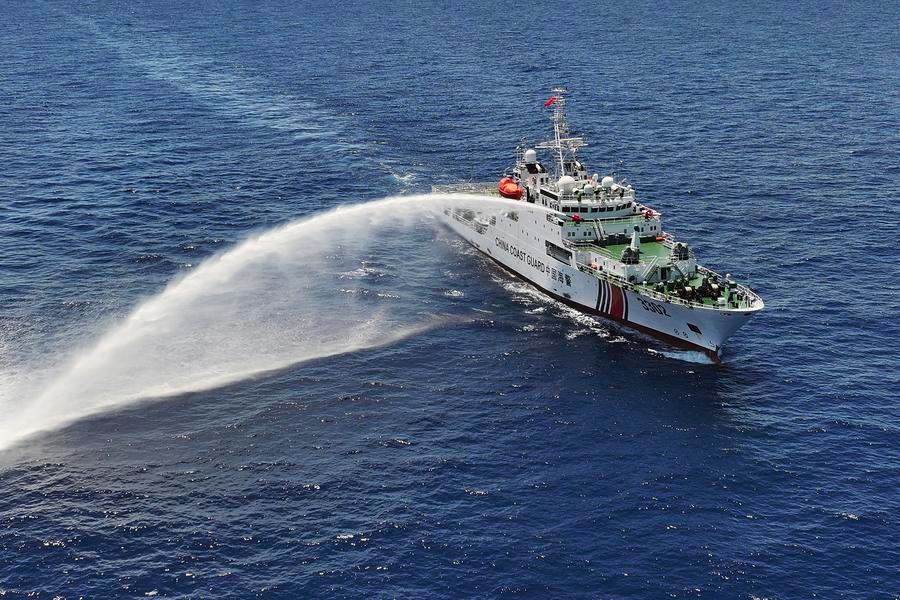
China Coast Guard vessel Chuanshan conducting water cannon training off Scarborough Shoal on May 5 2026. (Image credit: Xinhua)
Malaysia and Brunei extend the picture further. ISEAS – Yusof Ishak Institute Fellow Ian Storey notes that Kuala Lumpur downplays the dispute, remaining quiet about the China Coast Guard's (CCG) near-constant presence at Luconia Shoals and its regular harassment of Malaysian drilling rigs and survey ships in its EEZ, so as to prevent the dispute from overshadowing bilateral relations. The result is that PRC presence in Malaysia's EEZ has, over time, become normalised without reaching a crisis threshold. Brunei, which maintains a claim to Louisa Reef in the Spratlys that overlaps with PRC-claimed waters, has also adopted a generally muted stance on its claim; its economic exposure to the PRC, including infrastructure investment and petrochemical partnerships, reduces the incentive to resist, and the cost of active contestation has consistently appeared to exceed the cost of acquiescence. Neither outcome required Beijing to escalate to a visible confrontation.
Manila's mode of resistance and the allied network forming around it is therefore exceptional rather than representative of claimant behaviour. Beijing does not need to prevail against the Philippines and its partners on every front simultaneously. It needs the cost of resistance to appear higher than the cost of accommodation, and the stance of non-allied claimants provides that comparison, whether or not it is consciously deployed as a signal.
2. The grey zone system
Beijing's South China Sea toolkit is best understood as an integrated system rather than a collection of separate instruments, a framework developed by scholars and analysts including US Naval War College Professor Andrew Erickson on the three-force structure and AMTI director Gregory Poling on its integrated coercive logic. The CCG provides a law enforcement frame, operating under domestic legislation that asserts PRC jurisdiction and presents coercive activity as administration. The maritime militia provides mass and ambiguity, i.e., civilian-registered or civilian-presenting vessels able to crowd, block and harass other claimants while complicating the rules-of-engagement thresholds that apply to uniformed forces. The People's Liberation Army Navy provides the military backstop. Legal, administrative and cartographic instruments, including the 10-dash line (Beijing's 2023 updated maritime claim, adding a tenth dash off the eastern coast of Taiwan to the original nine) and Sansha City, the prefecture-level unit used to administer South China Sea claims, are used to frame tactical actions as ‘governance’.
AMTI's review of CCG patrols over the course of 2025 shows how this system is being operationalised and where Beijing is choosing to concentrate pressure. CCG ship-days at Scarborough Shoal more than doubled from 516 in 2024 to 1,099 in 2025, with patrols observed on 352 of 365 days. Sabina Shoal also saw a significant increase. The reallocation is visible in the declines elsewhere: ship-days at Second Thomas Shoal fell from 288 to 131, and at Thitu Island, the Philippines' most significant Spratly outpost, from 281 to 51, an 82 percent reduction. A separate AMTI report recorded a daily average of 241 maritime militia vessels across monitored reefs in 2025, the highest level in its dataset, concentrated primarily at Mischief and Whitsun Reefs, which together accounted for nearly half the total.
The pattern points to a layered model, with concentrated CCG pressure at priority flashpoints, backed by a militia network providing persistent presence across the broader theatre. Each patrol cycle extends the baseline of what counts as routine PRC presence, and it is that baseline that the grey zone system is designed to shift.
The coercive logic of this system becomes most legible in specific incidents and their timing. On April 10 and 11 2026, the PRC installed a 352-metre floating barrier across the entrance to Scarborough Shoal. The barrier appeared while the Philippines, Australia, and the US were conducting a Multilateral Maritime Cooperative Activity from April 9 to 12 and was removed by around April 13, only after the activity had concluded and days before the opening of Exercise Balikatan on April 20.
Equally revealing was what happened immediately after the Quanzhou talks in late March, when Manila opened initial discussions on potential joint oil and gas cooperation with Beijing. The day after the Quanzhou talks concluded, the PRC’s People’s Liberation Army (PLA) Southern Theater Command conducted combat readiness patrols around Scarborough Shoal. The sequence was characteristic, with cooperation and coercion wielded as simultaneous instruments. Beijing's established approach is to use diplomatic engagement to extract acknowledgement of its framing while maintaining military and physical pressure to reinforce the power asymmetry from which that framing derives.
The energy dimension of this dynamic warrants attention because it illustrates how grey zone pressure translates into political leverage. The Philippines' energy emergency, declared by President Ferdinand Marcos Jr on March 24 following supply disruption from the US/Israel campaign against Iran and compounded by the underlying vulnerability arising from the Malampaya gas field's original wells nearing exhaustion, created conditions for a diplomatic opening that Beijing was well placed to exploit. After Marcos signalled openness to joint oil and gas talks, the two sides convened the 11th Bilateral Consultation Mechanism in Quanzhou on March 27 and 28, with the Philippine Department of Foreign Affairs describing 'initial exchanges on potential oil and gas cooperation.' The PRC embassy in Manila simultaneously called on the Philippines to 'demonstrate sincerity' before negotiations could resume, while PRC Vice Foreign Minister Sun Weidong called for 'concrete actions' to improve ties, a sequence that framed maritime restraint as a precondition of energy cooperation.
Reed Bank, which is central to the broader joint development discussions and believed to hold significant natural gas reserves, is indicative of the underlying logic. Writing in the East Asia Forum, Nguyen Thanh Long points out that Beijing's 'joint development' proposal – Deng Xiaoping's formula, maintained for over 40 years, premised on the understanding that sovereignty belongs to the PRC – would, if accepted, implicitly convert a feature within the Philippines' exclusive economic zone (EEZ) into a jointly administered resource area, bypassing the 2016 South China Sea Arbitration Award ruling. Philippine constitutional constraints make a deal difficult, and Manila has said as much publicly. But the diplomatic channel exists, operating alongside coercive maritime pressure. The danger for Manila is not negotiation itself but negotiation under that pressure, in conditions of domestic energy stress, with a 2028 presidential transition approaching. Strong public opposition to sovereignty concessions limits Marcos' room for manoeuvre, but that same public opinion may also create domestic pressure for energy relief that Beijing can exploit. None of these pressures are individually decisive; together, they narrow Manila's margin in ways that do not require a confrontation to take effect.
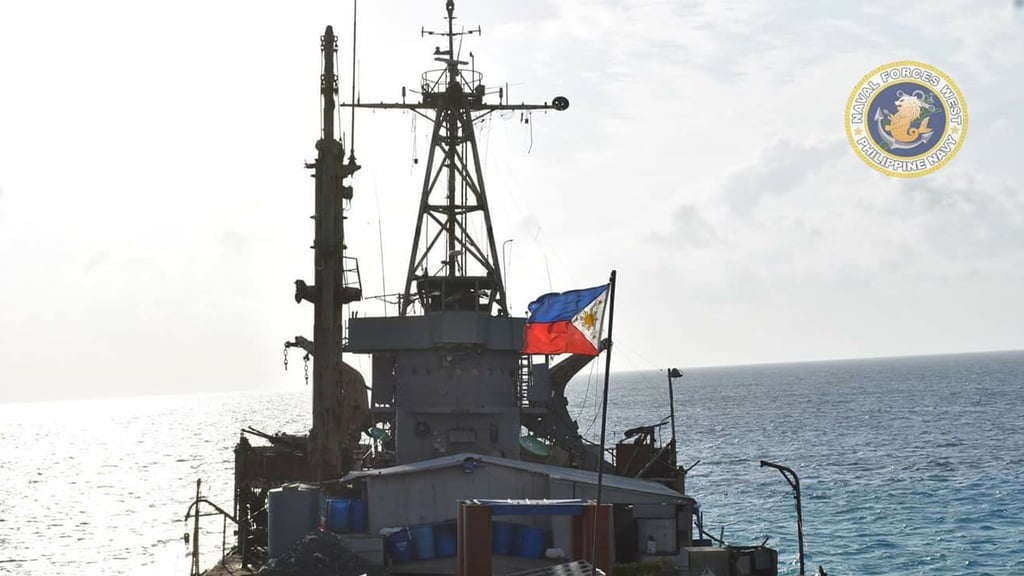
BRP Sierra Madre in 2017. (Image credit: Philippine Navy - Naval Forces West)
Other incidents in this period extend the picture. The March 2026 arrest of three Philippine defence-linked personnel accused of transmitting sensitive information, including resupply details for the grounded vessel BRP Sierra Madre at Second Thomas Shoal, to PRC intelligence handlers has direct operational implications, with the PRC seeking visibility into the logistics that sustain Manila's most exposed outpost. Philippine authorities also reported laboratory confirmation of cyanide in bottles seized from Chinese boats near the Sierra Madre, with at least four documented instances between February 2025 and March 2026. Manila's National Security Council characterised the incident as 'a form of sabotage' intended to damage marine life and deprive the crew of food. Beijing denied responsibility. Cyanide use by Chinese boats in the South China Sea is not a new allegation (it was formally raised at Scarborough Shoal in 2024) but the Second Thomas incidents, if substantiated, concerned not an unoccupied contested feature but a specific military installation and its crew's food supply.
On May 7, Beijing and Manila traded accusations over the Xiang Yang Hong 33, a PRC vessel described by Beijing as a scientific research ship, operating near Iroquois Reef, known in the Philippines as Rozul Reef, at the southern end of Reed Bank. Philippine authorities said the vessel was accompanied by one CCG ship and 13 maritime militia vessels, the grey zone force operating in the theatre where resource diplomacy is simultaneously being conducted.
3. The US presence problem
The question of US military capability in the South China Sea cannot be separated from the question of US political will. These are increasingly distinct variables.
The deeper issue was sharpened by the summit between President Donald Trump and President Xi Jinping in Beijing on May 14-15. Writing for the Council on Foreign Relations, analyst Joshua Kurlantzick observed that Southeast Asian governments emerged from the summit with significant concern about what the US may have conceded, or signalled willingness to concede, on PRC behaviour in contested waters. In another regional reading, Modern Diplomacy editor Rameen Siddiqui noted that Washington's current negotiating needs create pressure toward concessions, and 'the concessions most available are ones that matter enormously to Southeast Asia: reduced American pressure on Chinese South China Sea behaviour … and an implicit acknowledgment that Beijing has primacy in its immediate neighbourhood.'
At the May summit, Xi warned Trump that Taiwan was 'the most important issue in US-China relations' and that mishandling it meant the two countries risked 'collision or conflict'. Indeed, analysts have highlighted that Beijing increasingly treats Taiwan and the South China Sea as a connected strategic theatre, a framing that reinforces pressure on both fronts simultaneously. On May 21, Acting Navy Secretary Hung Cao confirmed at a Senate Appropriations hearing that a US$14 billion arms sale to Taiwan had been paused to preserve munitions for the Iran conflict. The explanation contradicted Trump's own reasoning, articulated as the summit wrapped up, that the sale might serve as a 'very good negotiating chip' with Beijing, a matter he said he had discussed with Xi 'in great detail.' If the regional reading of Washington's positioning is even partially correct, the US-Philippine alliance's deterrent function may be under quiet revision at the leadership level, not just subject to operational constraints.
The operational constraints nonetheless have grown more acute. The comparison between the People's Liberation Army Navy (PLAN) and the US Navy is useful only up to a point. US assessments put the PLAN at more than 370 ships, with projections of roughly 435 by 2030, compared with a US Navy battle-force fleet of 291 ships under the US Navy's May 2026 shipbuilding plan. But hull count alone is an insufficient measure of the problem. The more important distinction is between global capability and local concentration. The US remains the superior global naval power; the PRC has built a more concentrated force for the Western Pacific. In grey zone competition this allows the PRC to keep pressure concentrated around the disputed features that matter to it, while the US must distribute finite forces across the Pacific, the Middle East, Europe and the Atlantic.
The redirection of US naval assets to Middle East operations during the US/Israel campaign against Iran in early 2026 sharpened this problem in practice. Congressional concern surfaced early. At a Senate Armed Services Committee hearing on March 3, Senator Tammy Duckworth said that the Iran conflict was undermining US military readiness and making it harder to focus on defending American interests in the Pacific. The subsequent deployment pattern bore out that concern. By late April, three US carrier strike groups were simultaneously operating in the Middle East, the first time since 2003. The 31st Marine Expeditionary Unit (MEU), the only permanently forward-deployed MEU in the Indo-Pacific, had departed for the region on March 13 with approximately 2,500 Marines. Marine Commandant General Eric Smith told the House Armed Services Committee in May that the corps had left a gap 'unfilled' in the Indo-Pacific.
Moreover, according to flight-tracking data compiled by the South China Sea Strategic Situation Probing Initiative, a Beijing-based source whose government proximity requires careful handling, US land-based reconnaissance flights over the South China Sea fell to approximately 72 in February 2026, the most recent monthly figure available, down from around 102 per month in the preceding two months: a decline of roughly 30 percent in a single month. US global capability remains significant but in a theatre where Beijing is highly attentive to signals of allied resolve, reductions in forward presence are read and assessed as indicators of what the alliance will and will not sustain.
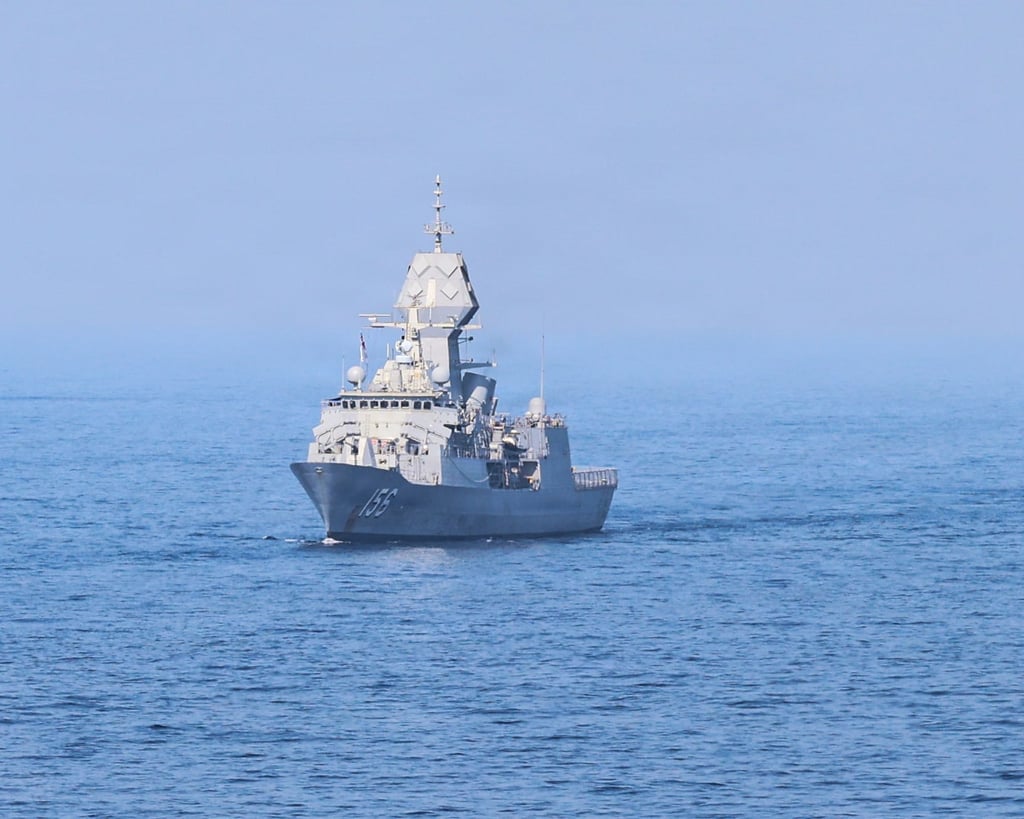
Royal Australian Navy Anzac-class frigate HMAS Toowoomba (FFH 156) cruises in formation with ships from the Armed Forces of the Philippines, Japan Maritime Self-Defense Force, RAN, Royal Canadian Navy, US Coast Guard and US Navy during the group sail exercise for Exercise Balikatan 2026. (Image credit: US Navy)
The allied response to the presence problem has not been passive. Exercise Balikatan 2026, involving 17,000 troops from seven countries, included US deployments of the NMESIS anti-ship missile system to Batanes, the Philippines' northernmost province, roughly 190 kilometres from the southern tip of Taiwan. Japan's participation carried its own landmark: on May 6, the Japan Ground Self-Defense Force fired Type 88 surface-to-ship missiles from Philippine soil for the first time, the first overseas live firing of a Japanese ground-based anti-ship missile since 1945, made legally possible by the Reciprocal Access Agreement that entered into force in September 2025. During the same window, the PLA Southern Theater Command announced that a PLAN surface task group had conducted drills east of the Luzon Strait, while Taiwan reported the Liaoning carrier transiting the Taiwan Strait southward on Balikatan's opening day, the same week Japan's destroyer JS Ikazuchi had transited the Strait. Analysts read the overlapping deployments as signalling directed simultaneously at Japan, Balikatan's allied forces and the diplomatic run-up to the Trump-Xi summit.
The NMESIS deployments demonstrate that the first island chain denial concept is being operationalised. The underlying basis is the Philippines' Comprehensive Archipelagic Defense Concept: if Manila cannot match the PRC's ability to maintain constant presence at every contested feature, it can instead seek to shape the surrounding maritime approaches by dispersing pressure across multiple geographic directions. But these deployments also expose a structural vulnerability: Typhon and NMESIS are US systems, operated under US authority. Their presence contributes to deterrence while they remain, but their withdrawal would be a US decision. An imperfect analogy can be drawn to the March 2026 transfer of THAAD and Patriot components from South Korea to the Middle East, carried out over Seoul's expressed opposition, with President Lee Jae-myung acknowledging that 'the reality is that we cannot fully push through our position.'
Both Manila and Canberra face different versions of the same issue. The US remains powerful, but the question is how much of an ally's deterrence strategy can safely rest on assets that are present by US decision and removable by US decision, and now potentially subject to bargaining that allies cannot observe or constrain.
4. Why this matters for Australia
Australia's exposure to the South China Sea is no longer only a question of trade routes or general support for maritime order. It is becoming an operational question. Canberra is deepening defence cooperation with the Philippines at the same time that the South China Sea contest is intensifying, while many of the capabilities intended to strengthen Australia's independent deterrent posture remain years away.
This is the practical significance of the AUKUS timing gap. The South China Sea contest of the late 2020s will be managed with Australia's current force structure. In submarine terms, that means the Collins class: six ageing diesel electric boats of which only two are available for deployment at any given time. The Australian government's May 2026 announcement of an $11 billion commitment to extend the life of the Collins fleet through the 2040s, far exceeding the original $4-6 billion estimate, is itself a measure of the gap.
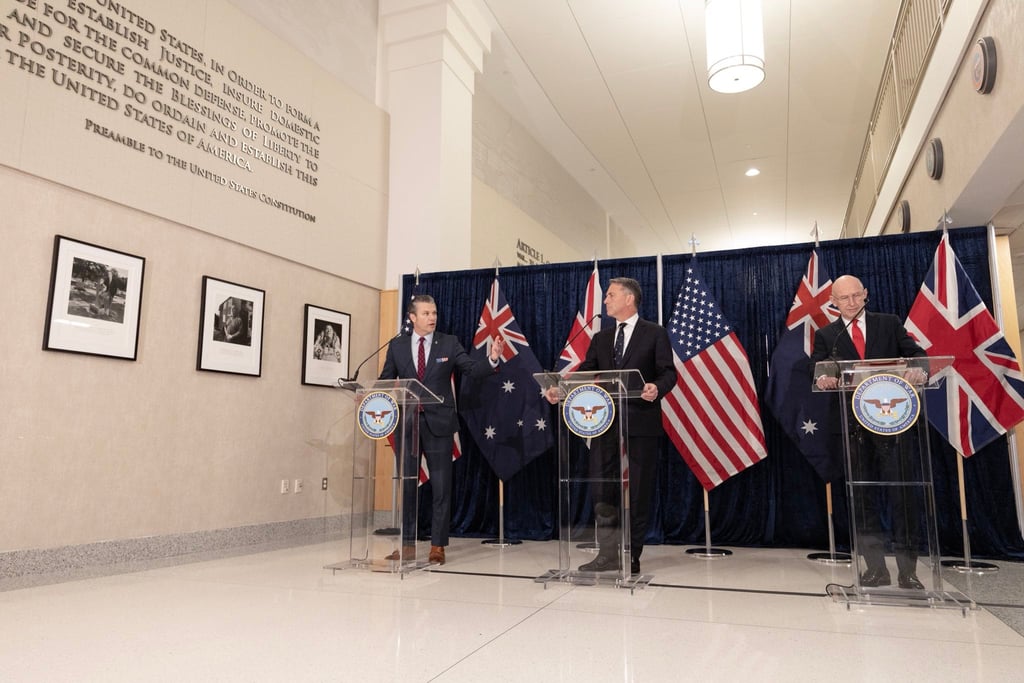
Deputy Prime Minister and Minister for Defence the Hon Richard Marles MP at an AUKUS Defence Ministers’ Meeting with UK Secretary of State for Defence the Rt Hon John Healey and US Secretary of War Pete Hegseth in Washington D.C. on December 11 2025. (Image credit: Australian Submarine Agency / Australian Government)
Australia's 2026 National Defence Strategy (NDS), released on April 16 and committing an additional $53 billion over the next decade, recognises the same problem in broader terms. It notes that PLA intercepts of foreign military vessels and aircraft operating under international law are becoming more frequent and 'at times unsafe and unprofessional', language that directly reflects the operational environment Australian assets are already encountering. It also states explicitly that the US 'increasingly expects its allies and partners to invest more in their own defence, reduce their reliance on the United States military and contribute more to collective defence' — the document's own acknowledgment that US presence cannot be assumed as a constant. The strategy increases defence spending and accelerates investment in long-range strike, undersea warfare, surface fleet expansion, missile defence and uncrewed systems, directions already established by the 2023 Defence Strategic Review and 2024 NDS. These are the right capability priorities. They are also 10-year investments responding to conditions that are developing now.
Australia is already encountering the sharper edge of this environment. Since 2022, Australian forces have been subject to a series of unsafe interactions with PRC forces: a PRC destroyer used hull-mounted sonar against Australian Navy divers from HMAS Toowoomba in the East China Sea in November 2023; a PRC fighter released flares across the path of an HMAS Hobart helicopter in the Yellow Sea in May 2024; a PRC fighter again detonated flares near a Royal Australian Air Force P-8A over the South China Sea in October 2025; and a PLAN helicopter intercepted and rolled toward an MH-60R launched from HMAS Toowoomba in the Yellow Sea in March 2026, requiring evasive action. These incidents matter because they show that Australian operations in contested maritime and airspace environments are being tested as a matter of routine. They sit within a broader threat picture: as noted above, the H6K bombers now deployable to China's South China Sea outposts can reach northern Australia with air-launched cruise missiles, connecting the infrastructure described in Section 1 directly to Australian territory.
The Australia-Philippines defence relationship sharpens this exposure. The Statement of Intent, signed on August 22 2025, to pursue a Defence Cooperation Agreement (DCA) is translating into specific commitments: eight infrastructure projects across five locations in the Philippines, annual defence ministers' meetings and joint patrols in the South China Sea. These build on the Strategic Partnership declaration that explicitly commits both countries to freedom of navigation, UNCLOS, peace and stability across the Taiwan Strait, and bilateral joint patrols. Marcos' own assessment underscores the geometry: 'If there is an all-out war, then we will be drawn into it,' he told Indian news site Firstpost in August 2025, speaking of a Taiwan contingency. The geography he was describing is also the geography through which South China Sea, Taiwan and allied force posture questions increasingly overlap. Canberra is becoming more directly connected to the operating environment in which a regional crisis would unfold.
The wider allied network is also becoming more material. The Japan-Philippines Reciprocal Access Agreement, which entered into force on September 11 2025, and the Acquisition and Cross-Servicing Agreement signed on January 15 2026 give legal and logistical form to a relationship that a decade ago was largely rhetorical. The Japan agreements in particular link two ends of the first island chain, connecting Philippine operations in the South China Sea to Japanese interests in the East China Sea and creating the basis for mutual logistical support between them. New defence procurement deals with South Korea signed in March 2026 reinforce the fact that Manila is actively reducing its dependence on any single external partner. The US Defense Logistics Agency's March 31 solicitation for a Defence Fuel Support Point in the Davao region, capable of storing 41 million gallons of naval and aviation fuel by 2028, extends the alliance's logistics network. Further north along Luzon's Pacific-facing coast, early-stage US defence and energy investment interest in Aurora province, including a US defence supplier's expression of interest in the Aurora Pacific Economic Zone, hints at the possible emergence of a logistics rear area for the northern theatre, though none of these projects has yet materialised.
Conclusion
The South China Sea contest is not being decided by a shift in conventional military balance. The problem is that Beijing is not relying on that level of competition. Its gains are being made through accumulation.
The Philippines is where this method is being tested most clearly. Renewed reclamation, intensified pressure at Scarborough Shoal, activity around Reed Bank and repeated pressure on Second Thomas Shoal do not amount to a decisive PRC victory. They do, however, narrow Manila's operating space and make each subsequent act of resistance more costly. The risk is not that the Philippines suddenly loses control of its maritime position, but that the baseline against which control is measured keeps shifting.
US missile deployments, Balikatan, Japanese participation, Australian–Philippine infrastructure cooperation and Manila's wider security partnerships all complicate PRC planning. But they do not fully answer the problem. Much of the visible deterrent weight remains dependent on US assets, US priorities and US political decisions. The distinction between these last two has become the central unresolved variable. Operational constraints are familiar problems that alliances have tools to manage. The question now being raised by the Trump-Xi summit and its regional reception is qualitatively different: whether Washington's commitment to contesting PRC behaviour in the South China Sea remains a fixed point, or whether it has become a bargaining chip. Allies cannot observe that negotiation, and they cannot constrain it.
At the same time, Beijing is using Philippine energy vulnerability and resource diplomacy to test whether pressure at sea can be translated into political accommodation. The Quanzhou channel, the Reed Bank discussions and the energy emergency that created the opening for both illustrate how the grey zone system functions beyond the waterline, generating the conditions under which coercion becomes leverage.
For Australia, this makes the Philippines a practical test of regional strategy. Canberra is becoming more operationally connected to Philippine defence while still relying on assumptions about open sea lanes, US forward presence and capability programmes that will mature over a longer timeframe. The competition in the South China Sea is attritional. Its danger lies precisely in the fact that it can proceed without triggering the mechanisms on which allied deterrence has traditionally relied. A strategy built mainly to respond to open conflict may still lose ground to a strategy designed to avoid one.
AUTHOR

Manager, Research Analysis, Australia-China Relations Institute, University of Technology Sydney
News
Australia-China Weekly Brief: October 2026 issues
The Australia-China Weekly Brief by the Australia-China Relations Institute at the University of Technology Sydney (UTS:ACRI) tracks key developments in...
News
Whose security counts in the Pacific?
While climate-related spending gets criticised, billions forked out for security and strategic engagement gets framed as for the “national interest”.
News
Australia-China Weekly Brief: September 2026 issues
The Australia-China Weekly Brief by the Australia-China Relations Institute at the University of Technology Sydney (UTS:ACRI) tracks key developments in...
News
If we asked the Americans to leave, would they?
Canada is looking for ways to protect its independence from Washington. Australia has embedded itself so deeply in the US military system that it risks being...
News
Australia-China Weekly Brief: October 2026 issues
The Australia-China Weekly Brief by the Australia-China Relations Institute at the University of Technology Sydney (UTS:ACRI) tracks key developments in...
News
Whose security counts in the Pacific?
While climate-related spending gets criticised, billions forked out for security and strategic engagement gets framed as for the “national interest”.
News
Australia-China Weekly Brief: September 2026 issues
The Australia-China Weekly Brief by the Australia-China Relations Institute at the University of Technology Sydney (UTS:ACRI) tracks key developments in...
News
If we asked the Americans to leave, would they?
Canada is looking for ways to protect its independence from Washington. Australia has embedded itself so deeply in the US military system that it risks being...