


- Posted on 1 Aug 2025
- 4 mins read
The facts of the Hulk Hogan privacy saga are stranger than fiction. In 2012, a sex tape appeared online showing Hogan having sex with a model who was married to his best friend, a radio DJ. The sex was apparently consensual. The twist was the DJ was the one filming, with Hogan (and the model) saying they didn’t know they were being filmed. Hogan sued the couple and settled out of court.
Then, when the Gawker website published an excerpt from the tape, Hogan sued the website for an invasion of privacy, intentional infliction of emotional distress and infringement of personality rights. Gawker refused to take down the clip, citing freedom of speech and the First Amendment. But in 2016 Hogan was awarded a staggering $212 million by a jury, which was later reduced to $47 million. The judgment bankrupted the Gawker website. It also set an enduring legal precedent: even in the US, where freedom of speech is highly protected, celebrities can successfully sue for some privacy invasions. The whole saga is complicated further because Hogan’s privacy lawsuit was bankrolled by Peter Thiel, co-founder of data giant Palantir, which has attracted controversy for its involvement in government surveillance.
In Australia, we’re in the middle of major privacy reform. Just last month, the new statutory tort for serious invasions of privacy came into effect. This belatedly brings Australia into line with comparable jurisdictions. However, journalists have an exemption from the tort, just as they do in the Privacy Act itself. This means you have little recourse if your privacy is invaded by journalists, even when such an invasion is not in the public interest.
This is poor. In a 2023 submission, we argued that the journalism exemption in the Privacy Act should be retained, but only if accompanied by the introduction of a statutory tort without an exemption for journalists, and with increased requirements for journalists to be subject to professional standards and effective complaints mechanisms. Sadly, neither of those two provisos came to be legislated. In Australia, freedom of speech is badly under-protected; but privacy remains under-protected too, particularly when it comes to protections against unscrupulous journalists.
If a Hulk Hogan-style sex tape were published by news media in Australia, the Privacy Act and the new statutory tort would offer no protection. That’s not to say there would be no recourse. The Crimes Act now contains s 91Q, which criminalises the distribution of intimate images without consent. And under s 91P, the recording of such images is also a crime. The maximum penalty under these provisions is a hefty fine or three years in jail.
What about our errant Astronomers? Would they have had any legal recourse if the concert had been in Sydney? Probably not, given all the disclaimers and notices about filming usually posted around venues. What’s more, I’m not suggesting that the kiss-cam should be illegal. But there is something creepy about it. At a 2012 college basketball game, one couple caught on a kiss-cam were visibly unimpressed, leading to boos and heckles from the crowd. As one commentator noted, it looked a lot like ‘harassment dressed up as stadium banter’.
The law can, and should, only go so far. I wouldn’t propose a law that bans kiss-cams. On the other hand, I do think the law should prohibit the non-consensual recording and sharing of sex tapes, even of celebrities. And of course, the law is only one way to protect privacy. Tech solutions are possible too. This month, Michael Davis and I were part of a team from UNSW and UTS that was awarded a grant to research an AI agent that will empower individuals in the face of digital services that pay scant regard to consent as they vacuum up data. You know, like the way your personal health app might be sending data to Facebook.
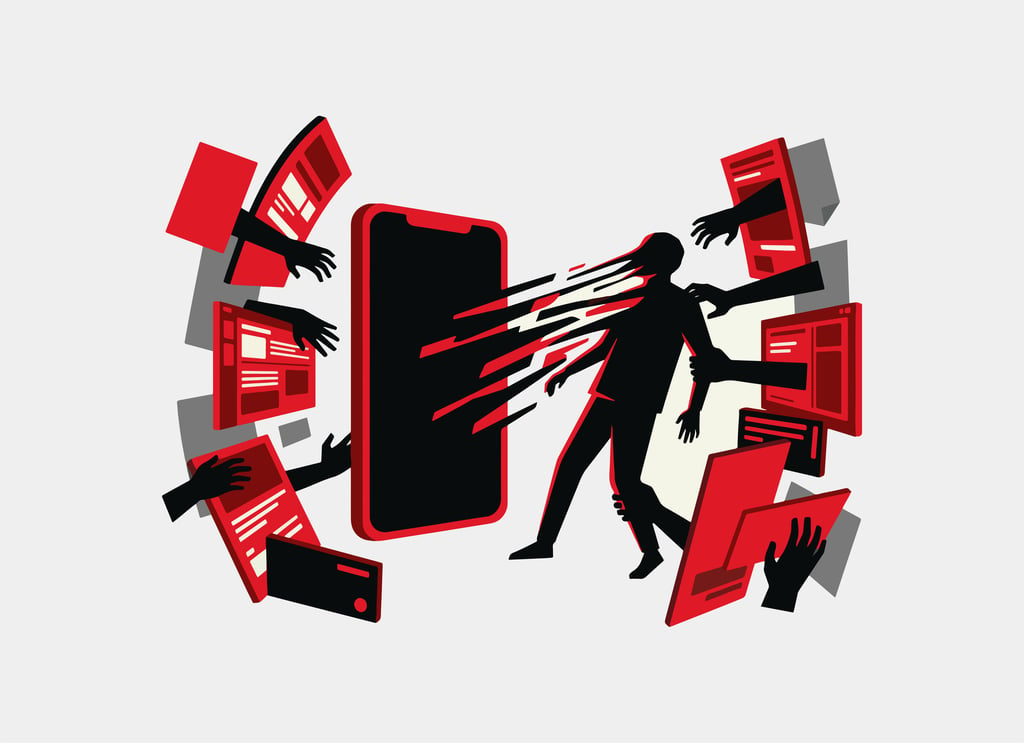
With all these AI news and AI influencers, it’s hard to know where to look. But one thing’s for sure: it’s increasingly hard to avoid being looked at. How many cameras and microphones are trained on you right now? Your phone? Watch? Laptop? TV? Car? Doorbell? We live in a world of pervasive surveillance, of kiss-cams, sex tapes and Cambridge Analytica (for which Meta has agreed to pay Australian Facebook users $50million). With our private lives being squeezed, we need to cherish the privacies that matter. The privacies that make us human. To help with that, we need to keep working to improve both privacy law and privacy tech, so that sometimes we can gaze out at the stars, or even just gaze starry-eyed, secure in the knowledge that no one is watching us.
Author

Associate Professor, Faculty of Law
Explore
News
Tell us what we want
Centre for Media Transition newsletter - Tell us what we want, what we really really want | Issue 18

News
Embedded links
Michael Davis looks at the recently announced partnership between USA Today Co. and Palantir, whose reputation has the company’s reporters up in arms.

News
A'muse'ing
Harry Craigie looks at Meta’s newly released agentic AI system Muse, which like many AI products, gives us plenty of what we want, but likely at the price of...
News
Deplatforming and deportation
Monica Attard looks at Latvia’s decision to expel exiled Russian journalist Leonid Ragozin, who had resided in the country since 2014. His reporting, while...
News
Tell us what we want
Centre for Media Transition newsletter - Tell us what we want, what we really really want | Issue 18
News
Embedded links
Michael Davis looks at the recently announced partnership between USA Today Co. and Palantir, whose reputation has the company’s reporters up in arms.
News
A'muse'ing
Harry Craigie looks at Meta’s newly released agentic AI system Muse, which like many AI products, gives us plenty of what we want, but likely at the price of...
News
Deplatforming and deportation
Monica Attard looks at Latvia’s decision to expel exiled Russian journalist Leonid Ragozin, who had resided in the country since 2014. His reporting, while...