


- Posted on 12 Mar 2026
- 4 mins read
Existential questions around the sustainability of the news business continue to swirl. Here in Australia, we are still waiting for the federal government to decide on whether the News Bargaining Incentive is the best mechanism to force digital platforms to help keep the lights on in newsrooms around the country.
In the United States, where free market ideology stands as a barrier against legislative mechanisms, The New York Times has come up with an ingenious, if not exactly new way to keep itself afloat. Just as The Washington Post announced a third of its journalists were to be made redundant, The New York Times announced an additional 1.4 million subscribers to add to its already very healthy 12.8 million paying readers, which had analysts wondering whether this was good news for journalism – or something different.
As it turns out, journalism isn’t the outright winner.
Analysts pouring over the Gray Lady’s subscriber stats have noted the success of a 21st century reimagining of a 19th century phenomenon – bundling. But in the current bundling formulation, news isn’t its most marketable moving part.
In fact, bundling of games, cooking and sport (The Athletic) are now marketed more prominently by The New York Times than its news-alone product. And that makes sense given the paper’s news only subscribers have dropped 65% since June 2022, making news a loss leader for this $2 billion digital revenue juggernaut, according to Ashan Gupta, a US based product management analyst.
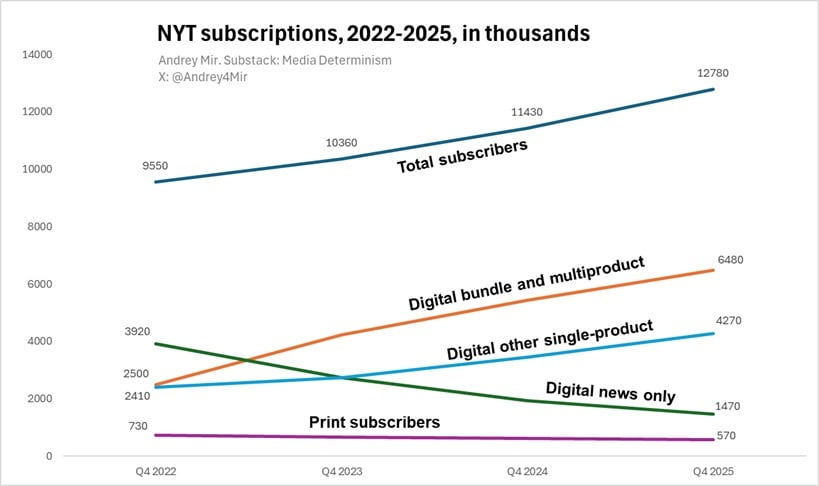
Now, the paper’s news-only offering is actually less easy to find than the "all access" option which offers subscribers games, audio, cooking and sport, or any of these as standalones. Bundling in “the lot” is also cheaper than opting for news alone.
News offerings to reach audiences has been the siren call for media organisations for many years now, one they’ve touted with pride, consistency and determination. In the United States, as in Australia, the glory days were also marked by subscribers buying in for the sports pages, or the classified pages which once we scoured to buy cars and homes. The internet however, has made it easy to access all these services cheaply but from different sources. The holy grail since the advent of the internet has been to find a way to get people to subscribe to newspapers in a disaggregated environment. The determination to keep news as the draw-card might have been the obstacle. It looks like the Gray Lady has stumbled on a solution: market all the add on’s - not news - as the main game. Indeed, its marketing logo is now, for family bundles at least “To each their own Times”.
Aakash Gupta notes The New York Times has built an attention ecosystem where “…Wordle gets you in the door, Cooking keeps you at breakfast, The Athletic owns your commute, and by the time you think about cancelling, you’d lose four products instead of one.”
Andrey Mir, a media theorist who focuses on the political economy of the news media says “One might argue this is just price sensitivity: if news-only costs the same as a bundle that includes games, cooking, product reviews, and sports, readers will naturally choose the bundle. And the numbers confirm it—bundles are growing. But that also reveals the real driver: non-news products are what’s actually attracting subscribers. News is becoming the add-on, not the draw.”
You would think that current global events would highlight the importance of verified, independent and objective news for anyone willing to pay. The statistics are telling a different story - news might now be just for the purists, and clearly their numbers are falling.
Author

Monica Attard
Co-Director, Centre for Media Transition
Explore


News
Is AI really the problem?
Susanne Lloyd-Jones looks at the AI breaches of Australian Federal government sites and questions whether agentic AI working independently of human...

News
Maintaining trust in an era of AI Slop
Chris Hall takes a deep dive into the increasing amount of AI use on YouTube and he looks at how serious youtubers are being challenged by the increased...

News
Jason Arday and the media
This DoubleTake episode of the podcast features journalist and University of Melbourne lecturer Sami Shah talking with Monica about the media treatment of the...
News
Is AI really the problem?
Susanne Lloyd-Jones looks at the AI breaches of Australian Federal government sites and questions whether agentic AI working independently of human...
News
Maintaining trust in an era of AI Slop
Chris Hall takes a deep dive into the increasing amount of AI use on YouTube and he looks at how serious youtubers are being challenged by the increased...
News
Jason Arday and the media
This DoubleTake episode of the podcast features journalist and University of Melbourne lecturer Sami Shah talking with Monica about the media treatment of the...