

- Posted on 29 Jul 2025
The Law Health Justice Community Advocacy Clinic is a collaboration between UTS Faculty of Law and Health Justice Australia.
About the collaboration
The LHJ Community Advocacy Clinic is a collaboration between UTS Law and Health Justice Australia, a field-building intermediary dedicated to enabling cross-sector collaboration. Health Justice Australia works in response to Australia's priorities of early intervention and prevention, and the development of connected service systems that leverage existing community and service infrastructure to meet the needs of individuals and families.
The clinic brings together student interns, academic supervisors and community partners to address the place of multidisciplinary partnerships in improving health and wellbeing. It is not a source of one-on-one advice; rather, it responds to shared community problems to provide information and advocate for change.
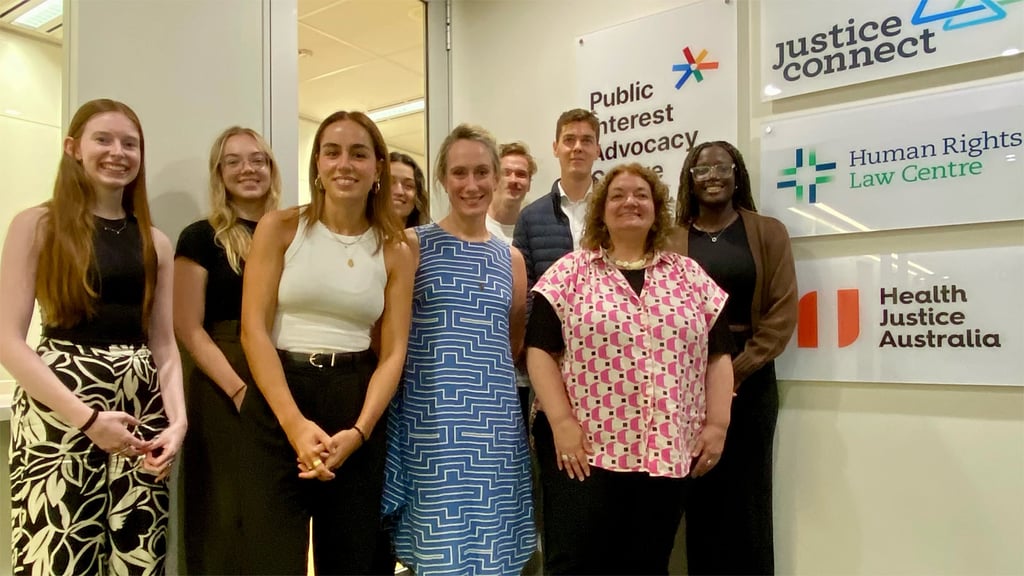
The Community Advocacy Clinic Project 2024
The Royal Commission into Violence, Neglect and Exploitation of People with Disability highlighted the disproportionate impact of ‘prenatal reports’ on people with disability. This is amplified for First Nations people with disability. These reports are not mandated in NSW but can be submitted to child protection systems when someone believes a parent poses a risk of future harm to children following their birth. The Commission highlighted how such reports can trigger responses that are discriminatory and contravene Australia’s obligations under both the UN Convention on the Rights of Persons with Disabilities and the UN Convention on the Rights of the Child. The inaugural Clinic focused on clarifying the meaning and implications of these reports for individuals, family members, and support workers. It also advocated for change.
The Community Advocacy Clinic Project 2025
Also influenced by the Royal Commission, in 2025 the clinic addressed the use of restrictive practices and people with disability. These practices – chemical, physical, mechanical, and environmental restraints - often breach basic human rights, leaving enduring physical and psychological trauma. Despite State and Commonwealth undertakings to reduce and eliminate restrictive practices – and commitments under the Convention on the Rights of Persons with Disabilities and the Optional Protocol to the Convention Against Torture – the ongoing prevalence of such practices highlights a failure to meet legal obligations as well as national promises of inclusive, rights-based care. The clinic advocated for change and provided five practical recommendations to help reduce and ultimately eliminate restrictive practices.
Want to find out more?
For more information about the clinic, please email Michael Thomson at: michael.thomson@uts.edu.au.
Learn more about Health Justice Australia (external link).
News
Law Health Justice Community Advocacy Clinic
A new collaboration between Law Health Justice and Health Justice Australia.

News
Law Health Justice Community Advocacy Clinic 2025
The Law Health Justice Community Advocacy Clinic is a collaboration between UTS Faculty of Law and Health Justice Australia.
News
Law Health Justice Community Advocacy Clinic
A new collaboration between Law Health Justice and Health Justice Australia.
News
Law Health Justice Community Advocacy Clinic 2025
The Law Health Justice Community Advocacy Clinic is a collaboration between UTS Faculty of Law and Health Justice Australia.