


Fotini chose UTS Engineering for its flexibility, strong community, and broad career pathways, building skills for diverse futures in mechatronics and beyond.
Fotini Koutsodimas sees studying Engineering at UTS as a foundation for many possible careers.
When she first encountered robotics in primary school, it sparked a curiosity she couldn’t quite name yet. Working with LEGO EV3 kits in Year 6, she discovered she loved problem-solving, building and experimenting. By high school, that curiosity had evolved into a strong interest in maths and physics, but she still wasn’t sure where it would lead.
“I knew I liked maths, but I didn’t really know what engineering actually was,” she says.
Fotini considered multiple paths. She enjoyed working with people just as much as technical subjects and even thought about pursuing early childhood education.
It wasn’t until she discovered mechatronic engineering, and later humanitarian engineering, that everything clicked.
“That was the moment it all made sense. I could combine my interest in technology with working with people and making a real impact.”
Finding purpose in mechatronic engineering at UTS
At UTS, Fotini found more than just an engineering degree; she found direction.
While studying a Bachelor of Engineering (Honours) Mechatronic, Fotini was drawn to its blend of mechanical systems, electronics and programming, particularly its connection to robotics and automation engineering.
But what surprised her most was the human side of engineering.
“I didn’t realise how much creativity and design thinking is involved. It’s not just technical, it’s about understanding people, working with them and designing solutions that help.”
Fotini developed skills across programming, CAD design and electronics. In one studio project, she designed and built a step tracker from scratch, from coding the software to 3D printing the housing.
“You’re involved in every part of the process. It’s hands-on and collaborative, and you see how everything connects.”
Gaining industry experience during an engineering degree
A key reason Fotini chose UTS was the opportunity to gain industry experience early in her degree. In her second year, she secured an internship at a small manufacturing company, where she worked on real engineering problems.
Her role combined design and programming; from modelling machine parts in CAD to developing a PLC-controlled test bench for hydraulic systems.
It gave me confidence in my skills and showed me how what we learn at university applies in industry. You’re not just studying; you’re already becoming an engineer.”
That experience reinforced her interest in mechatronics and helped her see the breadth of career possibilities.
Building confidence through a supportive engineering community
As a woman in a male-dominated field, Fotini was aware of the gender gap, but says the strong community at UTS made a critical difference.
“You might look around and realise there aren’t many women in the room, but you don’t feel alone because the community is so supportive.”
Through UTS Women in Engineering and IT (WiEIT) community, she became a Gender Equity Ambassador, delivering STEM workshops to school students and leading outreach programs.
“That’s been one of the most meaningful parts of my experience. Seeing how much representation matters, especially for young girls. It really stayed with me.”
She also participated in Lucy Mentoring Program, connecting with industry professionals who helped build her confidence and understanding of engineering careers.
The mentorships give me insights into what different roles look like in real world, which helps me back myself when applying for opportunities.”
Engineering with purpose
Fotini’s interest in humanitarian engineering shaped her approach to the field. Through coursework and extracurricular activities, she explored how engineering can address real-world challenges, from community-focused design projects to developing impact frameworks for organisations.
“It’s about creating solutions that genuinely benefit people. That’s what motivates me.”
This perspective has also influenced her long-term goals. She hopes to move into leadership roles where she can support others, particularly women in engineering.
“There’s still a retention gap for women in the industry. I’d love to be in a position where I can mentor and support others coming through.”
A mindset for the future
Now in her final year, Fotini reflects on how far she’s come from having limited technical knowledge to developing a broad, adaptable skill set.
“One of the biggest lessons is that failure is part of the process. You learn just as much from what doesn’t work.”
She also sees the multiple industry directions that a course in engineering can provide.
You realise your skills are transferable. You can work across different industries; it’s not limited to one path.”
Advice for future engineering students
“If you’re even a little bit curious, just go for it,” Fotini says.
She emphasises that you don’t need prior experience to succeed.
“You’re at university to learn. Don’t let the fear of not knowing enough hold you back because you’ll learn so much along the way.”
Why study engineering at UTS?
For Fotini, engineering at UTS combines creativity, technical skills and real-world impact, supported by a strong community and early industry experience.
“Your career really does start when you begin studying. You’re already building skills, gaining experience and finding where you fit.”
And for her, that journey started with curiosity, and is led by purpose.

Webpage
Aalia chose an Engineering degree because she believed it kept possibilities open.

Webpage
From cybersecurity curiosity to global impact, discover Noussayba's engineering journey at UTS.

Webpage
She is already shaping Australia’s future energy systems and is right now, studying abroad in Milan.
Webpage
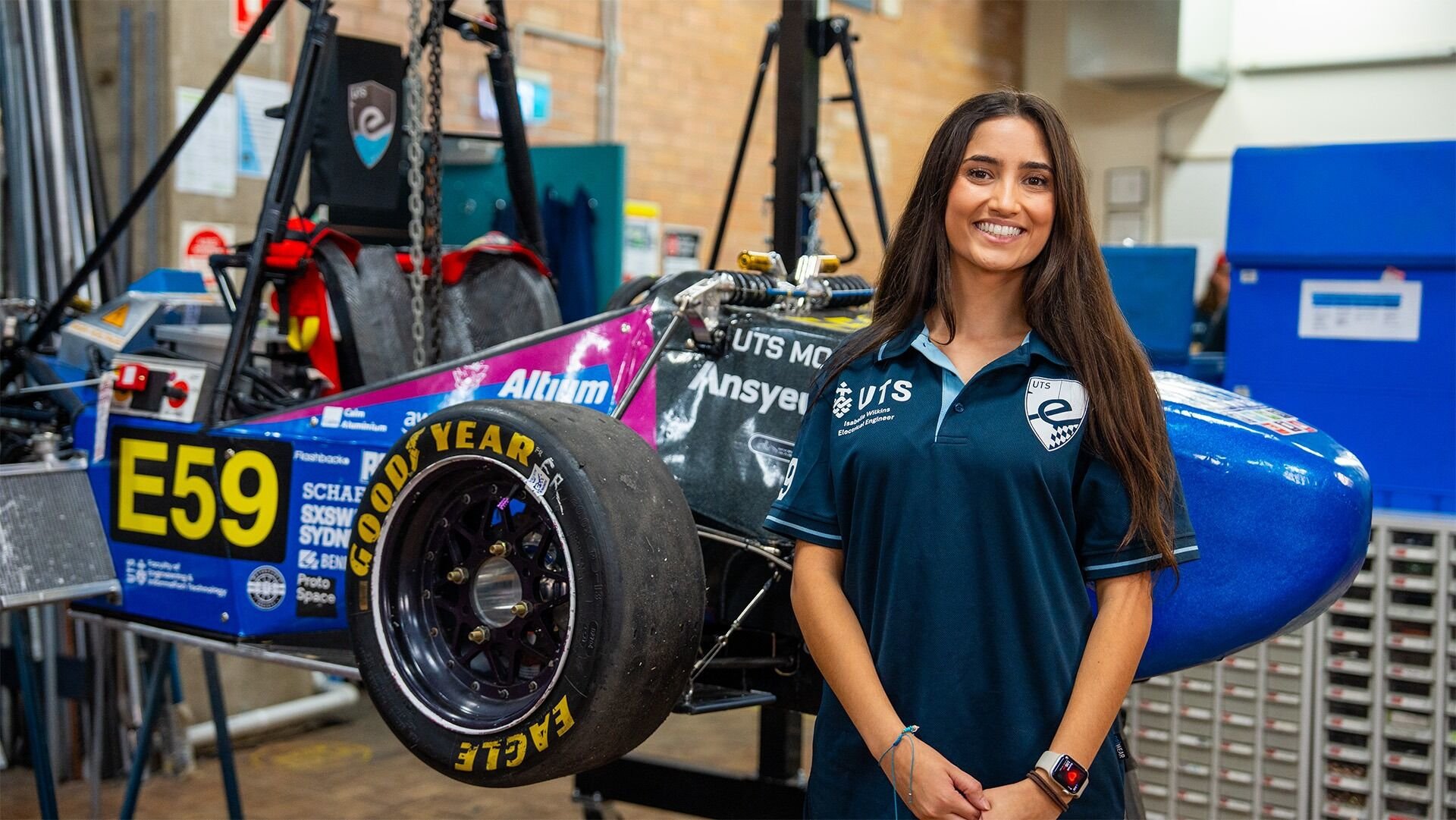
Isabelle's engineering journey isn’t just about degrees and grades; it’s about exploration, hands-on learning, and building connections that’ll shape a career.
Webpage
Aalia chose an Engineering degree because she believed it kept possibilities open.
Webpage
From cybersecurity curiosity to global impact, discover Noussayba's engineering journey at UTS.
Webpage
She is already shaping Australia’s future energy systems and is right now, studying abroad in Milan.
Webpage
Isabelle's engineering journey isn’t just about degrees and grades; it’s about exploration, hands-on learning, and building connections that’ll shape a career.