Why group work?

WrVtGkm0r7Q

Transcript

You are probably watching this because you have to do a group assessment task, and are wondering – wouldn’t it be so much easier if I did this on my own? Why group work?

Like it or not, working in groups is an integral part of your studies and uni assessments. If you don’t work well in groups, your grades might suffer. Beyond university, the ability to effectively interact and communicate with others to achieve a shared goal is a vital career and life skill. But no-one says group work is easy. It requires effort. However, most would agree that group work is essential. But why? What’s in it for you?

Think about the benefits for you: authentic preparation for the workplace, increased understanding of different perspectives, improved interpersonal communication skills such as listening, clarifying, explaining, giving feedback, sharing, negotiating, demonstrable collaboration skills such as flexibility, adapting to different roles, leadership, coaching, supporting, assisting others, organisation, planning, people management, self-management, time management, a network of meaningful working relationships and a greater sense of belonging.

So, as you start your group work, think about these benefits, maybe discuss them with your group, and identify the ones you want to focus on as you complete the group task.

Related links

Working in a diverse group

M7QNtm0B4Fc

Transcript

You are probably watching this because you have to do a group assessment task and are wondering, wouldn't it be so much easier if I did this on my own? Why group work? Like it or not, working in groups is an integral part of your studies and uni assessments. If you don't work well in groups, your grades might suffer. Beyond university, the ability to effectively interact and communicate with others to achieve a shared goal is a vital career and life skill. But no one says group work is easy. It requires effort. However, most would agree that group work is essential. But why? What's in it for you? Think about the benefits for you: authentic preparation for the workplace, increased understanding of different perspectives, improved interpersonal communication skills such as listening, clarifying, explaining, giving feedback, sharing, negotiating. Demonstrable collaboration skills such as flexibility, adapting to different roles, leadership, coaching, supporting, assisting others, organisation, planning, people management, self-management, time management, a network of meaningful working relationships and a greater sense of belonging.

So, as you start your group work, think about these benefits, maybe discuss them with your group and identify the ones you want to focus on as you complete the group task.

[Visuals: Four students, Devon, Joyce, Jyoti, and Juwin, are sitting together in a classroom, introducing themselves.]

Devon: I guess we could just start again. Um, right, my name is Devon. Devon Fury, in case you are interested. It’s a really cool last name. [laughs] And I’m studying a Bachelor in Business.

Joyce: My name is Joyce and I’m studying a Masters of Accounting.

Jyoti: My name is Jyoti. I’m doing a Bachelor in Business, majoring in Finance and Accounting.

Juwin: My name is Juwin. I’m doing a Bachelor in Business. Ultimately a business student studying finance and accounting major.

[On-screen text: WHAT’S YOUR GROUP WORK EXPERIENCE LIKE?]

Devon: So I guess we can jump right in and start talking about group work. If we want to talk about group work experiences, I was actually in one with Jyoti last semester?

Jyoti: Yeah.

Devon: Right?

Jyoti: One or two? I don’t remember.

Devon: I lose track. I lose track. Yeah, I think it was pretty positive overall. And honestly, what made it good was Jyoti was really keen to divide the work from the beginning.

Jyoti: Yup.

Devon: She pretty much charged straight in. Like we had just introduced ourselves and we stepped outside the classroom and I remember Jyoti was very keen. Like, “Okay, how do we want to do this? How do we want to break it up?” And it got everybody thinking about the structure of it, made sure that everyone was looking at what was actually in the project from day one.

[On-screen text: HOW HAVE YOU BENEFITTED FROM GROUP WORK?]

Jyoti: Well, for me personally, I think group work has been rewarding as an international student because most of my friends are through group work—[laughs]—unfortunately. So yeah, as an international student, when I came here, I didn’t know anyone. And even in class, it’s really hard to make good friends because you go to lectures and it’s like a big class, you don’t get to interact with anyone. And even in tutorials, you see them like once a week and you have another subject and you see them once a week and it’s really hard to connect. But through group work, you can connect with people, you are in touch with them, and sometimes you might be in the same class next semester. So that’s how you make friends. And also it helped a lot in communication skills. I personally try a lot to improve my communication skills but I give a big thank you to the group work provided by the university because it really helped me to communicate better than before.

[On-screen text: WHAT ARE THE BENEFITS OF DIVERSITY IN GROUP WORK?]

Joyce: I think, like, the diversity depends on age, background, culture and anything else, but let me say, in uni, most diverse groups are depending on diverse culture. Because we can learn from each other, from the different perspective, and I think the more people involved, the more value we can add in the team.

Juwin: I would say that my own personal benefit from having a greater diversity in a group is that you can have a sharing of ideas that you wouldn’t have had on your own.

Devon: The benefit I have observed from diversity is just having different perspectives to draw on.

[On-screen text: WHAT’S YOUR ADVICE TO OTHER STUDENTS?]

Joyce: Don’t be shy?

Devon: That’s great advice. Don’t be shy.

Joyce: Don’t be shy and, yeah I think that’s important.

Juwin: Yeah.

Devon: I totally agree.

Jyoti: In my opinion, I think it’s really important to start early. The earlier the better. It’s going to make life for everyone very easy. And secondly, not to be shy to choose parts. Like you can choose whatever part you feel comfortable with, so that’s going to make everybody’s life easier again.

Devon: But yeah, just keep an open mind. Be friendly, talk to people, it’s going to be fine. We’re pretty much all on the same boat. That guy who seems to know lots of stuff probably doesn’t know as much as he seems to you because you are not inside his head. The person who seems like they are not following at all probably knows a lot of stuff and is just shy or insecure, so—

Juwin: Yeah,

Devon: —fine.

Juwin: Yeah, it’s hard like that.

Devon: We are brothers in academics! Fight! Kill the assignments! [laughs]

Juwin: [laughs] Yeah, of course. Yeah, it’s always good to take a step back. You can’t always go with your first assumption. What we can take away from what has been said: you can’t always know who you are looking at is exactly everything that they are. Just make sure that you have that dialogue and you know what to expect from them in the future by knowing their strengths, their weaknesses, all those things for sure.

Related links

Making group work work

mWheKGSr3sI

Transcript

You are probably watching this because you have to do a group assessment task and are wondering, wouldn't it be so much easier if I did this on my own? Why group work?

Like it or not, working in groups is an integral part of your studies and university assessments. If you don't work well in groups, your grades might suffer.

Beyond university, the ability to effectively interact and communicate with others to achieve a shared goal is a vital career and life skill. But no one says group work is easy. It requires effort.

However, most would agree that group work is essential. But why? What's in it for you? Think about the benefits for you: authentic preparation for the workplace, increased understanding of different perspectives, improved interpersonal communication skills such as listening, clarifying, explaining, giving feedback, sharing, and negotiating.

Demonstrable collaboration skills such as flexibility, adapting to different roles, leadership, coaching, supporting, assisting others, organisation, planning, people management, self-management, time management, a network of meaningful working relationships, and a greater sense of belonging.

So, as you start your group work, think about these benefits, maybe discuss them with your group, and identify the ones you want to focus on as you complete the group task.

[Visual: Animated graphics show students working together in groups, collaborating on assignments, and discussing ideas. Text overlays highlight key skills such as communication, leadership, and organisation.]

[End of video.]

Related links

Freeloaders and suckers

TJhveEQmsOE

Transcript

You are probably watching this because you have to do a group assessment task and are wondering, wouldn't it be so much easier if I did this on my own? Why group work? Like it or not, working in groups is an integral part of your studies and uni assessments. If you don't work well in groups, your grades might suffer. Beyond university, the ability to effectively interact and communicate with others to achieve a shared goal is a vital career and life skill. But no one says group work is easy. It requires effort. However, most would agree that group work is essential. But why? What's in it for you? Think about the benefits for you.

Authentic preparation for the workplace, increased understanding of different perspectives, improved interpersonal communication skills such as listening, clarifying, explaining, giving feedback, sharing, negotiating. Demonstrable collaboration skills such as flexibility, adapting to different roles, leadership, coaching, supporting, assisting others, organisation, planning, people management, self-management, time management, a network of meaningful working relationships and a greater sense of belonging.

So, as you start your group work, think about these benefits, maybe discuss them with your group and identify the ones you want to focus on as you complete the group task.

[Visual: Animated illustration of a group of students working together. Some students are actively participating, while one student is sitting back, not contributing.]

A freeloader is someone who takes advantage of the other group members by taking a back seat and not contributing much, if at all. At the opposite end of the spectrum is a sucker, who ends up doing everything for those who are not pulling their weight. Freeloaders and suckers are one of the main reasons why so many students hate group work. It’s unfair to everyone involved, and causes a lot of resentment and unhappiness in the group. It also leads to poor outcomes for the group because only some of the members feel committed and involved. But there are ways to stop freeloaders and suckers!

Imagine group work heaven, where everyone has similar expectations about the outcomes of the group work, works towards a common goal, and knows exactly what their responsibilities and accountabilities are. It is so important for the group as a whole to agree on and establish common expectations and goals. For instance, if Tom just wants a Pass whereas Lin wants to get a Distinction, then Tom probably won’t put in as much effort as Lin. But if all the group members agree on the grade they want to achieve, they are more likely to work together to reach that common goal.

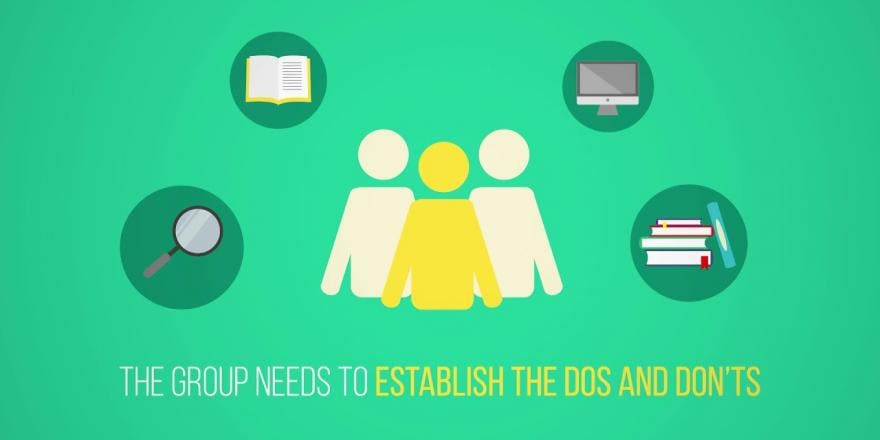
Likewise, to ensure that everyone is on the same page in terms of responsibilities and accountabilities, the group needs to establish the dos and don’ts—a set of rules that all group members have agreed to abide by at the beginning. For instance, Tom comes and goes as he likes during group meetings; sometimes, he fails to show up without informing anyone. Consequently, he doesn’t know what’s going on most of the time, and doesn’t complete his assigned tasks on time. This situation could have been avoided if the group had agreed on acceptable versus unacceptable behaviour, and the repercussions of unacceptable behaviour.

So, avoid the freeloaders and suckers problem from the start by sitting down as a group and discussing these issues. To help you establish the group goals, expectations, boundaries and plan, we have included a team charter template, a project plan template, and some other online resources.

7Z9FHMTaS5M

Transcript

You are probably watching this because you have to do a group assessment task and are wondering, wouldn't it be so much easier if I did this on my own? Why group work? Like it or not, working in groups is an integral part of your studies and uni assessments. If you don't work well in groups, your grades might suffer. Beyond university, the ability to effectively interact and communicate with others to achieve a shared goal is a vital career and life skill. But no one says group work is easy. It requires effort. However, most would agree that group work is essential. But why? What's in it for you?

Think about the benefits for you: authentic preparation for the workplace, increased understanding of different perspectives, improved interpersonal communication skills such as listening, clarifying, explaining, giving feedback, sharing, negotiating. Demonstrable collaboration skills such as flexibility, adapting to different roles, leadership, coaching, supporting, assisting others, organisation, planning, people management, self-management, time management, a network of meaningful working relationships and a greater sense of belonging.

So, as you start your group work, think about these benefits, maybe discuss them with your group and identify the ones you want to focus on as you complete the group task.

The life of a student is busy and full of competing demands. When it's your own uni work, you can juggle your priorities and if you misallocate your time, you’re the only one who takes the consequences. However, in a group task, if students don’t manage their time well, everyone in the group suffers, including you! If you don’t meet a group deadline, the next step can't be done. If you don't turn up to meetings, planning becomes chaotic. If you don’t do what you say, you damage your reputation and cost the group marks.

Take active steps to manage yourself and the task, so that time is used effectively and the group succeeds. Set up opportunities for clear and frequent communication - good communication helps everyone to be on the same page. Clearly identify the tasks and when they need to be completed by. It’s a good idea to set out a project timeline with task completion dates. The project timeline should be agreed upon and accessible by everyone.

Start your individual tasks in a group project early so you have time if you underestimate how long it takes. Aim to finish 24 hours before it’s due so you have time to deal with life’s unexpected challenges. Enter tasks in your online and phone calendar - starting times and completion targets. People often only enter the due date, and get the reminder to start when it’s too late.

Reply to communication from the group promptly. Ideally, the same day, and certainly within 24 hours. Try to put things in one email or message, with numbered action items rather than sending multiple messages or emails.

Commit to the time you are going to do a task. Don't think: “I’ll do it later”, or “I’ll do it sometime this week” or “I’ll do it tomorrow” or “I’ll do it tonight”. When we delay with vague timeframes, it’s likely to keep being delayed. We’re more likely to get it done if we have a specific time frame in mind: “I’ll do this tomorrow starting at 10am and aim to finish it by 11:30am”. Best of all is “I’ll get started now”!

Make a commitment to making group work work in your next group project. Take an active role in planning and communication, and always deliver on your commitments. However, if you have genuine reasons and difficulties preventing you from achieving the targets, don’t be afraid to reach out to your group members. That’s what group work is all about - working together to achieve a common goal!

Related links

Managing conflicts

2BmCM0ts8tU

Transcript

You are probably watching this because you have to do a group assessment task and are wondering, wouldn't it be so much easier if I did this on my own? Why group work? Like it or not, working in groups is an integral part of your studies and uni assessments. If you don't work well in groups, your grades might suffer. Beyond university, the ability to effectively interact and communicate with others to achieve a shared goal is a vital career and life skill. But no one says group work is easy. It requires effort. However, most would agree that group work is essential.

But why? What's in it for you? Think about the benefits for you: authentic preparation for the workplace, increased understanding of different perspectives, improved interpersonal communication skills such as listening, clarifying, explaining, giving feedback, sharing, negotiating. Demonstrable collaboration skills such as flexibility, adapting to different roles, leadership, coaching, supporting, assisting others, organisation, planning, people management, self-management, time management, a network of meaningful working relationships and a greater sense of belonging.

So, as you start your group work, think about these benefits, maybe discuss them with your group and identify the ones you want to focus on as you complete the group task.

Regardless of how well you get along with one another in a group, you can’t avoid having different opinions and disagreements. In fact, having diverse opinions and perspectives is a good thing because if we all agree and do everything the same, there is unlikely to be any innovation or development. However, if not handled effectively, such differences can lead to conflicts among group members. Unresolved conflicts or conflicts that are not managed properly can lead to a lot of unhappiness within the group. In the worst case scenario, some group members might choose to quit the group, which is devastating for the group outcomes and the individuals within the group.

So, how can you anticipate and manage conflicts? Be aware that there will be differences and disagreements within a group, that conflicts may occur in group work, and that this is okay. Be cooperative, flexible and adaptable to different approaches and ways of doing things. Set the ground rules at the beginning, on what to do when there are differences and disagreements, and what to do to manage and resolve conflicts when they arise.

A common cause of conflicts is poor communication. For instance, poorly expressed or inappropriate criticisms can be hurtful and lead to misunderstandings. If you feel frustrated or upset with an issue, the first step is to manage yourself. Take a breath (maybe more than one!) and calm yourself. Take care to really listen to others and respond to what they are saying. Try and identify a part that you agree with before criticising. Do not say or write anything in anger; you may regret it later. Try to consider the situation from the other person’s point of view. Perhaps, sleep on it. You may feel differently after.

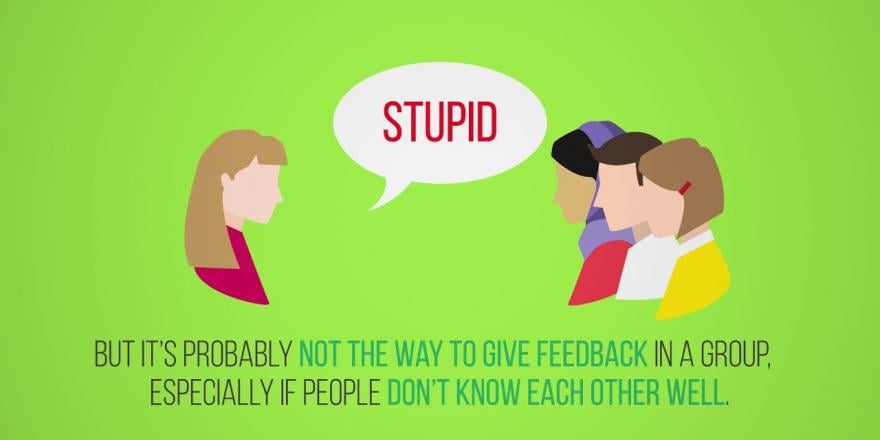
When there are differences and disagreements, it’s always preferable to talk face-to-face rather than communicate in writing as written communication can be more easily misconstrued. Be constructive and helpful when expressing your opinion or giving feedback. Focus on the issue, and not the person. When giving feedback, try to avoid personal judgements - you might say ‘that’s a stupid idea’ to a friend you know well but it's probably not a way to give feedback in a group, especially if people don't know each other well. You may want to use the sandwich technique: start with a positive, give your criticism, and follow it with another positive. Make it your aim to improve the situation, and not to put someone down.

Deal with a conflict immediately before it snowballs and becomes bigger, and more difficult to address and resolve. Ignoring it doesn’t make it go away. Also, be prepared to compromise. The goal is to get the task done. You don’t always have to ‘win’. Check in with yourself if something is really as important as it first feels.

When dealing with a conflict, get the full story from both sides. Consider the interpersonal needs of individuals as well as the task. Weigh the pros and cons of each side so that everyone can then make an informed decision. Often, acting proactively and making sure the group has clear outcomes identified with an associated timeline will help to reduce conflict.

It is perfectly normal and healthy for a group to experience disagreements because inevitably, the group members have diverse ideas, perspectives and experiences. In fact, you want to avoid groupthink, which is when some members do not want to express alternative views or new ideas that others may disagree with. Remember, an effective group is not necessarily one that is free of conflicts; an effective group manages conflicts as they arise, turning them into positive outcomes in achieving the group goals.

Related links