

- Posted on 9 Aug 2023
- Updated on 9 Aug 2023
- 4-minute read
Revolutionary new technology is designed to minimise the environmental damage every time we flush the toilet.
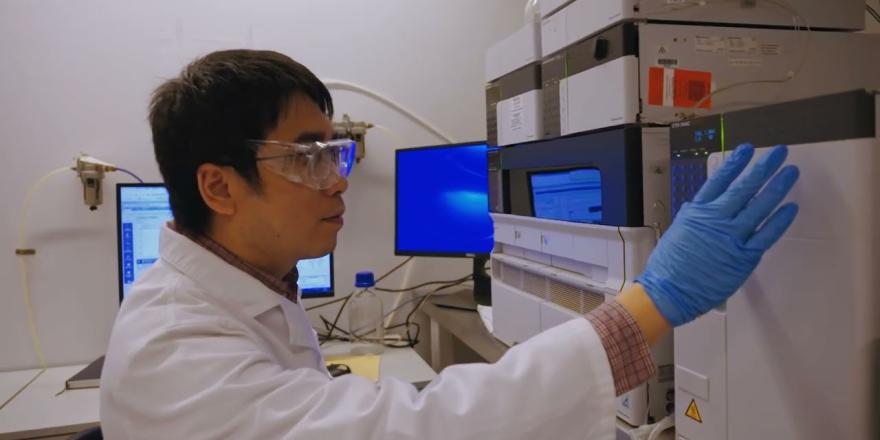
While wastewater treatment facilities purify every flush from our daily lives, they inevitably lead to some pollution. Current treatment methods release harmful pathogens, antibiotic resistance genes, microplastics, and forever chemicals.
Finding new ways to minimise the environmental footprint and improve the efficiency of wastewater treatment is a key goal of a research team led by Professor Qilin Wang working with Victorian utility South East Water and industry body .
“The focus of our research has been to develop technology capable of reducing the impact wastewater treatment has on the environment, without relying on additional external chemical or energy inputs,” says Professor Wang.
“Treating human waste using current methods consumes a large amount of energy. Although the current process is important to eliminate pollutants, the inherent trade-off is the significant environmental footprint created in the form of waste (sludge), pollutant discharge, carbon emissions and land use.”
Utilities such as South East Water share this vision in finding innovative ways to minimise the environmental footprint of wastewater treatment.
Strategic Research Manager at South East Water, Dr Li Gao, says their mission is to create environmentally friendly technology.
“We want to mitigate the environmental impact of wastewater treatment and protect Australia’s natural environment as well as natural environments around the world. We are so proud of the fact that we are getting very close to achieving this goal,” he says.
Unlike existing approaches, this is a closed-loop technology with easy retrofitting options and requiring negligible external chemical and energy resources
What's in the bog?
Sewage sludge is the solid waste produced during the wastewater treatment process. The current treatment methods for sewage sludge can cause pathogens and emerging pollutants such as antibiotic resistant genes, microplastics, and per- and polyfluoroalkyl substances (known as ‘forever chemicals’) to be absorbed into the water and soil.
The results can be devastating, causing chronic toxic impacts on flora and fauna.
In addition, every wastewater treatment facility also occupies several acres of land which leads to habitat loss, displacement of wildlife, soil erosion and contamination of natural ecosystems.
“My team and I have developed an on-site closed loop system that prevents pollution – including antibiotic resistance genes, pathogens, microplastics and ‘forever chemicals’ – from entering the environment every year,” Professor Wang explains.
“We have set out a novel approach integrating process engineering and fundamental sciences to develop an innovative treatment process that utilizes an on-site waste byproduct to minimise the environmental footprint of wastewater treatment.”
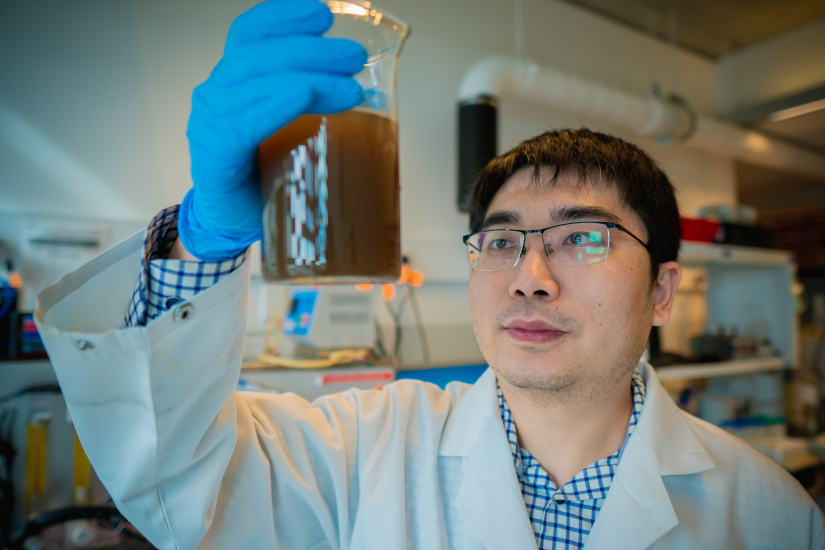
Professor Qilin Wang. Photo: Kevin Anastacio
Easing the pressure
This new methodology, created by Professor Wang and his team, essentially mixes a waste by-product in treatment process with the sewage sludge.
This process destroys the rigid structure of sewage sludge, promoting the degradation and removal of emerging pollutants in the sludge.
“The major breakthrough of our technology has been the utilisation of the on-site waste by-product of wastewater treatment – to protect Australia’s natural environment,” says Professor Wang.
“Unlike existing approaches, this is a closed-loop technology with easy retrofitting options and requiring negligible external chemical and energy resources. "
"By changing the way wastewater is being managed we can avoid eutrophication, which can lead to algal bloom, oxygen depletion and the destruction of aquatic ecosystems."
The results surrounding this new technology have been ground-breaking.
Several major advances have been made. Processing sewage through this method significantly reduced sludge volume which positively translates into a reduction in the amount of waste disposed into the environment.
Also, this method recorded a substaintial drop in undesirable microbes, pathogens, and emerging pollutants that are being discharged into the environment.
This new technology also minimises land occupancy of treatment tanks, therefore reduces the land usage required for treatment facilities.
Professor Qilin Wang is a finalist in the 2024 Eureka Prize for Environmental Research.
Research team
Professor, Faculty of Engineering & Information Technology

Chancellor's Research Fellow, Faculty of Engineering & Information Technology
Dr Huan Liu, Postdoctoral Research Associate, UTS School of Civil and Environmental Engineering
Dr Li Gao, Strategic Research Manager, South East Water

Building a research legacy inside elite sport
Since 2017, the University of Technology Sydney (UTS) and the Oklahoma City Thunder have worked together to better understand what drives performance,...

MekongELEVATE Research Partnership
MekongElevate is a four-year, multi-country initiative under the Mekong–Australia Partnership that seeks to strengthen the climate resilience of marginalised...
Bioengineering Protein Nanocages into Multi-target Vaccines for Alzheimer’s Disease
Alzheimer's disease (AD) is characterised by the clumping of abnormal proteins in the brain, which increases over time and leads to worsening cognitive...
Biotech start-up takes leap to regenerate Alzheimer’s damage
Australian biotechnology start-up Skin2Neuron found the perfect scientific and manufacturing partner to help their breakthrough cell-based treatment take root.
Building a research legacy inside elite sport
Since 2017, the University of Technology Sydney (UTS) and the Oklahoma City Thunder have worked together to better understand what drives performance,...
MekongELEVATE Research Partnership
MekongElevate is a four-year, multi-country initiative under the Mekong–Australia Partnership that seeks to strengthen the climate resilience of marginalised...
Bioengineering Protein Nanocages into Multi-target Vaccines for Alzheimer’s Disease
Alzheimer's disease (AD) is characterised by the clumping of abnormal proteins in the brain, which increases over time and leads to worsening cognitive...
Biotech start-up takes leap to regenerate Alzheimer’s damage
Australian biotechnology start-up Skin2Neuron found the perfect scientific and manufacturing partner to help their breakthrough cell-based treatment take root.