


- Posted on 16 Sep 2026
- 7-minute read
Australian biotechnology start-up Skin2Neuron found the perfect scientific and manufacturing partner to help their breakthrough cell-based treatment take root and become ready for clinical trials.
Key points
- Unique model of the UTS Biologics Innovation Facility helps researchers and biotech companies bridge the translational “valley of death” faster and cheaper than if they go it alone.
- Skin2Neuron has been using UTS facilities as a springboard. Their products will be made for use in clinical trials by Melbourne-based manufacturing organisation Cell Therapies.
- The BIF provided an environment where the Skin2Neuron team could refine its processes and prepare for technology transfer to Cell Therapies.
Skin2Neuron is a pioneering regenerative medicine technology that takes cells from hair follicles in the skin and turns them into neurons that can potentially replace brain cells lost to Alzheimer’s disease.
“Human hair goes through rounds of growth and retraction, a process governed by complex stem cells and precursor cells in the follicle. Less than 1 percent of these stem cells have a strong potential to become neurons under the right conditions,” said founder and chief scientific officer of Skin2Neuron, Professor Michael Valenzuela.
“We've done multiple animal studies – including in ‘doggie dementia’ – showing it’s feasible and practical to use these cells to try to treat Alzheimer’s and other degenerative diseases.”
For the past three years, the Skin2Neuron team has been developing the manufacturing processes to isolate, purify and grow human follicle-derived neuro-precursor cells and produce a personalised batch of transplantable cells.
That’s where the cutting-edge facilities and labs at UTS come in.
We had to find spaces to do both research and development as we’ve grown. UTS has a great combination of facilities that work for us.
UTS operates PC2-certified co-location laboratory space for start-ups and SMEs within the UTS Faculty of Science. It also operates the Biologics Innovation Facility (BIF), a good manufacturing practice (GMP)-like facility to help biopharmaceutical innovations from early development to clinical manufacture.
The model gives companies like S2N a home for their core laboratory operations while acting as a springboard into the university's broader research ecosystem, including access to specialist facilities, technical expertise and collaborative research opportunities.
As they work towards human clinical trials to test the cells’ effectiveness in treating Alzheimer’s disease, the team has needed technology partners who transfer and manufacture cell therapy products under GMP conditions.
They identified Melbourne-based Cell Therapies, a contract manufacturing organisation specialising in cell and gene therapies, as the partner to take them to the next level.
Its facility is licensed by Australia’s Therapeutic Goods Administration to manufacture cell therapies under GMP standards.
“We’re the experts in the science of making these cells: we've been doing it for almost 10 years. But we needed to transfer the technology – the know-how and production processes – to our partners who are experts in clinical manufacturing,” he said.
“The BIF has been the ideal environment to help us overcome the tricky transition between academic and GMP environments.”
It’s a well-known phenomenon in innovation circles where early-stage research (at a low technology readiness level (TRL)) can attract government funding while a more market-ready technology (high TRL) can win private and government investment.
In between, innovative companies can struggle as funds dry up and they enter a zone where commercialisation fails more often than not.
“The BIF is a state-of-the-art pilot biomanufacturing and training facility. We help researchers and companies develop and scale the processes needed to make advanced biopharmaceuticals, while also training people in how to manufacture them,” said BIF Director, Associate Professor Andrew Care.
“A big part of our role is helping researchers and small biotech companies bridge this ‘valley of death’. The support is fit for purpose – some teams may primarily need access to our specialised facilities, while others may need process development, scale-up or pre-GMP production to help them reach the next stage.”
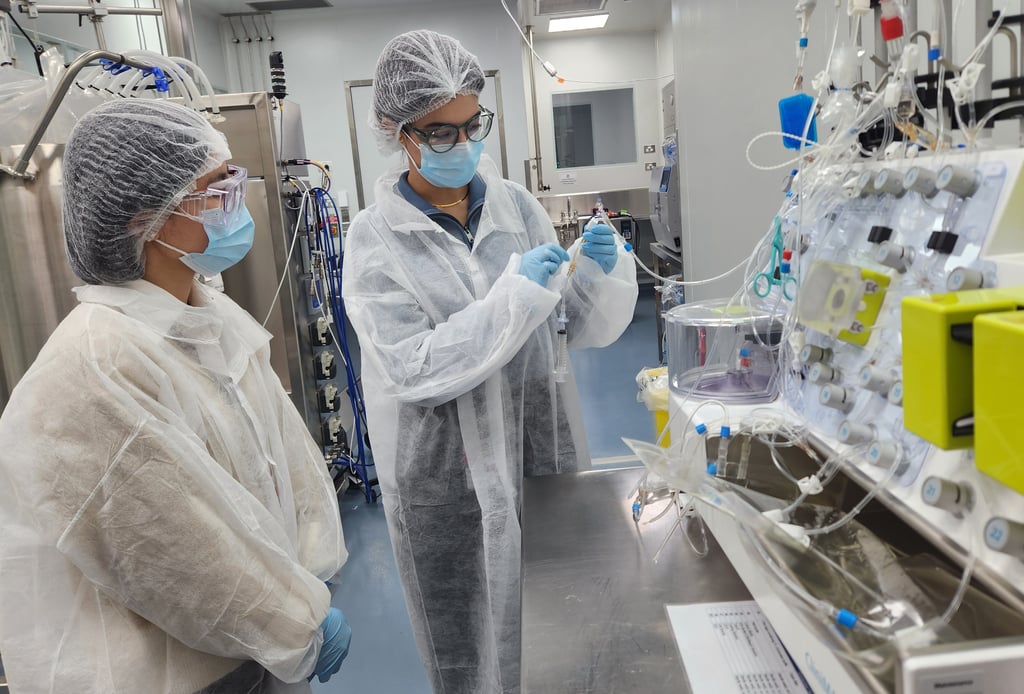
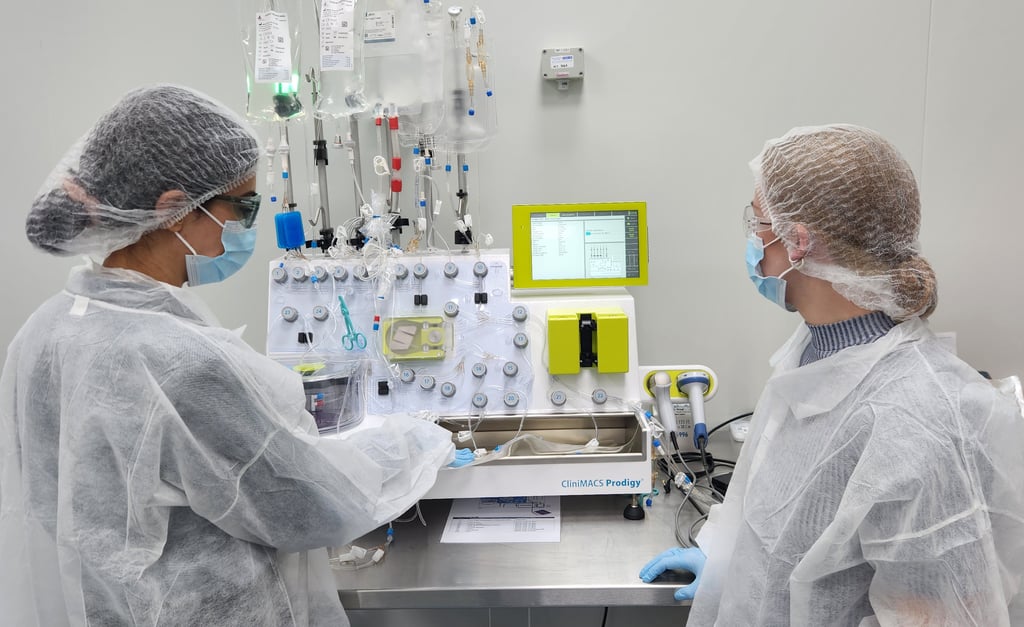
For Skin2Neuron, the BIF provided a controlled, GMP-like cleanroom environment under an ISO 9001 quality system, where its team could refine its process and prepare for technology transfer.
The BIF also hosted and facilitated hands-on technology-transfer activities between Skin2Neuron and Cell Therapies, allowing the teams to work together before progressing into formal technology transfer and qualification activities at Cell Therapies’ GMP facility in Melbourne.
“The BIF’s core goal is to be a translation enabler – helping teams de-risk critical development steps before they enter the much more expensive GMP manufacturing environment, and making that transition as smooth as possible,” Associate Professor Care said.
As Skin2Neuron passes the ball to Cell Therapies, they’ve now done several manufacturing batches of their cell therapy product in the BIF to refine, document and demonstrate the reproducibility of its process.
This work will enable Cell Therapies to complete production runs to exact specifications in their Melbourne GMP manufacturing facility independent of Professor Valenzuela and his team.
“It's all about replication, replication, replication. The next phase is to show that our cell product meets the product release specifications required on a consistent basis. That's the last main hurdle before we can apply for approval for human trial and start recruiting patients,” he said.
We’d be looking at 10 times the cost if we did all that product development in a commercial scale good manufacturing practice facility.
“There’s a very real ‘valley of death’ where SMEs can’t raise the capital for the pre-tech transfer part of their product development. Working with UTS, we bridged that gap and it’s been an important part of our story,” Professor Valenzuela said.
“We were at a TRL of around 4 before and now we're at a TRL of 6 or 7. This helped us make a step change in our value that helps us seek larger government and private investment. It brings us much closer to our goal of having a treatment for Alzheimer’s disease available to help people around the world.”
Skin2Neuron’s journey continues and as they continue to further research and development into their treatment for Alzheimer’s disease, there’s also potential for indications for other neuro-degenerative diseases.
And UTS is there to help Professor Valenzuela and his team get there.
“Ours is a deep collaboration. If and when we pursue other indications, this could mean new rounds of product development in the BIF. We’re already taking advantage of UTS’ other research facilities and capabilities, including flow cytometry, advanced microscopy, and bioinformatics,” he said.
“Universities are always talking about industry partnerships. There’s lots of valuable lessons about how to get that right in this model. Here, S2N and UTS are moving from talking to actually doing.”
UTS Biologics Innovation Facility
How the BIF can help take biotechnology innovations leap the valley of death towards clinical manufacturing.
Taking smarter, faster vaccines from lab to production
UTS is creating a pipeline of homegrown next-generation vaccines for Australia.
Artificial intelligence ushers in new era of personalised medicine
Biomedical startup 23Strands is working with UTS Professor Jie Lu to use artificial intelligence to revolutionise personalised medicine.
AI for a eye: New tool to take pressure off emergency doctors
A new artificial intelligence tool uses images from the back of the eye to simplify the diagnosis of critical diseases and injuries.

Building a research legacy inside elite sport
Since 2017, the University of Technology Sydney (UTS) and the Oklahoma City Thunder have worked together to better understand what drives performance,...
Taking smarter, faster vaccines from lab to production
UTS is creating a pipeline of homegrown next-generation vaccines for Australia.
Artificial intelligence ushers in new era of personalised medicine
Biomedical startup 23Strands is working with UTS Professor Jie Lu to use artificial intelligence to revolutionise personalised medicine.
AI for a eye: New tool to take pressure off emergency doctors
A new artificial intelligence tool uses images from the back of the eye to simplify the diagnosis of critical diseases and injuries.
Building a research legacy inside elite sport
Since 2017, the University of Technology Sydney (UTS) and the Oklahoma City Thunder have worked together to better understand what drives performance,...