

- Posted on 17 Oct 2025
Revealing Resilience supports organisations to apply individual-level resilience, poverty and inequality measurement tools in their programs. Learn about these tools below.
Across sectors
Equality insights and Equality Insights Rapid
equalityinsights.org
Equality Insights is a quantitative and gender-sensitive measure of multidimensional poverty that collects individual-level data to reveal how poverty varies based on gender, age, disability or other characteristics, including within households. It considers 15 dimensions – clothing, education, energy, environment, family planning, food, health, relationships, safety, sanitation, shelter, time use, voice, water, and work – plus assets, to provide insight into multidimensional poverty and financial circumstances.
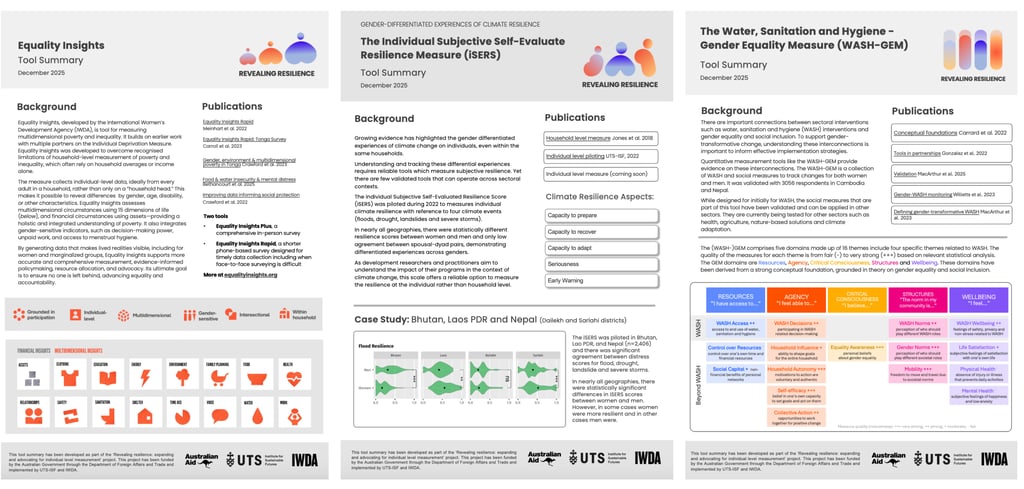
book_ribbon Equality insights and Equality Insights Rapid Tool Summary here.
qualKit
waterforwomen.uts.edu.au/qualkit
A curated set of qualitative monitoring and evaluation tools to explore gender equality or social inclusion-related changes associated with WASH programs. Includes methods such as micronarratives, photovoice, stories of transformation, positive deviance, q-sorting methodology, life histories and more.
Individual subjective resilience scale
A validated scale to measure individual climate resilience with reference to climate events such as floods and drought with emphasis on intra-household differences, adapted from the Subjective Self-Evaluated Resilience Score. Developed by UTS, currently under-going peer-review.
book_ribbon Individual subjective resilience scale Tool Summary here. 2026 research article about the iSERS tool.
Water, sanitation and hygiene
Water, sanitation and hygiene gender equality measure (WASH-GEM)
waterforwomen.uts.edu.au/wash-gem
The WASH-GEM is a novel quantitative measure designed to assist practitioners and researchers in exploring gender outcomes associated with water, sanitation and hygiene (WASH) programs for women and men. Online training is available here.
book_ribbon Water, sanitation and hygiene gender equality measure (WASH-GEM) Tool Summary here.
IWISE-12 and IWISE-4
ipr.northwestern.edu/wise-scales
The Individual Water Insecurity Experiences (IWISE) is a survey tool to quantify how often people experience 12 common water-related disturbances to emotional well-being or disruptions in daily activities.
Sanitation Quality of Life index
sanqol.org
The SanQoL-5 is a validated index that measures people’s experience of sanitation with five questions about privacy, disgust, safety, shame, and disease.
Food and agriculture
Food Insecurity Experience Scale (FIES)
fao.org/in-action/voices-of-the-hungry/fies/en
The FIES is an experience-based metric of food insecurity severity. It is used to estimate the percentage of a population that faces difficulties in accessing enough safe and nutritious food for normal growth and development and an active and healthy life.
Gender equality for food security
wfp.org/publications/power-gender-equality-food-security
The GE4FS measure combines the Food Insecurity Experience Scale (FIES) and a gender equality component. The gender equality component is made up of 18 mostly yes/no questions that cover five dimensions of empowerment: decision-making ability, financial self-sufficiency, freedom from violence, reproductive freedom and unpaid labour.