


Across the globe, domestic violence affects one in three women in their lifetime
Led by Professor Anne Summers AO, our research focuses on understanding the broad social and economic impacts of domestic and family violence in Australia.
Professor Anne Summers’ research into the impacts of domestic violence aims to support and inform the development of policies and strategies to significantly improve the lives of women and break the cycle of systemic disadvantage for future generations of Australian families.
Professor Summers’ research is supported by the Paul Ramsay Foundation, initially as an inaugural Paul Ramsay Foundation Fellow and from 2023 as part of a long-term partnership for change.
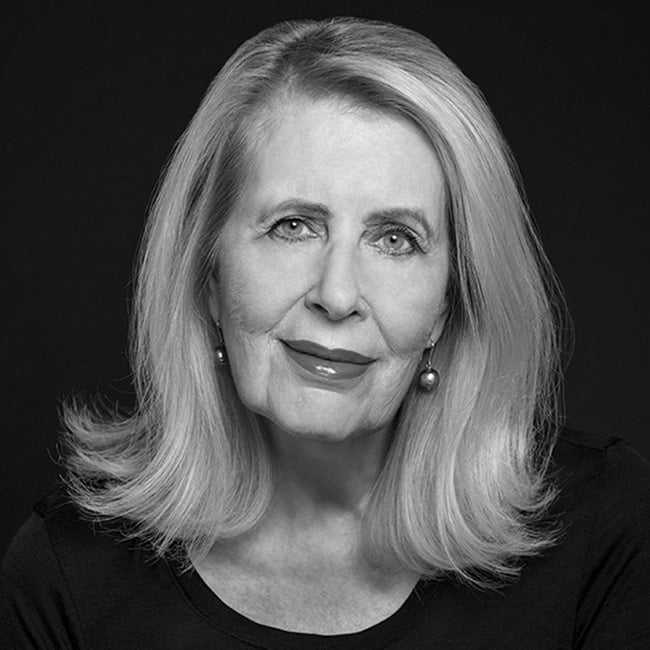
Domestic and family violence is a complex, multidimensional issue with far-reaching impacts for generations of families. There is an urgent need to develop effective policies and financial provisions for the thousands of Australians who experience domestic violence, and ensure they are supported in rebuilding their lives.
Professor Anne Summers AO
Our research lead
Professor Anne Summers AO is a renowned Australian author, journalist and researcher, with a long and highly accomplished global career in the fields of politics, the media, business and the non-government sector.
Anne has a longstanding commitment to addressing inequality and social injustice, and through her work has contributed to significant improvements in the lives of women, and society more broadly.
Based at UTS Business School, Anne’s research focuses on the pervasive impact of domestic and family violence in Australia, its broader economic implications and inequalities, and what government, policymakers and business can do to address this major societal issue.
In 2021, Anne was appointed a Paul Ramsay Foundation Fellow, located at UTS, and commissioned to undertake original data-based research to cast a new light on the incidence and nature of domestic violence in Australia.
Our research projects
Following the publication of the groundbreaking report The Choice: Violence or Poverty in 2022, the next stage of our research focuses on two key projects:
- Our data-based investigation of the impact of domestic violence on women’s employment focuses initially on why the labour force participation rate of women exposed to such violence is so much lower than for Australian women generally. The study will also seek to explore the extent to which employment may reduce or even prevent women’s exposure to domestic violence.
- Our development of a new longitudinal study will seek to obtain key data on relevant social issues related to domestic violence to measure the extent of violence in all its forms and which will focus in particular on the characteristics of the perpetrators of such violence. It is intended to present to government a fully-designed longitudinal study ready to be adopted and implemented, thus setting in train the collection of an invaluable and unprecedented set of long-term data to inform policy-making to reduce and eventually eliminate such violence from our society.
Our reports
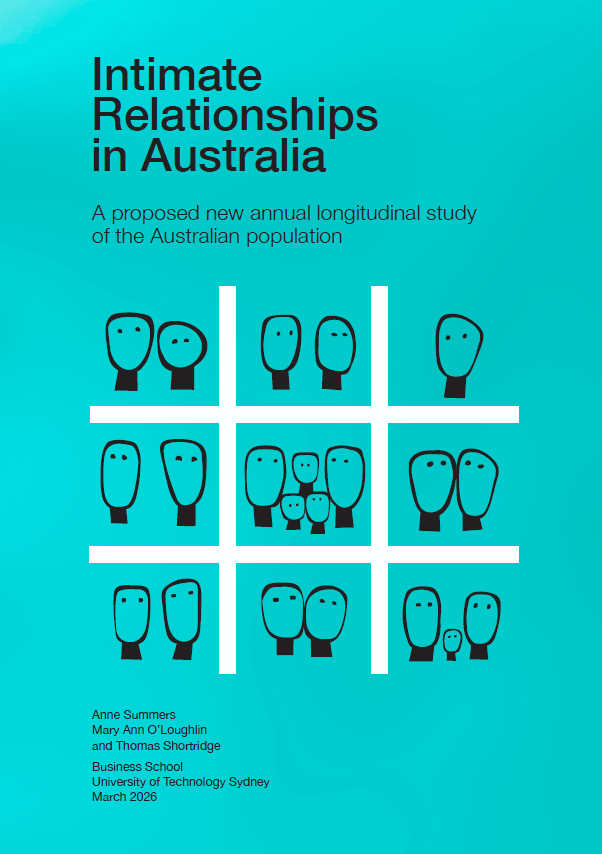
Intimate Relationships in Australia
This report proposes a new population-based annual longitudinal study, Intimate Relationships in Australia (IRINA), to generate urgently needed evidence about how intimate relationships form, evolve and end in contemporary Australia.
The data collected will show how and why some relationships become abusive or violent, revealing the causes, trajectories and consequences of intimate partner violence (IPV). These insights will be critical for identifying early warning signs of stress or breakdown in relationships, strengthening prevention and early intervention policies, and ensuring that services are responsive to people's needs.
The data will also reveal how people are coping with their lives more generally, particularly with stressors such as loneliness or thoughts of self-harm. This will be critical in informing government about people's physical and psychological needs and how they can be addressed.
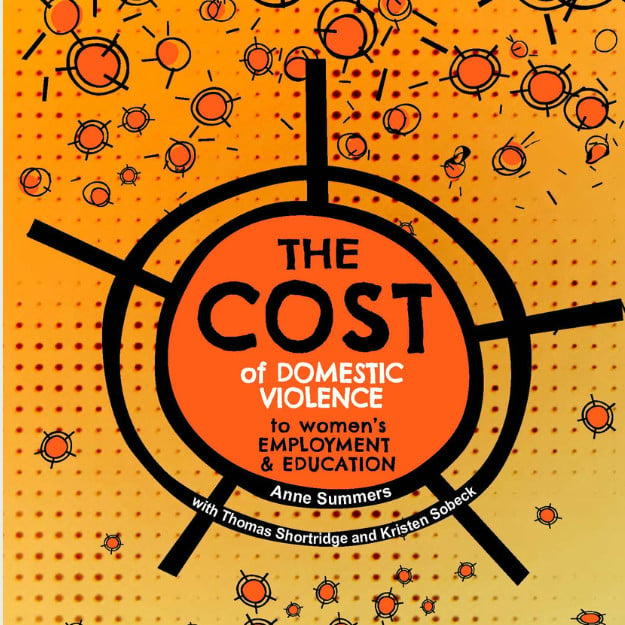
The Cost of Domestic Violence for Women’s Employment and Education
The data we use in this report enables us, for the first time, to quantify the economic impact of domestic violence on Australian women. We show that despite the significant growth in women’s employment and education in recent decades, domestic violence continues to have a large and ongoing negative impact on women’s ability to participate in the workplace and higher education.
This report, launched in February 2025, sets out in detail how large numbers of women have not attained a degree, have left the labour force, have reduced their working hours, or have taken time off work– all because of domestic violence.
Key facts
- In 2021–22, women who experienced partner violence or abuse in the past five years had a 5.3 per cent lower employment rate compared to those who had not. For women who recently experienced economic abuse, the gap was even greater at 9.4 per cent.
- For young women, domestic violence reduces rates of full-time employment by 9.1 per cent.
- Domestic violence leads to a stark 9.7 per cent reduction in university degree attainment for young women.
- Nearly 35 per cent of women who were working when they experienced domestic violence took time off work, with an average of 31 days off following the abuse.
Research for the report was supported by a Paul Ramsay Foundation Fellowship and based on customised data from the Australian Bureau of Statistics (ABS).
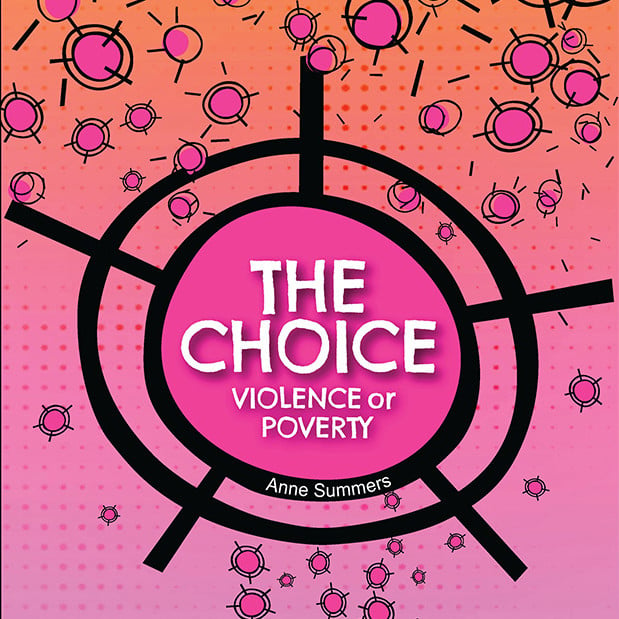
The Choice: Violence or Poverty
A ground-breaking report revealing the stark choice facing many Australian women who have experienced domestic violence at the hands of their partner: do they stay and risk the violence continuing or even escalating, or leave and face the high probability of a life of “policy-induced poverty”.
Launched in July 2022, the report signals the need for urgent policy changes to ensure that women who want to leave violent relationships can do so without being forced into poverty.
Key facts
- 275,000 Australian women had suffered physical and/or sexual violence from a current partner. While 90,000 of them wanted to leave, they felt unable to do so, with a quarter of them saying the main reason was lack of money or financial support.
- A further 82,000 temporarily separated but returned, again with 15 per cent of them saying they had no money or nowhere to go.
- 185,700 women with children aged under 18 were living as single mothers after leaving violent relationships. They represent 60 per cent of all single mothers, a far higher rate of violence than for any other group of Australian women
- 67 per cent of these now single mothers had children in their care at the time of the violence and 88,000 women said their children saw or heard the violence.
Research for the report was supported by a Paul Ramsay Foundation Fellowship and based on never-before-published customised data from the Australian Bureau of Statistics (ABS).
Contact us
Get in touch about our research, collaborative research opportunities, news and events.

Important resources
Professor Anne Summers recommends national surveys, reports and key domestic and family violence publications.
Past events

Elsie Conference: Celebrating 50 years of women’s refuges in Australia
15-16 March, 2024, UTS Tower Building 1
The story of Australia's first women's refuge is one of grit and hope. And its legacy is one that deserves celebration and recharged commitment.
Hosted by the University of Technology Sydney (UTS), the Elsie Conference will bring together refuge and shelter workers, advocates and organisations, researchers and public policymakers and anyone interested in reducing domestic violence. The conference aims to provide a national platform for attendees to celebrate the past and discuss emerging challenges.
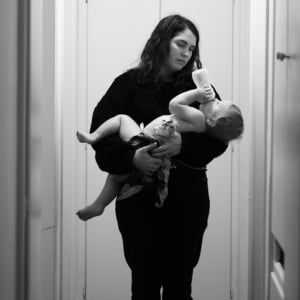
How do you change a bad law?
28 July 2023, UTS Business School
In the May 2023 budget, Treasurer Jim Chalmers announced an important change to the welfare payment for single parents: recipients could stay on it until their youngest child turned 14, up from the previous cut-off at 8 years old. The campaign that took place leading up to the budget is a success story of how lived experience, independent research, media attention, and a government-backed task force combined to reform a harmful policy. It’s a powerful case study for anyone wanting to change bad laws.
Terese Edwards, Anne Summers, Laura Tingle, Sam Mostyn and Verity Firth sat down to discuss how researchers, activists, policymakers, and the community sector can join forces to make a real difference and navigate complex politics to advocate for – and achieve – reform.

Violence or Poverty panel discussion
26 July 2022, UTS Business School
The National Plan to Reduce Violence against Women and their Children seeks to encourage and support women to leave violent relationships. But Australian welfare measures ensure that as many as half the women who choose to leave will end up in poverty.
Hosted by the UTS Centre for Social Justice and Inclusion and UTS Business School, this panel discussion features The Hon Anna Bligh AC, Professor Anne Summers AO, Leanne Ho, CEO of Economic Justice Australia, and Professor Carl Rhodes on the implications of findings from The Choice: Violence or Poverty report and how we can remove barriers facing women looking to escape partner violence.