

My name is Peter Jones, I’m a senior technical officer here at UTS, I’ve been here since 1976 and still loving it.
The facility has come together over the last few years by combining a few faculties together, in the last few years we’ve had a number of upgrades to our facilities and buildings, in fact this building that we’re in now was only refurbished seven years ago and we’re about to go into a new building next year.
The teaching that we do here at Environmental Sciences is both in an aquatic area and also in a terrestrial area, and we do field work and laboratory work as well.
We do a really wide range of research here in environmental sciences. We do focus in two main areas – we have the climate change cluster, which looks at marine sciences and plus the terrestrial environment, and the other one is our environmental sustainability.
Quite a number of our laboratories are PC2, or quarantine accredited. This accreditation is not only good for our students and staff, but it allows industry to come in and use our labs at their professional standard.
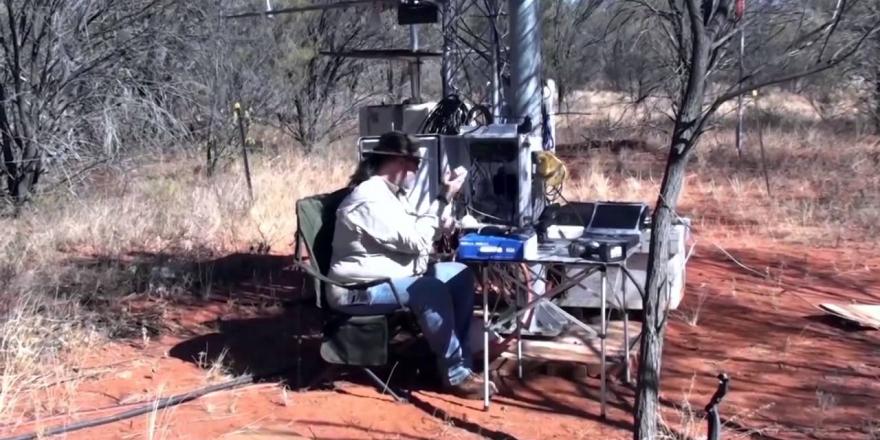
One of the reasons I love working here is that we have so much amazing equipment, and I’d like to take you through some of that. In the terrestrial environment we have some Edico Variance towers. Our Edico Variance towers are located in Central Australia and they’re about twelve metres high and along them have a whole lot of sensors, and these censors determine how much CO2 and water vapour moves through the environment. We also have the Picaro instrument, which we measure C13 content in both leaves and wood.
At the moment we are putting together a continental wide inventory of the C13 contents. This will be able to tell us about the variability of water content and photosynthesis across Australia. This is incredibly important for the management of groundwater and natural resources.
One of the most interesting and emerging areas we’re getting into here at UTS is remote sensing and ecological modelling. This technology allows us to measure landscape scale parameters and also helps us to determine the impacts of climate change.
One of the coolest instruments we’ve got is the ASD spectro-radiometer, which measures spectro information across the landscape for plants, water and soil. The measurements can be made remotely by mounting the instrument on the tower or in aircraft or on drones or even carried across the field by hand.
I’ve been at UTS but it’s been really exciting, we have fantastic facilities, and wonderful people working here, and we’d really love to hear from anybody who’d like to collaborate with us.
My name is Peter Jones, I’m a senior technical officer here at UTS, I’ve been here since 1976 and still loving it.
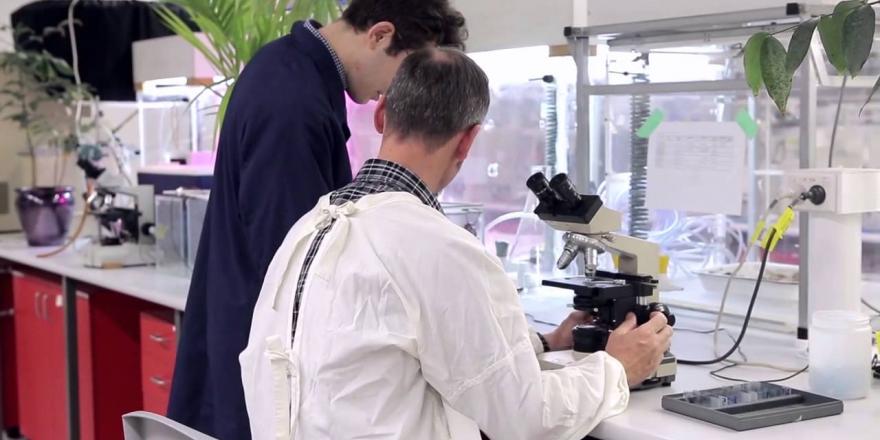
We’ve got some great facilities here to support both teaching and research in areas of plant and wildlife. Some of the research that we do here with plants has found that plants have an incredible ability to remove pollutants out of the air, so we have these plant chambers where we are able to extract air out of the chamber and measure it before and after a plant is put in there to see how it’s improved the air quality.
We all know that cities are polluted and the air we breathe, it’s very important to us that it’s clean, and this research using the plant chambers is able to extrapolate what happens out in the city environment and also what happens in our office.
Although we’re a city university we have a glasshouse on our roof, a number of glasshouses actually and they’re all computer controlled to control the amount of light, and temperature, and even humidity in these glasshouses. By that we can run a whole lot of different experiments. So the glasshouses are providing a natural light source, very unlike in the laboratory, but much more like the real world.
One of our research facilities in the field includes the Port Augusta facility down at the arid land of the Botanic Gardens. Down there, they’re looking at the effect of high temperature extremes on desert plants, and how those plants are affected by them and respond to high temperature extremes. This is really important for looking at the effect of climate change to determine what plants are going to be knocked out, and what plants will survive.
Currently we have a group of researchers working in the field up at Kakadu National Park, looking at the impact of cane toads on quoll populations. This research feeds into the conservation of some of our really unique wildlife. The team is currently training quolls to reject cane toads from their diet.
We also have a Centre for Compassionate Conservation, which is looking at ways to manage our wildlife in a more humane way. The team is currently looking at alternative ways, other than culling, to manage population growth.
I’ve been at UTS but it’s been really exciting, we have fantastic facilities, and wonderful people working here, and we’d really love to hear from anybody who’d like to collaborate with us.
My name is Peter Jones, I’m a senior technical officer here at UTS, I’ve been here since 1976 and still loving it.
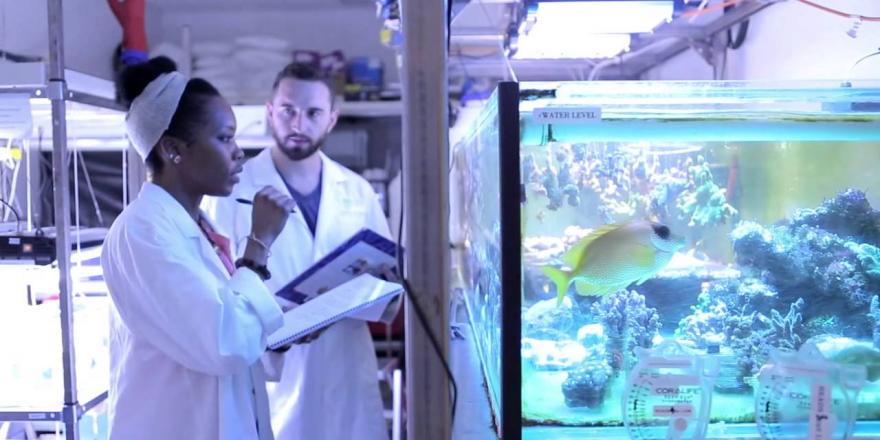
Coral bleaching is a really important issue which is happening in our oceans right around the world, and in our labs we’re able to do research in that area by having coral tanks here at Sydney to act as a source for our material to do research on.
Some of the research we’re doing is not only on large organisms, but it’s down to the sub-cellular microbiological level as well. Our molecular microbiology lab allows us to do research right down to the micro level – we can look at a drop of seawater. We can do anything, including DNA extracts for genome sequencing to groundbreaking microfluidic capabilities.
We have one of the largest and unique algal culture collections in Australia. This research is associated with coral reefs, marine bio-toxins and harmful blooms in the Australian coastal waters.
In marine biology, the auto-fluorescent properties of photosynthetic plankton can be exploited by (???). This allows us to characterise abundance and community structure of fighter plankton.
We have an area of research dedicated to aquatic and fish ecology. This research is important because it is perhaps showing how climate change is moving tropical fish down into temperate waters.
UTS is the only laboratory in the world that has a collection of state-of-the-art bio-optical sensors.
While we do have amazing facilities here on campus, we have a strong emphasis on field teaching and research. We could have more than 10 operations happening in the field at this very moment. We have people working in Kakadu National Park, on Herron Island, in Central Australia in the semi-arid area, so we do a wide range of fieldwork. We think it’s very important to have that practical aspect; you can’t be an environmental scientist unless you get dirt under your fingernails.
I’ve been at UTS but it’s been really exciting, we have fantastic facilities, and wonderful people working here, and we’d really love to hear from anybody who’d like to collaborate with us.