• University of Technology Sydney home
  • Home

    Home
  • For students

  • For industry

  • Research

Explore

  • Courses
  • Events
  • News
  • Stories
  • People

For you

  • Libraryarrow_right_alt
  • Staffarrow_right_alt
  • Alumniarrow_right_alt
  • Current studentsarrow_right_alt
  • Study at UTS

    • arrow_right_alt Find a course
    • arrow_right_alt Course areas
    • arrow_right_alt Undergraduate students
    • arrow_right_alt Postgraduate students
    • arrow_right_alt Research Masters and PhD
    • arrow_right_alt Online study and short courses
  • Student information

    • arrow_right_alt Current students
    • arrow_right_alt New UTS students
    • arrow_right_alt Graduates (Alumni)
    • arrow_right_alt High school students
    • arrow_right_alt Indigenous students
    • arrow_right_alt International students
  • Admissions

    • arrow_right_alt How to apply
    • arrow_right_alt Entry pathways
    • arrow_right_alt Eligibility
arrow_right_altVisit our hub for students

For you

  • Libraryarrow_right_alt
  • Staffarrow_right_alt
  • Alumniarrow_right_alt
  • Current studentsarrow_right_alt

POPULAR LINKS

  • Apply for a coursearrow_right_alt
  • Current studentsarrow_right_alt
  • Scholarshipsarrow_right_alt
  • Featured industries

    • arrow_right_alt Agriculture and food
    • arrow_right_alt Defence and space
    • arrow_right_alt Energy and transport
    • arrow_right_alt Government and policy
    • arrow_right_alt Health and medical
    • arrow_right_alt Corporate training
  • Explore

    • arrow_right_alt Tech Central
    • arrow_right_alt Case studies
    • arrow_right_alt Research
arrow_right_altVisit our hub for industry

For you

  • Libraryarrow_right_alt
  • Staffarrow_right_alt
  • Alumniarrow_right_alt
  • Current studentsarrow_right_alt

POPULAR LINKS

  • Find a UTS expertarrow_right_alt
  • Partner with usarrow_right_alt
  • Explore

    • arrow_right_alt Explore our research
    • arrow_right_alt Research centres and institutes
    • arrow_right_alt Graduate research
    • arrow_right_alt Research partnerships
arrow_right_altVisit our hub for research

For you

  • Libraryarrow_right_alt
  • Staffarrow_right_alt
  • Alumniarrow_right_alt
  • Current studentsarrow_right_alt

POPULAR LINKS

  • Find a UTS expertarrow_right_alt
  • Research centres and institutesarrow_right_alt
  • University of Technology Sydney home
University of Technology Sydney home University of Technology Sydney home
  1. ... About UTS
  2. ... Information on Faculties...
  3. ... Faculty of Health
  4. ... School of Public Health
  5. Indigenous health resour...
  6. Art Gallery

Art Gallery

explore
  • Indigenous health resources
    • arrow_forward Art Gallery
    • Essential understandings
      • arrow_forward Colonisation, racism and chronic disease
      • arrow_forward Health, social and emotional wellbeing
      • arrow_forward Heterogeneity of Indigenous Australians
      • arrow_forward Indigenous ways of knowing, being and doing
      • arrow_forward Resilience, survival and thriving
      • arrow_forward Social justice
      • arrow_forward Spirituality
      • arrow_forward Transgenerational trauma
    • arrow_forward Faculty of Health’s graduate attribute
    • Resources
      • arrow_forward Colonisation, racism and chronic disease
      • arrow_forward Health, social and emotional wellbeing
      • arrow_forward Heterogeneity of Indigenous Australians
      • arrow_forward Indigenous ways of knowing, being and doing
      • arrow_forward Resilience, survival and thriving
      • arrow_forward Social justice
      • arrow_forward Spirituality
      • arrow_forward Transgenerational trauma
    • arrow_forward Teaching and learning strategies
    • arrow_forward UTS Policy Framework

Despite the all-encompassing term ‘Aboriginal art’, artwork produced by Aboriginal people does not constitute a homogenous genre.

Before the invasion we narrated our identity, spirituality, legends and obligations to the land, through an intricate combination of verbal and visual storytelling. Following European conquest ‘Aboriginal art’ was initially considered in terms of being the artefacts of a primitive race (Fisher 2012).

Nowadays however, ‘Aboriginal art’ is recognised as an evolved and diverse collection of traditional, rural, urban, contemporary and often political personal expression (Fisher 2012). What has to be appreciated is the continuing rich symbolic significance of ‘Aboriginal art’ as an expression of culture, and personal and group identity (Taylor & Veth 2007).

Art is a powerful medium. Visual images can appeal on a more visceral level enhancing understanding and allowing students to aesthetically engage with the experiences and expressions of Aboriginal people. In terms of this resource pack, art could be used to evoke understanding that Aboriginal identity is inseparable from country, family and culture. The topic of ‘Aboriginal art’ has immense scope for assessment items and discussion, particularly in the context of aesthetic, political, ethical, and economic terms.

Included in the gallery are examples of art that we have labelled under the eight sub-categories. The included artworks are not exhaustive or entirely illustrative of the full scope of art produced by Aboriginal people. Also included under the umbrella term ‘Aboriginal art’ and not included here are music, ceremony, language, lore, dance, craft, utensils and weapons, storytelling and theatre.

The original artwork on this site is supplied by Lucy Simpson, Gaawaa Miyay Designs,  gaawaamiyay.co.

We are also grateful to the many artists who have allowed us to reproduce their work on the site. They may be used in teaching environments providing the copyright holder is acknowledged.

The work of Lucy Simpson
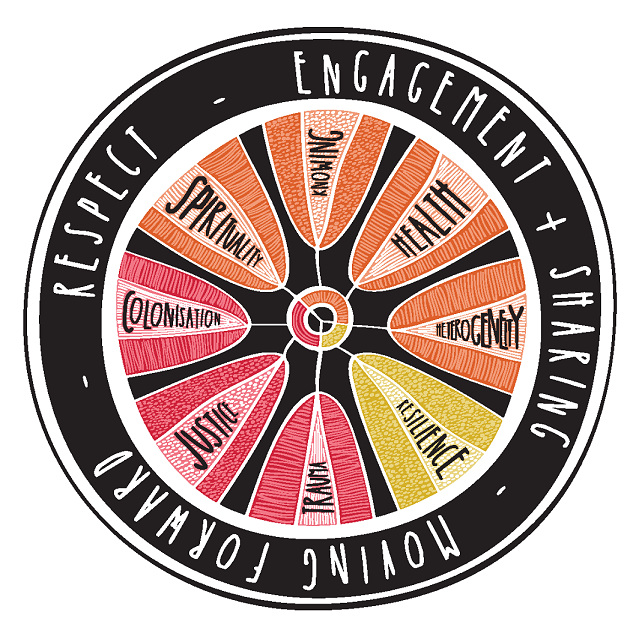
Indigenous artwork by Lucy Simpson

Artwork by Lucy Simpson, Gaawaa Miyay Designs, gaawaamiyay.co.

Indigenous artwork by Lucy Simpson

Artwork by Lucy Simpson, Gaawaa Miyay Designs, gaawaamiyay.co.

Other artists' work

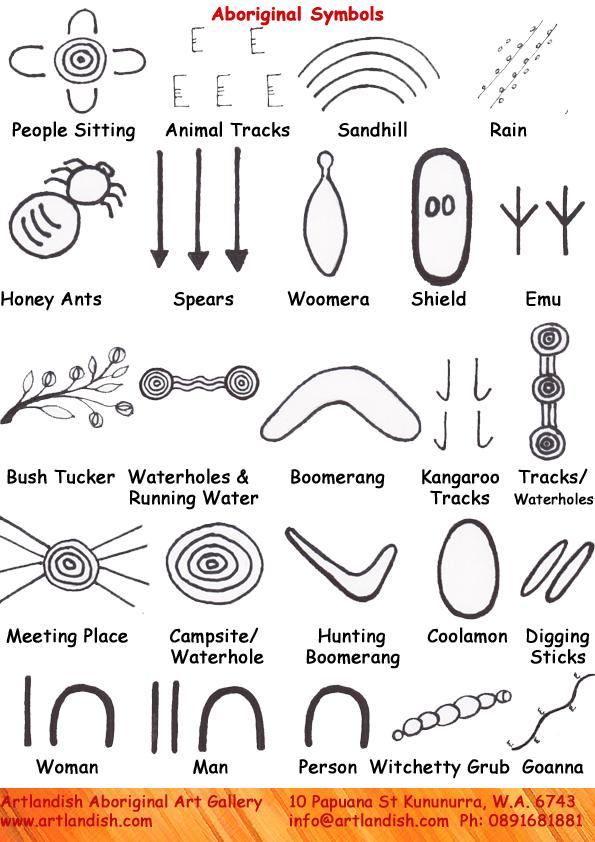
Aboriginal symbols by Kirstie Linklater

Reproduced with the kind permission of the artist: Kirstie Linklater.

These symbols are an indication only and not representative of all artists’ work.
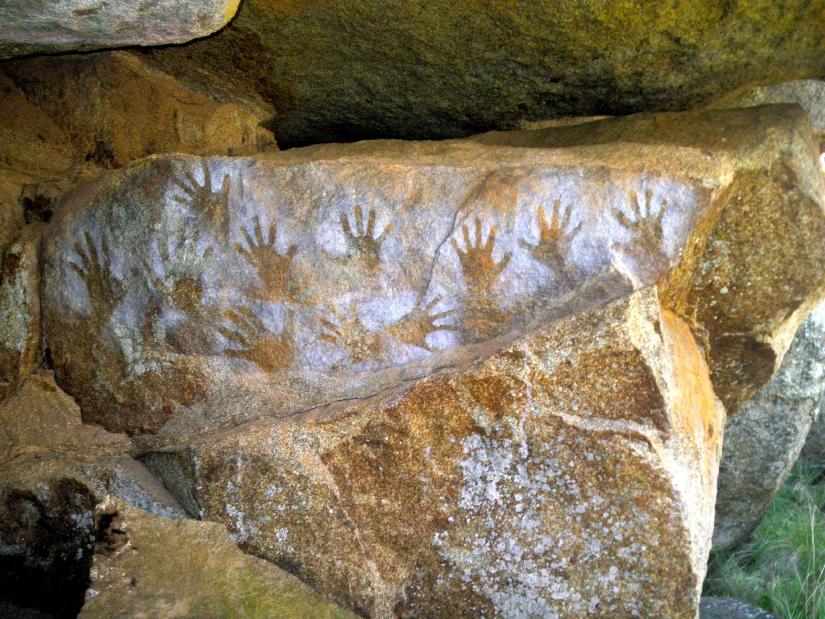
Aboriginal Rock Art

Aboriginal Rock Art reproduced with the kind permission of Don Hitchcock, donsmaps.com.

Hand stencils, a traditional form of Australian Aboriginal painting. Ochre (white in this case) is mixed with water, put in the mouth and blown over the hand placed on the rock.
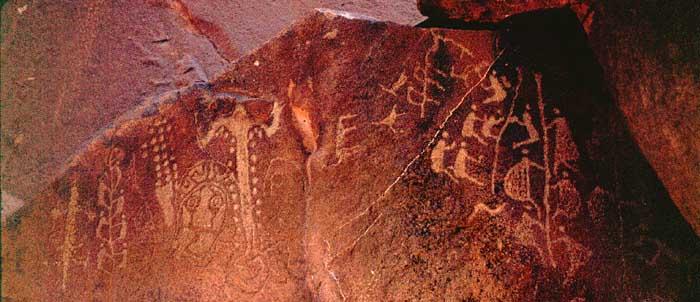
Murujuga petroglyphs

Murujuga petroglyphs. “Copyright by Robert G. Bednarik, with permission by Traditional Custodians”.

Reputed to be the world’s largest complex of petroglyphs, the rock art of the Dampier Archipelago in Western Australia is under severe threat of destruction through industrial development. About 24.4% of the rock art on the main island, Murujuga (Burrup) has been destroyed since 1963, and the remainder has been subjected to slow deterioration through acid rain caused by industrial installations immediately adjacent to the rock art.
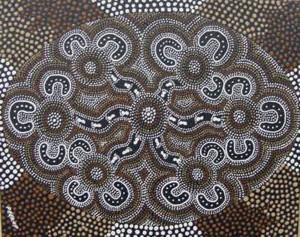
Dreamtime artwork by Jeff Roberts

Jeff Roberts : Dreamtime. Image used with permission

Today paintings are created using modern-day materials, but the use of traditional symbols and art styles helps to keep this ancient culture alive. The symbols used in contemporary Aboriginal paintings are the same as those found on cave paintings and rock art.
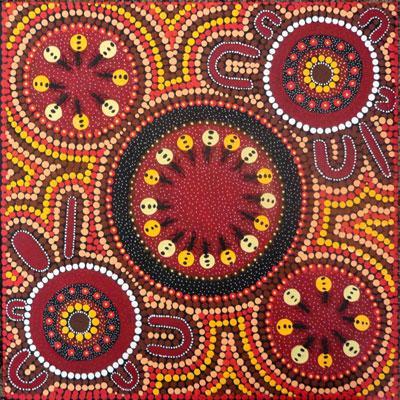
Families Digging Honey Ants artwork by Kathleen Buzzacot

Families Digging Honey Ants by Kathleen Buzzacot. Reproduced with kind permission of the Artist.

Aussie Aussie Aussie 2002 artwork by Richard Bell 

Aussie Aussie Aussie 2002, by Richard Bell. Reproduced with kind permission of the Artist.

Constantly provoking, constantly political. This man is at the crux of social change, fighting for the appreciation of what it means to be an Aboriginal in the 21st century.  He is able to get away with often very controversial, aggressive and political statements because he adds an element of humour and beauty to his work. “Aboriginal art” is a topic Bell and many others have discussed and disputed extensively. In an interview with the members of proppaNOW and Archie Moore, the group discusses what defines aboriginal art concluding that it is their colour alone which has given them this label. Ah Kee gives the example of Jackson Pollock who is not referred to as an “American” artist, thus why should Richard Bell and Vernon Ah Kee’s work be defined by their race?  For Richard Bell “Aboriginal art” or what he refers to as “ooga booga” is “the stuff made by real Aborigines for white consumption”.
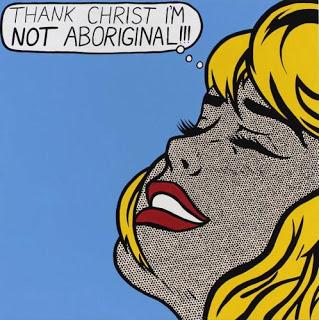
The Peckin Order artwork by Richard Bell

The Peckin Order, by Richard Bell. Reproduced with kind permission of the Artist.
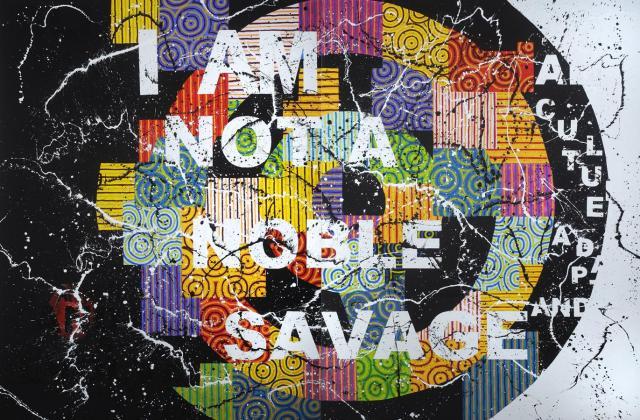
Life on a Mission artwork by Richard Bell

Life on a Mission, by Richard Bell. Reproduced with kind permission of the artist.
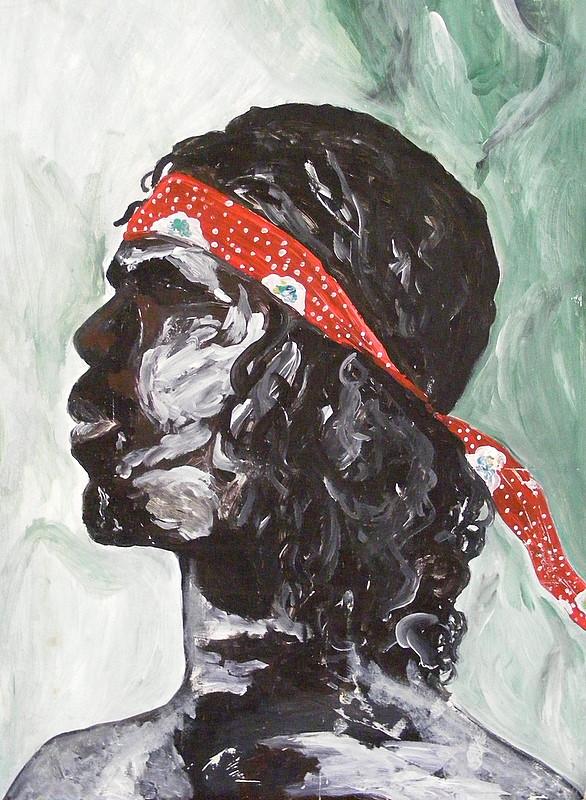
Indigenous Man artwork by Jacqui Stewart

Indigenous Man by Jacqui Stewart. Image provided by the artist. jacquistewart.com.au
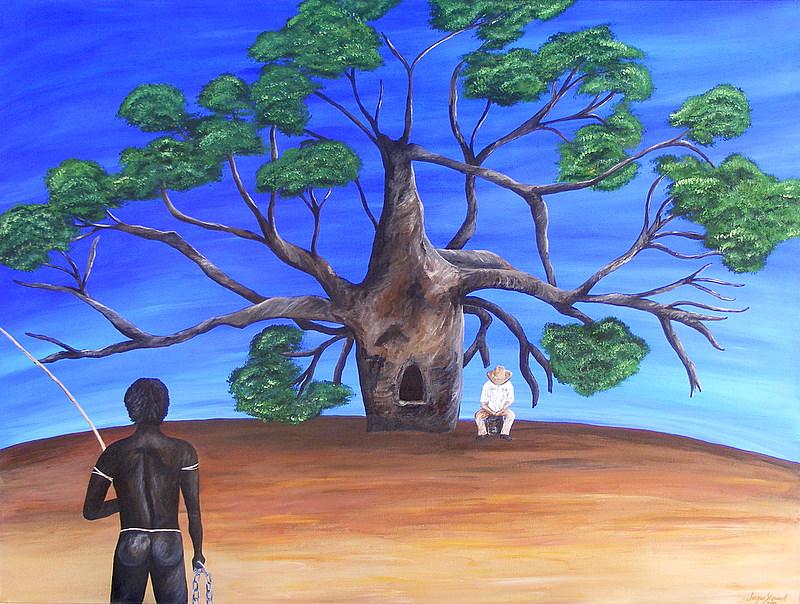
 

Prison Boab tree: chainless by Jacqui Stewart

Prison Boab tree: chainless by Jacqui Stewart. Image provided by the artist. jacquistewart.com.au

The Prison Boab Tree is situated just over 23km along the King River Road near Wyndham WA.  The tree was used in the 1890′s as an overnight lockup for Indigenous Australian Prisoners on their way to Wyndham.  The tree is of cultural significance to the local Aboriginals. The Indigenous man is holding his chains, showing strength, courage and freedom. In the background the prison guard is sitting slumped over displaying remorse.
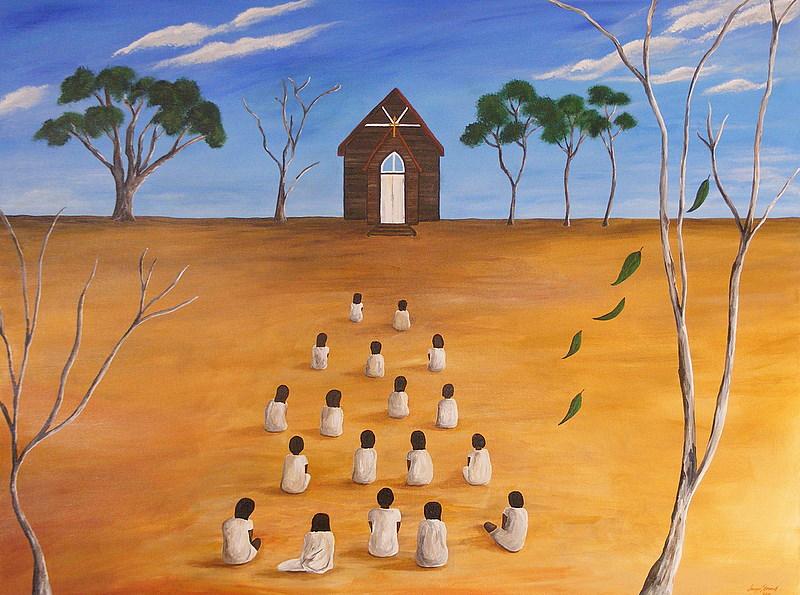
Hope Beyond the Window: a Stolen Generation by Jacqui Stewart

Hope Beyond the Window : a Stolen Generation by Jacqui Stewart. Image provided by the artist. jacquistewart.com.au

Between 1910 and 1970 up to 100,000 Aboriginal children were taken forcibly or under duress from their families by police or welfare officers. Most were under 5 years of age. The painting was influenced by photograph’s of Moore River Native Settlement in WA.

Acknowledgement of Country

UTS acknowledges the Gadigal people of the Eora Nation, the Boorooberongal people of the Dharug Nation, the Bidiagal people and the Gamaygal people upon whose ancestral lands our university stands. We would also like to pay respect to the Elders both past and present, acknowledging them as the traditional custodians of knowledge for these lands.

University of Technology Sydney

City Campus

15 Broadway, Ultimo, NSW 2007

Get in touch with UTS

Follow us

  • Instagram
  • LinkedIn
  • YouTube
  • TikTok
  • Facebook
  • WeChat

A member of

  • Australian Technology Network
Use arrow keys to navigate within each column of links. Press Tab to move between columns.

Study

  • Find a course
  • Undergraduate
  • Postgraduate
  • How to apply
  • Scholarships and prizes
  • International students
  • Campus maps
  • Accommodation

Engage

  • Find an expert
  • Industry
  • News
  • Events
  • Experience UTS
  • Research
  • Stories
  • Alumni

About

  • Who we are
  • Faculties
  • Learning and teaching
  • Sustainability
  • Initiatives
  • Equity, diversity and inclusion
  • Campus and locations
  • Awards and rankings
  • Leadership and governance

Staff and students

  • Current students
  • Help and support
  • Library
  • Policies
  • StaffConnect
  • Working at UTS
  • UTS Handbook
  • Contact us
  • Copyright © 2025
  • ABN: 77 257 686 961
  • CRICOS provider number: 00099F
  • TEQSA provider number: PRV12060
  • TEQSA category: Australian University
  • Privacy
  • Copyright
  • Disclaimer
  • Accessibility