

Powering the future
Our recently refurbished Electrical Engineering laboratories give you the opportunity to turn theory into practice in industry-standard environments. Here, you can explore power systems, control systems, and electronics using the same tools professionals rely on. These spaces are designed to help you build practical skills, gain confidence, and prepare for real-world engineering challenges.
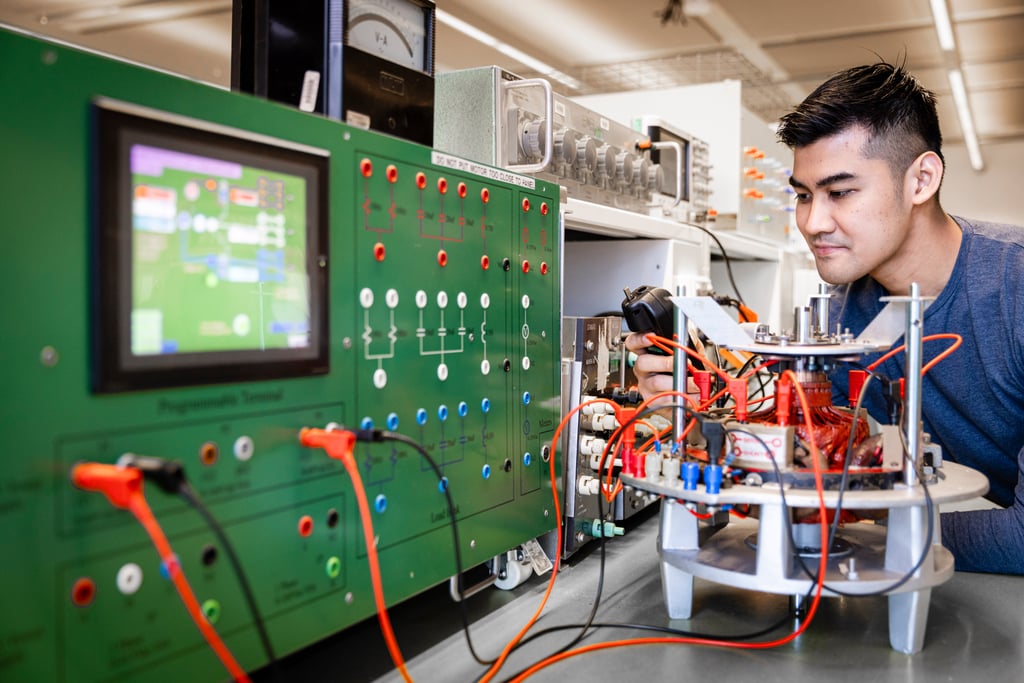
Power Systems Laboratory (CB11.10.103)
The Power Systems Laboratory gives students hands-on access to industry-standard tools for exploring real-world electrical power systems. With 12 dedicated workstations, this space lets students experiment with single-and three-phase supplies, motor construction, and power system protection. They learn how power generation works, understand load sharing, and measure motor performance, building a solid foundation in practical power engineering principles that prepare them for professional challenges.
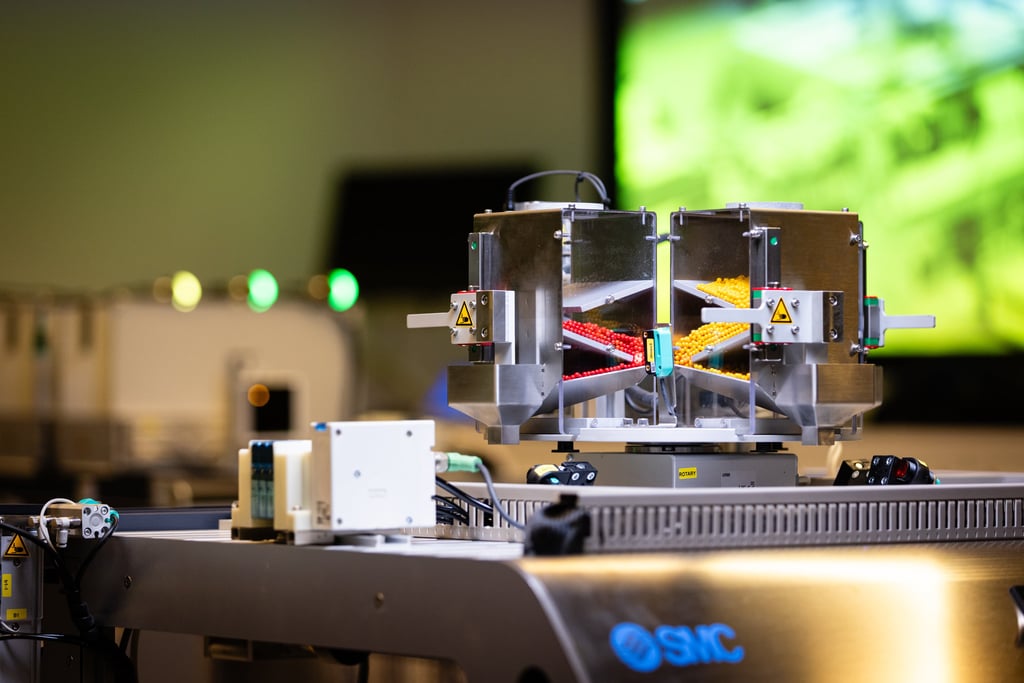
Control Laboratory (CB11.11.300)
The Control Laboratory gives you hands-on access to advanced tools for designing and testing control systems in environments that mirror real-world challenges. With 12 specialised stations equipped with scale models of industrial systems, including gantry cranes, this space allows students to model, design, and implement controllers with confidence. They gain practical experience in both analog and digital control methods, building skills that prepare them for complex engineering applications.
Signals Laboratory (CB11.11.302)
The Signals Laboratory gives you hands-on access to advanced tools for electrical signal measurement and processing in environments that reflect real-world challenges. With 16 dedicated stations equipped with oscilloscopes, waveform generators, power supplies, and multimeters, this space lets you work with telecommunications trainers and data acquisition systems to complete tasks such as analogue modulation and signal feedback control. Designed for later stages of study, the lab helps you build practical expertise that prepares you for complex engineering applications.
Junior Circuits Laboratory (CB11.11.402)
The Junior Circuits Laboratory is a foundational space featuring 50 stations for first-year Electrical, Mechanical, Mechatronics, and ICT students. Each workstation is equipped with essential industry tools such as digital storage oscilloscopes and function generators, enabling students to build and test low-voltage circuits as they develop core engineering skills.
Embedded Software Laboratory (CB11.11.404)
The Embedded Software Laboratory focuses on microcontroller programming and gives students hands-on access to flexible microcontroller boards, PCs with compiler software, and testing equipment. This space is designed to help students program, test, and refine their microcontroller-based projects, gaining practical experience in embedded systems development that prepares them for real-world applications.
Embedded Projects Laboratory (CB11.11.404)
The Embedded Projects Laboratory is where advanced ideas come to life. Designed for hands-on work in analogue and digital electronics, including capstone projects, this space offers state-of-the-art facilities for circuit board assembly and project development. With a focus on supporting small groups, it provides students with uninterrupted time and resources for tackling complex, long-term engineering challenges—helping you move from concept to fully realised solutions.
Environmental Engineering Biological Process Research Laboratory (CB11.12.409)
This lab is designed for safe, hands-on research with microorganisms, genetically modified organisms and low-risk aerosols. While it’s a core hub for our postgraduate community, final-year biomedical and environmental engineering students also step in to tackle their honours projects and gain real experience working alongside active research teams. The lab is equipped with the essential tools of biological science, from autoclaves and fume hoods to incubators and advanced microscopes, providing learners with everything they need to explore environmental and biological processes with confidence and curiosity.