



Technical Intelligence for Gene Research and Healthcare
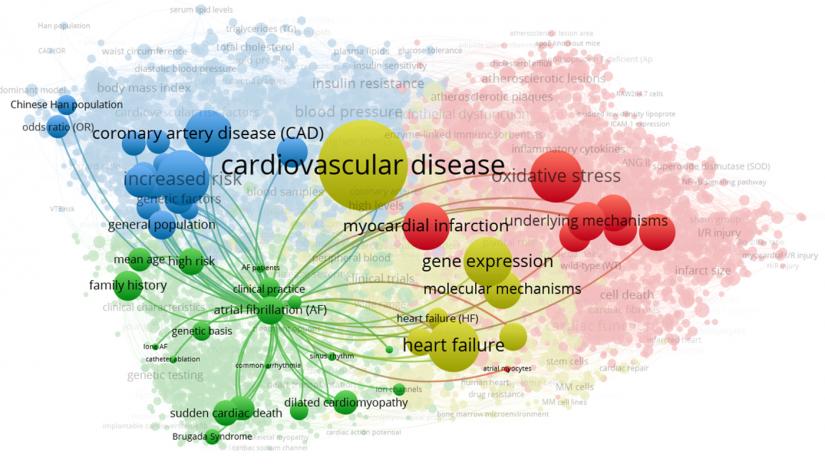
Intelligent bibliometrics for tracking and predicting technological change
Research Leads
Dist. Prof. Jie Lu and Dr. Yi Zhang
AAII Research Lab
Decision Systems and e-Service Intelligence
Collaborators
23Strands
The rapid development of gene research, together with the significantly increase of related scientific documents, challenges entrepreneurs in systematically capturing knowledge with limited expert support and identifying business opportunities in a short time.
Intelligent bibliometrics provide an express solution of constructing a knowledge base for a given gene-related disease. This project developed a systematic toolkit to analyse large-scale scientific documents for technical intelligence e.g., identifying key players of a given domain, profiling key research areas and their associations, and tracing the evolutionary pathways of research topics over time.
Representation Learning on Large Scale Administrative Data

Image: Stocksnap (front) and Gerd Altmann (back) / Pixabay. Originals edited.
Research Lead
Dr Guodong Long
AAII Research Lab
Data Science and Knowledge Discovery
Collaborators
Australian Commonwealth Department of Health
The key to effective policy development is implementing the right policy for the right group of people at the right time. To support this ethos, the public service is keen to develop predictive modelling methods to leverage the information hidden within its administrative data about different population cohorts.
In a large-scale service system, such as the Australian healthcare system, user data exists in complex structures reflective of the complexity of human interactions. Appropriate ways to model this complex structured data is a challenge common to many organisations, from sector-scale commercial services to national-scale public services.
A generalized representation of complex data is the most desirable data format for processing, particularly for large organisations and government agencies that typically deal with data on a massive scale. In particular, utilising powerful deep learning tools could be one of the implementation framework for representation learning on large-scale administrative dataset. The framework will preserve the complex relationships in an unsupervised or self-supervised manner, and to protect privacy in a decentralised training scheme without direct access of the sensitive data.
The DSKD Lab has collaborated with Australian Commonwealth Department of Health a series of projects that apply the most advanced machine learning techniques to model and analyse healthcare administrative data to promote effective policy development.
Using Virtual Reality to Create Certainty in Clinical Decisions using Complex Genomics
Research Leads
Professor Paul Kennedy
A/Prof Dan Catchpoole
AAII Research Lab
B; iomedical Data Science
Collaborators
The Children’s Hospital at Westmead
Western Sydney University
UTS Animal Logic Academy, Samurai Punk
Sony Foundation
Tour de Cure
The complex human genome underpins the biological mechanisms of a patient’s cancer. Presently the knowledge provided by the genome is inaccessible to clinicians making treatment decisions for patients.
We develop machine learning and data analytics methods to model patients in a virtual reality space emphasising appropriate genomic similarities and differences. Our VR Technology allows cancer specialists and analysts to move into the 3D space and to explore the patient cohort from within. It enables clinicians to find patients with genomic similarities with other sufferers, moving far beyond simple statistical clustering methods to enable clinicians to uncover genomic relationships, and inform decision making for treatment regimens with a breadth and accuracy that has not been previously possible.
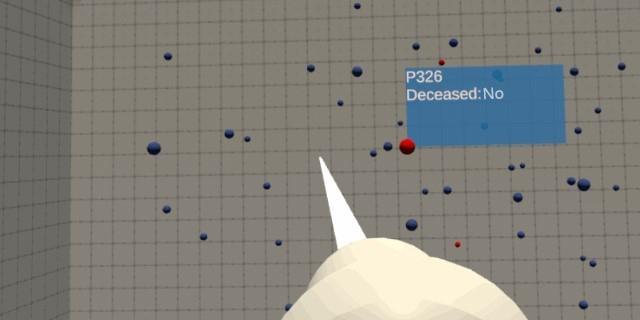
Clinicians can explore the three dimensional space of the patient cohort with data simplified into clusters of genomic similarities, for clinicians to make more informed decisions of treatment regimes for individual patients
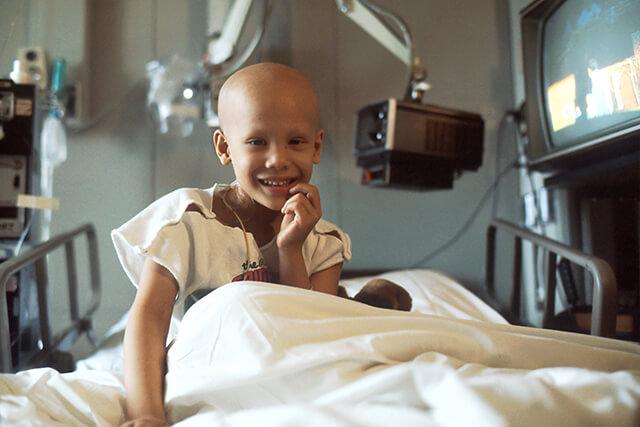
VR technology enables clinicians to uncover genomic relationships to support decisions for the treatment of childhood cancer.
Image: National Cancer Institute /Unsplash