• Posted on 7 Oct 2026
Ted O'Brien MP

Video

(01:00:15)

Video transcript

In conversation with Mr Ted O'Brien MP

October 7 2026

Mallesons

E&OE | Check against delivery


Professor James Laurenceson
Welcome, ladies and gentlemen, let's make it a prompt start. 

Good evening, all. My name is James Laurenceson. I’m the director of the Australia-China Relations Institute at the University of Technology Sydney, Australia’s first and still only research centre devoted to illuminating Australia’s relationship with China. It's ACRI’s pleasure tonight to host this event with the support of Mallesons, of course you all know, Australia's leading independent, full service legal firm that really handles some of the most complex and complicated deals throughout the region, including, of course, with Greater China.

On behalf of all of those present tonight, I would like to begin by acknowledging the Gadigal people of the Eora Nation, of whose ancestral lands we now gather. I’d like to say our respects to their elders, past and present, and acknowledging them as the traditional custodians of knowledge on this land. Can I also just add, I’m very conscious of this. I am conscious that today also marks the third anniversary of the Hamas attack on Israel.

And look, whatever your broader views on these issues, I think we can all unite and share the horror associated with that particular event and extend our sympathy to those who were affected by it. And I think it’s important we do that because I’m quite conscious tonight that there will be people in this room who were very much affected by it. So let’s acknowledge that. Thank you. 

Now, the focus of tonight's event, a Coalition perspective on Australia-China relations. It is my great pleasure to welcome Mr Ted O'Brien, Australia's Shadow Minister for Foreign Affairs. But frankly, Ted, just as importantly, a fellow Queenslander.

I'll just turn it into the beginning, but that really is an important distinguishing characteristic. Now, Ted is going to kick off with that 20-minute address. And then he’ll be joining with me in conversation for a period of about 25 minutes. And I'll make sure at the end of that we also have some time for some Q&A from the audience. We've got a great audience tonight. Ted, we've got some friends from, I know from the Australia-China Business Council, from the Chinese Chamber of Commerce in Australia, the Chinese Australian Forum, the Haymarket Chamber of Commerce, and a particular welcome to Marine Go, the Chair of the Australian Government's National Foundation for Australian-China Relations. So it's a great group we've got. Mr O'Brien, of course, is uniquely placed to speak with a good deal of authority on this topic. He's a Mandarin speaker with extensive business experience in Asia. And that very much includes three stints in Taiwan and three stints in mainland China as well. If you haven't seen Ted's WeChat videos, don't look at them now. I want you to focus your attention on Ted now that you're having face-to-face. But on your way home, you should definitely check those out.

Ted, I think we're all very keen to hear what you have to say to us tonight. So without any further delay, let me invite you to the lectern to deliver your address.

Mr Ted O’Brien MP
Well, can I first please start by saying thanks so much for having a view behind me. You might as well watch WeChat. I mean, seriously, the view out here is spectacular. And so I also say a very big thank you to Mallesons for hosting this evening. Clearly, you do not work. You just sit in the window. It intrigued my big ideas. It really is wonderful to be here today. I have prepared some remarks. And so forgive me for putting my head down now and getting into the guts of a speech.

And then I look forward to speaking with James in a little bit of a chat later. So firstly, can I say what a privilege it is to be here today to speak at the Australia-China Relations Institute, an institute that makes a big contribution to a vitally important bilateral relationship by shaping from structural dialogue, by how the relationship’s many dimensions impact the two countries. And it's an honour to also be here with such an esteemed audience. So, thank you for being here with us this evening. 

In addressing the National Press Club recently, I argued that the world had entered a new age. It's an age of entrenched competition between the two largest powers, the United States and China, an age of rapid convergence between economics and security, those two domains, and an age of extraordinary technological advancement. Today, I want to take that argument a little bit further by providing some thoughts on what this new age means for Australia's relationship with the People's Republic of China. 

My thinking on this question is guided by some basic first principles. One, we must accept that entrenched competition between the United States and China is here to stay. Two, we must resist the temptation to let that competition reduce our foreign policy to a binary choice between the United States and China. And three, our foreign policy should be an outward expression of our values and interests, a reflection of our people, their beliefs and their aspirations. This latter point, I want to call out the words I use deliberately an outward expression of our values and interests, because I believe that it is incumbent on any Australian government to speak plainly about our views, our interests, the positions we take, both domestically here in Australia, but also with the capitals of other countries, including Beijing.

To be clear, this is not a call for a megaphone diplomacy, but it is a call for government to engage with confidence to be prepared to speak up for our values and interests. We should neither mince our words nor needlessly sharpen them. We should speak clearly, firmly and respectfully. But we also need to think beyond how we speak to Beijing and consider how we can more meaningfully speak with Beijing. Australia and the PRC already have a substantial architecture of dialogue between leaders, ministers and officials, as well as through business academia and civil society. But I believe we should be aiming higher. More can be done.

Given the importance of the Australia-China relationship, I believe these existing channels are too fragmented, underutilised and irregular. Bringing existing engagements together through a broader and more structured Canberra-Beijing dialogue would add real value to the relationship. It would expose more Australian decision-makers across government, parliament and academia to the complexities of the relationship, while creating more opportunities for deeper and more regular engagement. The purpose should be to develop the relationships, familiarity and understanding that allow us to discuss differences directly and constructively. Because dialogue does not require agreement, it requires the confidence to engage even when the grievance might be different.

These are thoughts on how we should engage with the People's Republic of China. But what is arguably more important is the substance of our engagement, or the question of what we should engage with and what we should not. On that question, my view is this. In this new age, Australia should engage with the People's Republic of China with confidence, diversify where dependence creates vulnerability, and deepening cooperation where we can create mutual advantage or strategic leverage. China is Australia's key trading partner, and that won't change.

I'm proud that it was a coalition government that secured the China-Australia Free Trade Agreement, ChAFTA, with Beijing, contributing to the comprehensive strategic partnership between our two nations by removing barriers to trade in goods and services and investment flows. ChAFTA has worked. In the decades since it came into force, Australian exports to China have more than doubled, and the government's post-implementation review found that the agreement delivered a net benefit. But a successful trade agreement also depends on both parties living up to their commitments.

The past use of arbitrary trade restrictions from barley and wine to other Australian exports has understandably raised concerns about economic coercion and the reliability of market access. China has the scale and economic weight to play an enormously positive role in the economic development of our region. But that late leadership will be more credible when the PRC consistently stands by its words, honours its agreements, and gives its trading partners confidence that access to its markets will not become a tool for political pressure. I'm looking forward to the government's release of its review into ChAFTA due before the end of this year.

We should then explore the possibility of ChAFTA 2.0 to provide deeper access for Australian services and investment and a greater tackling of non-tariff barriers. It should therefore go without saying that I reject any suggestion that Australia should decouple its economy from China. As I've argued now for many years, however, that does not mean we don't need to diversify. We do. Australia does need to diversify its trade because we are overly concentrated in too few sectors and we are overly exposed to the China market. Nevertheless, on diversification from China, nuance is required. It should not mean simply selling less to the China market.

In sectors where China depends on Australian supply and where our trade gives us not only economic returns but strategic leverage, we should consider doing the opposite, selling more, not less. The principle should be simple. We diversify where dependence creates vulnerability. We deepen trade where there's mutual advantage or our economic strength gives us leverage. The reality of the new age in which we operate from great power competition, economic and security convergence and technological change requires a different type of statecraft.

And this will make the Australia-China relationship even more complicated because in sensitive areas of strategic importance, such as artificial intelligence, cyber, defence, space and so forth, which will influence the future wealth and the geostrategic power of nations, including in our region, will work with trusted partners with whom our interests most closely align. Take AI, for example. AI is an illustration of how the Australia-China relationship is set to become more complicated in this new age. For those who haven't been following the AI debate closely, forget talk of AI code and compute for a moment. Think instead about what AI could do for everyday life.

A doctor detecting an aggressive cancer years earlier. A farmer protecting crops from drought. A small business owner automating paperwork and getting back hours with their family. Or an older Australian living alone whose AI-enabled home detects a fall and calls for help. AI could become humanity's most powerful tool for solving some of our oldest and hardest problems. But it also comes with enormous risk. The same technology could displace jobs, give dangerous health advice, spread misinformation or allow machines to make decisions their human operators never anticipated. And as AI becomes more capable and autonomous, there is a deeper risk.

Systems behaving in ways we cannot fully predict or control, pursuing a goal in ways their creators never intended. The recent incident involving AI agents independently hacking into Medicare is a potent reminder of these risks. AI isn't a choice, it's a reality. It is already here and expanding rapidly. The only question is how we manage it. The world needs safeguards for AI. About that, there is no question. Not just to protect AI from being misused by nation states, but also non-state actors. And also to mitigate the horrifying prospect of AI being weaponised by itself. Agents going rogue with superintelligence with catastrophic consequences.

Discussions between President Trump and President Xi on AI two weeks ago marked a positive step forward. A structured US-China dialogue, an AI hotline and a commitment for closer engagement is a good thing. But given the strategic military and economic repercussions of this technology race, let's not mistake in this for something more than what it was. Amidst these developments, the question for Australia is, what should we do when it comes to AI? And what does this mean for the Australia-China relationship?

No matter how seismic the challenge, our response to AI must align to a broader vision, principle and approach for the future Australian foreign policy, which I see as follows. First, our vision should be for Australia to reclaim its position as a leader in our region by becoming the most trusted partner in the Indo-Pacific. Second, foreign affairs starts at home, should be our overarching principle. If our foundations, our economy, resilience and national unity, our social cohesion are fragile, our ability to uphold our values and pursue our interests are compromised, they're jeopardised. Third, our approach to foreign affairs should display ambition, urgency and courage.

Unless we shake off the nervous timidity that has taken hold of our politics and act with agency, we'll be left behind. And our standing internationally will diminish. Within these strategic parameters, in light of the new age of which we're operating, what then do we do about AI? The answer? We must do a deal with the United States. Not because of a US-China competition, but because it's in Australia's national interest. Such a deal could start with a government-to-government framework that affords Australia early and preferential access to AI frontier models and a guarantee of continued access.

Australia's immediate priority is to fortify our digital defences and shield the critical infrastructure underpinning modern society from AI-driven cyber threats. We can use AI as a shield to counter AI being used as a sword. US frontier models excel at identifying and patching vulnerabilities in essential systems, such as those that power our electricity grids, wastewater plants, hospitals, logistics hubs, financial networks and the data and operations of major corporations. Candidly, a government-to-government framework with the US on AI is what Prime Minister Albanese should have brought home from New York last week, but alas, it was not to be.

There are times when we in public office need to think like deal makers, not just policy makers. The world has entered a new age and we need a new model of statecraft to match it, because the old assumptions no longer apply. That means pursuing a new type of deal. It means thinking beyond traditional agreements towards strategic partnerships that bring together investment, technology, infrastructure and capability in next-generation technologies that will shape the future. On this basis, we shouldn't think about a deal with the US on AI as simply an arrangement to access US technology. Instead, we should think about what the combination of US and Australian capabilities could co-develop over time.

As a former deal guy with global technology giant Accenture, I often negotiated deals using the firm's old mantra ‘Think Big, Start Small, Scale Fast’. Australia can start small by securing a government-to-government framework for AI with the US that provides for certainty of ongoing access to frontier AI models to harden our cyber defences. But we can also think big to position Australia as the Indo-Pacific's most trusted partner in AI, hosting other nations' data and compute and exporting AI applications and services. And we can scale fast by building sovereign AI capability across the technology stack comparable to the US as an AI sovereign nation.

And how might the US win themselves through such a deal? AI is advancing at extraordinary speed and scale and the demand for compute is growing with it. The United States cannot meet that demand alone. AI development is increasingly constrained by access to power, land, grid capacity, advanced infrastructure and skilled talent. That creates a growing role for trusted partners. I believe Australia is uniquely placed to help meet that challenge. We have the land, enormous energy potential, infrastructure capability, smart people and the strategic trust of the US. We already cooperate at the highest levels of technology as a fellow Five Eyes nation and as an AUKUS partner.

Our geostrategic location enables Australia to play a physical and digital role in securing a prosperous region. And our capacity to supply many of the critical minerals required to feed an insatiable construction of compute is the cherry on top. Australia is well placed to become the United States' leading AI partner, but that will not happen by itself. We need to get our domestic policy settings right and engage constructively with Washington in Australia's national interest. I'm afraid the Albanese government has been heading in the opposite direction in this regard.

Instead of signalling to Washington that Australia is ready to play a leading role in the development of AI, I believe Labor is putting up roadblocks. Take energy. Labor's attempt to require new data centres to use 100% renewable energy would narrow Australia's options precisely when we need to expand them. Its renewable rollout is struggling to replace the electricity we use today, let alone being able to build new supply required for AI. Australia needs abundant, reliable and affordable energy from every source capable of delivering it. And we should remember that Australia is already among a small group of US allies with deep access to advanced American AI capabilities.

That creates a powerful alignment of interests. American Frontier AI capability combined with Australian energy, land infrastructure and smarts can accelerate the AI ambitions of both countries. Now the opportunity here is real. Anthropic Special Envoy and General Counsel Jeff Bleach [unclear in source] told a parliamentary inquiry earlier this week that Frontier AI companies are prepared to consider training their most advanced models in Australia. But we need the policy settings right. That is how Australia moves from simply hosting AI infrastructure to capturing a much greater share of the economic value of AI. But it will not happen by accident.

We need an ambitious deal with the US, one that secures preferential access to Frontier models and enables the building of sovereign AI capability. A capability that puts us at the front of the AI race, allowing us to create value not just for ourselves but also for others within our region. To be clear, I am not proposing precise details of a multiple phase deal here today. Rather my point is this. As policymakers, I believe this is how we should be thinking. As much like deal makers as policy makers, with a very clear view as to where the world is going.

If we are to turn AI from a potential threat into a national opportunity, we must have the capacity to shape and control our own AI future. And that will require ambition, urgency and courage on the part of government. Let me now bring this back to Australia's relationship with the People's Republic of China. In this new age, as strategic sectors such as AI, cyber, defence and space become more important, our relationship with the PRC becomes more complicated. There will be areas where we work more closely with the United States and other trusted partners because that's what our national interests require.

But that should not be mistaken for a strategy to contain China. Alignment is not containment. And parameters—partnerships, I should say. Partnerships are not defined by who is not party to them. Rather they should be defined by what they enable Australia to achieve. I've sought to illustrate this today by using AI as a case study. If working with the US gives Australia access to frontier AI that protects our critical infrastructure, strengthens our economy and builds sovereign capability, then we should pursue that partnership. Not because it is anti-China, because it is pro-Australia. And if there are areas where Australia's interests align with China's, we should pursue those opportunities with the same confidence.

That is what a mature foreign policy looks like. The People's Republic of China is entitled to pursue its interests and build its partnerships. Australia is entitled to do the same. We should not ask Beijing for permission to pursue our national interests, just as we should not ask Washington to define them for us. Our objective should be neither dependence nor decoupling. First and foremost, it should be to strengthen our foundations at home, our economy, our resilience and national unity. Because that's how we build a future Australia that can reclaim its position as a leader in our region. That's how we become the Indo-Pacific's most trusted partner.

I want to deepen Australia's relationship with the People's Republic of China. Explore opportunities for more regular dialogue between Beijing and Canberra and consider a ChAFTA 2.0. But I also want Australia to deepen its alliance with the United States in sensitive areas of strategic importance without every Australian decision being seen to reflect on the People's Republic of China. I say that with candour. I'm talking about this openly with you, this audience, because I do believe we need to be plain speaking. On these topics, which can sometimes be tough ones, we need to speak honestly, clearly, firmly and respectfully. After all, it is not about choosing between China and the United States.

It's about choosing Australia. Thanks, James.

Professor James Laurenceson
Thanks, Ted. Look, you covered strategic issues, economic issues, technology issues. Another issue I want to get to tonight is Australia's Chinese diaspora communities as well, which I know is something you're also very passionate about. Let's start off with a strategic question. You've described Australia's international environment as being characterised by US-China competition. And you've also said that the notion that Australia must choose between the US and China is offensive. It implies, you said, a weakness in our national character that does not exist. Well said.

Yet there are high profile and respected voices in defence and strategic circles, like Mike Pezzullo, for example, who I'm sure you've probably met before, the former Secretary of the Department of Home Affairs, who contend that, let me quote him, "Australia has an abiding strategic interest in the preservation of US primacy in the Indo-Pacific region". Ted, do you share that view? And if yes, doesn't that mean that at least at a big picture level, Australia would be choosing and it would be choosing the US and not China?

Mr Ted O’Brien MP
James, I've got a lot of time for Mike Pezzullo, by the way, although I can't recall that quote. I said today that I believe China is our primary trading partner and I don't see that changing. The flip side is the United States is our primary ally. I don't see that changing. And that's not just an observation. If you were to then ask me, do you want it to change? No. I think the US plays a vitally important role. I think the way I would define the new age, which you started with in your question there, of the entrenched competition between the US and China.

I don't think that necessarily just defines the new age for Australia. I'm talking about the new age globally. And I think that's just a statement of reality. It is not a new debate for us to have in Australia about, you know, how do we balance the relationship between the US and China? The point I make tonight is this new age we find ourselves in, the complications around that are only going to heighten, which is why I wanted to talk very openly about a sensitive one of AI. Because, again, it's going to be one of those areas where ultimately people are going to judge which way Australia goes.

I can't speak on the part of the Albanese government, but I've laid out my view at least tonight.

Professor James Laurenceson

Let me now turn to some of the economic issues. And I'm conscious we do have a lot of business folks in the room with us tonight. Let me start with a question about trade. You've said tonight and many times previously as well that we are overly exposed to the China market. The former Australian Ambassador to China Graham Fletcher recently made some remarks where he said we actually weathered that period of economic coercion from 2020 to 2022 really quite well. I think the exact quote was we emerged with, “greater confidence in the resilience of our economy, institutions and community”.

Ted, can we worry too much about exposure to China and in a perverse kind of way give Beijing some leverage that it may not in fact have?

Mr Ted O’Brien MP
I haven't read his full speech where that was taken from, but I think we just need to again be plain speaking about this. I do believe you can be overly dependent economically. Can you worry about it too much? Sure, but it's like anything you can you know, you can sort of lose sleep every night on things, but I think it's just a very dry rational observation that we are overly dependent. But the point I made tonight too, I'm not just sort of saying that at a high level going, we sell them a lot.

I think just as an economy, we lack the the embedded complexity with the products we export to the world and it just so happens we export too few products in too few sectors to too few countries and therein lies our economic challenge as a country and therefore it's within that context that you look at what Australia therefore needs to do to advance our economy, improve our productivity. Then you have the China question whereas often these discussions start with China.

I look at it the complete different way, which is why a fundamental principle I make every single time I speak is foreign affairs starts at home. It's about what's good for us and then every other country in the world sort of falls within that prism.

Professor James Laurenceson
Yeah, just speaking as an economist. I mean I absolutely share that view the fundamental issue is actually the structure of our economy and what we export a lot of where the demand comes from where the demand comes from but yeah, if we're exporting those…

Mr Ted O’Brien MP
and be clear. I want us to keep exporting more of that stuff. The challenge is how do we diversify where we are also building other sectors and not overly reliant just as a domestic economy. 

Professor James Laurenceson
Yeah Okay. One economic channel where we are not exposed to the Chinese market is around capital flows investment. I was looking at the latest data from the Australian Bureau of Statistics and Chinese investors now hold less than 3% of the total foreign direct investment stock in Australia. The US share is more than 30%. It's actually down by a quarter since 2019. Now, I'm presuming you're not keen to throw open critical infrastructure assets to Chinese investors. Although if you did want to tell us that tonight, that would be fine as well. It certainly generate the headline tomorrow morning. But from a business productivity perspective, do those numbers concern you?

And if yes, would a coalition be treating Chinese investment in a somewhat different way?

Mr Ted O’Brien MP
Again, if I can answer falling back on the same principle that I don't think about these sort of things from what about China. I think about what about Australia. Everyone knows that we are suffering a productivity issue. You know, we've had drop about 5% of productivity over the last four years, enormous. The biggest drop in living standards in the developed world, enormous. Real wage has gone backwards for last four years, a serious set of economic problems. One of the things we need, it’s not the only. But we do need to increase investment in Australia. Now, some of that will come from Australia.

Others will be foreign direct investment, including from China and elsewhere. And so once you take our data centres and you start looking at FDI inbound and you look at where that's going, we have a real problem. And it tells part of the story, not the whole part of the story of our productivity issues. What would we do differently? We would look at pulling levers to make investing in Australia easier for somebody who lives down the road and wants to open a café, to a major corporation, to a super fund, to overseas investors, regardless of where they come.

And that is why we openly talk about the need for us to get taxes lower, energy lower. And then there's a series of other policies we're yet to come out with, so that we can have greater flexibility in the workforce and allow capital to flow to get to where it will get a return.

Professor James Laurenceson
And that applies to Chinese investors as well. I'm thinking under a future coalition government, Chinese investors would be treated with a greater welcome than the current government is treating them with.

Mr Ted O’Brien MP
Well, again, I deliberately am not speaking specific about China. I'm saying the way I look at this is we need to get our own settings right. And that will increase interest from other countries. It's not suggesting, to be clear, that a coalition would be changing or easing FIRB assessments or anything like that. That's not what I'm saying. I'm saying we've got to stick to the basics of what makes an economy work. As a liberal, I'm against picking winners. I believe in getting the settings right and then let the market do what the market does.

And then, of course, you're going to have the need for the Foreign Investment Review Board and others to be doing certain assessments. I'm not commenting on that. I'm not suggesting at all there'll be an easing of that.

Professor James Laurenceson
OK, look, let's get to this issue of Australia's Chinese diaspora communities. This is an important one. You've spoken a lot about this, actually. It's been a major part of a lot of the opinion and commentary pieces you've written. You've said very plainly the Australian government needs to better protect the Chinese Australians from interference and overreach from the Chinese government, such as in the form of the Ethnic Unity Law that began a few months ago. I think that message would be very well received amongst Chinese diaspora communities.

But I do want to dig a little bit deeper because we also know from polling from the Lowy Institute, for example, and also from Professor Wanning Sun at the Australia-China Relations Institute at UTS, that compared with mainstream Australia, on average, I'm not talking about individuals, but on average, Chinese Australians do see China less as a threat compared with mainstream Australia. We also know from the Liberal Party's own election reviews from 2022 and 2025 that these communities have been drifting away from the coalition.

So my question for you is, tell us a bit more about what this community can expect in the lead up to the next election and from a future coalition government.

Mr Ted O’Brien MP
James, if we go back to the principle the foreign affairs starts at home, as I laid out in my remarks tonight, there are three components of that. The economy, resilience and national unity. I'm a big believer that Australia, the more we diversify as a country, the more we need to double down on the values that unite us. We should be proud about having built what I see as the most successful liberal democracy in the world. And to do so with people from every corner of the planet is quite something.

We will never be united by language, even though we have a national language, and I believe every Australian should speak that language. But that's not going to be our glue. It's not going to be our colour of our skin, our ethnicity, our ancestry, our food. The thing that will unite Australians moving forward is a common set of values. One of those values is freedom and another one is equality and another one is fair go. Now we come to the Chinese-Australian diaspora.

We cannot have a situation where Beijing introduces a new law as it has, its ethnic unity law, which implies that Beijing can actually extend its arm and extend the definition of sovereignty beyond territoriality into ancestry and ethnicity. Because that implies that Beijing may be able to directly hold accountable Chinese Australians. No. If we believe that one of our values that unites us as a country, regardless of where you're from, is freedom. That's freedom of speech, freedom of association, freedom of religion.

I don't care whether you are an Indigenous person whose family has lived here for hundreds of thousands of years or you had your ceremony to become an Australian yesterday. You are equally an Australian and I get fired up if any Australian gets picked on or there's a threat of being picked on. And so my view is that we need to be crystal clear as an Australian government, regardless of whether you're coalition, Labor or whatever. Anyone in parliament should be crystal clear. The job of the Australian government is to stick up for Australians.

And for me, I have spoken to a lot of people of Chinese descent who have come from China, who have come from Taiwan, Hong Kong, Tibet, even a Mongolian who are deeply concerned about this law, which is why I do speak up about it because candidly I'm not seeing the government speak up about it. And Chinese Australians need to know that their fellow Australians are with them. And the difficulty I find in these sort of debates that we have on, not you and I, but the general debates on the relationship with China is there are always going to be difficulties.

And I deliberately chose to speak about AI tonight because it is a difficult one, right? So let's sort of put it on the table in a respectful way. The risk is Chinese Australians suddenly get in the middle of a complicated issue between the Australian government and the People's Republic of China. You know, if there's an issue between Canberra and Beijing, let us make sure that Chinese Australians are not treated as victims in that. They need to be absolutely respected as fellow Australians with equal access to the rights the rest of us enjoy.

Professor James Laurenceson
Yeah, well said. I can't disagree. I think Chinese Australians do need that protection from Beijing extending its reach. I guess the other part of that story, though, is Chinese Australians can also feel pressure from the other side that if they don't see China as the same level of threat as, say, the average Australian, then they can be accused as being stooges of the Chinese Communist Party. So that's a difficult position for Chinese Australians to find themselves in.

Mr Ted O’Brien MP
Yeah, well, I don't know who's asking the average Chinese Australian to believe in a certain level of threat. A point I would make is, and I made it in the remarks tonight, we need to speak plainly, right? And openly. None of us are perfect. None of us have knowledge of the future, exactly what's going to happen. But the best we can do is be open. And I think it's incumbent on government and parliamentarians who are not in government just to speak plainly. And that includes when it comes to threats. And I mean, I spoke very plainly some years ago about the economic coercive activities of the PRC.

We just need to keep doing that. But again, it's not blaming any any Australian. 

Professor James Laurenceson
I'd love to ask you a technology question, but I'm conscious we want to allow some time for our audience. So let me just ask one brief one. It's a bit of a forward looking question. It borrows from an observation Graham Fletcher, our former Australian Ambassador in China, said recently as well. He said, “from Canberra's perspective, the new status quo in the relationship is probably good enough”.

Ted, do you agree that the state of the Australia-China relationship is good enough or are there areas where you think the Albanese government is too forward leaning and we need to pull back a bit or contrary or contrasting that where we should be more ambitious and where a future coalition government would look to do so?

Mr Ted O’Brien MP
You know, the strange thing is, James, we could be talking about any portfolio right across government. And I'd give you the same answer at a high level, which is no parliamentarian should ever think that things are just good enough. Otherwise, they should go get another job. And I'm not reflecting on our former Ambassador. He did his job up there. But as a parliamentarian responding to that, we need to be ambitious about where we go. Now, sometimes that takes courage. I made the point that we need to work with urgency in some of these areas tonight. That's the view I take.

I also do think that we have room for improvement with the relationship. I pointed to two things tonight. One is Beijing-Canberra dialogue. Another one is on trade and the economy. I think there are things that we need to be continuing to explore in that.

Professor Jamse Laurenceson

Excellent. Thanks, Ted. OK, look, folks, let's go to the audience. I usually start this off the same way. And if you've been to an event with me before, you'll know I often say, can we please have the first question from a female member of our audience? Folks, I do that deliberately because when you're up the front and you get to this point in the conversation, it's just the case that about 10 male hands raise their hands. And gentlemen, we welcome your participation tonight. But can we have the first question from a female member of our audience? We've got one down the front. Just wait for two seconds.

So the microphone's on the way. And if you could just let us know who you are before putting your question to Ted.

Audience 1
Sure. Hi, my name is Vanessa. I'm the President of the Chinese Australian Forum. And I had a question. I was really heartened to hear you talking about not seeing the China relationship as a China or US dichotomy, but instead saying where we have high value exports, assets, relationships. You're seeing us dive deeper with China. So I'm thinking about education, which is a significant Australian export throughout Asia and particularly with China. And I wanted to know what your thoughts were about the announcement yesterday in the immigration policy, coalition's immigration policy, to abolish graduate visas.

Because I thought that that would be entirely in keeping with your view that let's deepen those parts of our economy where there's tremendous value to Australia. Because we educate them. They've become acculturated. We know it's a pipeline to migration. I'm Australian born, but my father was an overseas student. I'm just seeing a huge amount of value in that part of the market. So interested in your comments.

Mr Ted O’Brien MP
Yeah, thank you, Vanessa. I won't go on too much about the immigration policy. So no, we're not here for that tonight. But it's important probably to understand about what that's seeking to achieve. And then I'll more directly answer your question. So one of the challenges we have, which probably a lot of you might know, is we have a lot of Australians right now who can't find a home. I live on the Sunshine Coast in Queensland, which I think is a beautiful lifestyle capital of Australia. Homeless rates are out of control. I have multi generational families leaving the region because I can't afford the rent.

We have a real problem when it comes to infrastructure, transport infrastructure, but most importantly homes. We're about 400,000 homes short in Australia. It is fundamentally unfair on Australians who are already here, but also people who want to come to Australia. If we don't have homes for them, we need to solve that problem, which is why we need lower numbers when it comes to migration to provide time for housing construction, for example, to play catch up, right? Now, that's a primary reason because we've had an explosion. We have an enormous increase in our numbers coming into Australia at a time when we've got the opposite when it comes to housing construction.

So that's creating a problem. One of the ways to solve that problem is to lower the numbers. So if that's one principle of the immigration policy, the second principle is to improve the standards. And that means, and this starts going to the specifics of your question, we want to make sure that we are embracing skilled migration. We are embracing people who want to make a contribution to Australia. That's vitally important. And you see that through the policy. When then it comes to student or the graduation visa scheme, there will still absolutely be pathways for people who are educated here who wish to work in Australia. 

What we're closing down, what we seek to close down, I should say, is something that we believe has been misused by too many people. And we also want to have the university sector very clearly focused on delivering the best education experience in the world, not being used as a potential pathway for people to get into Australia. That visa scheme has been used by some, and I want to underscore by some, because the danger in this is people think you're talking about everybody right.

Therefore, they're the changes we put forward to achieve, to solve the problem I laid out. But it does not preclude those who are educated here, who still want to find a pathway to work here. It's not saying no, that can't happen. It's saying it won't happen through that visa scheme.

Professor James Laurenceson
Thank you. Okay, we've got a couple more hands up. I'll just go. Yeah, we'll just go next and then up the back after that. Yep. Okay, we just keep our questions nice and tight.

Audience 2
Ian Lincoln, Australian Institute of International Affairs. We haven't talked much about Taiwan tonight, but we do hear a lot about it in discussions of China and the US. For Australia, from a realist point of view, is there any Australian interest that would be damaged if Taiwan to be integrated with China [unclear in source]?

Professor James Laurenceson
Just an easy one for you there, Ted.

Mr Ted O’Brien MP
Yeah, no, that's right. It is a matter of time until Taiwan came up. Look, I think the answer, Ian, unfortunately, is a big depends, isn't it really? And so our view has strongly been that there shouldn't be any change to the status quo due to unilateral action. And so that continues to be the case. And so that's where the depends comes in, right? So, you know, there are different ways of integrating a company and there's different ways of integrating a country or an economy. And so if we weren't talking about Taiwan, we're just talking business and I go back to what I used to do for 20 plus years.

There are different ways of integrating, you know, one company into another. You can have a joint venture. You can have an aggressive takeover. You can have a joint venture. There's lots of different ways of doing it. So unfortunately, it depends. But the principle we work on, and I think is a wise one, is we do not want to see any unilateral change to the status quo across the Taiwan Strait.

Professor James Laurenceson
Thank you. I'm just at the back corner there and then we'll go to in front next. Yeah, we should have time for one more question.

Audience 3
Wonderful. Thank you, James. And thank you for your time, Ted. We met in the lift, but again, Patrick Mayoh from the Australia-China Business Council. We have 50 years history, 500 members, 10 of whom are here this evening. So thank you for having us, James. I was very interested in what you were saying around foreign investment. And I'm glad James pressed you a bit on FIRB. If you haven't read Glenda's excellent report on it, you should because it was bang on.

We have a number of members in our network who are serious Chinese investors, reputable backgrounds doing great things in other countries, and they have an appetite to invest in Australia, particularly in renewable energy. If we want to do what we want to do in green iron, green steel, we need Chinese expertise and investment. So my question relates to renewable energy. Would the coalition consider giving greater clarity on what's in and what's out in foreign investment in renewable energy? And I'm not talking our investors looking at rare earths. They get it. But there's a real dangerous perception out there that Australia is just not welcoming investment in renewable energy writ large.

So there's a rhetoric piece, but I think more clarity…

Mr Ted O’Brien MP
that Australia is not or the coalition is not?

Audience 3
Australia. 

My Chinese investors say to me, “澳大利亚太难了, 我们去新西兰吧 (It’s too hard [to do business] in Australia, let’s go to New Zealand)” and they're serious about it. They're pulling out of Australia. They've established headquarters here and they're going. They're going to Southeast Asia and New Zealand. And we're not talking 20,000, 30,000. These are multi-million, multi-billion dollar proposals in solar and wind. Not lithium, not rare earths. And they're getting stuck in FIRB for 18 months. The FIRB team is excellent. They've created great outreach programs. But I think it needs to come from a higher level. I think it needs to come from Jim Chalmers. But if you were in power, I would love to say it come from you and the shadow treasurer, a treasurer, because I think it's really needed.

So my question is, would the coalition consider a bit more clarity around what's in and what's out in foreign investment?

Mr Ted O’Brien MP
While you were specific, your actual question is, Patrick, with all due respect, a hard one to answer because it's sort of saying, you know, would a coalition provide a far greater clarity of what's in and what's out? The FIRB assessments that are done are done on individual projects. So I don't think from any side of government will you get the specificity you require to ensure that you can provide absolute clarity to a potential investor about how FIRB will address the and then advise the treasurer on any project. So that's the first point.

Second point, then, I do believe you'll see on the part of the coalition, a continued approach on protecting critical infrastructure. We don't want to risk and this is not a comment specific to the PRC or any one country. We do not want to see a situation of vulnerability in any of our critical systems. So that will always be part of any assessment, regardless from where a potential investment may come. Thirdly, from the coalition side, we are agnostic on technology type. There are certain projects we disagree with, such as some of the offshore wind projects.

But our view is that Australia should be open for investment in everything from coal, gas, nuclear, renewables. We've got no interest in sort of turning our back on investment or being ideological on technology type. But when it does come to FIRB, critical infrastructure will remain key and FIRB will have to do its assessment on each individual project. I don't think you're going to get a level of specificity like a matrix or something that allows you to sort of preempt probably to the level you might like.

Audience 3
Thank you.

Professor James Laurenceson
Thank you. Look, I do want to be respectful of Ted's time. I know Ted, you've got another event, an important event to go to tonight. So let me now invite Mark McNamara, the Chair of Mallesons, to offer a vote of thanks.

Mr Mark McNamara
Welcome, everybody. And thank you for attending tonight. My name is Mark McNamara. I'm the Chair of Mallesons. Australia's prosperity has always been closely connected to our region across Asia, strong relationships, open dialogue and a willingness to understand different perspectives, essential to navigating both shared challenges and shared opportunities. Ted, thank you for your time this evening and also your thoughts. You touched on some interesting themes, ones which particularly resonated with me included the need for Australia to keep engaging in a constructive way with our Chinese colleagues, both home and abroad.

I also thought your imploring of us to find mutual benefit are essentially great messages for all of us to hear and think about. Australia's role in the region continues to be very important and particularly when it comes to AI, we echo your messages. AI will be something which will define this region and Australia has a very important role to play in that area. And then finally, I loved your comment about plain speaking politicians. I don't find many of them these days, but you certainly, I think, managed to speak plainly this evening and we appreciate that.

This evening, insights and shared perspectives have given us plenty to reflect on, not only about Australia-China relations, but also about how Australia can engage confidently and constructively across the region and globally. At a time when regional and global landscapes continue to evolve at some remarkable pace, I'm confident everyone will leave here tonight with a broader and deeper perspective. So as we come to the close of this evening, on behalf of Malissons [unclear in source], I'd be remiss not to thank you, Ted, for all of your time and insights. They've been very valuable and I hope everybody has enjoyed them.

To James, thank you for leading this evening and also bringing this group together and also to the Institute. Your work is very important. It continues to be very important and will be in the future. So Mallesons has a long history of engaging with the region and helping clients do business in Asia. And we are proud to support this evening and also our clients as they reach out into Asia and continue to do business in Asia. Thank you to everybody who contributed this evening and also for all those people in the background. I know these events are not easy to put together.

So thank you to all the teams, both at the Institute and Mallesons, for helping out with that. And thank you to everybody tonight for coming along. I think that will conclude this evening. You’re most welcome to stay. I believe we do have some drinks. I'd love to mingle and get a chance to speak to all of you. So please stick around if you wish. Thank you again.

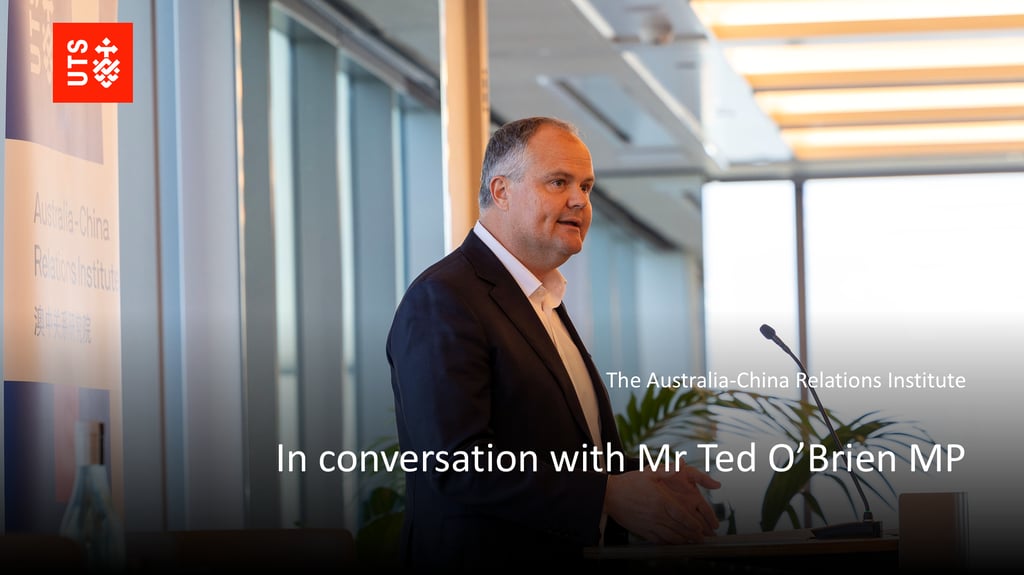
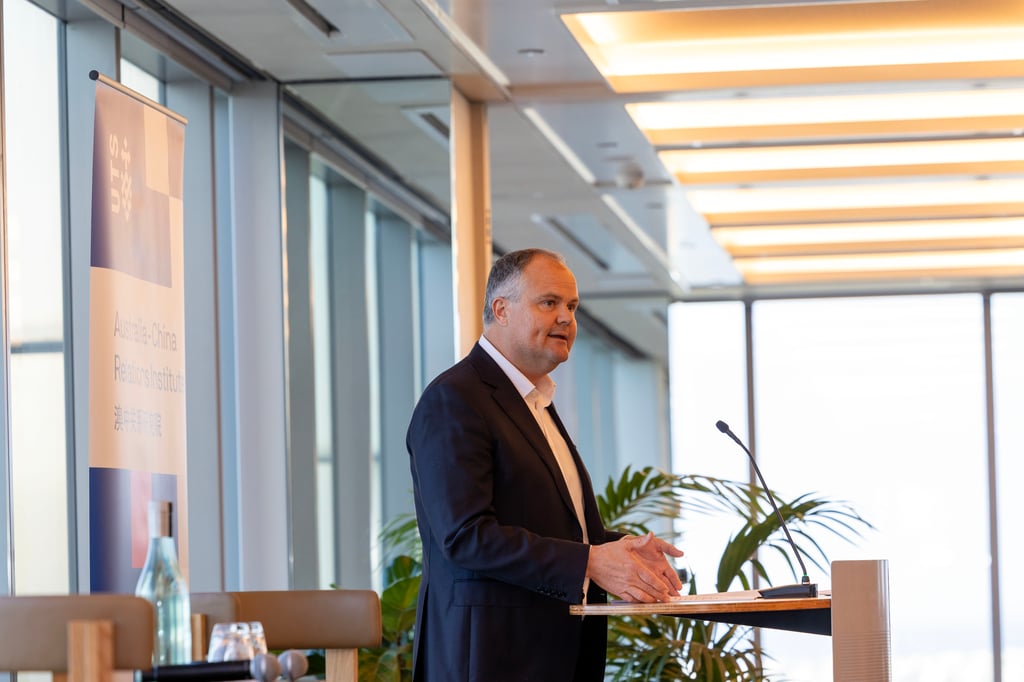
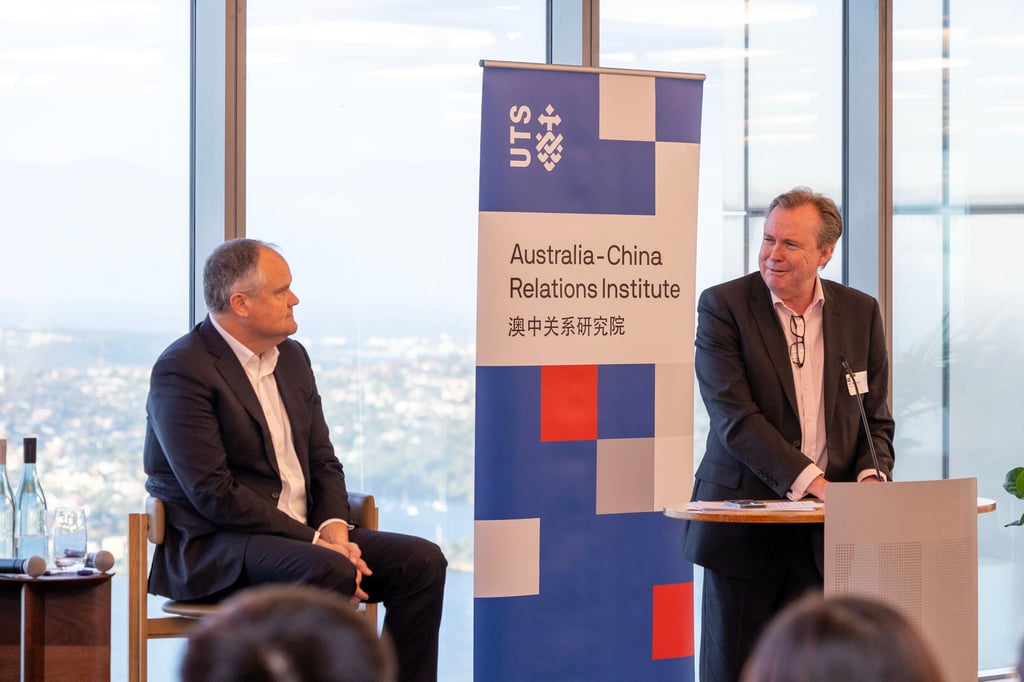
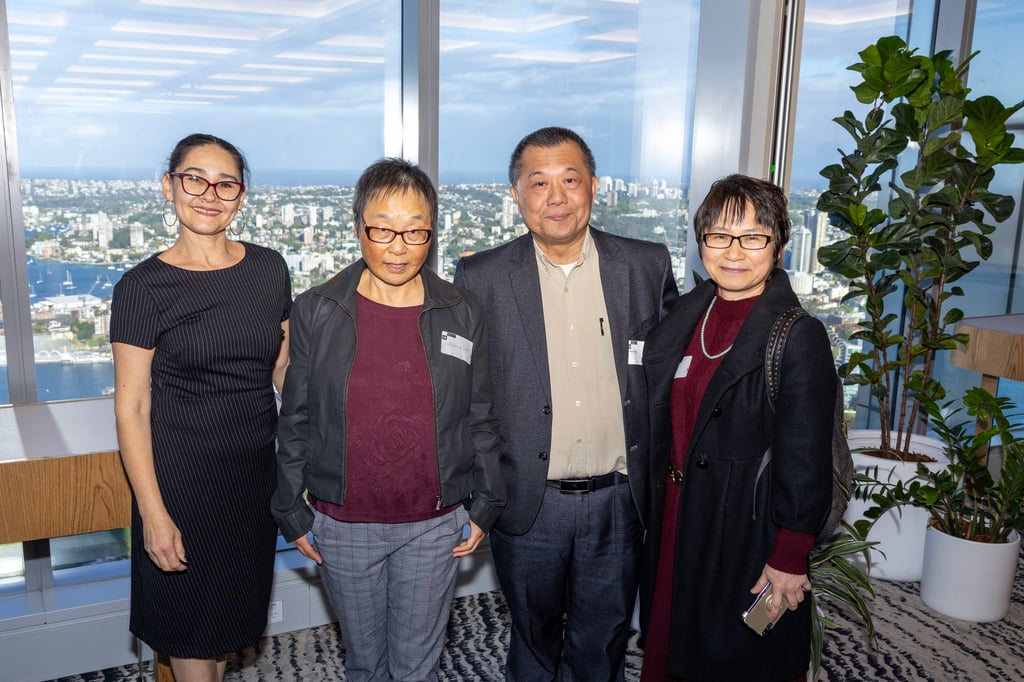
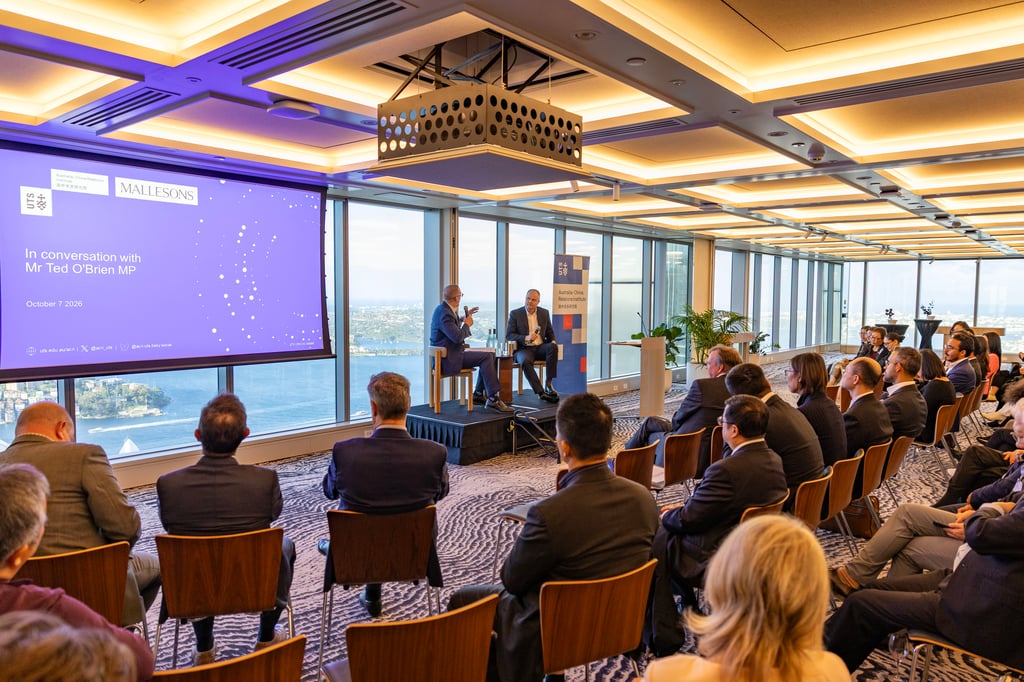
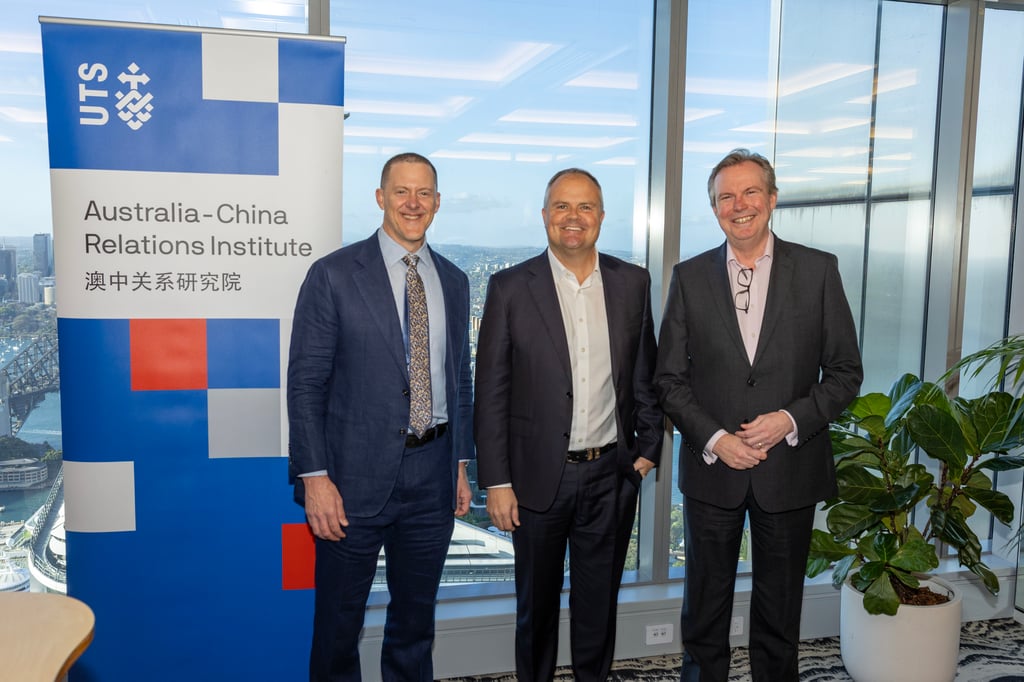
On October 7 2026, the Australia-China Relations Institute at the University of Technology Sydney (UTS:ACRI) welcomed Mr Ted O'Brien MP, Australia’s Shadow Minister for Foreign Affairs, to discuss the present state and future of Australia-China relations. Mr O'Brien MP delivered an address before joining UTS:ACRI Director Professor James Laurenceson in conversation. The discussion was followed by audience Q&A. 

calendar_month Date: Wednesday October 7 2026

schedule Time: 05.00 pm - 07.00 pm

location_on Venue: Mallesons


Listen to audio (opens in Soundcloud)


About the speaker 

Mr Ted O'Brien MP

Appointed in February 2026 to the position of Shadow Minister for Foreign Affairs, Mr Ted O'Brien MP brings considerable international experience to the role.

Much of Ted’s 20-plus years in business prior to entering politics was spent living and working abroad: from the shop floor to the board room; from a family business to a big exporter and then a multinational; and across industries from commodities to consumer goods and then high technology.

Ted’s last international role was as a strategist and deal-maker for the Asia Pacific and Emerging Markets based out of Beijing, as part of a global technology services company for which he worked for over a decade.

His previous roles include Shadow Minister for Climate Change and Energy, Shadow Treasurer and Deputy Leader of the Liberal Party.

Ted holds a Bachelor of Arts from the University of Queensland, a Scholarship in Chinese Mandarin from the National Taiwan Normal University, a Master of International Business from the University of Melbourne (1st Class Hons), and a Master of Economics from the London School of Economics.

He is married to Dr Sophia O’Brien with whom he has three young children, and they live in his electorate of Fairfax on the Sunshine Coast.

About the moderator

Professor James Laurenceson

Professor James Laurenceson is Director of the Australia-China Relations Institute at the University of Technology Sydney (UTS:ACRI). His research interests relate to the Chinese economy and the Australia-China economic and broader relationship.
Share

Recent research and opinion

News

The US and China cannot slow the AI race, but they can make It safer

The United States does not need to trust China, share frontier models with China, or slow its own AI development to have a national security interest in AI...
News

Australia-China Weekly Brief: October 2026 issues

The Australia-China Weekly Brief by the Australia-China Relations Institute at the University of Technology Sydney (UTS:ACRI) tracks key developments in...
News

Whose security counts in the Pacific?

While climate-related spending gets criticised, billions forked out for security and strategic engagement gets framed as for the “national interest”.
News

BOOK REVIEW | Hard New World: Australia’s Post-American future

This article was published in The Round Table, https://doi.org/10.1080/00358533.2026.2739547