


- Posted on 5 Oct 2026
By Mark Beeson
This article was published in The Round Table, https://doi.org/10.1080/00358533.2026.2739547
Hard New World: Australia’s Post-American future, by Hugh White, Collingwood, Vic, Australia Black Inc, 2026, 224 pp., A$ 36.99, ISBN 9781760646226
Hugh White is rightly considered to be one of the best security analysts in Australia. Hard New World is a very important contribution to the debate about Australia’s security and the changing international order with which policymakers must contend. White’s conclusions will win him few friends in Canberra, but the book is all the better for that. As he points out
We live in difficult times, and governments carry an immense responsibility to navigate us through them. Today we confront the failure of our entire political system to respond to that responsibility. (p 185)
Much of the book is taken up with spelling out what makes the current historical moment especially ‘difficult’, which even readers not enthralled by Australia’s distinctive circumstances and failures will find illuminating. History and geography may make Australia’s leaders especially unimaginative, timid, and reluctant to confront a rapidly changing litical reality, but the transformation of the international system means that the ‘rules-based order’ is not coming back, White argues, and that’s a problem all leaders will have to confront.
The United States was the hegemonic foundation of this system but ‘shifts in the global distribution of power are undermining America’s global leadership and transforming the world order’ (p 7). Whoever follows Trump will be confronted by the unforgiving reality of relative American decline, something that has even more profound implications for loyal allies like Australia whose policymaking elites are ‘in denial’, not least about the ‘transactional’ nature of every alliance relationship.
Given the importance White attaches to both the United States declining ability and willingness to play its long-standing role as the anchor of alliance relationships in Asia and Europe, it might have been worth considering why policymakers cling so tenaciously to old ideas. As White’s own analysis demonstrates, there is no shortage of credible and insightful studies of Australia’s relationship with the US or the region of which it is a part, but they are generally studiously ignored in Canberra.
By contrast, the war in Ukraine has focused the attention of European leaders because ‘the credibility of America’s commitment to defend Europe has been shattered’. Interestingly, White’s essentially realist analysis of great power competition leads him to conclude that ‘Europe needs Russia to be strong enough to resist any Chinese attempt to dominate Eurasia’.
The book’s preoccupation with this sort of grand strategizing explains the focus on the ‘US-China contest’, which White considers to be more dangerous than the Cold War because, unlike the Soviet Union, China is dissatisfied with the US-dominated status quo and feels ‘impelled’ to overturn it. As he rightly points out, ‘nothing is more important [for China] than to be treated as an equal by other great powers’ (p 111).
The big question in this context, of course, are the lengths to which China might be prepared to go in order to achieve this. White argues that in a possible conflict with China over Taiwan, ‘the chances of anything that looks like a US victory have shrunk’ making it less likely the US would fight’ (p 121). China has a greater ‘resolve’ than the US and this may prove decisive, he claims. Indeed, this applies to China’s regional role and desire to establish a sphere of influence, too, a possibility about which he is admirably phlegmatic: ‘whatever new order might emerge from a peaceful transition – even Chinese hegemony in East Asia and the Western Pacific – would not be as bad for us as a great power war to try to prevent that hegemony’ (p 172).
While this might seem an entirely sensible position for a middle power with an increasingly unreliable ally to take, White suggests that ‘our leaders do not understand that Australia has to find a way to get along with China one way or another’ (p 158). The problem is compounded by the fact that ‘our strategic relationship with America today is a dishonest muddle’ (p 175), symbolised most conspicuously and expensively by the ill-starred AUKUS project.
White favours a more modest and appropriate defence posture in which ‘our armed forces should be designed primarily to defend Australia independently’ (p 165). Given Australia’s uniquely favourable geographical circumstances and the absence of obvious enemies, this looks entirely appropriate, too. More contentious is the idea that this might require ‘a minimum nuclear deterrent to backstop capable conventional forces’.
Although White provides a persuasive, clear-eyed analysis of Australia’s – and the world’s – changing strategic landscape, readers hoping for a path to peace and stability will be disappointed. Perhaps it’s a consequence of speaking hard truths to power, or perhaps it’s just that it’s increasingly difficult to make a plausible case for peace in our time, but that’s no reason not to read this book.
We can only hope that it will be read in Canberra and contribute to a real debate about what security actually means in a uniquely fortunate country like Australia. Greater self-reliance looks sensible, but so does encouraging greater regional and even international cooperation to address rapidly emerging and/or worsening challenges like climate change, the threats posed by AI, endless wars, and the increasingly desperate circumstances that distinguish so many in the Global South. But that may be a story for another book.
AUTHOR

Mark Beeson
Adjunct Professor, Australia-China Relations Institute, University of Technology Sydney

News
The US and China cannot slow the AI race, but they can make It safer
The United States does not need to trust China, share frontier models with China, or slow its own AI development to have a national security interest in AI...
News
Australia-China Weekly Brief: October 2026 issues
The Australia-China Weekly Brief by the Australia-China Relations Institute at the University of Technology Sydney (UTS:ACRI) tracks key developments in...
News
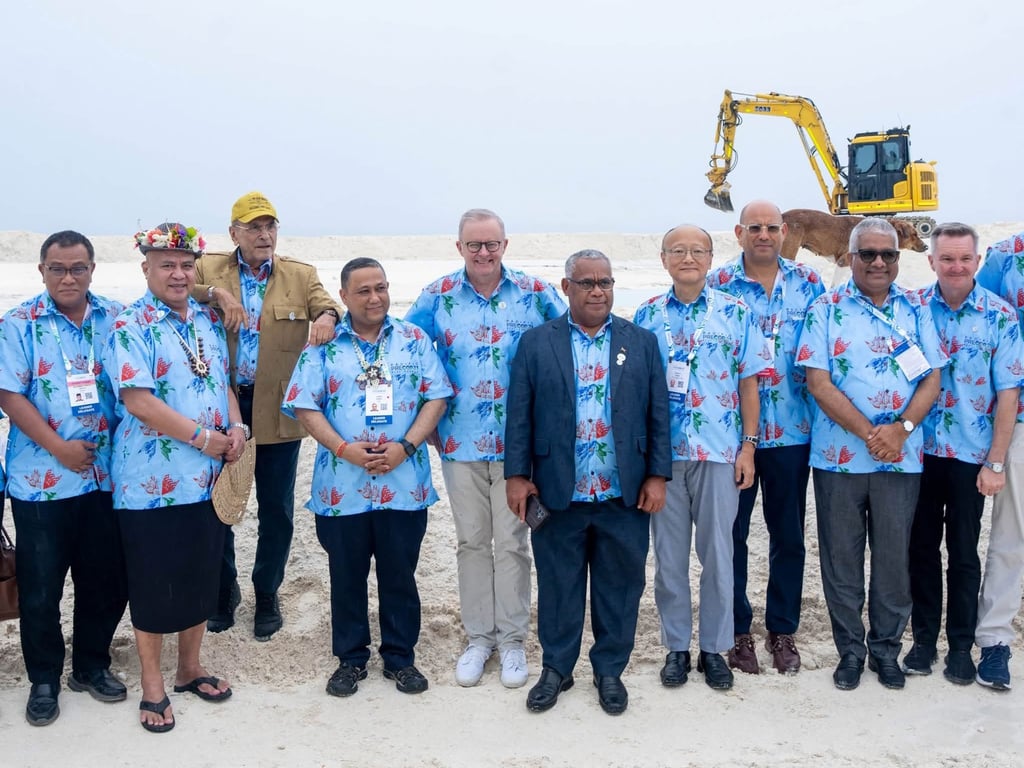
Whose security counts in the Pacific?
While climate-related spending gets criticised, billions forked out for security and strategic engagement gets framed as for the “national interest”.
News
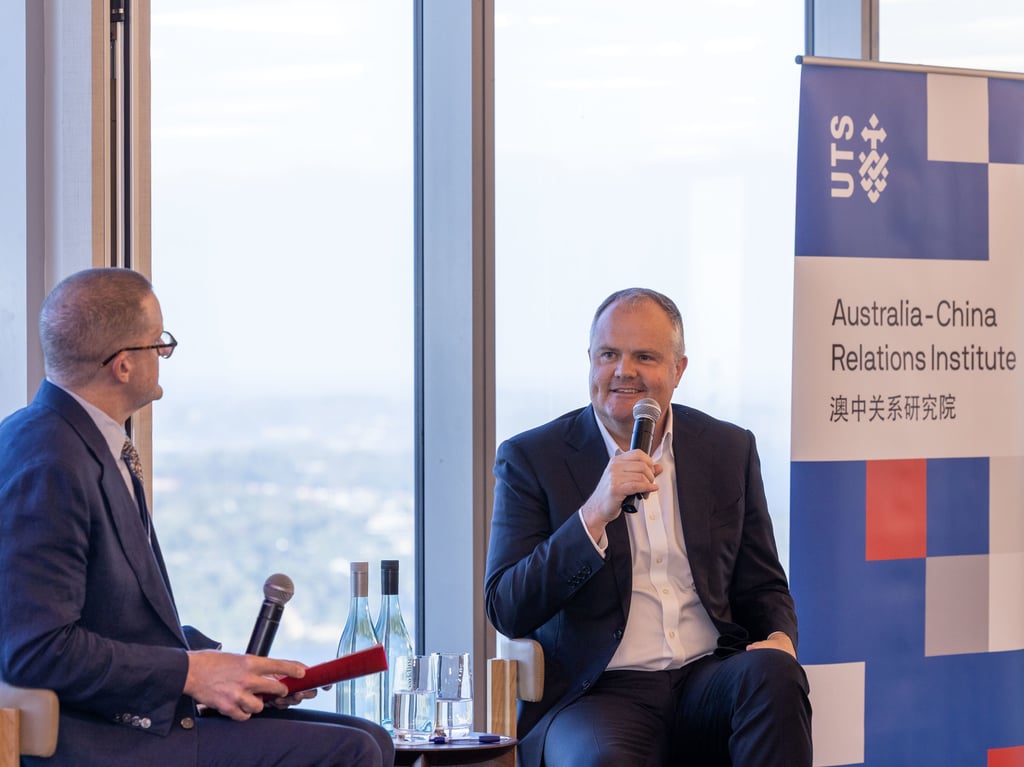
In conversation with Mr Ted O'Brien MP
On October 7 2026, the Australia-China Relations Institute at the University of Technology Sydney (UTS:ACRI) welcomed Mr Ted O'Brien MP, Australia’s Shadow...
News
The US and China cannot slow the AI race, but they can make It safer
The United States does not need to trust China, share frontier models with China, or slow its own AI development to have a national security interest in AI...
News
Australia-China Weekly Brief: October 2026 issues
The Australia-China Weekly Brief by the Australia-China Relations Institute at the University of Technology Sydney (UTS:ACRI) tracks key developments in...
News
Whose security counts in the Pacific?
While climate-related spending gets criticised, billions forked out for security and strategic engagement gets framed as for the “national interest”.
News
In conversation with Mr Ted O'Brien MP
On October 7 2026, the Australia-China Relations Institute at the University of Technology Sydney (UTS:ACRI) welcomed Mr Ted O'Brien MP, Australia’s Shadow...