


- Posted on 27 Aug 2026
By Elena Collinson
The Australia-China Weekly Brief by the Australia-China Relations Institute at the University of Technology Sydney (UTS:ACRI) tracks key developments in Australia-China relations over each week.
August 20 - August 27 2026
1. Universities inherit a broader – and blurrier – research security test
Canberra further tightened research security controls after Labor accepted a last-minute Coalition push to bring researcher-to-researcher collaborations within the Foreign Relations Act. Universities must now identify and disclose individual academics’ overseas collaborations that could ‘adversely affect Australia’s national interest’.
Separately, it emerged that PRC police had seized the passports of ANU academics and PhD students for several hours during a May 2024 teaching visit to Shandong University, adding another dimension to scrutiny of the now-terminated ANU-Shandong partnership.
The takeaway: The amendments push universities to police individual collaborations against a broad and undefined ‘national interest’ test, creating incentives to over-comply.
Research links involving countries under heightened security scrutiny, including the PRC, are likely to face particularly cautious treatment, potentially chilling academic freedom and international collaboration beyond sensitive areas.
The Shandong passport incident adds a further layer to that risk calculus by highlighting exposure to foreign state action. If Canberra judges university self-management inadequate, mandatory notification or more prescriptive controls on individual collaborations remain a possible next step.
2. Liu Jinsong arrives in Canberra as China’s new ambassador-designate
PRC diplomat Liu Jinsong arrived in Sydney on August 24 before travelling to Canberra by public bus, saying he ‘thoroughly enjoyed’ speaking with ‘ordinary Australians’ on board.
In a statement issued on arrival, he said Australia and the PRC have ‘no fundamental conflict of interests’, while also stressing the need to respect each other’s ‘core interests and major concerns’.
Before formally presenting his credentials, the PRC embassy’s Chinese-language announcement (Aug 24) presented him as the ‘new ambassador’, and published images of his engagement with Chinese-Australian community representatives. DFAT subsequently issued a protocol note that ambassadors-designate should avoid activity implying they have formally assumed office.
The takeaway: Liu’s appointment suggests Beijing increasingly sees Australia as a regional strategic problem to manage. He most recently headed the PRC Foreign Ministry’s Asian Affairs Department and his background equips him to handle the security and geopolitical issues most likely to generate friction. His opening emphasis on ‘core interests’ signals that Beijing expects stabilisation to coexist with firm boundaries on issues it considers non-negotiable.
His early focus on public diplomacy, from the folksy bus trip to engagement with Chinese community representatives, suggests a more visible style. The protocol wrinkle is minor, but DFAT’s rapid reminder indicates that such outreach will be closely watched, particularly where it intersects with longstanding sensitivities about political influence and community engagement.
3. Canberra’s strategy tested from two directions
Former Home Affairs secretary Mike Pezzullo has revived his 2021 ‘drums of war’ warning, writing that conflict with the PRC should be treated as a standing planning problem.
Strategist Hugh White reaches a different prescription from a similarly pessimistic outlook, arguing that US retreat from Asia reflects deeper shifts in American power and interests, and that Australia should prepare for a region without guaranteed US primacy or protection.
The takeaway: Pezzullo and White challenge Canberra from opposite directions but together, they expose how much current strategy depends on two uncertain propositions: that closer US alignment will continue to deter major conflict, and that Washington will remain willing and able to sustain that role.
Canberra’s combination of deeper US integration and diplomatic stabilisation with Beijing is designed to manage those risks without confronting either possibility directly. The harder question raised by both arguments is what Australia does if deterrence fails, US power recedes or both occur together.
4. AML scrutiny raises the bar for Chinese property capital
AUSTRAC’s Operation Claw has uncovered potentially hundreds of millions of dollars in suspected mortgage fraud, including cases involving offshore or third-party funding, and referred individuals and entities linked to suspect applications to regulators and law enforcement. The findings coincide with the expansion of Australia’s anti-money laundering regime.
The takeaway: Australia’s tougher AML regime is raising the documentation burden on Chinese property capital, especially where purchases rely on family transfers, offshore accounts or complex ownership structures. Combined with PRC capital controls, that creates a two-sided squeeze: getting money out of China is harder, and proving its provenance in Australia is becoming more demanding. The likely effect is not just less Chinese investment, but a shift toward buyers with simpler, more transparent funding.
5. Other developments – Joint cooling textile research and renewed farmland scrutiny
Australia-China research delivers cooling textile
Adelaide University and Zhengzhou University researchers developed a coloured fabric that significantly reduces heat exposure. The project highlights the continued practical value of bilateral research collaboration in lower-risk fields, even as wider research security scrutiny intensifies.
Food security returns to the foreign investment debate
The National Farmers’ Federation is urging Canberra to treat agricultural land and critical supply chains more explicitly as national interest assets. With China the second-largest foreign holder of Australian agricultural land, the intervention could broaden China-focused scrutiny from farmland ownership to control of processing, logistics and other food system infrastructure.
Past issues
AUTHOR

Manager, Research Analysis, Australia-China Relations Institute, University of Technology Sydney

News
The US and China cannot slow the AI race, but they can make It safer
The United States does not need to trust China, share frontier models with China, or slow its own AI development to have a national security interest in AI...
News
Australia-China Weekly Brief: October 2026 issues
The Australia-China Weekly Brief by the Australia-China Relations Institute at the University of Technology Sydney (UTS:ACRI) tracks key developments in...
News
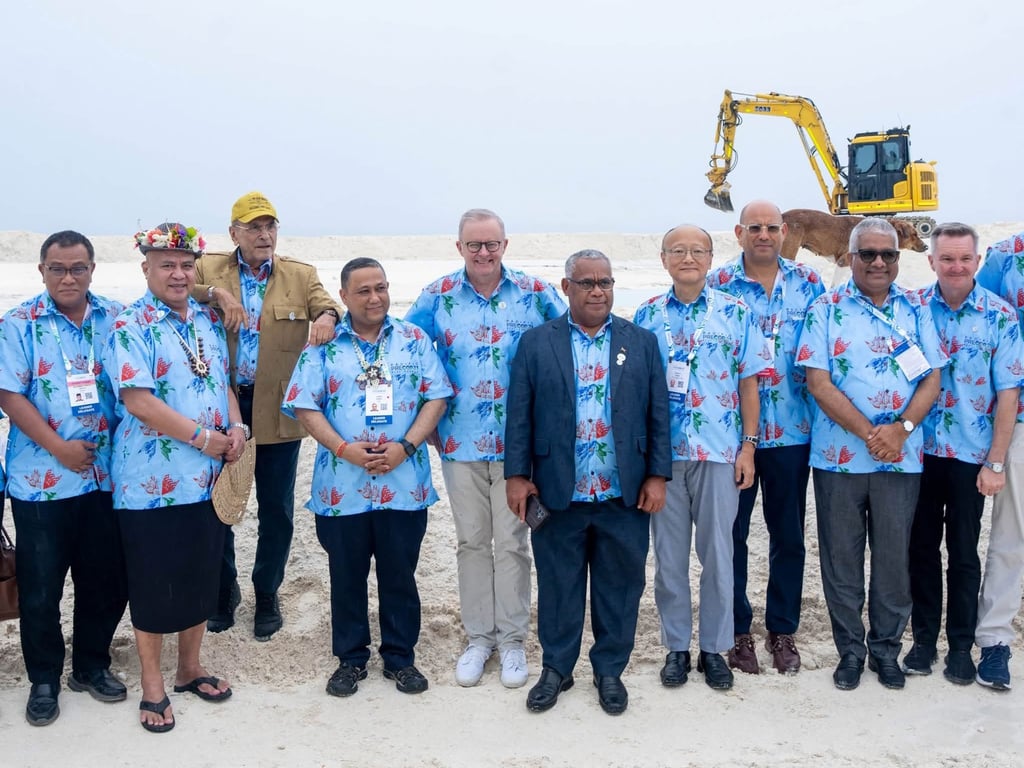
Whose security counts in the Pacific?
While climate-related spending gets criticised, billions forked out for security and strategic engagement gets framed as for the “national interest”.
News
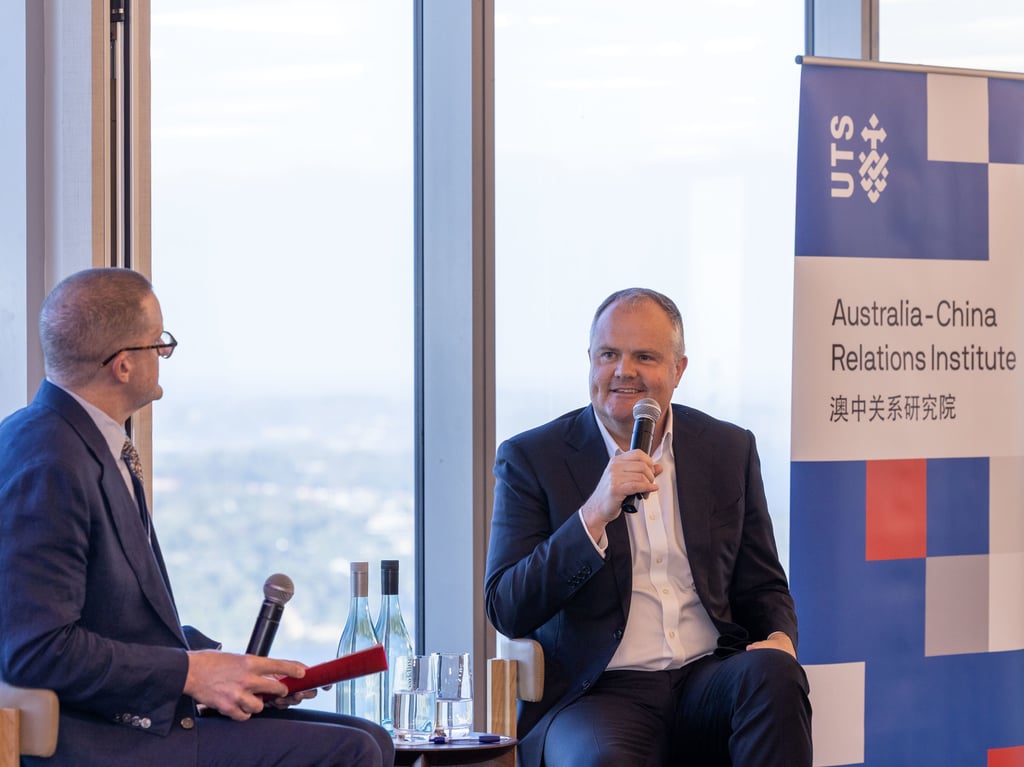
In conversation with Mr Ted O'Brien MP
On October 7 2026, the Australia-China Relations Institute at the University of Technology Sydney (UTS:ACRI) welcomed Mr Ted O'Brien MP, Australia’s Shadow...
News
The US and China cannot slow the AI race, but they can make It safer
The United States does not need to trust China, share frontier models with China, or slow its own AI development to have a national security interest in AI...
News
Australia-China Weekly Brief: October 2026 issues
The Australia-China Weekly Brief by the Australia-China Relations Institute at the University of Technology Sydney (UTS:ACRI) tracks key developments in...
News
Whose security counts in the Pacific?
While climate-related spending gets criticised, billions forked out for security and strategic engagement gets framed as for the “national interest”.
News
In conversation with Mr Ted O'Brien MP
On October 7 2026, the Australia-China Relations Institute at the University of Technology Sydney (UTS:ACRI) welcomed Mr Ted O'Brien MP, Australia’s Shadow...