

  • University of Technology Sydney home
  • Home

    Home
  • For students

  • For industry

  • Research

Explore

  • Courses
  • Events
  • News
  • Stories
  • People

For you

  • Libraryarrow_right_alt
  • Staffarrow_right_alt
  • Alumniarrow_right_alt
  • Current studentsarrow_right_alt
  • Study at UTS

    • arrow_right_alt Find a course
    • arrow_right_alt Course areas
    • arrow_right_alt Undergraduate students
    • arrow_right_alt Postgraduate students
    • arrow_right_alt Research Masters and PhD
    • arrow_right_alt Studying online
  • Student information

    • arrow_right_alt Current students
    • arrow_right_alt New UTS students
    • arrow_right_alt Graduates (Alumni)
    • arrow_right_alt High school students
    • arrow_right_alt Indigenous students
    • arrow_right_alt International students
  • Admissions

    • arrow_right_alt How to apply
    • arrow_right_alt Entry pathways
    • arrow_right_alt Eligibility
arrow_right_altVisit our hub for students

For you

  • Libraryarrow_right_alt
  • Staffarrow_right_alt
  • Alumniarrow_right_alt
  • Current studentsarrow_right_alt

POPULAR LINKS

  • Apply for a coursearrow_right_alt
  • Current studentsarrow_right_alt
  • Scholarshipsarrow_right_alt
  • Featured industries

    • arrow_right_alt Agriculture and food
    • arrow_right_alt Defence and space
    • arrow_right_alt Energy and transport
    • arrow_right_alt Government and policy
    • arrow_right_alt Health and medical
    • arrow_right_alt Corporate training
  • Explore

    • arrow_right_alt Tech Central
    • arrow_right_alt Case studies
    • arrow_right_alt Research
arrow_right_altVisit our hub for industry

For you

  • Libraryarrow_right_alt
  • Staffarrow_right_alt
  • Alumniarrow_right_alt
  • Current studentsarrow_right_alt

POPULAR LINKS

  • Find a UTS expertarrow_right_alt
  • Partner with usarrow_right_alt
  • Explore

    • arrow_right_alt Explore our research
    • arrow_right_alt Research centres and institutes
    • arrow_right_alt Graduate research
    • arrow_right_alt Research partnerships
arrow_right_altVisit our hub for research

For you

  • Libraryarrow_right_alt
  • Staffarrow_right_alt
  • Alumniarrow_right_alt
  • Current studentsarrow_right_alt

POPULAR LINKS

  • Find a UTS expertarrow_right_alt
  • Research centres and institutesarrow_right_alt
  • University of Technology Sydney home
University of Technology Sydney home University of Technology Sydney home
  1. ... For students
  2. ... Experience UTS
  3. Experience law at UTS
  4. How to become a lawyer in NSW: The four-step guide

How to become a lawyer in NSW: The four-step guide

explore
  • Experience law at UTS
    • arrow_forward With an IP career, Sai is bringing art and law together
    • arrow_forward From PLT to the high life in London
    • arrow_forward Technology is transforming the legal sector. Graduates must transform too.
    • arrow_forward What to expect on Open Day 2026 at the Faculty of Law
    • arrow_forward Four myths about postgraduate law, busted
    • arrow_forward Harnessing the power of intellectual property
    • arrow_forward From theory to practice, PLT brings the Law to life
    • arrow_forward Never too late: a mid-career foray into the law
    • arrow_forward One degree, countless careers
    • arrow_forward With postgraduate Law, Arhita is making her mark
    • arrow_forward Valuable insights into law recruitment process: Student perspectives
    • arrow_forward For Steve Nott, a Juris Doctor was a personal and professional step up
    • arrow_forward Are you a ‘dementia-capable’ legal practitioner?
    • arrow_forward 5 ways our Migration Law course will set you up for an exciting career | UTS Law
    • arrow_forward 6 tips to become a top performing Law student
    • arrow_forward 7 tips to manage postgraduate studies
    • arrow_forward Benefits of combining your Law degree
    • arrow_forward Five career options for law graduates
    • arrow_forward How to become a lawyer in NSW: The four-step guide
    • arrow_forward Technology and innovation: the future of law
    • arrow_forward Think you’re ‘too old’ to study law? Think again
    • arrow_forward A career in social justice
    • arrow_forward From business manager to banking lawyer
    • arrow_forward It’s never too late for a law degree
    • arrow_forward Postgraduate law can lead to more than just a legal career

From your first lecture to your admission at the Supreme Court of NSW—here is your roadmap to a legal career

woman studies at desk

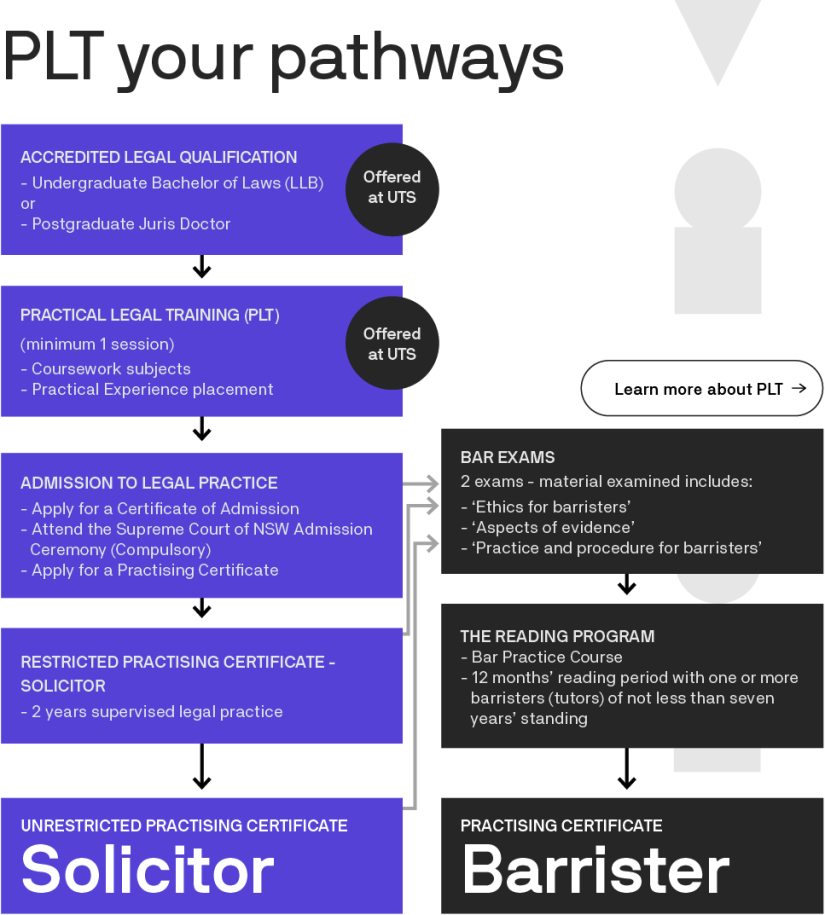
The law journey at a glance

Ready to pursue a career in law?

Becoming a lawyer is a rigorous but rewarding process. In New South Wales (NSW), there are four distinct steps to moving from a student to an admitted legal practitioner.

solicitor vs barrister: What's the difference?

Most law graduates start as solicitors, but it is important to know where each path leads.

FeatureSolicitorBarrister
Primary RoleThe first point of contact for clients. They advise on and manage legal work including contracts, litigation, and case management.Specialist advocates who represent clients in court and provide expert opinions on complex matters. They are engaged by solicitors on behalf of clients.
Work EnvironmentLaw firms, government agencies, not-for-profits or in-house corporate teams.Usually self-employed, working from ‘Chambers’.
How to get thereYour journey starts as a lawyer once you receive your Practising Certificate (see step 4)Requires passing Bar Exams after gaining admission as a legal practitioner (see step 3).

Step 1: 
Complete an accredited legal qualification

Duration: 3–5 years

Your journey begins with an academic foundation. At UTS, we offer two primary pathways depending on your current education level.

Which degree is right for you?

  • I am a high school leaver: 
    BACHELOR OF LAWS (LLB)
    • Duration: 4 years full-time
    • The details: An undergraduate degree that combines legal theory with real-world practice. You can also combine this with degrees in Business, Science, IT, and more. LLB can include PLT.
  • I already have a degree in another discipline: 
    JURIS DOCTOR (JD)
    • Duration: 3 years full-time
    • The details: A postgraduate qualification designed for graduates from non-law backgrounds or those with an international legal qualification who want to pivot their career into law.

Step 2: 
Practical Legal Training (PLT)

Duration: ~6 months

A law degree teaches you the law; PLT teaches you the skills needed to be a lawyer. This compulsory practical training covers the day-to-day skills you need, such as trust accounting, soft skills, ethics, and litigation practice.

The UTS Advantage:

Unlike many other institutions, UTS offers a one-stop shop. You can include PLT in your LLB or JDPLP, or you can complete your PLT directly with us immediately after finishing your degree.

Explore the Practical Legal Training (PLT) Program

Step 3: 
Admission to Legal Practice

(The Ceremony)

Once you have your degree and your PLT certification, you are ready to make it official.

  1. Apply: Submit your admission application to the Legal Profession Admission Board (LPAB) for a Compliance Certificate.
  2. Attend: Once approved, you will attend an Admission Ceremony at the Supreme Court of NSW.
  3. Oath: You will take your oath of office and sign the Supreme Court Roll.

Congratulations! You are now an admitted legal practitioner.

Step 4: 
Your practising certificate

(Start your career)

Admission makes you a lawyer on paper, but to work you need a Practising Certificate.

  • The Solicitor route: Apply to the Law Society of NSW for a Restricted Practising Certificate. You will work under the supervision of a senior lawyer for two years. After that, you can apply for an Unrestricted Practising Certificate.
  • The Barrister route: While some sit the Bar Exams immediately, many lawyers work as solicitors first to build a network and experience before specialising in courtroom advocacy.

Don't wait to kick-start the legal career of your dreams
Start your law journey today

Pathways to becoming a lawyer

Learn more about PLT

Acknowledgement of Country

UTS acknowledges the Gadigal people, the Boorooberongal people of the Dharug Nation, the Bidiagal people and the Gamaygal people upon whose ancestral lands our university stands. We would also like to pay respect to the Elders both past and present, acknowledging them as the traditional custodians of knowledge for these lands.

University of Technology Sydney

City Campus

15 Broadway, Ultimo, NSW 2007

Get in touch with UTS

Follow us

  • Instagram
  • LinkedIn
  • YouTube
  • TikTok
  • Facebook
  • WeChat

A member of

  • Australian Technology Network
Use arrow keys to navigate within each column of links. Press Tab to move between columns.

Study

  • Find a course
  • Undergraduate
  • Postgraduate
  • How to apply
  • Scholarships and prizes
  • International students
  • Campus maps
  • Accommodation

Engage

  • Find an expert
  • Industry
  • Research
  • News
  • Events
  • Experience UTS
  • Stories
  • Alumni
  • Giving

About

  • Who we are
  • Faculties
  • Learning and teaching
  • Sustainability
  • Initiatives
  • Equity, diversity and inclusion
  • Campus and locations
  • Rankings and ratings
  • Leadership and governance

Staff and students

  • Current students
  • Help and support
  • Library
  • Policies
  • StaffConnect
  • Working at UTS
  • UTS Handbook
  • Contact us
  • Copyright © 2026
  • ABN: 77 257 686 961
  • CRICOS provider number: 00099F
  • TEQSA provider number: PRV12060
  • TEQSA category: Australian University
  • Privacy
  • Copyright
  • Disclaimer
  • Accessibility

We use cookies and similar technologies to provide a better experience

We use scripts (e.g. cookies) that read, store, and write information on your browser. The information we process include your IP address, session details and browsing activity. We use this information to improve our website, personalise your experience and support marketing efforts. Learn more in our Website Privacy Notice.

Close

This banner is displayed for testing purposes only. You may close it by clicking the “X”, or simply ignore it. We apologise for any inconvenience.