

Undergraduate students enrolled in a Bachelor of Laws or a combined degree with a Bachelor of Laws may choose to undertake the Legal Futures and Technology Major.

Video: Legal Futures and Technology Major - Introduction

oXiztd6Ix9E

Transcript

Increasingly, technology is part of everyday legal practice as it evolves and advances. Technology is also an integral part of our legal future.

This series of videos is designed to provide more information about the Legal Futures and Technology major that is available for undergraduate law students at UTS. This should help you understand more about the major and plan so that you are able to meet the eligibility requirements to complete the major. It will also give you more information about the technology law subjects that are available for all undergraduate law students at UTS.

Technology is disrupting the practice of law. Recently, generative AI tools have presented challenges and opportunities for the legal profession, but this is only one of many challenges and opportunities that we have already encountered and we expect to encounter in the future.

AI has already been accepted as a tool that can aid legal research and discovery in document generation, but generative AI expands the potential role of technology in legal practice, along with the potential for its misuse.

At the same time, data analytics can protect legal outcomes or assess causes of action in disputes and negotiations. These tools need to be used thoughtfully by lawyers to minimise risk and ensure ethical practice.

Lawyers also increasingly encounter new types of technology that require regulation, from smart contracts to cryptocurrency to NFTs. The major helps you to understand how all parts of your legal education can be relevant to these questions of legal technology. This understanding is critical as lawyers encounter or participate in virtual legal services and are asked to advise on them.

The major recognises that increasingly, clients are demanding more than traditional knowledge and skills from lawyers. Expectations are shifting and lawyers play a key role in the regulation and management of technology, including the ethical dimensions of technology.

Legal professionals have an opportunity to partner with clients and experts across a range of disciplines in order to address modern challenges by developing innovative solutions.

In the Legal Futures and Technology major, we provide you with many of the skills that you will need to address these challenges at UTS. We have drawn on the deep knowledge and understanding of technology in our law faculty and across the university to launch the first legal technology focused major, the UTS Law Legal Futures and Technology major.

The introduction of the major in 2018 followed extensive research and industry consultation. This research highlighted the critical importance of providing our law students with skills to address ongoing technological disruption and understand its impact on the legal profession. Even in five years, the need for these skills has intensified with the development of new technology that challenges the role of legal professionals.

The core subjects in the major include hands-on real-world technology coursework to help our students develop and hone these skills. Students have opportunities to undertake legal internships with a Legal Futures and Technology focus that helps students to develop relevant practical skills when they encounter legal problems related to technology. These skills include project management and effective group work and communication.

Students undertaking the major are highly competitive in the legal jobs market and the skills they learn complement other law faculty programs, including Mooting and the Allens Neota Logic UTS Law Tech Challenge.

Students undertaking the major have the opportunity to learn from a range of experts in the field. On this slide, you can see the academics who teach the core subjects of the major. Dr Genevieve Wilkinson teaches the first capstone subject, Professor David Lindsay teaches the second capstone subject and Dr Ivana Wright teaches disruptive technologies. These academics are joined by other experts who teach a range of electives available as part of the major.

Students have diverse opportunities to learn from these experts in different fields where technology is important, including intellectual property, media and digital platforms. Our students are also able to undertake honours research theses supervised by these academics on diverse topics.

All of these subjects equip our students to learn from experts about how they can manage a legal future where technology plays a critical role.

  • The Major consists of five subjects, totalling 30 credit points. 
  • The Major is undertaken in students’ penultimate and/or final year.

Compulsory subjects

Video: Legal Futures and Technology Major - Course structure
QApEgawlS60

Transcript

Increasingly, technology is part of everyday legal practice as it evolves and advances. Technology is also an integral part of our legal future.

This series of videos is designed to provide more information about the Legal Futures and Technology major that is available for undergraduate law students at UTS. This should help you understand more about the major and plan so that you are able to meet the eligibility requirements to complete the major. It will also give you more information about the technology law subjects that are available for all undergraduate law students at UTS.

Technology is disrupting the practice of law. Recently, generative AI tools have presented challenges and opportunities for the legal profession. But this is only one of many challenges and opportunities that we have already encountered and we expect to encounter in the future. AI has already been accepted as a tool that can aid legal research and discovery in document generation. But generative AI expands the potential role of technology in legal practice, along with the potential for its misuse. At the same time, data analytics can protect legal outcomes or assess causes of action in disputes and negotiations.

These tools need to be used thoughtfully by lawyers to minimise risk and ensure ethical practice. Lawyers also increasingly encounter new types of technology that require regulation, from smart contracts to cryptocurrency to NFTs.

The major helps you to understand how all parts of your legal education can be relevant to these questions of legal technology. This understanding is critical as lawyers encounter or participate in virtual legal services and are asked to advise on them.

The major recognises that increasingly clients are demanding more than traditional knowledge and skills from lawyers. Expectations are shifting and lawyers play a key role in the regulation and management of technology, including the ethical dimensions of technology.

Legal professionals have an opportunity to partner with clients and experts across a range of disciplines in order to address modern challenges by developing innovative solutions.

In the Legal Futures and Technology major, we provide you with many of the skills that you will need to address these challenges at UTS. We have drawn on the deep knowledge and understanding of technology in our law faculty and across the university to launch the first legal technology focused major, the UTS Law Legal Futures and Technology major.

The introduction of the major in 2018 followed extensive research and industry consultation. This research highlighted the critical importance of providing our law students with skills to address ongoing technological disruption and understand its impact on the legal profession. Even in five years, the need for these skills has intensified with the development of new technology that challenges the role of legal professionals.

The core subjects in the major include hands-on real-world technology coursework to help our students develop and hone these skills. Students have opportunities to undertake legal internships with a Legal Futures and Technology focus that helps students to develop relevant practical skills when they encounter legal problems related to technology. These skills include project management and effective group work and communication.

Students undertaking the major are highly competitive in the legal jobs market and the skills they learn complement other law faculty programs, including Mooting and the Allens Neota Logic UTS Law Tech Challenge.

Students undertaking the major have the opportunity to learn from a range of experts in the field. On this slide, you can see the academics who teach the core subjects of the major. Dr Genevieve Wilkinson teaches the first capstone subject, Professor David Lindsay teaches the second capstone subject, and Dr Ivana Wright teaches Disruptive Technologies. These academics are joined by other experts who teach a range of electives available as part of the major.

Students have diverse opportunities to learn from these experts in different fields where technology is important, including intellectual property, media and digital platforms. Our students are also able to undertake honours research theses supervised by these academics on diverse topics. All of these subjects equip our students to learn from experts about how they can manage a legal future where technology plays a critical role.

In this video, I will talk to you about the subjects that comprise the compulsory subjects in the major, noting that you're also required to choose two other approved electives. In all, the major consists of five subjects totalling credit points. It's therefore important to make sure that you have credit points available to enrol in the major.

There are two compulsory capstone subjects, Capstone One and Capstone Two. The Capstones are designed to bring together much of what you've learnt in your law degree and to expand on it with a technology focus.

As your third subject, you have a choice between an elective, Disruptive Technologies and the Law, and a local internship including the Law Tech Clinic. It's usual and advisable for students to complete the Disruptive Technologies elective before studying Capstone One, as what you learn in the elective will help you with the capstone subjects.

Finally, you must choose two other electives from a range of approved technology law electives, which includes subjects such as intellectual property law, media law, workplace health and safety, and regulating technologies.

The first of the capstone subjects is Technology, Law, Policy and Ethics. This subject explores the policy and ethical issues that arise in light of the significant impact that technology is having on the world, and the role of lawyers in shaping policy and protecting the vulnerable. Lawyers need to be adaptive and technically capable. In response to these impacts, and in line with UTS philosophy, it's important for students to understand the ethical implications of new and emerging technologies.

Ethical and policy issues arising from innovative technology pose new threats to our freedoms, privacy and security, but also opportunities to use technologies to find solutions to some of the world's great problems. Technology also offers an opportunity to resolve some of the United Nations' problems in achieving its Sustainable Development Goals.

This subject engages with changes and challenges resulting from technological developments that could be addressed by the law, including emerging legal technology which can erode the possibility for human review and oversight, and technology that enables governments and private organisations to monitor our moves and listen to our conversations.

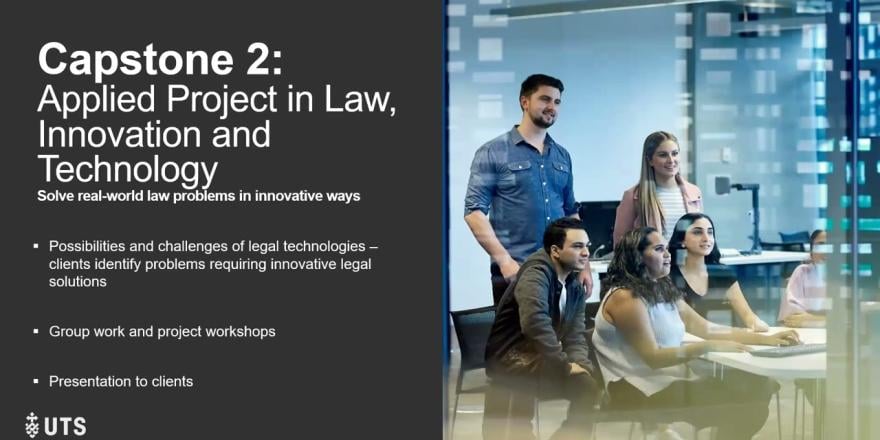
The second capstone subject is the Applied Project in Law, Innovation and Technology. This is a practically oriented subject in which students use legal project management skills to solve real world technology law problems in innovative ways. In this subject, students work in teams to solve problems for clients over a full semester and are required to present throughout the semester. Students learn skills in legal technology law and in teamwork. In addition, the subject introduces students to legal technologies and, importantly, how technology is changing the practice of law.

The projects students have worked on in past years have included technology law projects involving generative AI, the energy sector, fintech, smart cities and agritech. Working on projects such as these is a great opportunity to get up to speed in rapidly evolving areas of the law that will continue to be important.

In addition to the two capstone subjects, students enrolled in the major must complete either the Disruptive Technologies elective or the local internship. Technologies such as artificial intelligence, big data, the Internet of Things, cryptocurrencies, smart contracts, fintech and legal tech pose fundamental challenges for law and regulation. That said, the law often lags behind technology.

The challenges of disruptive technologies mean that technology lawyers must be advanced problem solvers, including being able to advise clients about the application of laws that are not fit for purpose and in contributing to policy debates about how to regulate new technologies. This subject equips students with the essential tools needed to understand how existing laws apply to new and emerging technologies and to contribute to debates about law reform. This includes providing the necessary foundation in areas of the law, such as intellectual property and data privacy law.

As you might imagine, given the subject matter, the material covered in the subject varies from year to year in response to topical issues.

Students that do not enrol in Disruptive Technologies have the option of completing a local internship with a technology focus. The internship provides students with the opportunity to obtain practical legal experience and develop professional skills through working with a local host organisation. It involves participation in an internship for several weeks during the teaching session and involves placement at a legal service provider.

Students can also enrol in the Law Tech Clinic, which is delivered in partnership with BOTL and Lander & Rogers. The clinic includes a seminar programme delivered by experts in legal technology, as well as working over the semester on a Law Tech project under the supervision of partners at Lander & Rogers, which involves developing a practical solution such as a chatbot or an app.

Students must undertake 76106 Technology Law, Policy and Ethics (Capstone 1) and 76107 Applied Project in Law, Innovation and Technology (Capstone 2). Capstone 1 must be completed prior to enrolling Capstone 2.

Students commencing their study in Autumn wishing to complete the major MAJ09443 Legal Futures and Technology need to ensure that they study 76106 Technology Law, Policy and Ethics (Capstone 1) in their final Autumn session before they study 76107 Applied Project in Law, Innovation and Technology (Capstone 2) in their final Spring session. 

Students commencing their study in Spring wishing to complete the major MAJ09443 Legal Futures and Technology need to ensure that they study 76106 Technology Law, Policy and Ethics (Capstone 1) in their penultimate Autumn session before they study 76107 Applied Project in Law, Innovation and Technology (Capstone 2) in their final Spring session. 

The two compulsory subjects total 12 credit points.

Optional subjects 

Video: Legal Futures and Technology Major - Optional subjects
-8IGP7IQKPg

Transcript

Increasingly, technology is part of everyday legal practice as it evolves and advances. Technology is also an integral part of our legal future.

This series of videos is designed to provide more information about the Legal Futures and Technology major that is available for undergraduate law students at UTS. This should help you understand more about the major and plan so that you are able to meet the eligibility requirements to complete the major. It will also give you more information about the technology law subjects that are available for all undergraduate law students at UTS.

Technology is disrupting the practice of law. Recently, generative AI tools have presented challenges and opportunities for the legal profession, but this is only one of many challenges and opportunities that we have already encountered and expect to encounter in the future. AI has already been accepted as a tool that can aid legal research and discovery in document generation. But generative AI expands the potential role of technology in legal practice, along with the potential for its misuse.

At the same time, data analytics can protect legal outcomes or assess causes of action in disputes and negotiations. These tools need to be used thoughtfully by lawyers to minimise risk and ensure ethical practice.

Lawyers also increasingly encounter new types of technology that require regulation, from smart contracts to cryptocurrency to NFTs. The major helps you to understand how all parts of your legal education can be relevant to these questions of legal technology. This understanding is critical as lawyers encounter or participate in virtual legal services and are asked to advise on them.

The major recognises that increasingly clients are demanding more than traditional knowledge and skills from lawyers. Expectations are shifting and lawyers play a key role in the regulation and management of technology, including the ethical dimensions of technology. Legal professionals have an opportunity to partner with clients and experts across a range of disciplines in order to address modern challenges by developing innovative solutions.

In the Legal Futures and Technology major, we provide you with many of the skills that you will need to address these challenges at UTS. We have drawn on the deep knowledge and understanding of technology in our law faculty and across the university to launch the first legal technology-focused major, the UTS Law Legal Futures and Technology major.

The introduction of the major in 2018 followed extensive research and industry consultation. This research highlighted the critical importance of providing our law students with skills to address ongoing technological disruption and understand its impact on the legal profession. Even in five years, the need for these skills has intensified with the development of new technology that challenges the role of legal professionals.

The core subjects in the major include hands-on real-world technology coursework to help our students develop and hone these skills. Students have opportunities to undertake legal internships with a Legal Futures and Technology focus that helps students to develop relevant practical skills when they encounter legal problems related to technology. These skills include project management and effective group work and communication.

Students undertaking the major are highly competitive in the legal jobs market and the skills they learn complement other law faculty programs, including Mooting and the Allens Neota Logic UTS Law Tech Challenge. Students undertaking the major have the opportunity to learn from a range of experts in the field.

On this slide, you can see the academics who teach the core subjects of the major. Dr Genevieve Wilkinson teaches the first capstone subject, Professor David Lindsay teaches the second capstone subject, and Dr Ivana Wright teaches Disruptive Technologies. These academics are joined by other experts who teach a range of electives available as part of the major.

Students have diverse opportunities to learn from these experts in different fields where technology is important, including intellectual property, media and digital platforms. Our students are also able to undertake honours research theses supervised by these academics on diverse topics. All of these subjects equip our students to learn from experts about how they can manage a legal future where technology plays a critical role.

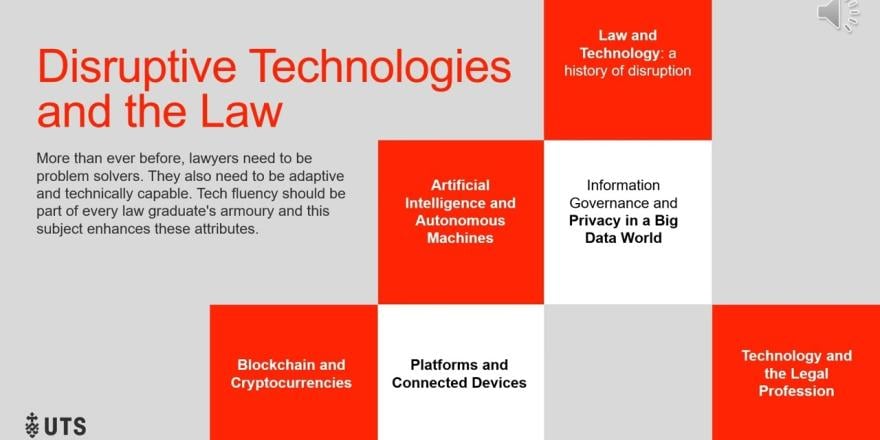
One of the requisite choices in the major is the subject Disruptive Technologies and the Law. This subject covers the impact that disruptive technologies are having on the type of work that lawyers do and the way that they do it. There are three powerful forces at play in this space. First, modern technology is changing the way that society does business and the way that we relate to each other. As a consequence, technology is changing the way that different types of relationships break down and how laws are broken.

Second, lawyers are confronted by a need to find new and better ways to manage and make sense of huge quantities of digital information and electronic correspondence. And finally, regulators and legal professionals are struggling to keep pace with innovation.

This subject explores these three themes and covers a wide range of topics including a brief history of how disruptive technologies have and will continue to impact the law, the regulation of data and privacy in a big data world, artificial intelligence and autonomous machines such as self-driving cars, blockchain technologies including smart contracts and cryptocurrencies, digital platforms, connected devices such as smart speakers and other Internet of Things devices, and finally the interaction between technology and the legal profession and the professional obligations we have as lawyers in relation to the effective and ethical use of technology.

More than ever before, lawyers need to be problem solvers. They need to be adaptive and technically capable. Tech fluency should be part of every law graduate's armoury, and this subject enhances these attributes.

In addition to Capstone and your requisite choice, students are required to select two elective subjects to complete the major. There are a range of elective options available to students undertaking the major, and you are encouraged to check the handbook for the most up-to-date list.

Electives cover a wide range of topics relevant to technology, including the protection of innovation and creativity under intellectual property law, how data may be used under relevant privacy and data protection regulations, media law and the regulation of digital platforms, and important questions such as why and how we should regulate technology in general.

The requisite options, including Disruptive Technologies and the Law and local internship, are also available as electives, so students can undertake both options should they choose. And finally, those students who are eligible for honours can select subjects as electives in the major.

Students must choose 6 credit points from the following options:

76105 Disruptive Technologies and the Law or76097 Local Internship or 79992 Law Tech Clinic

Students must choose 12 credit points from the following options:

76070 Biomedical Law and Bioethics

76105 Disruptive Technologies and the Law

76056 Intellectual Property Commercialisation Overview

76084 Intellectual Property: Copyright and Designs

76085 Intellectual Property: Trade Marks and Patents

76114 Just Tech

76097 Local Internship

76063 Media Law

76019 Media and Digital Platform Regulation

76089 Privacy and Surveillance Law

76113 Regulating Technologies

76090

76040

79992 Law Tech Clinic

Not all subjects are offered each session. Students must check the Handbook and follow the progression set out in the Handbook. Students must also check the university timetable to ascertain which subjects are offered in each session.

Local internship

Students undertaking an internship as part of the Major must choose a tech-related internship. See tech-related internships; .

Honours

Students who undertake the Major and who meet the criteria for honours can choose to undertake honours as part of their degree and still qualify for the Major. The subject requirements for students completing both the major and honours (MAJ09444) are:  

  • Both 76106 Technology Law, Policy and Ethics (Capstone 1) and 76107 Applied Project in Law, Innovation and Technology (Capstone 2).
  • Choice of 76105 Disruptive Technologies and the Law or76097 Local Internship or 79992 Law Tech Clinic

Enrolment 

Video: Legal Futures and Technology Major - Enrolment
OElkkChjX3s

Transcript

Increasingly, technology is part of everyday legal practice as it evolves and advances. Technology is also an integral part of our legal future.

This series of videos is designed to provide more information about the Legal Futures and Technology major that is available for undergraduate law students at UTS. This should help you understand more about the major and plan so that you are able to meet the eligibility requirements to complete the major. It will also give you more information about the technology law subjects that are available for all undergraduate law students at UTS.

Technology is disrupting the practice of law. Recently, generative AI tools have presented challenges and opportunities for the legal profession. But this is only one of many challenges and opportunities that we have already encountered and we expect to encounter in the future.

AI has already been accepted as a tool that can aid legal research and discovery in document generation. But generative AI expands the potential role of technology in legal practice, along with the potential for its misuse.

At the same time, data analytics can protect legal outcomes or assess causes of action in disputes and negotiations. These tools need to be used thoughtfully by lawyers to minimise risk and ensure ethical practice.

Lawyers also increasingly encounter new types of technology that require regulation, from smart contracts to cryptocurrency to NFTs. The major helps you to understand how all parts of your legal education can be relevant to these questions of legal technology.

This understanding is critical as lawyers encounter or participate in virtual legal services and are asked to advise on them.

The major recognises that increasingly, clients are demanding more than traditional knowledge and skills from lawyers. Expectations are shifting and lawyers play a key role in the regulation and management of technology, including the ethical dimensions of technology.

Legal professionals have an opportunity to partner with clients and experts across a range of disciplines in order to address modern challenges by developing innovative solutions.

In the Legal Futures and Technology major, we provide you with many of the skills that you will need to address these challenges at UTS.

We have drawn on the deep knowledge and understanding of technology in our law faculty and across the university to launch the first legal technology focused major, the UTS Law Legal Futures and Technology major.

The introduction of the major in 2018 followed extensive research and industry consultation. This research highlighted the critical importance of providing our law students with skills to address ongoing technological disruption and understand its impact on the legal profession.

Even in five years, the need for these skills has intensified with the development of new technology that challenges the role of legal professionals.

The core subjects in the major include hands-on real-world technology coursework to help our students develop and hone these skills.

Students have opportunities to undertake legal internships with a Legal Futures and Technology focus that helps students to develop relevant practical skills when they encounter legal problems related to technology.

These skills include project management, effective group work and communication.

Students undertaking the major are highly competitive in the legal jobs market and the skills they learn complement other law faculty programs, including Mooting and the Allens Neota Logic UTS Law Tech Challenge.

Students undertaking the major have the opportunity to learn from a range of experts in the field.

[Visual: Slide showing the academics who teach the core subjects of the major.]

Dr Genevieve Wilkinson teaches the first capstone subject, Professor David Lindsay teaches the second capstone subject, and Dr Ivana Wright teaches Disruptive Technologies.

These academics are joined by other experts who teach a range of electives available as part of the major.

Students have diverse opportunities to learn from these experts in different fields where technology is important, including intellectual property, media and digital platforms.

Our students are also able to undertake honours research theses supervised by these academics on diverse topics.

All of these subjects equip our students to learn from experts about how they can manage a legal future where technology plays a critical role.

[Visual: Transition to Associate Professor Maxine Evers speaking to camera.]

Hello, my name is Maxine Evers and I'm an Associate Professor here in the faculty. I was involved in the establishment of the Legal Futures and Technology major.

I'm going to speak to you about the eligibility requirements for undertaking the major.

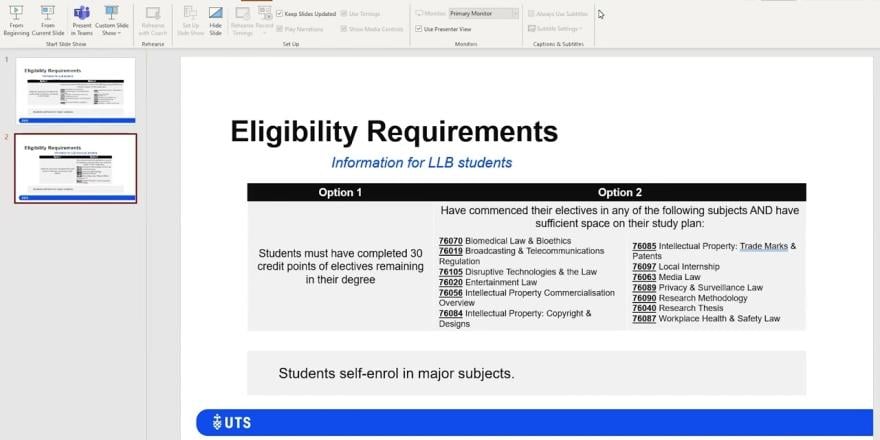
If you are an undergraduate student, whether undertaking the Bachelor of Laws or a Bachelor of Laws combined degree, and you wish to undertake the Legal Futures and Technology major, then you have options. Both options have the same core requirement: that you have credit points remaining from your electives in your study plan.

Once you have established that, you can enrol in any of the subjects listed in the major. That will then put you into the major stream; you don't need to enrol in anything else specifically.

You don't need to contact the student administration or the faculty—just enrol in the major subjects.

If you are already undertaking some subjects that are listed in the major, and including those subjects you have credit points remaining, you may decide to continue with major subjects and therefore graduate with the Legal Futures and Technology major listed on your testamur.

If you are unsure as to whether you meet the eligibility requirements in terms of having space in your study plan, I encourage you to contact the faculty's Director of Students. They will be able to give you advice about your study and whether or not you have room in your plan to undertake the credit points required for the major.

If you are a student undertaking honours or considering honours, you can also undertake the major, provided that the honours component will be part of the major.

This means you need to ensure you have space to do the required methodology, which is a prerequisite to undertaking the thesis in the major.

A thesis in the major would be in relation to the broad area of technology, so you would likely contact one of my colleagues in the law faculty who work in the area of law and tech.

As far as eligibility requirements are concerned, it's very straightforward: you need to ensure that you have those credit points of electives.

You can just go ahead and enrol in the relevant subjects. But as I said earlier, if you have any concerns or questions, contact the faculty's Director of Students—their details are on the faculty web page under 'Current Students'—and get some advice.

Thank you very much.

To be eligible to enrol in the Major, you must have 30 credit points of electives remaining in your degree. Students are encouraged to consider their subject enrolments well in advance as some electives are offered once every two years.

Related links

Law and tech at UTS

Technology and innovation: the future of law

Legal tech internships