

The UTS graduate attributes represent what we want our students to become - graduates who will:

  1. Be equipped for ongoing learning and inquiry in their personal development and professional practice;
  2. Operate effectively with the body of knowledge that underpins professional practice;
  3. Commit to the actions and responsibilities of aprofessional and global citizen and
  4. Have knowledge of Indigenous Australian contexts to inform their capability to work effectively for and with Indigenous Australians across their professional discipline.

Each faculty has adopted these broader attributes to create faculty graduate attributes.
1w3NbLK2Foo
 0:01one of the ways in which all know that we have achieved our objective 0:05of inspiring graduate success is that our graduates will be highly valued 0:10and sought-after by employers so what will it take for that to happen 0:15when I talk to most people I think it will be the caliber 0:19academic results that is the most important thing that employers are 0:24looking for 0:24but actually academic results come in 0:28at number four and have done so for the last four years 0:32in the Graduate Outlook Survey a major survey of employers 0:36about what they're looking for when they interview graduates 0:40you be surprised as I was to say that consistently 0:44for the last four years the number one 0:47and most important selection criterion 0:50has been interpersonal and communication skills 0:53both region and are all coming in at number two 0:57again for the last four years has been the graduates passion 1:01knowledge of the industry drive commitment 1:05and attitude and consistently at number three 1:09has been the graduates ability to engage in critical reasoning 1:13how will develop the analytical skills are their ability to solve problems 1:18engage in natural thinking and their technical skills 1:21and as said previously the caliber 1:24of the academic results comes in at number four 1:28we recently had an opportunity to interview some employers 1:32and here's what they had to say about what they're looking for 1:36I'm attend the academic and the GPA is a small pot the candidate's application 1:41is an important hot I mean if you've got a number fails 1:45as a recruit I'm gonna be asking the questions why 1:48and but it is just a small pots and we're looking for 1:51well-rounded can stick so we're looking to see the constant are involved in 1:55things outside 1:56their academic studies to show that they fill other skill 1:59I'm in terms of skills we look for and with the team work best huge one in 2:03consultancy 2:04I mean he's got to work with others across with levels flexibility and 2:08adaptability is signing 2:09important I'm actually all site people's interpersonal skills are very important 2:15we are looking at people's ability to a working attain 2:18environment with people that I don't know why and 2:21their ability to put their ideas forward and communicate without necessarily 2:25taking I did agree2:26

and and their ability to listen to others and integrate other people's ideas

Graduate framework

Each course at UTS has a graduate profile that describes the intended capabilities of its graduates. It addresses three broad domains: personal, professional and intellectual and details the attributes graduates will develop through the course, including the professional roles for which they will be prepared.

Graduate profiles are developed alongside the UTS Model of Learning so they take into account the over-arching attributes that all UTS graduates will have, and complement these with discipline- and profession-specific qualities. Course curriculum, including subject objectives and assessment criteria, is mapped against graduate profiles, to ensure there is a strong link between the intended attributes of graduates and what is taught. UTS uses a development framework for demonstrating the links between subjects, courses and the UTS Graduate Profile Framework.
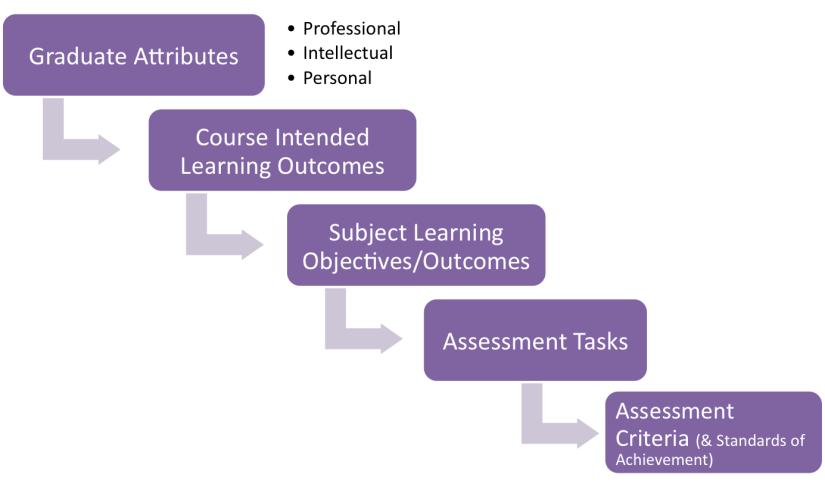
Diagram showing a flow chart moving through stages: Graduate Attributes; Course Intended Learning Outcomes; Subject Learning Objectives/Outcomes; Assessment Tasks; and Assessment Criteria and Standards of Achievement