

Say My Name is an initiative to decolonise the ways in which we understand and recognise names deemed as ‘tricky’, ‘unfamiliar’ and ‘foreign’ within Anglo-Australian contexts.
This initiative aims to amplify, celebrate and acknowledge the rich diversity in our workplaces and beyond. Colonial legacies have engineered specific sounds, words, accents and ways of speaking and listening as more ‘familiar’ than others, causing many non-Anglo-sounding names to be mispronounced – or not pronounced at all.
Check out the resources below, including videos and educational infographics on how you can respectfully:
- Ask someone how to pronounce their name
- Correct someone on how to pronounce your name.
What is Say My Name?
How to guides
 Tips on asking to pronounce someone's name. |  Tips on requesting someone to pronounce your name. |
Email signature guide
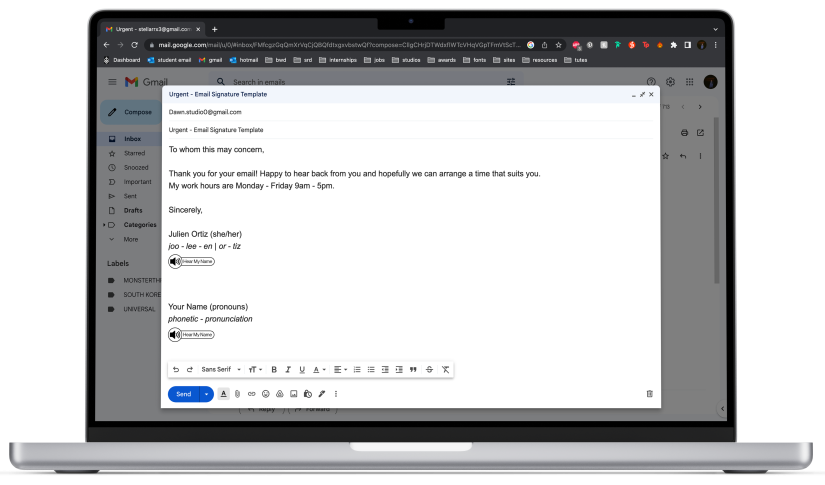
You can share the proper pronunciation of your name using a link to an audio in your email signature. Follow the steps below:
- Create the audio recording (opens a new window)
- Download the Say My Name icon (opens a new window)
- Add the phonetic spelling of your name and link to the audio pronunciation in your signature
Example:
Say My Name in the media
- Decolonising Names - Wide Open Air Exchange, 2SER (podcast)
- Call me by my name - UTS LX Lab (article)
- Does it matter to say my name correctly? With, Not for, Centre for Inclusive Design (podcast)
Use the buttons to expand or collapse the section.
-

Say My Name presentation slides by Dr Elaine Laforteza.
-
Meet our Say My Name storytellers - Dr Elaine Laforteza, Dr Bilquis Ghani, Arif Ongu, Dr Zozan Balci, and Natasa Lasarevic, as they share their personal experiences with navigating the world with their names. These stories aim to amplify their voices and engage audiences to start a conversation by asking how to pronounce people's names and continuing to say it correctly.
Read transcript
Transcript
[Music] Hello, my name is Dr Elaine Laforteza, and I work at the UTS Centre for Social Justice & Inclusion as the Equity Diversity Project Officer on Cultural Diversity, and as a Social Impact Practitioner. My cultural heritage is Filipino, and I have lived in the Philippines, Europe, and the US. And I migrated to Australia nearly 30 years ago. [Music] It depends on who I am meeting, so with those from an Anglo background, nine times out of ten they're either confused, fascinated, or both, when I say, "My name is Elaine Laforteza". My last name is never met in a neutral manner. I'm asked to repeat my name and most often people think it's exotic. But with those from a Latin and or Filipino background I met with a real joy and excitement just from knowing that we share a similar linguistic understanding. [Music] So, how do I feel with these kinds of reactions? I've developed a stock standard way of introducing myself in this way. I don't just say "Hello, my name is Elaine Laforteza". I say, "My name is Elaine Laforteza, I can spell that for you, or I can help you say it, or I can say it again." So, I do have an assumption that people will be quite confused and unsure of what to do when I say my last name. So, I suppose I feel like I have to do a bit of work for people to even comprehend, to even manage my name. [Music] I asked them to say their name and really listen to how it sounds. I try really hard to say it properly and if I don't get it right the first time, I tell the other person that I really appreciate their name and I want to say it properly. And I know a lot of times it's work, but it's a necessary work in terms of ensuring the other person and yourself are actually learning something and being kind in those exchanges and acknowledging and validating that person's name. So that's what I do when I see a name or meet someone with a name that I'm not familiar with. [Music]
It's important for me that other people can say my name correctly because that's the thing that identifies me. But extending this, it's also really important that people don't just say my name correctly, but they can spell and write my name correctly. This can have legal and institutionalised consequences. If my bills don't cite me correctly, I can't prove that it was me who paid them. If I need to show evidence of this further on my marriage certificate, for example, my last name was misspelled, and it was a whole process to correct. On school awards in the past and other kinds of messaging, my last name often got misspelled too, so it would be like I'd achieve this great thing at school, but the award didn't reflect that I had actually achieved that because it was misspelled.
[Music] What does my name mean to me my family and my cultural background and heritage? Well, I've had a long history of struggle with my name. When I migrated to Australia as a young kid of 10 years old, I changed my surname to my stepdad's Anglo surname because I wanted to belong, to feel like I belonged to my family and to the new and very white context I was living in. But through the years as I became prouder of my Filipino heritage and was brave enough to be more "Filipino", my name, has meant that I can clearly vocalize my Filipino cultural background and heritage. And yes, the name itself was born out of Spanish colonization, so the name also speaks of this history. What it means to me, my family, and cultural heritage then is a complexity and dynamic routes and routes in which we have come to be where we are. And this is a history I don't intend on erasing or silencing. So, I say my name proudly, Laforteza.
[Music] So, this is a story about a time when someone got my name wrong and how I felt about it. I've had people call me "Lafartsa". Yes, which made me laugh but I don't really want to be known as flatulence. I've also had people call me Fortaleza, which was really annoying. Even when I corrected them, they'd still say Fortaleza and not Laforteza.
When someone actually gets my name correct, I livee with joy and surprise I have actually been in situations where they go Elaine Laforteza, I'm like "What?". And if it's someone who isn't Filipino, I'm always surprised that they can say it and I really appreciate it when someone makes the effort to say it correctly.
I hope that the Say My Name campaign brings awareness to how language norms are shaped by ongoing colonial impositions in Australia. Although we speak over 300 languages in this country, we do have a monolingual mindset. And English is the language that is dominant, and this is a dominance that has been enforced through colonial conquest of the country. So, I'm hoping this campaign makes us more mindful and more active in our commitments to decolonising how we speak, how we sound, how we listen, and how we interact with one another. Within the tertiary sector, the significance of this campaign is that it demonstrates that our campus life is multicultural, it is diverse, and we need support to acknowledge and to celebrate this. [Music]
Read transcript
Transcript
[Music] Hi, my name is Bilquis Ghani. I work at the University of Technology Sydney as the Gender Equity Programs Manager here at the Centre for Social Justice and Inclusion. My cultural background is originally from Afghanistan. Both parents and my family and I came to Australia in the late 1980s - 1987 when we fled the Soviet occupation of Afghanistan.
[Music] Usually when I introduce my name to somebody I haven't met before, I get quite a lot of surprises quite often. And I think it's because it's an unusual name here in Australia. It's not so uncommon in my country in Afghanistan and in the region. I know that it's also quite a common name like parts of Indonesia as well. But yeah, I think it happens because it is unusual, and people are not familiar with it.
How I feel about those reactions? I think this difference, different ways that that reaction comes across sometimes. I find that sometimes it can be quite ostracising or isolating... reaction I think sometimes it comes across that way. And sometimes it comes across as you know the other person's just genuinely curious, and they want to know more about where that name came from. I think it really depends on the way that that surprise that an original surprise is communicated.
[Music] When I see a name or meet someone with a name that's not familiar to me, because I have an unfamiliar name myself, I know how it can come across sometimes when you're trying to understand somebody's name. I think, you know, the intention for me when I do come across someone with an unusual name, is to try to get it right because I think it's important to do so. And I make that explicit, and that's how I generally handle it is if I do need to ask them again to repeat their name, I think just being really sincere and saying, "Sorry I missed that the first time, can you please help me get it right because I think it's important that I get your name right." And I have used those exact words in the past before. It's sincere, it's sincerely trying to get it right because you respect the person. And you think that it's, you know, worth the effort to get right.
[Music] I think it's important for people to try to get your name right because it is such an embedded part of who you are. It's the name that I've been raised with, it's part of my identity, and yeah, I think I think that's why it's important, and it is I think a mark of respect as well. You know, personally, I think when somebody tries to say your name and gets it wrong and asks for clarification, that's never bothered me at all. I think I accept that my name is an unusual name here, and I'm very, very happy to help or repeat or remind, that that's totally fine. I guess what bothers me is when I get introduced to somebody else through somebody, you know, through a mutual friend or a contact, but I get introduced as the shortened, as a shortened name, without letting this new person actually get to know what my actual name is. I understand that, you know, especially, you know, in this in our culture here in Australia, you know, shortening someone's name is a marker of familiarity or friendship, and I don't mind that at all. But I think when I'm meeting somebody new, it's only correct to give them a chance to get to know my name before it's shortened to anything else. On a day-to-day, if somebody's calling me Bil or Bilqs, or whatever, it is you know somebody that I know well, but it doesn't bother me at all. Like I said, it's a micro familiarity, but yeah, I think when I'm meeting somebody new, I should be introduced as my full name.
[Music] My name was given to me, I was named after my grandmother who I didn't get to meet, unfortunately. But I guess, you know, beyond just my grandmother, my name is a reminder of my heritage and where I come from, and the incredible women that have come before me in my family, and my culture. And I think that's why it's important to, you know, communicate my name clearly and to try to understand how to pronounce my name. It's really a link to a heritage that's very much an embedded part of my identity until today. So, I guess that's why I find that, you know, being able to pronounce my name or try to say my name is it's a marker of respect. And it's because the name means so much to myself, and in my culture, and my family heritage, and history as well.
I think that when... there has been times in the past when people have gotten my name wrong and this doesn't normally worry me too much, because... if it if it comes from a sincere, you know, trying to get it right and then, you know, not getting it perfectly right and that's fine. Because I my name also has that gutterable 'Bilquis' as well, so you know quite often the norm of saying my name is either Bil-quees or Bil-kwis and none of those are technically correct, but you know that that's fine, I know that you if you're not raised with those kind of guttural sounds it's very difficult to do so those kind, those don't worry me too much. I think it's just that you know what I mentioned before - the only time it's ever bothered me is when somebody's not even tried - they've kind of skimmed over it if I've corrected them. Like a really simple one is people usually drop the 's' at the end of my name. It's Bilquis not Bil-key and I've mentioned it several times. It's not a pronunciation thing, it's just not paying attention thing that bothers me a little bit because it's, I'm not asking you to say the gutter roll or anything like that, I'm just asking you to complete my name. But also, I think the main thing for me is introducing me as Bil or Bilqs to somebody new without acknowledging that actually my full name is Bilquis. And I don't think it's all that difficult I mean we've got, we can say Natasha, we can say Arnold Schwarzenegger, I think we can say Bilquis Ghani.
[Music] I think that when someone gets your name correct it stands out and it feels really nice. It feels really good that this person has put some effort into trying to pay you that respect, yeah, and it does stand out, it does show and it's something that's valued I think it actually helps break the ice a little bit.
I hope that the Say My Name campaign will bring some of these, just some of these issues and some of these topics and themes to light. If you have a name that's a common name, this might be quite an alien thing to you, but if you do have a name that's an unusual name, I think, you know, the say my name campaign can help you embrace that uniqueness and to celebrate the heritage and the culture that it comes from. Within the tertiary sector, I think that the say my name campaign is really important in the tertiary sector. We value knowledge creation. We value breadth and depth, and robust experiences, and research and teaching. We encounter diverse populations both within the workforce and within our student body. And so, understanding that saying somebody's name correctly, attempting to do so, making the effort to do so is such a clear, open and easy marker of respect in an industry like the tertiary sector. I think it's low-hanging fruit and I think we can all do it and I think that's what the say my name campaign can do for everybody. [Music]
Read transcript
Transcript
[Music] Hi, my name is Arif Ongu. I was born in Turkey, came here as a very young child and grew up in Australia. I work as a Training Specialist, Centre for Social Justice and Inclusion here at UTS.
[Music] When I introduce myself to someone new, I get a whole range of different reactions. I always pronounce my name in the way it is meant to be pronounced as Ar-if, and the range of reactions goes from "Oh, where's that from?" The people trying to pronounce, it to people saying, "Oh, there's no way I'm going to be able to roll my r's", so there's a whole range of different reactions. I'm not sure if people feel that it's difficult and they want to do the right thing or they just think it's not worth the trouble.
When I meet someone that has a name that I'm not familiar with, I try very hard to pronounce it the way they have introduced themselves, and will often ask "So, sorry how was that pronounced again? Let me, let me try to get it right." I think that's the way that works best for me, but different people have different ways of responding to that, I guess.
I think it's important that people say my name correctly or at least try to say it correctly because it shows a certain level of respect and a valuing that my name is important and that it I as an individual am worth the trouble it takes to say my name properly.
My name is a Turkish name that stems from an Arabic term. It's pronounced a little bit differently in the Turkish community, but it's a name that has a significant meaning and it means 'someone who knows', which you know may or may not be appropriate for me but it has some value in that it comes with meaning, and it comes with a lot of thought that my parents have put into naming me. It was also the name of my grandfather so there's a lot of, sort of, significance of where the name came from.
I think the time I remember most when people didn't try to get my name right was, and this is this has happened more than once, but when people say, "Oh wow, so what should I call you?" And that's always a really amazing sort of question for me, it's like well at least try to say my name, what should I call you? That's like me, you know, if someone says my name is Michelle, "Oh, so can I call you Fatima?" So, that's the strangest reaction I've had and unfortunately, it's been more than once, and I find that completely inappropriate. It's suggesting that not only is my name too difficult for them to try to say but actually I'm not worth the effort it takes to say my name the way it is.
[Music] People almost never get it exactly correct, my name, but I think it's okay because as long as they're trying as long as they don't say "Oh, can I call you Ariel or Arthur" or some other name that they find easier to say, I think it's okay that that people pronounce it in a way that they can as long as that they're making an effort.
I hope to Say My Name campaign will have an impact on the people valuing difference in our society because if we're not even able to value people enough to say their name correctly, or try to say their name correctly, then we're going to have a hard time moving towards any sort of culture of inclusion and acceptance [Music]
Read transcript
Transcript
My name is Zozan and I'm originally from Germany but my mom is from Turkey and my dad is from Italy. And I've been working at UTS for about six years. I teach in the Faculty of Arts and Social Sciences but I also work at the Centre for Social Justice & Inclusion. When I introduce myself to someone new, I get actually really anxious because my name is not easy to pronounce, for most people, it's not a very common name and usually I have to repeat it. So, if I say, "Hi, my name is Zozan," I usually have to repeat it a few times and I think it's just because people are not used to it. But I hate it, I hate introducing myself to new people. Most people cannot pronounce it very well, they forget it. And yeah, it's just not a great feeling to introduce myself to someone new.
When I meet someone whose name I don't know, I actually, if I can before I meet them, if I know I'm meeting them in a scheduled meeting, I actually try to Google their name and hear it online because there's actually ways to hear how it is pronounced. So, for example, I really struggled with, it turns out a quite common name, Siobhan, that is kind of spelled like Sio-bhan and I really didn't know how to pronounce that. And it turns out it is an Irish name and it is pronounced Siobhan. And so, I actually figured that out by just youtubing the name. But of course, there's also other ways of doing that. You could simply just ask, "Hey, you know, am I pronouncing your name correctly?" I do that sometimes when, you know, for example, when I'm in a research conference and I have to introduce someone, I actually just walk up to them and I'm just really honest, like, "Look, I'm not really sure how to pronounce your name. Could you tell me how you would like me to pronounce it?" And then I actually make an effort to write it down how it is pronounced and make sure that I get it right. I think that's the respectful thing to do and that's what I wish a lot of people would do for me. I think it's important that other people try to pronounce my name correctly, simply because it doesn't make me feel so alienated. I know that it would be easier if my name was Kate or Maria but it isn't and that doesn't mean that, you know, I should be sort of like this lost cause, it is always nice when someone tries to make your name, you know, part of a common name pool if you will. So, you know, the more people can pronounce it, you know, the more it is something that people make an effort with and it's just respectful to pronounce someone's name correctly, right? I mean, everybody would say that.
My name interestingly doesn't actually mean that much to me. It is the result of my parents having this great idea of letting everyone put a name in the hat when my mom was pregnant with me and just pulling one out. And my, back then seven-year-old sister wrote Zozan on a piece of paper because she had seen the name on a children's book. It was a Turkish children's book but the story was about a Kurdish girl called Zozan and also, I'm not Kurdish, I now have this Kurdish name because my parents felt that this was a fair thing to do, seeing as that name was picked out of a hat. So, it's actually really interesting because people who know that it is a Kurdish name often speak to me about it and kind of confront me about it. And if I say I'm not Kurdish, they actually feel that that is like a political statement or something, when it's actually, I'm not Kurdish. So, I think, a lot of people think that just because I have a name that isn't Kate or Maria, I'm really like, associated with some, with a particular culture. But, you know, the truth of the matter is, I did not have a say in what my name would be and so I'm just stuck with it. But, you know, that is an assumption people make, that it somehow means something to my identity, it's not, it's someone else's choice. I think I have hundreds of stories, where people got my name wrong
but I think the worst one was probably on the phone, once I was introducing myself with the company, back in the day, I was working for a company called Medianet and I would answer the phone with "Medianet, Zozan speaking" and the lady on the other end actually said, "Hi, Lasagna." And that's no one's name, okay? So that's weird, it's an Italian dish. And I thought that was really weird because how could... If you don't know what I just said, don't repeat my name wrong back to me. And obviously it's kind of weird to call me Lasagna and think that's an actual name for a person. So that's probably my most memorable one. And yeah, and I just felt it was very strange that she would repeat that even if she, you know, she could have just asked, "Hey, I didn't quite get that. Can you repeat your name?" I think it's great when people get my name correct, just because it means they listened to when I said it, they were genuinely interested and they genuinely make an effort to make me feel included. Because I think if you constantly have, you know, you are pronouncing everyone's names correctly but your name is never pronounced correctly, that just kinda makes you feel like an outsider. Like, there's something weird about you, that other people find really hard to understand or say and it just makes you feel like an outsider. And so it always makes me feel happy when a student of mine or a colleague or a new person really at least tries to say it correctly or gets it right on the first go. That happens and it's amazing! And it just makes me feel like, "Wow, I'm a normal person with a normal name."
One thing I personally hope will come out of the Say my name campaign is actually, students having more confidence in correcting, I'm gonna say the adults in the room, when they get their names wrong. And what I would also kind of love is, if students who have a non-English name, actually insisted that people said their actual name instead of coming up with an English name. So, for example, when I first went to university in England, I actually introduced myself as Susan, just to make it easier for people. My name is not Susan, it's a very old lady name. And I did not feel it right to say it that way but I did because it just made it easier for my teachers and classmates to call me that. I kept that up for about a year and then I stopped because it just didn't feel right. And when someone said, "Susan," I actually wouldn't look because that's not my name. So then I really just decided, I'm gonna pick the battle every time and insist that people call me Zozan. And I wish that a lot of students would have that confidence as well, you know, to not just anglify their names or you know, accommodate others but actually just kind of say, "Hey, this is my name, this is who I am and it would be great if you could make an effort, I know this name may be unfamiliar to you, but it is, you know, it is my name and I would like to be called this." So what I would hope is that it gives a lot more young people who have, you know, ever-increasing multicultural backgrounds, the confidence to just, you know, say their name and insist that others say it too.
Read transcript
Transcript
- Hello, I'm Natasa Lazarevic.
I'm Serbian and Australian or SoBro Australian.
I'm completing a PhD
in Bioinformatics and Digital Health
at the University of Sydney.
I am developing a pregnancy app.
I'm also a casual academic tutor in anatomy and histology.
I teach both undergraduate students
and students in medicine all about the body.
- When I introduce myself verbally with my surname,
people are often taken aback,
which is understandable
because it's a long surname
with a different pronunciation
of letters than an English speaker would expect.
People are even more confused
when they see my name written down.
Natasa is spelled N-A-T-A-S-A
so without an H.
Because there's an accent on the S that makes a shu sound.
People often call me Natasa instead,
even though I include a pronunciation of my name
in my email signature and an audio pronunciation
of my name on my LinkedIn profile.
- I'm a bit disappointed when people spell my name wrong
via email because the correct spelling is
in my email address and signature.
I understand that often auto-correction auto corrects
my name to include an H,
but it really is not that hard to remove the H.
To me, it demonstrates a lack
of attention to detail and care.
I do not mind if people mispronounce my name
or spell it wrong when they are well-intentioned
and have genuinely tried to pronounce it or even spell it.
I'm always happy to teach others
but can be quite disappointing when no effort has been made.
- When I teach students online,
I ask them to introduce themselves using their audio
or in the chat and to answer an icebreaker question like,
"Do you like pineapple on pizza?"
I pronounce eac


About Say My Name
Say My Name was initiated by the University of Sydney's Mosaic Network. Inspired by this initiative, Dr Elaine Laforteza as part of the UTS Multicultural Women's Network (MWN), with the support of the Centre for Social Justice & Inclusion, worked with Design students at UTS to create the visual assets for the campaign.
Design students at UTS formed Dawn Studio as part of the Socially Responsive Design program: Stella Li, Misra Imran Khan, Jessica Yoong and Julien Ortiz. Studio leader: Ryan Curtis.