

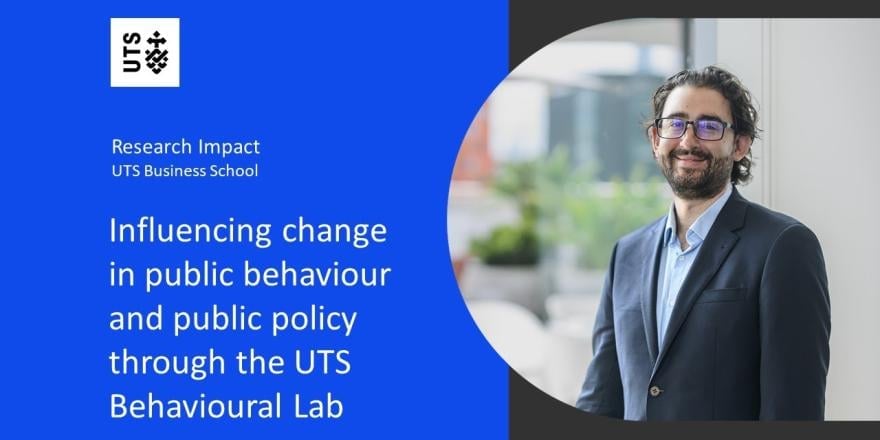
A single goal unites studies at the UTS Behavioural Lab – understanding human behaviour. We believe this is the key to effective decision-making and social impact.
Our research expertise includes organisational, managerial, group and individual judgments, preferences and decisions from all areas of the UTS Business School, including accounting, economics, finance, information systems, management, marketing and operations.
Many Behavioural Lab member projects start with Behavioural Lab seed grants. Ideas are often workshopped with other members at bi-weekly Behavioural Lab meetings. Recent examples of funded projects are covered below.
Nudging for sustainability – Dr Adrian Camilleri, UTS Behavioural Lab Director
Dr Camilleri, who specialises in cognitive psychology, has been working with the meal delivery service, HelloFresh, to study consumers’ responses to different types of food labelling and nudge marketing to promote meals with a smaller carbon footprint.
The art of Perseverance – Dr Elif Incekara-Hafalir, UTS Behavioural Lab Deputy Director
Persistence is, by definition, difficult. So how do we incentivise it? For this study, Dr Incekara-Hafalir, a behavioural economist, collaborated with researchers in Australia and Malaysia to present students with various reward schemes for completing quizzes. The result? A clear winner. The best incentive, it seems, is one that empowers the participant.
Saved by the bank – Maximilian Reisner
Would you let your bank’s AI system automatically select your home loan? According to research by Reisner, an economics PhD student, if you’re a woman, you’re more likely to say ‘yes’. Operating from the Behavioural Lab, Reisner is studying consumer attitudes to digital banking with a focus on improving trust.
Upping the care factor – Associate Professor Natalina Zlatevska and Aimee Smith
Non-profits know the geographic location of their cause impacts giving: the further away it is, the more difficult it is to elicit a response. Dr Zlatevska and Smith have reviewed various marketing approaches, finding that campaigns with a single, emotive image are most effective.
Politically motivated – Dr Geetanjali Saluja
Does it pay for brands to get political? Only if it’s done right, according to Dr Saluja, whose study of a controversial Nike campaign shows that it ultimately boosted company profits. But for others, brand activism has backfired spectacularly. This project, undertaken with Associate Professor Nitika Garg, explores the impact of a consumer’s political ideology and what it means for marketing departments.
- auctions and markets
- choice modelling
- consumer preferences
- persuasion
- policy-oriented experiments
- prosocial behaviour
- randomised controlled trials
- rent-seeking contests
- risk and uncertainty
- time preferences and self-control
- voting and committee decisions
If you are interested in being paid to participate in research studies conducted by members of the Behavioural Lab, you can learn more and sign up on our UTS Behavioural Lab recruitment site
Registration in our Behavioural Lab database does not commit you to participate in any particular study but will ensure that you receive email notifications about upcoming studies you can sign up to participate in. You are free to unregister yourself from this database at any time.
Our privacy policy explains how we safeguard personal and sensitive information.
If you are interested in working with members of the UTS Behavioural Lab, contact us at BehaviouralLab@uts.edu.au