An 80,000 word PhD thesis would take 9 hours to present. Their time limit? 3 minutes

The Three Minute Thesis (3MT) competition is an exciting opportunity for research students to showcase their work and develop their presentation skills. 

Find out more about what’s involved and how you can take part. 
The final will take place on Wednesday 2 September 2026. Get your tickets below.

About 3MT

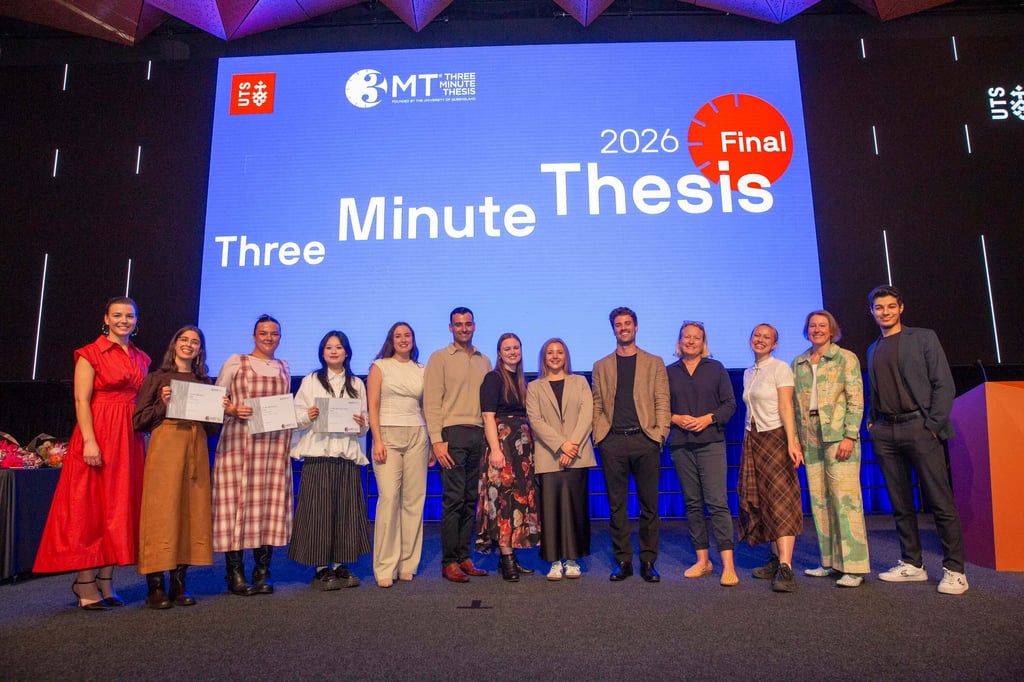
Group of 10 winners at the 2025 Three Minute Thesis Finals.

Winners and finalists

Meet the 2025 UTS 3MT winners and finalists, whose topics included maternal healthcare, sign linguistics, accounting and auditing practices, regenerative agriculture, osteoporosis and more.

About Three Minute Thesis

Winner of the 2026 UTS 3MT Finals

Nikita Kapahi from the School of Communication and Social Sciences in the Faculty of Design and Society took out the top honour with her presentation, ‘Intercultural conflict mediation’. She earned $3000 in prize money as well as a place at the 2026 Virtual Asia-Pacific 3MT competition representing UTS.

When Nikita was exploring what research question to interrogate, she became interested in negotiation and mediation. She was surprised to find that there was very little reference to culture, and this gap has become the subject of her PhD.

Read more

Three Minute Thesis Final

UTS 3MT Final 2026

(00:56:00)

UTS 3MT Final 2026 transcript

Welcome everyone to the 2026 University of Technology Sydney Three Minute Thesis finals. I'm Sarah Kinkle. I'm the academic director of HDR programs in the graduate research school and I will be your MC for the afternoon. So, oh, thank thank you. Thank you. Yes. Thank you. Ul-tim-o. Ul-tim-o. Um, now the Three Minute Thesis competition challenges PhD candidates to communicate years of hard-earned research in just three minutes using language that can be understood by a non-specialist audience because even for all of us who are researchers, we're not all researchers in this, right? Um, and with just a single presentation slide, it is truly truly one of my favourite events of the year. So, it's wonderful to see so many members of our research training community, our staff, our students, our candidates, family, friends, and supporters here today as we celebrate some of the outstanding research taking place across UTS. And of course, I also want to give a big welcome and an acknowledgement to everyone who's also joining us online today. Um before we begin formal proceedings, it is my pleasure to introduce Yvonne Weldon AM to deliver the welcome to country. 

Good afternoon ladies and gentlemen, sisters and brothers, all genders and identities. As I said, my name is Yvonne Weldon. I am a Wiradjuri woman from Cowra here in New South Wales from the waters of the Clare which later became known as the Lachlan and of the Murrumbidgee rivers. I am a representative of the Metropolitan local Aboriginal land council, who are caretakers with culture authority under the Aboriginal land rights act. I would like to pay my respects to all elders past and present to all First Nations to you and the ancestor of the lands you've travelled from or are from. There is so much across this continent that is unknown. Our practices of generations and generations. There are some 160 culturally distinct groups in Europe. But across this continent, Australia is its own continent. There are over 250 different cultures just of the First Nations with hundreds more from across the globe. This country includes everyone. We don't turn our back because we don't exclude. I thank you for including me, the First Nations, and all of us. We can and we do achieve so much more when we do so together. Our boundaries are written into the Earth's natural landscapes. The boundaries of the Eora are the Hawks River in the north, the Nepean in the west, and the George's River in the south. On behalf of the Metropolitan local Aboriginal Land Council, the elders and also the members, I welcome everyone to the lands of the Gadigal. I acknowledge Gadigal people whose spirits and ancestors will always remain with this land, our mother earth. My people, this country's people are the oldest continuously living culture of the world. And all of us are creating our fusion together into all that we do to be shared and to be honoured with kindness, creating our connections to 65,000 years. The difference that you're all making can change and shape the directions of many generations through your sharing and your giving is an investment. An investment in a better society and university, but also a better country. Our coming together today is the proof of live practice of what a community is and what we need more of in our society and our world. The difference that you're making is inspiring. But I get my greatest inspiration from my grandchildren. And we all need to think about what that is for all future directions. How do we make it better for everyone? But know that in the footprints of our ancestors we walk, leave the prints as they stand. Make sure they stand the test of time for everyone in a positive way. Think about that difference that you are making today and tomorrow and what we need to do every single day to become the milestones of a all-inclusive future. So let us all draw upon my people's spirits as we continue on our journey. May my people's spirits walk with you and guide you as we strive forward for us all. Again on behalf of the Metropolitan Local Aboriginal Land Council, Ninyini, Nala, Wongen, Mari, Bajari, Gadi, Nerda. Welcome to Gadigal Country. Let's make a difference today so we can have an awesome tomorrow. Have a wonderful day.

Thank you so much, Yvonne. Now I would like to introduce our judges for this afternoon. Um as I introduce you, please come and join us on stage. So our first judge is Ahmed Da'na. He is an industrial designer and current PhD candidate in our faculty of design and society. His research focuses on custommade need ankle foot orthosis for polio survivors developed in partnership with a Sydneybased orthotic clinic to translate the world into real world impact. Translate the work into real world impact. Ahmed won the finals last year. So he's returning as champion um and went on to represent UTS in the Asia-Pacific Three Minute Thesis showcase. He's also a casual academic at UTS with a keen passion for public speaking. So, welcome Ahmed. Our second judge is Professor Anika Gauja Um, she is provancor research here at UTS. As a political scientist, she has 20 years experience providing expert media commentary on truly contentious events like elections and also the Eurovision Song Contest. Anukica has communicated her research on democracy and political participation to politicians, giving lectures um in the Australian Senate, for example, pubgoers um participating in raising the bar, parliamentary inquiries, and also as an expert witness in legal proceedings. Her federal election podcast below the line, which was developed in conjunction with Sydney Uni, Latroe and the Conversation, reached number seven nationally in the Apple News podcast charts and attracted more than 40,000 listeners. So, welcome. Our third and final judge for this afternoon is Dr. Naomi Koh Belic. Um, she is a science communicator who broke into the industry through UTS Three Minute Thesis. She is an alumna of ours. Um, welcome back. And she previously was a presenter on the Discovery Channel and the ABC. She is the creator of the Screen Australia, Screen New South Wales, and AIDC funded health series, Bimbo Biology. Dr. Naomi is also the inaugural ABC Science Journalism Fellow where she's currently developing a health YouTube series. Welcome, Dr. Naomi. So, there's obviously there is a lot of research communication cred on this judging panel. So, thank you again so much for joining us and for sharing your expertise with our finalists. So, we have nine amazing candidates from across UTS today. They're going to be representing all of our faculties, our research institutes, so many different diverse disciplines. As I said, this is truly one of my favorite events of the year because of the way that it reflects the depth and breadth and the creativity and the impact and the importance of the work that our research candidates do here. Um, so we're going to get to hear from them in just a moment. Um, but before we do, I want to just briefly recap why we are here and what the rules of this game actually are. So three minute thesis is um a competition. It's a research communication competition that celebrates the research conducted by PhD students. It cultivates students academic presentation and research communication skills and is now a globally recognized competition. There's over 900 different institutions in 85 countries that hold three minute thesis events and the winner of this event will go on to represent UTS in the Asia-Pacific competition as Ahmed did last year. Fundamentally, this is a communication competition for researchers. So, how clearly can you communicate and how effectively can you engage the audience? Um, again, most of us being non-speists in the things that you're talking about. And one of the things that I really like about it as well is it's also about creativity within constraints. There are a lot of parameters for our presenters to keep in mind. Presentations are limited to 3 minutes maximum. Thus the name of the competition. Again, that probably isn't a surprise to anyone. Um, competitors who go over three minutes are disqualified. You only have a single static PowerPoint slide. So that means no animations, no sound, no video, no fun props. Um, it has to be spoken word. So again, no poems, no dance, no rap battles. Um, the judging criteria are partly around how well the research itself is communicated. Do we understand the motivation and the background and the significance of the research question? Can we understand your research strategy and design? Can we understand how um what your findings and your conclusions are so far? And the other component is about the quality of the presentation itself, how engaging it is. Was this language appropriate for us, your non-speist audience? Was your PowerPoint slide well- definfined? Did it support your presentation? Did you convey enthusiasm for your research? Did you hold our attention? So that's how our judges today will be assessing um our presenters and their decision is final. But in addition to the uh judges decision, they will decide our winner. They will decide our runner up. But there is also a people's choice award in which you will be able to vote once all of the presentations have finished while the judges are making their deliberations as well. And your vote is final in that. So once we have each presentation, our judges are going to provide a couple of brief points of feedback for our presenters and then we'll move on to the next finalist. So with all that, let's get three minute thesising. So please welcome our first finalist, Jordan RDS, to the stage for his presentation, Liquid Gold, the untapped resources in RP. >> [applause] >> Who else started their morning with a trip to the bathroom to pee? I know I did. I know billions of people around the world do. We pee multiple times every day without a second thought. But what if with every flush we were wasting a valuable resource that holds the power to revolutionize the way that we grow our food and care for our ecosystems? Let me explain. While urine contains just 1% of what goes down the drain, jammed into that tiny drop of liquid gold is up to 80% of all the nutrients in our waste water. Urine is an untapped treasure trove just waiting to be unlocked. The big problem is that if too many of these nutrients find their way into our lakes, rivers, and oceans, they can trigger toxic algaal blooms and cause mass fish kills like we've seen in South Australia. Our relationship with nature is fundamentally broken. But what if changing the way we thought about our pee could mend this broken relationship? Well, if we could capture the urine at the source using urinals and specially designed urine diverting toilets, we could prevent this water pollution as well as peycling it into renewable fertilizers. Unfortunately, our systems are far from circular, meaning we're literally pissing away our liquid gold. To scale these fertilizers safely and effectively will require new approaches to governance. Jordan, what the hell is governance? Governance is the rules. It's the institutions. It's the partnerships made between farmers, water utilities, fertilizer producers, and you, the consumer. To close a loop between the bathroom, the field, and the kitchen table. This is the focus of my research. I want to understand how nutrients are currently being governed in the system and whether this can be done in a more nature friendly way. To answer these questions, I traveled the world interviewing experts in the United States, Europe, and South Africa to help understand from experts who are leading the most innovative nutrient recovery initiative programs on the planet. My aim was to learn from their success and failures to shape Australia's approach to nutrient governance. Across three continents, I found that the technology already exists. In South Africa, they're pecycling urine at Cape Town Stadium. Imagine the thousands of liters of piss that could be recycled at a rugby match between the walabbees and the spring box. No, governance is the biggest issue. Fragmented laws and social taboss like this ick factor which can actually be overcome through educational podcasting. Scan the QR code to find one I prepared earlier. Despite this, the coolest solution I found is actually rather simple. Start getting your hands dirty. People report feeling closer to nature when they use these fertilizers in their gardens and fields. To grow a plant using something from our bodies is magic. It's alchemy. So the next time you're in the bathroom taking a piss, remember the value of your pee and the untapped potential in every single flush. I'm going to Oh. Oh, I was about to start yelling. That's a good thing. Good thing it came on before I started. I've not just been screaming. Um, congratulations. That was wonderful. I wanted to check in. How are you feeling coming up first? >> I think it's good now. >> Yeah. [laughter] Yeah. You get to relax and enjoy it. That was phenomenal. Well, the opening hook really got me in there cuz I think it's something we can all relate to and I didn't know I was pissing away liquid gold. I'm feeling very fancy and very rich now. >> Thank you. >> That was uh excellent, Jordan. Nice to kick us off. Very powerful, easy to understand, great structure throughout your impact. It's global. You communicated that great and you still made it really humorous. So, props to you. Good job. [applause] All good. Get off the stage, Sean. [laughter] >> Our second finalist is Meg Price um with a presentation when AI answers what happens between us. Thank you. Human relationships are overrated. [laughter] That little moment between us, that's exactly what I'm here to talk about. There was a few seconds there and you might have thought, what's she going to say next? It's called a felt pause and it's a small but really important space where we start make making meaning. My name is Meg Price. I'm researching what happens to our ability to relate to each other when we start talking to AI. Now, AI gives us quick answers and sometimes that's exactly what we want. But more and more people have started taking their uncertain moments to AI feels easier. But what if the uncertainty isn't a block or an obstacle to human connection? What if it's actually this spark that sparks human connection? So to research this, I set up embodied living labs. And what I did is I got people to come in and I got them to talk to an AI bot. And then I got them to just stop, notice, reflect. Where do they feel that in their body? And they drew what they felt on life-siz body maps. I then combined this living lab research with a number of expert interviews and it's really interesting because people told me that AI it's just a tool but their bodies showed a far more complicated story. They a lot of them talked about warmth in their chest or unease in their stomach. And one participant, a doctor, drew this giant hook up his backside. And when he explained it, I could almost feel myself just left dangling because of something AI was responsible for. But his message was really clear. He said, "If we take the human out of the loop, we put humanity on the hook." Now, that's pretty dramatic, but in everyday life, we hardly notice this is happening. It's really slow. one AI conversation at a time. But if we start skipping the uncertainty, we're going to skip that felt pause sensing what the moment needs next between us. And you may never use AI. Someone you love does. Your children will. So, it's probably already between you whether you like it or not. Today, we're going to hear research from my colleagues here that will change the way we live. But if we fail to care for each other, what kind of world are we creating? Because we do make sense with AI, but we make meaning with each other. So, human relationships, they're not overrated. They are far too important to let AI quietly erode. And we need to design and guide AI for human flourishing. Thank you. [applause] Meg, >> I feel like we've got a connection. [laughter] >> I do too. >> I know. And I I really love that. I loved how you were able to convey the substance of your research through your poise, your delivery, your humility, and your genuine interest in the research subject. So, really well done. >> Thank you very much. I think I have a very similar comment because I feel like it felt so conversational and I think it's because through your research you have all of this experience giving words and language to something that is so hard to describe and I think that made you just feel so easy to listen to and engage with. So thank you. >> Thank you. >> Thank you May. Thank [applause] you. Our third finalist is Wenzang um with a presentation titled sending the right message a GPSG guided vaccine against triple negative breast cancer. Thank you. >> Welcome everyone to my presentation. Let me start from one simple question. Do you still remember COVID 19 pandemic? Well, the answer is of course. Of course we do. We all remember how tough it was. But we also remember one great weapon against CO, the mRNA vaccines. They taught our immune system what the virus look like. That made me wonder whether we could use the same idea to teach our immune system to find a cancer. My research is focusing on triple negative breast cancer or called a TMBC an aggressive type of breast cancer. Now imagine our immune systems as a security team. The immune soldiers patrol the body every day ready to fight the enemies. But TMBC is a clever enemy. It hides from the immune system and pretends to be part of the body. The immium soldiers may walk straight past because they don't know what it looks like. So without a wanted posters, they cannot recognize such an enemy. A special immune cell called a dendritic cell act as a immune systems intelligence officer. It processes the information about enemies and pass it onto the immune soldiers. But how can we tell the TMBBC tumor identity to that intelligence officer? This is where my GPS guided MR cancer vaccines comes in. So thinking of the mRNA as a recipe that carried the right message which is TMBC tumor ID. But this recipe is fragile and may be destroyed before reaching its destination. So I protect it into a tiny waterproof and short resident bubble made of lipids called a lipid nanop particles. Then I add targeting molecules onto the surface of the nanop particles. It works like a GPS guiding the nanop particles to the dendritic cells. Once the lipid nanoparticle reach the dendy cells, it opens up and release the recipe inside. Then the dendritic cells internal factory will follow the recipe, create a one to pest for TNBC, then shows to the immune soldiers. Now the inum soldiers know what to look for. They can recognize the TMBBC tumor, find it and attack it. This is not a preventive vaccine. It's a therapeutic vaccine which designed to help our immune system fight a tumor already there. In my research, I'm testing whether this GPS guided system can deliver MR more precisely to the dendritic cells and generate a stronger immune attack against TNBC. And if successful, this approach could provide a new way to treat TNBC. Because different tumor carries different ID, we could change the recipe inside and adapt the same platform to treat other cancers or even be personalized for individual patients in the future. By sending the right message to right cell, I hope to turn a highen tumor into a clear target. Thank you. [applause] Congratulations uh Wendy that was lovely. Uh I'm not a scientist and you able to explain in a very simple analogy that was enjoyable uh entertaining and really showed us how powerful your research can be. So congratulations. >> Thanks. >> Yeah, I think that's great point Ahmed. Um I love the analogy. I loved how you presented it sequentially on your on your slide. I also really liked how at the end of your presentation you talked about the impact that you're going to achieve with your research. Um so the presentation was focused um and I really came out of it thinking yes you're going to change the world. Thanks when thank you. [applause] Remember guys along the way here start thinking about your people's choice votes. Okay? You don't get to choose to the end but start making your list. Um, our fourth finalist this evening is Terry Ray with a presentation titled Therapeutic Dragon Training: The Effectiveness of a Therapeutically Applied Dungeons and Dragons Group Program in a Public Community Mental Health Setting. Thank you, Terry. >> A shadowy figure blocks your path. You can feel it start to drain your hope, motivation, and energy. It whispers, "You are not good enough, and you will fail." But you are not alone. Your adventuring party stands beside you, offering support and encouragement. The weapons that you're using are the coping strategies that you've learned along the way. With every new encounter brings learning and growth. With every victory makes even the darkest of enemies feel a little less frightening. This can be what it feels like to play a therapeutically applied role playing game. This monster represents depression. However, the same concept can be applied to a variety of mental health issues. For example, the fear that I'm currently feeling presenting in front of an entire audience could be called performance anxiety or more imaginatively a mind flare, a hydra, or a doppelganger. Let's go with mind flare. If you felt that this was a compelling way to deliver mental health care, why hasn't it reached our mainstream services? Allow me to take you on a quest. Our backstory. Early intervention and meaningful engagement are our best weapons in the treatment of mental health issues. However, some people with complex mental health presentations may not be able to engage in traditional therapies. Exploring the realm. We know that gamification of mental health interventions can improve engagement and retention. Pioneering therapists across the world have started using role- playinging games as a way to deliver psychological therapy. However, the evidence is still at level one based largely on case studies and anecdotal reports. A new quest begins. So, we asked a simple question. What would happen if we combined the iconic Dungeons and Dragons with evidence-based cognitive behavioral therapy? Could it improve social anxiety, depression, PTSD, and self-esteem? Packing our inventory. Our 8week campaign teaches psycho education, social skills, problem solving, teamwork in a fantasy, and immersive environment. Early victories. Our pilot study shows we're on the right track. We saw improvements in social anxiety, depression, PTSD, and self-esteem. The Big Boss Battle. We've leveled up to a randomized control trial. We're testing therapeutic Dungeons and Dragons against people that play modern board games. The True Big Boss. Unfortunately, our greatest adversary isn't a dragon. It's stigma. There are those that believe that there's no place for role playing games in mental health treatment. This is why rigorous research matters. A new quest awaits. Imagine if people looked forward to going to therapy instead of avoiding it. It's our hope that therapeutically applied role playing games can help people to realize they are more capable than the monsters they face. Looks like that mind flare wasn't quite so scary after all. Thank you for helping me slay it. >> Scary scary. [applause] >> You can't run away yet. You still have a little bit more. Um, that was such a beautiful slide and I really appreciate the way that I feel like you built a world to bring us into which was so so perfect for this. Thank you. >> U, sorry I wasn't sure if it was um, excellent work. Uh, I thought that was fascinating. Uh, I'm not understanding D and D, but those references were very easy to understand. Um, so appreciate that. And I I think this research project is so unique and the gamification of it, it's very exciting. >> Congrats. >> Thank you, Terry. >> Our fifth finalist this evening is Nikita Kapahi with a presentation titled Intercultural Conflict Mediation. Thank you, Nikita. >> [applause] >> These two look a little angry. They're in the middle of a divorce mediation. Mediation is an alternate attempt at conflict resolution before things get rather intimidating, timeconuming, and expensive in court. Mediation is facilitated by a mediator, an impartial third party who helps to guide disputants through a structured process of negotiation. Mediation is often used in business, workplace, and neighborhood conflicts. In family disputes like this one, mediation can help to avoid long drawn out custody battles and empower both parents to create solutions that work best for their children and families. But this mediation session has fallen apart. or because the mediator misinterpreted a sentence. In Japanese, this directly translates to I will think about it. But in reality, it means politely no. And this is because the mediation frameworks in Australia are shaped by Western norms. This is despite the fact that over 50% of Australians like me born in India are migrants or children of migrants. I noticed this the first time I attended a mediation conference and found myself surrounded by middle-aged white women. When in a week-l long mediation course, less than 15 minutes was spent discussing culture. And when I failed my practical mediation exam and was told I waved my hands too much. In my PhD research, I'm interviewing both mediators and disputants alongside a culture and worldview survey. And I'm daring to ask, why don't our mediation frameworks and standards reflect the diversity of conflict styles and approaches across cultures? For example, in Malaysian, Omani, Somali, and Aboriginal cultures, elders are seen as trusted and respected mediators. But this contrasts with western frameworks which specify that mediators must be impartial, detached, without any pre-existing relationships with disputants. During my interviews, one mediator referred to himself as the normal white guy. He questioned whether mediation needed to match culture whilst failing to recognize how these processes were embedded in his own culture. By challenging the narrow constraints of Australia's western centric mediation standards, my research refuses to stay silent. It demands that Australia's accredititation standards and practices for mediators amass evolve to cultivate genuine respect and understanding for all who come to the table. [applause] Nikita, the narrative arc in that was beautiful. I I I started off thinking we all need to know more about mediation, but then when you flipped it to language and culture and identity, that made me think about mediation in a way I'd never really thought about before. Uh, and that will change me forever. So, thank you. >> Thank you. >> The content was absolutely phenomenal. I think you were just so commanding and compelling and it was absolutely perfect for what you were trying to convey. Thank you. >> Thank you so much. >> Thank [applause] you, Nikita. >> All right. Our sixth finalist this afternoon is Rachel Hoffman with a presentation titled The Invisible Evidence: How We Can Searcher for DNA. Thank you, Rachel. >> [applause] [laughter] >> Is anyone here a fan of crime scene shows? You know the ones. Every episode they go to a crime scene, they collect a bunch of swabs, and then 20 minutes of ambiguous science later, they found the killer's DNA. [laughter] In the real world, forensic science is far less fantastic. But what is fantastic is trace DNA. That's DNA that we leave behind through contact with our skin. It really is an incredible tool to identify criminals, and we could collect it from any item a criminal touches. There's just one problem. We can't see it. It's invisible. And we have no definitive way to test a surface to see if trace DNA has been left behind like we can with blood, for example. So, if you were a crime scene investigator and you had to find a criminal's DNA at this crime scene, where would you swab? The door, maybe the broken window. The criminal has likely touched these during the break-in. but so has the owner of the house. How do you know that you're collecting criminal DNA? What if you had a tool to help you know where to look? That's where my project comes in. I've worked with the New South Wales Police Force to analyze 300,000 trace DNA samples and over 10 years worth of casework. I wanted to find out what items most often had a trace DNA profile found and if that changed depending on the crime. Then I went case by case and analyzed if finding that DNA profile was useful in that specific investigation. My results showed that the items that most often had trace DNA profiles found weren't actually finding criminal DNA. So all of that effort and work wasn't helping the investigations at all. I used my results to build a decision-making model I then provided to crime scene investigators along with a real world scenario to see how this information can help them decide what to collect at the crime scene. The results were amazing with the participants stating how helpful they found the information and how they wanted access to it in the field more often. So, we're making that happen through our ongoing partnership with the New South Wales Police Force. We've built a dashboard that's going to allow this kind of information to be accessible to crime scene investigators in the field in real time. My project is helping law enforcement create better outcomes. So, there is better use of forensic resources, fewer unnecessary samples and a greater chance that when we find DNA at a crime scene, it's actually useful to an investigation so we can help our communities keep safe. So, when you're heading out for a day or a night on the town, just remember you might be leaving without a trace, but your DNA probably won't. Thank you. [applause] >> Congratulations. Um, I love that you were so passionate about it. You couldn't stop smiling. Um, which is awesome for us to all feel as well. And I love the CSI stuff too and how you've structured it, how you talked about it, it's very exciting and yeah, the partnership aspect and all the results you've got I think is phenomenal. Um yeah, very exciting. Congrats. >> Yeah, that was um that you really pulled me into that presentation. I think the combination of your your slides, your enthusiasm and and and good nature about crime um made me think I'm a detective too and I was looking and thinking where could that where could I swab? Um so that was that was really brilliant and engaging and yes I also think that um in the middle section of your presentation your research methodology was really clear and that stood out really nicely. So congrats Rachel. >> Thank you Rachel. Our seventh finalist this evening is Antonio Perez with a presentation titled A Neuroaddaptive Framework for identifying and transferring high-erforming learning states. [applause] [clears throat] Imagine you're climbing the mountain behind me. The summit is clear, but the safest path is hidden beneath the snow. Would you step onto the untouched snow, or would you follow the footprints of someone who's already reached the top? Most of us would follow the footprints. They would not make the climb effortless, but they would reveal a path shaped by experience. Learning a complex skill presents the same problem. We can see experts succeed, but we cannot see the invisible decisions that get them there. That is the mystery my PhD investigates. Can expertise leave a measurable signature? I study engineering students as they solve complex 3D spatial problems. While they work, I capture signals from their brain, eyes, and body. Together, these signals create something that a teacher cannot see simply by watching. A momentby-moment record of how a learner responds. This gives us a richer understanding than performance scores alone. It is the difference between seeing only the climber at the summit and seeing every decision made on the way up. My research takes three steps. First, I capture the hidden brain and body signals behind problem solving. Second, I map the expert signature within them. Where do high performers look? When are their brains most engaged? How do their bodies respond as they make correct decisions? Third, I test how that signature can be transferred into guidance for novice learners. For the brain, I use carefully designed auditory stimulation to support patterns associated with expert performance. For the eyes, I transfer the expert gaze pattern into visual cues, guiding learners towards what matters most. And for the body, I use validated breathing techniques to help learners regulate their mental state and stress. Together, these support attention and regulation. This is not about giving the learners the answer. It is about shaping the conditions to help them recognize and approach the problem more effectively. Today, I'm studying engineering students. But the same approach can support people learning any complex skill. Because in our society, we've become so focused on rapid output and the next AI model upgrade, it has never been more crucial to develop our own skills as human beings. And the key to unlocking that potential is within us. It's just been invisible until now. So look again at the footprints behind me. My research asks whether we can capture the hidden path experts take, transfer it into practical guidance, and support the next learner in taking a better informed step. Because perhaps expertise is not a talent some people simply possess. Perhaps it's a path others can learn to follow. [applause] Thank you, Antonio. That was really wonderful. I honestly love that you got up here and you just took over that stage. I felt like you were very present and comfortable and you I've never heard of this in my life and I feel like you were able to bring me in and use language that made it so easy for me to follow. So, thank you. >> Thank you. >> Congrats, Antonio. That was uh fascinating. Uh yeah, I think your your entire methodology was super clear. You you you've laid it out very clearly for us. It was really nice to understand. And then on top of that, use your slide really well at the very end to really connect everything. So nice work. >> Thank you. [applause] >> All right. Our eighth finalist this afternoon is Franchesca Giner um with a presentation titled Enabling innovation, the role of policy and regulation in digital finance. [applause] Everything around us has value. Whether it's the house we live in, the ideas we create, or the money in our wallets. Over time, we found better ways to reflect and manage value. From the invention of paper money to today's stock markets, each step has brought more efficiency and accessibility. Now, technology allows us to take a step further by creating digital representations of real world assets. These digital assets make it possible for more people to invest. They facilitate trading and can even create entirely new markets. This can unlock billions of dollars in economic gains. But here's the catch. How can we introduce this innovation to financial markets if regulators can't even agree on what it is? Policy makers around the world classify digital assets in different ways because financial markets depend on regulatory certainty. This inconsistency prevents digital assets from passing the security check. And here is exactly where my research steps in. I'm proposing a digital asset taxonomy that works like a screening system. It sorts digital assets into clearer categories and once they are understood, they can be used in financial markets. At first we identify the underlying real world asset. The reason is simple. We need to distinguish between different asset classes like money and stocks. But the tricky part is to understand how the value of the underlying asset is effectively connected to the digital representation. We categorize into four main mechanisms that all have different regulatory considerations. By combining these two dimensions, underlying reward asset and type of digital connection, we get a classification system that is way more granular than previous approaches. Therefore, we can reveal the true substance of digital assets. But hold on, it gets even better. By mapping existing classifications and regulations onto our framework, we find that the majority is incomplete and does not account for all types of digital assets in a consistent way. We can point out the unclear areas and make it easier to compare how different countries approach digital assets. In the end, it's about giving financial innovation the clarity it needs to move forward. And to be honest, I never imagined in my dreams that my research could have this kind of impact. But today it is informing the Reserve Bank of Australia and our markets regulators as to me that is the most rewarding part of doing a PhD seeing my work contributing to change. Thank you. [applause] >> Thanks Franchesca. It was really nice to hear you reflect on the end about what the PhD means to you and uh the impact that you've had on the Reserve Bank. Your presentation um really conveyed a sense of your um confidence and knowledge in the subject matter. You explained it very very clearly. Um you were able to articulate the significance of the problem but also that it's a global problem that affects everyone. So wonderful presentation and thank you very much. >> Thank you. I sorry no [laughter] give round of applause. >> I also think it's just so clear how emotionally invested you are in this. Like it's so palpable all the different sections that you care about and what excites you and you were able to convey that so well. So thank you. >> Thank you. >> Thank you [applause] Francesca. Our final presenter this afternoon is Matilda Slater Phillips with a presentation titled Homicide, Genocide, and the Murder of the Nonhuman. Thank you, Matilda. [applause] Life and death. We think of them as the beginning and the end. But do we ever stop to consider that our interpretation of what it means to be alive and what it means to die shapes everything that the law can protect? That realization is where my journey began. To begin my thesis, I asked a deceptively simple question. How does the law understand death? And perhaps more importantly, what deaths does it refuse to recognize? And I discovered something unsettling. The law recognizes the death of a person, but it has no framework for the death of a language, no remedy for the death of a knowledge system, and no language for the death of country or spirit. Death after death after death, and the law looks away. This journey led me to challenge the deeply unsettling human- centered foundations of the law using a decolonizing methodology grounded in indigenous ways of knowing, being, and doing. Because First Nations perspectives remind us that life is relational. People, knowledge, community, and country are all inseparable. And when one dies, the damage travels. It reshapes entire worlds. But Western law doesn't see this. It needs one victim, a perpetrator, and one bounded harm rooted in a phys in a physical body. So I ask, is legal protection ever truly universal? We speak about murder as though it is a core fixed concept applied equally, but whose death has counted, whose suffering has mattered, the answers are not and have never been neutral. And most often, it has been First Nations people whose harm remains invisible. The law does simply not respond to harm. It decides which harms are visible. It decides who is worthy of protection and it decides who can be sacrificed. Because the law is not impartial. It is a product of history. It is a product of power and power leaves fingerprints. So where has this journey taken me? Well, it's to the other sides of the story. We know homicide, the killing of a person. We know genocide, the killing of a group. But my research has uncovered that these concepts are not enough to protect the non-human. So I've turned to the emerging sides you can see behind me like ecoside the death of ecosystems or epistemicide the death of knowledge systems. And what I found is that each names a profound harm. Yet still none can fully account for what happens when the victim is culture or knowledge or country itself. That gap is where my research lives. By rethinking harm through a First Nations lens, an understanding of what it truly means to be worthy of protection is made. Because if the law decides who lives and who dies, shouldn't we ask whose hand is tipping the scale? Thank you. [applause] Congratulations. Um what a powerful finish uh to the 3MT. Um very very meaningful topic and I think it's very applicable to today and the way you've worded it out just tells all of us a nice little reminder of appreciating our roots uh so we never forget it. So thank you >> uh Matilda. That was yeah that was incredible. Um I think from the simplicity of the first question that you asked around the law understanding death to you ended with so much more than just a thesis. You issued a challenge to the law. You issued a challenge to everyone here to society to think about death to think about harm um and where we want to take ourselves and our planet in the future. So thank you very much. >> Thank you. [applause] Guys, let's give another round of applause for all of our finalists. [applause] Now, there's no question that they had a very hard task in front of them here, but I do actually think our judges might have a harder one now. The hard work starts now, ladies and gentlemen. So, in a minute, I'm going to take the judges backstage to make their deliberations. I want to encourage you to please take this time, go get some snacks, wet your whistle, vote in the people's choice awards, meet a new friend. Um, and we will reconvene in a few minutes once the judges have had a chance to make their decisions. All right, ladies and gentlemen, I am so excited to say that the votes have been counted. The judges have reached their decision. You have also had your say. And now it is time for you to please come back. Take your seats. We're about to announce the winners. All right, I hope you guys had a chance to get a drink, get a snack, have a chat, um, think about your liquid gold if that's where you're at right now. Um, before we do move on here to actually to announcing our winners, I would like us to please give another round of applause. I can't tell you how many conversations I had or overheard that emphasized what an amazing slate of performances this really was tonight. Um, and how many times I overheard people saying a version of I bet the judges are having a fist fight back there. Um, I'm not sure it quite came to that. I think I stepped in in time. Um but truly there were some really really fantastic presentations and it's just such a delight and a privilege to get to hear you speak again so knowledgeably and so passionately about the work that you're doing to make our world a better place because that's fundamentally what this is about and I felt like every one of these presentations really embodied that with clarity and with vision. So again truly it was a privilege for me. Um okay onto the business end of the evening. Um I am going to ask um our runner up Naomi. May I ask you to please come and present our runner-up award. You come here. You hold this. Don't let anyone see it until we actually make the announcement. Um, our first award this evening is our runnerup award as decided by the judges. And our runner up is Matilda Slater [applause] Phillips. [music] >> [music] >> Now, our next award was voted on by you, the people. Um, I would like to invite um Ahmed up to please present the winner to our people's choice award. Again, hold it so that no one gets a preview. Um, our people's choice award at the 2026 UTS 3minut thesis finals goes to Wang [music] [music] [music] And now our final award of the evening. Anika, may I have you on stage, please? So, our 2026 threeminut thesis overall winner will go on to represent UTS at the Asia-Pacific semifinals. It is only fitting that we have a countdown because everyone else had to. Three, two, [music] one, and Nikita. [music] [music] And Nikita, may I ask you to say a couple words? One minute, not three. [music] Um, hi everyone. Oh, sorry. Hi everyone. Um, I mean, I just want to really say thank you to everyone who helped put this competition together. Um, we had some amazing mentors, our HDR coordinators who had our back. um everyone who came to the pitches, all the other competitors in the faculty competitions, all my fellow competitors. Um and I think it's a great opportunity. It was a really great opportunity to celebrate everyone's um research. I think I've just been hyping everyone's research because I'm so excited about everything. Um but yeah, thank you so much for running the competition and if you're a fellow PhD student in the audience, I would highly recommend taking part because um it's a really great experience. So, thank you. [applause] >> [music] >> Thank you all so much. Thank you so much for make taking the time to be here to celebrate our candidates, to celebrate the amazing research that they're doing. Let's please have one final round of applause. [applause] Now, I'm going to invite our presenters to please join me on stage for some photos, and I'm invite everyone else to continue partaking in food and drink and conversation. And again, thank you so much for spending your Wednesday afternoon with us.

Feedback from previous 3MT finalists

Three Minute Thesis: Founded by the University of Queensland.

First held at the University of Queensland in 2008, the Three Minute Thesis (3MT) has grown in popularity and become a highly anticipated event for research students. Competitions are now held in over 900 universities across more than 85 countries worldwide.