Watch the information video

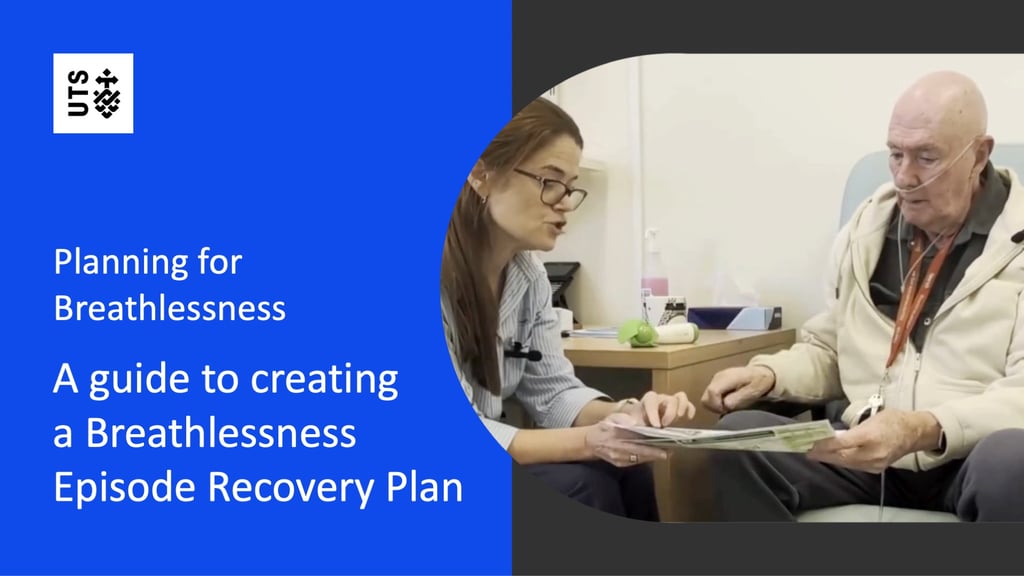
A woman and an elderly man are seated, discussing a document. The left side features a blue panel with text: 'Planning for Breathlessness: A guide to creating a Breathlessness Episode Recovery Plan' alongside a UTS logo.

To learn how to use the draft Breathlessness Episode Recovery Plan and user guide, watch the information video by clicking on the 'play' button above. 

[00:00:09.00] - Narrator
Welcome to this video designed to help people living with COPD create a personalised breathlessness episode recovery plan. This training is informed by the BREATHE research project and aims to support people with COPD and those who care for them with tips and tricks for recovering from breathlessness episodes. John is a person with COPD, and Mary is a clinical nurse consultant working in respiratory care. Together, they'll help explain how to best plan for breathlessness episodes. If you don't already have one, you can download a copy of the breathlessness episode recovery plan and user guide from the link or QR code shown on the screen. This video is a little bit long, so make sure you're comfortable while you watch.


[00:00:58.22] - Narrator
Breathlessness can happen for many reasons. Some people live with low levels of breathlessness every day, but others also experience sudden episodes where breathing becomes much worse on top of their usual level. These episodes can feel frightening, especially when they come without warning. That's where a breathlessness episode recovery plan can help. It sets out simple non-medicated strategies to bring your breathing and thinking under control. You can create this plan yourself or with a health professional. This could be your GP or another doctor, nurse, or allied health professional, like a physiotherapist or an occupational therapist. You can also create this plan with a support person, like a family member or friend. The plan shown in this video is just two pages, so it's easy to use. It comes with a user guide that explains how to personalise the plan and offers extra tips and tricks to prepare for episodes ahead of time. There's also a shorter version of the plan, which provides a quick reminder for you or someone else to go through the steps that work best for you. The plan and guide were co-designed with people with COPD, families who support them, healthcare professionals, and researchers from the University of Technology, Sydney, as part of the breathe project.


[00:02:15.10] - Narrator
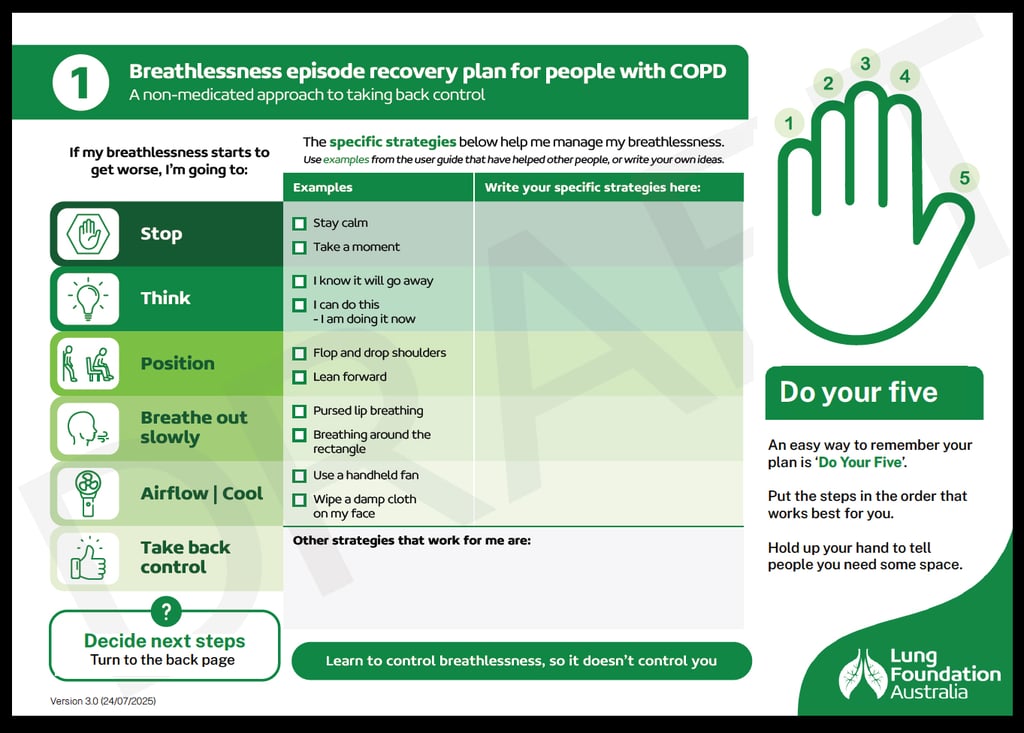
On the first page of the plan, you'll find five simple approaches to help you regain control during an episode. These are stop, think, position, breathe out slowly, and airflow/cool. You can put these steps in the order that works best for you using the 'Do Your Five' hand. When you notice your breathlessness worsening, lift your hand and work through each step. Sometimes you or your support person may need a reminder of what specific strategies work best for you. The plan includes examples and space for you to add your own in each section. When you first set up your plan, read section three of the user guide, where you'll find even more examples written in simple, clear boxes. The user guide also includes information for support persons so that your family, friends, or carers know how best to help.


[00:03:07.20] - Narrator
Now that you've seen how the plan works, let's join John and Mary as they sit down together to personalise his breathlessness episode recovery plan.


[00:03:20.05] - Mary
So what we can do is we can fill in this plan. Here are the examples of what you can do. And now what we can do here is write down what your strategies are and then a quick reminder that you can either put on your walker or carry with you is we can write the strategies on the hand. So you're going to 'Do Your Five'. And what we can do is put down what works for you in the order. So would you like to do that with me now?


[00:03:45.09] - John
Oh, yeah.


[00:03:46.07] - Mary
So what's the first thing do you think that when you get breathless, I heard you say, you stop what you're doing. So should we put that as number one?


[00:03:55.25] - John
Absolutely.


[00:03:56.23] - Mary
Excellent.


[00:03:57.19] - John
I mean, sometimes there's a temptation to not stop because you're not rushing to do something, but then it's counterproductive.


[00:04:04.11] - Mary
Exactly. So this is a reminder to you - stop. Think of the tortoise and the hare. Sometimes doing it a bit slower will get you there quicker in the end.


[00:04:15.19] - Narrator
Stop can mean something different to everyone, and a few examples are provided in section three. When you stop, it can help people around you understand that something is going on. It can tell them that you may need some space, and it can let people know you need to deal with things your self for a moment. It can also be used to tell people not to talk to you so you can save your breath. This can help you concentrate and figure out your next steps.


[00:04:39.18] - Mary
Okay, so what should we put as our next one, do you think? I think you were talking about that you really need to-


[00:04:47.14] - John
Well, that's what I do. I mean, pretty much in order, I think. But to think, you got to think, well, you got to identify the situation that you're in. You know you've done it before. So the thing is just stay calm and just wait a little bit of time to go by. That's the thinking part of it, as far as I'm concerned.


[00:05:07.28] - Mary
Great. So where it says here, it says, write your specific strategies. I'm going to add that. For stop, and it's going to - remember to stop. Think about what has happened before.


[00:05:39.04] - Narrator
During a breathlessness episode, it's common to feel frightened or to have unhelpful thoughts that can add to the panic. Section three outlines some strategies to manage your thinking, which can include things like self-checking, using positive self-talk, remembering key facts about breathlessness rather than myths, using relaxation or distraction techniques, creating a calm environment, or using other ways to make you feel safe and in control.


[00:06:06.05] - Mary
And then what do you think is the next thing you would do, or do you do things altogether?


[00:06:12.28] - John
In many cases, it might just be the first two things.


[00:06:18.04] - Mary
Exactly.


[00:06:18.26] - John
But then if it's a little bit more... If it's going to take a little bit more time to recover, I'd probably go to the position one because I think you've just got a... As part of the thinking process, you need to sort of get your lungs to sort of be more responsive to what's going to happen next, which is breathing.


[00:06:38.27] - Mary
I'm going to put position here. And your position is, you said you like to lean forward and drop the shoulders. Should we put that there?


[00:06:48.23] - John
Yeah, sure.


[00:06:49.02] - Mary
Excellent. Okay. So lean forward.


[00:06:56.07] - John
Drop your shoulders.


[00:06:57.05] - Mary
Drop your shoulders.


[00:07:01.19] - Narrator
Breathlessness episodes can happen standing up, sitting down, or even lying down. For all of these, you can adjust your position to help you breathe better. There is no one position that's better for everyone. Try different ones to find out what works best for you. You can find examples of different positioning techniques in section three. You can also watch Mary take John through a couple of these examples next.


[00:07:24.26] - Mary
Have you ever noticed when you get breathless, that sometimes you all tense up because of that anxiety? So it's really important to drop those shoulders and get into that position. So if you just lean forward slightly for me. See your shoulders are down, which is great. Perfect. And then your arms are relaxed. Of course, if you've got the table, you can lean on the table like this, and you can even have a bit of a rest if you're having problems. One, when you're out and about and there's not a chair, is leaning up against the wall, and you can either pop your back, relax your legs, drop your shoulders, and that's a nice position. Or you can actually lean on the wall with your arms up a little bit and just supporting your head. If you don't have a wall or you don't have a trolley, the other one is actually putting your fingers in the belt loops of your pants and just leaning forward. And as you can see, I've dropped my shoulders and I'm leaning forward, and that actually helps me get in that position that allows the lungs to work.


[00:08:35.11] - Mary
Okay. And then you said with the breathing out that you smell the roses, blow out the candles.


[00:08:41.03] - John
That's correct.


[00:08:41.13] - Mary
So should we put that one down? And then show me that breathing that you do. So you're smelling the roses and blowing out the candles. That's fantastic, John.


[00:08:55.21] - Narrator
When people get breathless, they often focus on trying to get air in and forget about breathing out. But with COPD, it's important to clear the old air first. This makes room for fresh air to come in. If you don't, you may end up shallow breathing very fast, which can feel frightening because you can't take deep breaths in. That's why health professionals often say "focus on the out-breaths, the in-breaths will take care of themselves". Techniques like pursed-lip breathing or breathing around the rectangle are simple ways to slow your breathing down and help you recover during your breathlessness episode. You'll find step-by-step instructions of these techniques in section three of the user guide.


[00:09:35.29] - Mary
So the last one which you haven't used before is the air flow or the cool and I'm going to give you the fan because fans, they're not all the same, and we want a fan that's going to work properly. So this one is from the Lung Foundation. Nice and easy to turn on, not too hard to hold. It's quite ergonomic for your hand, and it's just blowing that cold air on the bottom half of your face while still doing those techniques that you were doing. So breathing in through the nose, out through the mouth and that cold air actually stimulates some nerves in your face, sends a message to your brain to say, I'm getting enough air. So it really stops that gasping air. So it's a way of-


[00:10:23.23] - John
It is quite reassuring, actually.


[00:10:24.12] - Mary
Yeah, great.


[00:10:26.22] - John
I must admit, I have tried the air conditioning or the fan in the car.


[00:10:30.17] - Mary
Yeah, after you've gone to the car and you're really puffy and that's the first thing you turn on.


[00:10:34.22] - John
That's right. I sit there and rest while I was thinking about negotiating getting out of the car park.


[00:10:40.04] - Mary
So I'm going to say use your fan. But I'll also put in brackets, air conditioner in car, because you told me that you also use that. And then it's take back control. Excellent.


[00:10:59.14] - Narrator
There's good medical evidence that cool air directed at your face can help reduce breathlessness. It can also be helpful to cool your face or neck. You'll find more examples of air flow and cooling strategies in section three of the user guide.


[00:11:15.18] - Mary
So, John, as we were talking before, getting breathless is really frightening because you're always thinking "Am I going to catch my breath?" But it's also really frightening for people around you, whether it's the cleaner, family or friends. What's your experience with that? Have you got someone that has seen you breathless before?


[00:11:36.22] - John
Yes, my daughter checks on me on her way to work occasionally, and she checks up. But I think she's a little bit out of her depth. She sees me in a bit of a panic sometimes, or she thinks, well, I'm breathing too hard, and I think sometimes she might overreact a little bit. So it'd be good if she could help me a bit more.


[00:11:57.15] - Mary
Yeah, and I think that that's really natural, because if you see someone you love that's distressed, it's automatic - "I want to call the ambulance". But you don't need to call the ambulance all the time because you can 'Do Your Five'. This booklet has some great information, especially for our support people. So for people that come into our home and who may see us breathless, we can not only show them the breathlessness action plan so that they can actually see that that you're in control and that you're doing your five. You can show them your five hand, but you can also show them different pages in this book. And there's specific pages here just for your support persons. And it goes through some of the things that you might want to cover with them and things to tell them to do. More importantly, things to tell them not to do. And I think you know exactly what I'm talking about when they start panic and hover all over you and you want to tell them that "I'm okay, take a step back". And all of that information is here. So it's a nice way to go through what you need when you get breathlessness.


[00:13:15.05] - Narrator
If you have support persons like family or friends, it's important to work together with them to plan for your breathlessness episodes. Talk to them ahead of time about how they can best help. Over time, support persons become expert and may notice things that you miss. If you change your plan, let everyone know so they are up to date. Make sure to show them the user guide as there are some tips specific to support persons scattered throughout it.


[00:13:40.26] - Mary
So we've filled out the front of your breathlessness episode recovery plan. On the back, what we need to do is fill out a few other things. I'm going to put your name and the date that we've done this because your techniques may change over time, and you might find one thing works and one thing doesn't, and we can always cross that out and put something new. You were saying that sometimes when you get breathless, that you might call the COPD nurse just to discuss your symptoms. So I'm going to put her name down, and I'm also going to put her phone number down. That way, if you do get in a panic and sometimes - "Oh, I don't know what to do!" - you can look here the numbers right in front of you, or if you've got someone visiting and they're worried, they can do it.


[00:14:29.05] - Mary
So, John, it's really common that when people get breathless, they get some really frightening thoughts. And it's quite natural when you can't breathe, you start thinking "Am I ever going to catch my breath? Am I doing harm? Am I going to have a heart attack? Am I going to collapse?" I think it's really important to understand that your breathlessness, although it's frightening and although it's scary, it's actually not doing you any harm at all. Your normal 'John breathlessness', so that breathlessness that you expect to get when you exert yourself, making the bed, doing your exercise, doing shopping, that breathlessness, although it's horrible, it's not doing you harm. And by learning techniques to control it, which is what you're doing, really helps control your breathing. Of course, you have to understand that there are days where you'll get breathless, where it may be a sign that something is going on. So it's really important to remember that people with COPD can have good days, bad days, and sick days. So a good day is where you're feeling great, you can get on and do all your work. Your bad day is that it's a little bit cold outside. You might not have slept as well. So you're a little bit more breathless than usual, and that's okay. Then there's the sick days, and that's when you get the other symptoms associated with your breathlessness. And often come at different times than when you'd normally expect it. So if you get chest pain, palpitations, swollen legs, along with your breathlessness, that's bad breathlessness. And although you can still use these techniques to help control the breathlessness, you also need to treat the cause. So you need to see your doctor, call the ambulance, or take your emergency medication. So how do you know if it's a good day, bad day, sick day? Of course, you're going to look out for those symptoms. But another way is when you 'Do Your Five' and you're trying to control your breathlessness, if it doesn't get relieved within 10 to 15 minutes, that's another warning sign that this might be a bad day and you need to do something medical about it. So 'Do Your Five' for about 10 to 15 minutes. Hopefully, your breathing comes under control. But if it doesn't, you then have to move on to what are your next steps. And you can either look at your COPD Action Plan if you've got one, you can ask for some medical advice, or of course, you can call triple-O. But it's also important to remember that if you still don't catch your breath after 10 to 15 minutes, there might be something else going on. So it's really important to once again think, have I got any other symptoms? Has Did my sputum changed? Did I not sleep well last night? Are my feet swollen? Things like that. And if anything is out of the ordinary, it's really important that you seek medical attention, whether that's ringing your GP, your COPD Nurse, or if it's really bad and you're frightened or you're getting other symptoms with your breathlessness, such as chest pain or coughing up really bad stuff, is that you can ring triple-O.


[00:18:00.00] - Narrator
Everyone has different breathlessness triggers, and it's important to know what's normal so you know when things don't feel right. You may already know this, or you may still be trying to figure this out. It may take time, but you will become expert on your breathlessness. If you can understand it better, it will be less frightening. For some people, it can be helpful listing their breathlessness triggers out, and you can do this using the prompts on page number seven in the user guide.


[00:18:29.24] - Mary
So John, we've gone through the five and you've remembered them and we've added in a couple of extra little steps. What I want you to do is when you go home and you're doing those activities that make you breathless, I want you to keep practicing your five. And then I might get you back next week and we'll talk about it and see if we need to make any changes to the plan. Because as we know, you'll try something and it works great, you'll try other things and it doesn't work. And that's where we can go through the booklet again. And If something doesn't work, we can always put something else in instead, or you might come across something that works fantastically, and we can add that to your five as well. Does that sound okay?


[00:19:09.23] - John
Sounds great.


[00:19:10.11] - Mary
Excellent.


[00:19:11.19] - Narrator
You may, of course, not have a health care professional you can revisit to help you revise the plan. So after a breathlessness episode and when you're feeling better, you can use the prompts on the second page of the plan to do this yourself. Reflect on what made your breathlessness worse, what strategies worked well or didn't, and what did others do that was helpful or not. If you have friends or family that know about your plan, make sure to discuss any changes you make. You might not need to review your plan every time, though. The more you practice and use it, the more you'll remember how to best take back control of your breathing during episodes. For some people, it can help to record your breathlessness episodes. This can help you, any health care professionals, and your support person see patterns over time. You can find an example of a 'breathlessness episode diary' in section four of the user guide.


[00:20:03.09] - Mary
I think it's really important to remember that getting breathless doesn't mean you're getting worse. It might mean that you're actually doing extra activities. And this is a way to track it. Because you might say, "I've had to use my fan five times today. Yesterday, I only used it three times." But the reason you've used it five times is you've walked to the shops, you've made your bed, and you've done exercise. So this diary helps you kind of track when you're getting breathless and works out if it's good breathlessness, bad breathlessness, or sick breathlessness. So we've got here, you can put the date, the time, what's happened, and basically, what things you did to control your breathing and how you felt afterwards, and any tips and tricks in the comments. So that way, over time, you can actually see how your confidence in managing breathlessness is improving.


[00:21:03.22] - Narrator
Finally, there's some information in section four of the user guide around getting the most out of life despite breathlessness. You can also find some useful links here to resources for yourself or your support persons. By personalising your plan with strategies that work for you, you will be more prepared for breathlessness episodes. Keep it somewhere visible, share it with any support people, and practice using it so you can learn to control your breathlessness so it doesn't control you.


[00:21:32.06] - Narrator
The breathlessness episode recovery plan and user guide shown in this video were created by people living with COPD for people living with COPD. It was co-designed with families who support them, healthcare professionals, and researchers from the University of Technology Sydney, as part of the BREATHE research project. To find out more, visit www.uts.edu.au/breathe.

Download draft resources

Click on the pictures below to access draft versions of the Breathlessness Episode Recovery Plan and User Guide. 

The ‘Do Your Five’ Hand is also included as a postcard size print out.
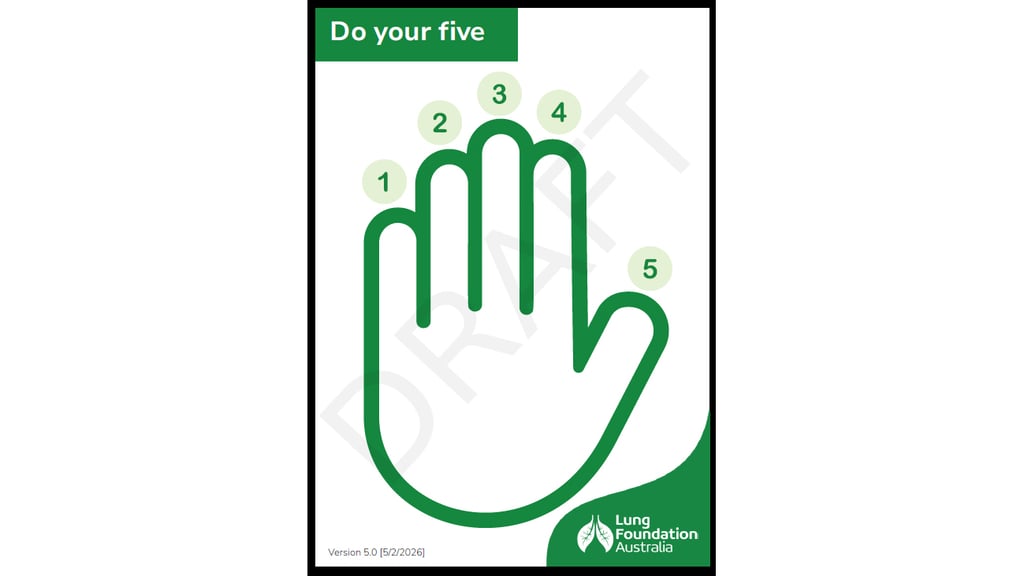
Illustration of a green hand outline numbered 1-5 on each finger, titled "Do your five" by Lung Foundation Australia

‘Do Your Five’ Hand (draft)

Indicative graphic of the breathlessness plan

Breathlessness episode recovery plan (draft)
user guide cover

User guide (draft)

The plan and user guide above have been co-designed with people with COPD, their support persons and expert clinicians.

In collaboration with the Lung Foundation Australia, researchers at the University of Technology Sydney (UTS) are testing the plan in hospitals and inviting feedback to improve it.

Get more information

Learn more by visiting the BREATHE Project website or by calling

Muneeba Chaudhry on 0493 867 101 or emailing breathe@uts.edu.au