

Autonomous Learning for Decision Making in Complex Situations
Abstract of the Laureate project
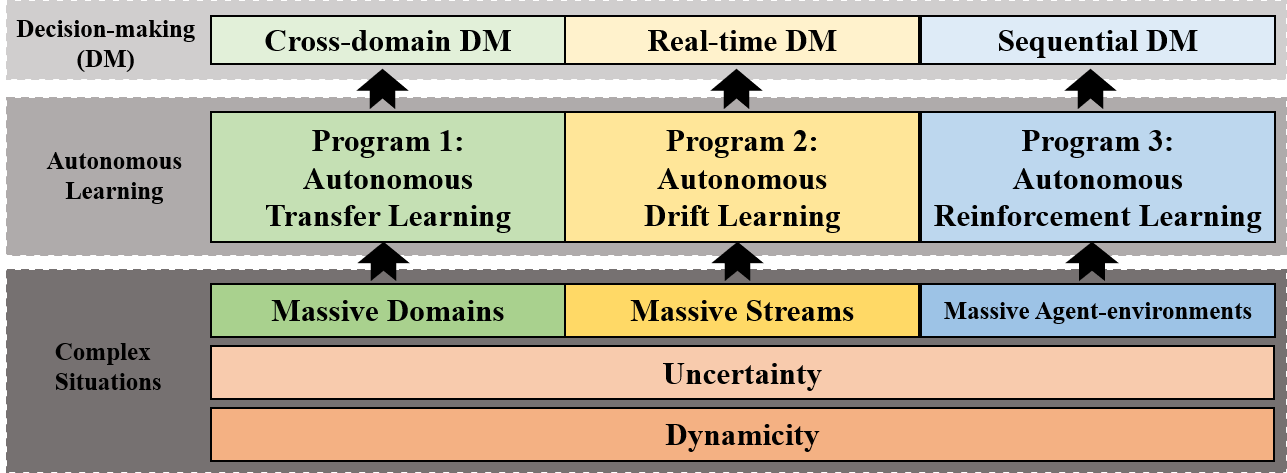
The project aims to create a novel research direction – autonomous machine learning for data-driven decision making that innovatively and effectively learns from big data to support decision-making in complex (massive, uncertain, dynamic) situations.
A set of new theories, methodologies and algorithms will give artificial intelligence the ability to learn autonomously from data to enable machine-learning capability to effectively handle tremendous uncertainties in data, learning processes and decision outputs, particularly enabling smart learning in massive domains, massive streams, and massive-agent sequentially changing environments.
The project outcome is to improve data-driven decision-making in multiple industry sectors.
Technical programs
This project has three main technical programs:
- To develop methodologies of autonomous transfer learning (ATL) for cross-domain decision support systems and recommender systems in massive domains with uncertain, data insufficient and dynamic environments.
- To develop methodologies of autonomous drift learning (ADL) for real-time prediction, recommendation, and decision-making in massive data streams to support decisions given unpredictable stream pattern changes.
- To develop methodologies of autonomous reinforcement learning (ARL) for sequential decision making in massive agent-environments to support decisions under sequential interactions.
Applications, translation and impact
The intended outcomes of the project include original ATL/ADL/ARL machine learning methodologies associated with algorithms, demonstrated prototypes and applications, which will have a transformational impact in most industries in Australia because machine learning is changing business prediction and decision-making processes. The outcomes will significantly improve the timeliness and quality of decision-making driven by data and will directly contribute to Australia’s capacity for artificial intelligence.
Selected application areas and partnering with industry
- Healthcare (via e.g. WHA and 23Strants to improve assessment, analysis and prediction in healthcare).
- Transportation (via e.g. Sydney Trains to implement auto rail replacement bus planning and optimise transportation).
- Agriculture and Logistics (via e.g. Blue Logistics to enhance supply chain management).