

- Posted on 30 Jun 2020
- 43-minute read
Millions of Australians are protesting violence and systemic racism. But with more than 500 deaths of First Nations Australians in police custody since 1980, why has it taken tragedies played out on foreign soil to confront our own issues?
When it comes to Australia’s history and race struggles, there is still ignorance throughout white Australia, all the way up to our Prime Minister. Are we seeing the catalyst for real recognition and reform, or will the moment pass?
Our panel
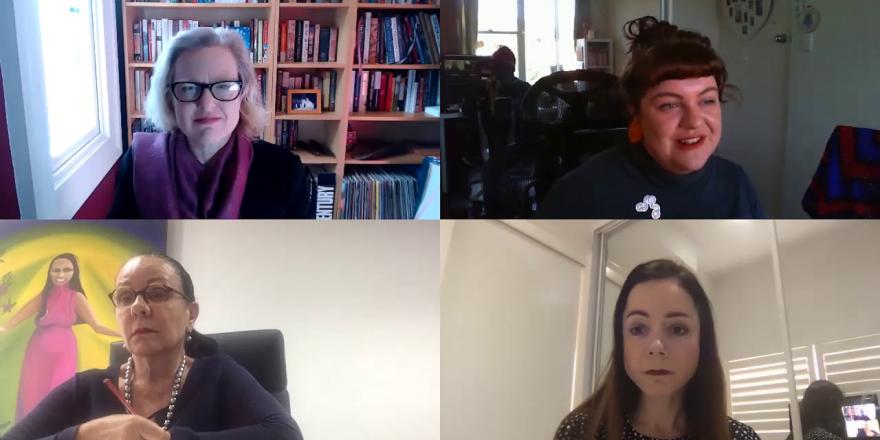
- The Hon. Linda Burney MP, Shadow Minister for Families and Social Services, Shadow Minister for Indigenous Australians
- Alison Whittaker, Research Fellow at UTS Jumbunna Institute for Indigenous Education and Research and author, BLAKWORK
- Prof. Thalia Anthony, Professor of Law at UTS (and proud Cypriot woman)
- Facilitated by The Hon. Verity Firth, Executive Director of Social Justice at UTS.
Presented by UTS Jumbunna Institute for Indigenous Education and Research and Centre for Social Justice and Inclusion.
A transcript of the conversation is also available.
‘The protests are really powerful for two reasons. There's the physical demonstration but they're also really important for the people that participate to understand that there is broad support, that there are many fellow travellers, for whatever the issue is, and in particular with Black Lives Matter and what has flown out of that has been so powerful. You just look across the world to see how it's been – it's changing things, it's changing curriculum, it's changing practice, it's changing physical space. None of those things would have happened had there not been the physical demonstration that we have seen.’
The Hon. Linda Burney
‘There is a big focus in this space on truth and knowledge deficits as a way to move forward. That's a really important first step, but if we go through this process of acknowledging slavery as a practice here and as a foundational practice of Australia as a colony, and then do nothing about it, then that is not only a wasted opportunity. It's its own kind of violence and betrayal. The knowledge should drive us to do something.
'Often, as people in universities, we are kind of told to pursue the truth and to pursue knowledge to a particular thing, and we can become obsessed with that as the end goal and forget that is actually the start, and that should include redress schemes for stolen wages but it should also include a really broadened conversation around recreations, which universities in the United States are beginning to take seriously as well.’
Alison Whittaker
‘We need to understand that the media actively defend police and actively demonise Aboriginal people, especially young Aboriginal boys.
‘There have been studies that show that the media often reproduce verbatim press releases coming from police forces and police unions, and so they're giving the police pretty much a blank cheque to represent their side as they like. By contrast, we consistently see stories where kids are named and shamed, Aboriginal kids, and so it creates this culture where Aboriginal kids are treated as a problem, are treated as a risk, and that feeds into police violence being legitimised against them and kids being tortured in custody.
‘So I think the media is absolutely complicit in this violence. By contrast, though we have a role on social media to really rewrite these stories. I want to acknowledge there has been a strong presence of black tiles coming from the United States, but I want to acknowledge the work of First Nations families in running campaigns around say their names and our responsibility to support those campaigns, and they also manifest in campaigns like justice for Dungay or justice for Ms Dhu. That campaign around saying their name is really important in humanising those people who have been lost, who have been killed by this system.’
Prof. Thalia Anthony
Byline: Laura Oxley, External Communication Officer, Centre for Social Justice and Inclusion