

• Posted on 29 Oct 2020
  • 48-minute read

Health, Housing, Human Rights and COVID-19

Australia is the only liberal democracy without a Charter of Rights or a Human Rights Act. The recent pandemic has brought a raft of social justice issues to the surface both nationally and internationally – significantly in housing and health.

Do we have enough protection for basic human rights in Australia at every level? What would it look like if every member of our community had essentials like quality health care, dignified aged care, and a secure roof over their heads – in the good times and the bad?

In this session, Hugh de Kretser (Human Rights Law Centre), Kate Colvin (Everybody’s Home Campaign), Annie Butler (Australian Nursing and Midwifery Federation), and Verity Firth (UTS) discuss how we can create better outcomes for society by putting human rights at the core of decision making.
Wk7MJUojugk

Descriptive transcript

Hello, everybody. Thank you very much and welcome to today's event. Before I begin, I want to acknowledge that wherever we are in Australia, we are all on the land of First Nations peoples. One of the nice things we've got people to do at other webinars is, if you want to acknowledge the land where you are today, please type it in the chat. Make that special acknowledgement to Elders past, present and emerging in the area where you are. I'm on Gadigal land, Gadigal of the Eora Nation. Both my house and the university, UTS, is on Gadigal land, and I want to pay particular tribute to the Gadigal people as the traditional custodians of knowledge that our university stands on, and that's really important when you consider that we are a university. So, please put your acknowledgements in the chat as we go along.

My name is Verity Firth. I'm the Executive Director of Social Justice at the University of Technology Sydney, and I also lead up our Centre for Social Justice and Inclusion. Today's event is called Uncharted: Health, Housing, Human Rights and COVID-19. We're presenting this webinar today in partnership with the Human Rights Law Centre. It's my big pleasure to be joined by the Executive Director of the Human Rights Law Centre, Hugh de Kretser, alongside our other distinguished panellists, Kate Colvin and Annie Butler. I'll have an opportunity to introduce them all properly with their bios and everything shortly. But before we do that, a little housekeeping.

Firstly, the event is being live captioned. If you'd like to view the captions, click on the link that is in the chat panel. You'll find it at the bottom of your screen in the Zoom control panel. Click on the chat and the captions will open in a separate window.

If you have any questions at all during today's event, you can type them into the Q&A box and there will be an opportunity to ask questions in this event. However, I'll be asking them, because that will make it easier. So, type your questions into the Q&A box. There's also an upvote function, so you can actually vote other people's questions up. On the whole, I tend to ask the questions that have the most votes, because they obviously tend to be the questions that people are most interested in having answered. So, if you have any questions, please start typing them into the Q&A box as we go along.

So, today's event is aptly titled Uncharted: Health, Housing, Human Rights and COVID-19. The recent pandemic has brought a raft of social justice issues to the surface in Australia and, of course, internationally—significantly, housing and health. It has also caused many of us to question whether or not we have enough protection for basic human rights in Australia. I ask this in the light of the fact that Australia is the only liberal democracy without a Charter of Rights or a Human Rights Act. So, we're going to be discussing all of that today in the context of COVID, but specifically also in the context of rights to housing and health.

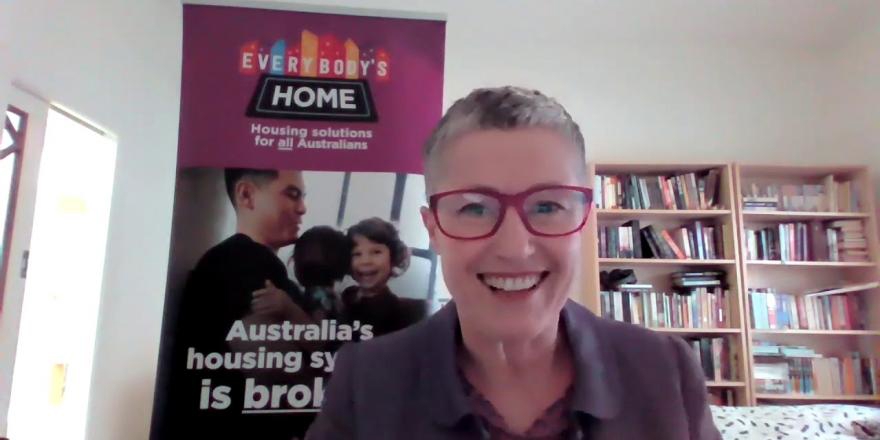
So, it is my pleasure, of course, to introduce our panellists. First up, Kate Colvin. Kate Colvin is the National Spokesperson for the housing and homelessness campaign Everybody's Home. Everybody's Home launched in 2018 to campaign for a fairer housing system in Australia and has grown to become an alliance of over 300 partner organisations and more than 28,000 community supporters. Kate is also the Deputy CEO of the Council to Homeless Persons, the peak body for the homelessness sector in Victoria. So, welcome, Kate.

Annie Butler is the Federal Secretary of the Australian Nursing and Midwifery Federation. She is a registered nurse with more than a decade's experience working in public hospitals, the community and on health education projects, and a further decade working in research and education. Annie believes that we must fight to maintain the professions of nursing and midwifery in Australia and ensure their advancement. She is passionate about improving Australia's system of health and aged care and the critical role that nurses and midwives have to play in the future of our health system. Annie is particularly keen to see nurses drive change for improvement in Australia's aged care sector, which we'll be talking about further today. Welcome, Annie.

And Hugh. Hugh de Kretser is at the Human Rights Law Centre. He began at the Human Rights Law Centre as a board member when it was established in 2006 and became the Executive Director in 2013. Hugh started his legal career at the law firm Mallesons and then began working to protect and promote human rights as the manager of the Brimbank Melton Community Legal Centre and the Executive Officer of the Victorian Federation of Community Legal Centres. Hugh currently serves as a Director of the Victorian Sentencing Advisory Council and a member of the Advisory Board of the University of Melbourne Law School. He has previously served as Commissioner of the Victorian Law Reform Commission, a board member of the National Association of Community Legal Centres and a governance committee member for Knowmore, the national service that provided legal help for people navigating the Royal Commission into Institutional Responses to Child Sexual Abuse. So, welcome, Hugh.

And I should say, actually, that before we were live today, we were talking to the panellists and all three panellists are based in Melbourne. So, all three panellists have just emerged from lockdown and are feeling very happy about that. So, I'm sure we'll also be talking a bit about that later on as well.

We're here today to consider how we can create better outcomes for society by putting human rights at the core of decision making. What would it look like if every member of our community had the right to essentials like quality healthcare, dignified aged care and a secure roof over our heads in the good times and the bad?

So, we're going to begin today's discussion with some short opening statements from each of our guests. I think we'll begin with you, Kate. Would you like to start us off?

Thank you. Can I start by acknowledging that I'm joining the conversation from Wurundjeri country and pay respects to Elders past and present. I want to start by taking us back to that time before the crisis and before the COVID crisis—of course, we were just coming out of the bushfire crisis then—but talk about how homelessness services and the housing system work in ordinary times so that I can reflect on how things worked when COVID happened.

In Australia, on any given night, we've got 116,000 people who don't have a home. Not all are sleeping rough—only about 5% of those are sleeping rough. Others are in really overcrowded accommodation or in a rooming house or in other forms of accommodation that are not considered a proper home. We've got almost 200,000 Australians on wait lists for social housing—either public housing, community housing or Indigenous housing—and for many years we've had declining federal government investment in social housing.

So, we've got this background context of increasing homelessness need, a great level of need and increasing need, people not being able to get into the lowest cost forms of housing, which is social housing, and a government who's not providing the resources that are needed. Then along comes March 2020 and we have this massive health crisis.

One of the things, just to bring home the cold, hard reality of how homeless services work, is that it's not like schools or even emergency rooms in hospitals where, if there's a large flood of new people coming in, then the resources generally—Annie might dispute this in relation to hospitals—but generally the resources are expanded to provide service to the people who are needing it. The way that homeless services are funded is that a certain amount of money is provided to provide hotel accommodation and support to people, and if those resources are not adequate to meet the level of need, then there's no extra. So what happens in practice is that people get turned away.

In Australia, in ordinary times, 253 people are turned away from homeless services each day, which basically means they've come knocking on the door of a service and they've run out of money to provide hotel accommodation. Turnaways are one way that services manage that demand, which is far in excess of the resources available to provide support to people. The other is by providing time-limited periods of temporary accommodation. Someone might be provided with two weeks' accommodation in a rooming house, but after that, they'll need to find their own options. Obviously, in a situation where it takes many years to get into social housing on wait lists, a couple of weeks doesn't help people.

So, then we end up in March and we've got this COVID crisis. A lot of state governments stepped up and provided increased resources to get people into hotel accommodation. I think often that's been interpreted in a really cynical way as, "Oh, well, homeless people are going to become spreaders of disease," but I actually think in terms of the public imagination and what was happening in those early days of COVID, there was a great outpouring of concern. From decision makers to all of us in the community, everyone was equally staring down the barrel of a pandemic that everyone could see was going to be very dangerous, and there were responses that were created to deliver what was needed to people who were really vulnerable.

So, I think there was some real positivity about the fact that state governments were like, "This group of people, particularly rough sleepers, many of whom have chronic health conditions, will be hugely at risk if the pandemic is allowed to run crazy through that population." So, people were put into hotel accommodation. That's a really good point, but it's not a perfect solution. One of the things that gets confused when we talk about homelessness is the distinction between having a roof over your head and having a home. Being in a hotel room is not a home, and particularly during lockdown, when you can't leave the room other than for the four allowable reasons that people are allowed to leave the room.

So, it's not like it was just a couple of weeks. People were, in many cases, in hotel rooms for a couple of months, and that was really very challenging for people who were in that environment and often meant that sometimes people would leave into other forms of accommodation because it wasn't meeting their needs.

The other problem is I think sometimes we feel like, "Oh, the problem of homelessness is being solved because state governments have put people in hotel accommodation," but a lot of people who were in hotel accommodation were single people on the JobSeeker payment. Even though that payment was increased for a short period of time, the base level of JobSeeker, which will be the level after 31 December, is so low that people on that payment can't afford housing in the private rental market. So, basically, they have nowhere to go from the hotel accommodation.

They couldn't get into public housing because the wait lists are too long. They couldn't get into private rental because they wouldn't be able to sustain it past December. So, the number of people, particularly in Victoria, in hotels grew and grew without people being able to get out into a longer-term option.

The other thing that's happened is that the resources available for that hotel accommodation—so you've got more people coming through the doors and into those hotels each day—didn't keep expanding to meet that need. So, we're back at the circumstance where homeless services are having to manage a limited amount of resources with a large number of people needing those resources, and so limitations on length of stay and triaging of people into that form of accommodation have been reinstated, both in Victoria and, I think, people in Sydney would have seen there's been a growth in rough sleeping. That's basically because there's not the resources for hotel accommodation and there hasn't been housing options for other than a small number of people who are in those hotels.

I just want to go back to that sort of midpoint of COVID, when we had a large number of people in hotels around the country—perhaps around 33,000 have been in hotels across the pandemic—and think about what government could have done at that moment when all of these people, many of whom were highly vulnerable, were there in hotels and they could have been housed. There were options put up to the federal government, a model called the SHARP proposal—Social Housing Acceleration and Renovation Program—which was about doing four things in succession: putting money into renovating social housing that's offline because it's damaged; bringing those properties back online; buying distressed assets in the private market because there were almost-built homes that developers had gone bust because of COVID that could have been purchased and quickly finished and brought into use; shovel-ready social housing projects that would have kept construction workers working and also delivered a social housing outcome; as well as options that, if the federal government in particular had invested, like head leasing, which is when the state goes and rents properties and then rents them on to people who could have moved into them from the hotels.

So, there were a whole lot of options that would have provided a secure housing pathway into long-term housing and which didn't happen. Some states, including Victoria and New South Wales and to a lesser extent some of the others, have provided small amounts of long-term housing, and that will mean that some people will have had the experience of going into hotels and then into long-term housing, and that's a really good outcome. Others, the majority, will have had the experience of a short time, sometimes a bit of an extended short time, in hotels, which is a good thing in terms of preserving people's health during that period, but they are not housed, and they will not be unless the government turns around that declining investment in federal money for social housing and actually starts to do what's needed to build our social housing stock up so that everyone can have a home.

So, maybe I'll stop there. I'm not sure if I've gone to five minutes or less.

No, thanks, Kate. That's a really good introduction to the issues facing housing in this time and beyond this time. Annie, can we hear from you?

Yeah, thanks very much, Verity, and thank you for the invitation and to my fellow panellists today. I would also just like to acknowledge that I'm joining this meeting from the lands of the Wurundjeri people and I pay my respects also to Elders past, present and emerging and to any Aboriginal people who are joining us today.

I'm the Federal Secretary of the Australian Nursing and Midwifery Federation, which for those of you who may not know is the union and professional organisation for nurses, midwives and care workers across the country. We are now also Australia's largest trade union, with almost 300,000 members, and members who have been at the heart of Australia's response to COVID-19 on virtually every front and have witnessed our successes and our failures.

It's fair to say that COVID-19 has shaken us all and in fact is continuing to shake many parts of the world. But while recognising that the second wave in Victoria has been extremely challenging—and as Verity said, I now have the grin of a Cheshire cat as a Melburnian on the first day of release from lockdown—even with this second wave, Australia has been fortunate with regard to the COVID-19 outbreak compared to many other countries around the world.

While Australia has a number of natural advantages, the pragmatic action taken by governments and their engagement with and responsiveness to health and other experts and their advice has led to what is regarded globally as successful containment of the pandemic's outbreak.

That said, our management of the COVID outbreak has revealed much about us. It's not only highlighted but also deepened our existing inequities and shown us that our systems favour some Australians over others. It has shown us our strengths and our weaknesses. Our health response, from an adaptable, universally accessible system staffed by highly skilled clinicians and structured to support the delivery of quality care, has been our great strength.

This system is also underpinned by a public health approach that is reasonably equipped to manage the challenges involved in balancing competing rights, interests and values in the midst of a public health crisis and recognises that restrictions to individual liberty may be necessary to protect the public from serious harm.

An approach supported by a community that over the last few months has largely committed to a united response of shared responsibilities and interests, and this week's outcome we're seeing in Victoria is testament to this commitment. Despite this, our weaknesses have been several, and from my union's perspective, our aged care response has been one of our greatest weaknesses.

A fragmented, immature system, poorly staffed by a lowly paid, often lower skilled, predominantly female workforce without structures that support the delivery of quality care and which consequently, although tasked with protecting and caring for some of our country's most vulnerable, has been shamefully inadequate in its response to the pandemic, so tragically demonstrated by the situation seen here in Victoria.

It is significant that almost three-quarters of all deaths from COVID-19 in Australia occurred in aged care, and when considered in the context of Australia's overall success in managing the pandemic, it should be regarded as all the more shameful.

Put quite simply, the rights of older Australians living in residential aged care were not recognised. Older Australians were not afforded the same opportunities, the same care or the same chance as everyone else in the community to deal with COVID-19.

While this disparity existed well before the pandemic, the outbreak over the last few months has truly exposed our country's poor treatment of its older citizens. In considering whether a rights-based approach could result in better handling of the consequences of COVID-19, I would say yes, of course, but we need much more than an articulation of human rights. We need to make sure that we build the systems and structures that ensure everyone's rights are equally recognised—systems and structures that guarantee an Australian society that provides for all Australians equally. Thanks, Verity.

Thank you for that, Annie, and I'm sure there'll be some questions. That's a really good headline too. Hugh, you're next.

Thanks, and thanks, everyone. I'm coming from Boon Wurrung land, and I would just like to acknowledge the particular importance of the rights to health and housing to Aboriginal and Torres Strait Islander people and the shameful failures of Australia in protecting those rights and the legacy of dispossession and injustice that has fuelled the lack of access to those rights on an equal basis for Aboriginal and Torres Strait Islander people in this country.

So, I'd just like to start by saying: what are human rights? Human rights are the essential things that we all need to live a decent, dignified life. Governments around the world have promised to uphold human rights. There are human rights treaties at the international level where these rights are set out in international law, but the problem in Australia is they haven't been translated fully into our domestic law.

So, those rights that exist and that Australia has promised to comply with are often very hard to enforce and hard to realise here in Australia as a practical and as a legal issue. We have no national Charter of Human Rights that translates those international human rights that the Australian government has promised to comply with comprehensively into Australian law, but we do have charters at the state level—in Victoria, recently Queensland adopted its human rights charter, and the ACT was the first jurisdiction in Australia to have a charter.

Those charters are what we might call modest versions of a human rights charter, but they are important, they have power, and they are making a difference. I think when you look at the COVID-19 pandemic, it is a global human rights crisis—there's no doubt about that. It's a crisis in terms of the impact on people's right to life and health, but also on the impact on other human rights as a result of government responses to the COVID-19 pandemic.

Governments here and around the world are often having to make agonisingly hard decisions about what measures to put in place to protect life and health and necessarily restricting other rights in the process of that. Human rights law provides an incredibly useful compass, if you like, to help governments make these decisions, to get them right, and that is really about a process of balancing human rights. Very few rights are absolute and so, as Annie said, rights can be limited.

We can limit our freedom of movement to protect people's right to life and health, and in Victoria we've experienced that acutely. My family and I returned from the US; we were put in hotel quarantine. A quarantine program is a necessary element of protecting life and health in this pandemic—limiting people's right to liberty in order to protect people's right to life and health, and particularly the most vulnerable members of our community.

A charter says you can limit human rights if you have a good reason to limit that human right and you do so in the least restrictive way—the lowest level of restriction to get the job done—and that test is really powerful in helping governments to get the right decisions in this pandemic and helping the community to assess whether governments are not doing enough to protect our life and health, getting it right or going too far.

We've seen a number of cases here and around the world using human rights law to test that, and in Victoria we've got a case around the curfew at the moment. So, whether it's about masks, curfew, quarantine, border closures, human rights law provides that really useful compass or guide to get this right.

A charter at the national level would help in terms of protecting human rights in this pandemic. It would help governments make the right decisions. A charter basically would do two things: it would require governments and public servants to think about—act compatibly and properly consider—human rights, as the language in charters says. So, think about human rights and make sure you comply with them in your actions in delivering services and developing laws and policies, and it would give people the power to take action if their human rights are breached.

The impact in Victoria, and I think we'll see in Queensland and the ACT and in other jurisdictions like Canada, the UK and New Zealand, shows that the biggest impact of a charter is as a preventative tool. Working properly, a charter will help governments to make those decisions and get laws and policies and services right, and that preventative role is critical. But where governments get it wrong, it's important that there is access to remedy, and that's where you need to have access and power for people to take action if rights are breached.

So, a charter will help in this pandemic. It will help to build a fairer, more compassionate society. It will give us a framework that will mean that the values we all care about—like freedom, equality, dignity, respect—that we hold on to these in these dark times, these tough times, and it will complement the existing laws that we have around workplace health and safety, negligence, and public health and wellbeing laws.

That's something that we have a campaign to try and achieve—a national charter. Charterofrights.org.au—people who care about this issue, I encourage you to look at that website and support the campaign.

Thanks, Hugh. So, I'm just going to ask a question of each of the panellists and then I'm going to throw it open to the floor. We've already got some questions coming up in the Q&A, so thank you for people putting in your questions. Remember, you can vote up the questions you particularly like as well, and we'll make sure we get to the most popular ones.

I might come to you first, Annie. I thought that your framing around the crisis in aged care really being about the rights of older Australians not being respected was a really powerful one and in some ways strikes to the heart of our culture, really, about why is it that we don't respect the basic human rights of our older people. I just want to put that out there a little bit if you have any views on that, and also, but more pointedly, how do we get decision makers to respect those basic human rights of our older people, and why has not enough been done, considering the litany of tragedies that you outlined in your opening?

Thank you very much, Verity. I think the two are connected. So, perhaps just to start in the rights of older Australians—astonishingly to me, a charter of aged care rights exists. It actually came into effect on 1 July 2019, but—and it goes to points that you mentioned of enforceability. So, it exists; there are words on paper that say that every older Australian has a right to safe and high-quality care and services, be treated with dignity and respect, live without abuse and neglect. When we see that the Royal Commission into aged care—their interim report was titled "Neglect"—clearly the words on the paper don't mean much at the moment.

So, then going back to why—I personally and my union, we've known about this for at least two decades, and can I just quantify how many times we've tried? From 2009, my union has participated in, given evidence to, written submissions to 29 separate inquiries into aged care and the aged care system. Now, to the Royal Commission, in a couple of weeks we will make our 28th submission just to the Royal Commission. So, it's not as if we haven't been able to articulate the problems and put that forward.

But the pivotal question is, you ask, why aren't we listened to? It goes to not just the rights or the lack of rights of older Australians but also to those who care for them who are predominantly female. I think the key problem here is underpinned by our culture of ageism and our culture of sexism. The advocates largely for those who are in aged care are our predominantly female workforce, our predominantly female union, and often the daughters and the wives—other relatives as well—but it's often a female voice that is not given, not empowered, not heard, and not responded to.

I think that the system continues to privilege one set of rights and interests over another set of rights and interests, and those interests rest with providers and governments and they don't rest with the individuals, the recipients of care, and very much they do not rest with the worker. The workers' rights in this sector are completely ignored, themselves largely female, as I said in my opening, lower skilled, often from a migrant background, and they are positioned to be at the beck and call—so-called—there's a movement in aged care of individual consumer choice and consumer rights have to be protected. Again, in our view, that doesn't afford equal rights or choice to everybody. It's a very middle class concept. If you're a homeless person, what sort of capacity do you have to exercise those rights?

So, it's very much an unequal system and, unlike the health system, which is well equipped and well prepared, it does not have the structures and supports to allow those voices to be heard and those rights to be recognised.

A lot to do in the area of aged care. Kate, similarly, the Universal Declaration of Human Rights states that one of a number of the human rights is that there is a human right to adequate housing. So, it exists—it's a bit like what Annie was just saying—it exists there, it's written down. How feasible is that in Australia? And I ask that also with the understanding that 70% of Australians actually own or are buying their own home through a mortgage. We've got a high private ownership of housing in Australia compared to other areas. Is that one of the reasons? Why is the right to housing not seen as something more fundamental in a country that calls itself the great egalitarian nation?

I think it's—when you say that there's this huge preponderance of people in the community who own their own home, and there's also a very large investor population. Over the past few decades, there's been a changing understanding of what housing means in the Australian national idea of things. We've gone from housing being very much about home to housing being about wealth creation, and there's a whole very popular narrative about investing in housing and getting wealthy. I think that seeps into people's thinking, even as homeowners, and so, consequently, we don't generally think of home in the same way that we think of health.

In Australia, there's a very strongly held feeling that if you go into a public hospital, then you'll be triaged and treated according to who has the most need and that you'll be provided with the service that you need until you've been made well, and then you'll be dispatched from the hospital. But in the housing system, the understanding is different; it's about wealth. I think that's what we need—we need to change that narrative so that the home function of housing is put first and foremost. The government could very easily make sure that everybody has a home. It's not at all beyond the bounds of what is realistic or possible. It wouldn't even really be that difficult. It would take about $6 billion a year for, admittedly, a good number of years, but whilst it sounds like a lot of money, it is not more than what is spent on other areas which are arguably less important.

Investing in social housing is about providing a housing solution to people who can't afford housing in the private market, but fixing Australia's housing system is also about fixing how the private market works. Currently, the private market is not a wholly free market. There's all sorts of government investment into the private market that skews it in ways that benefit investors rather than benefiting people who need a home. $11 billion a year goes into government subsidies to investors in the forms of capital gains tax exemptions and negative gearing. $11 billion a year—I'm saying it would take $6 billion a year for a number of years to provide the social housing that we need.

So, it's about how government has made choices about how it intervenes in the housing market, and those choices can be changed, but I guess only if we work collectively to change that narrative and to put pressure on government to change the way the housing system works.

I really like what you have to say about that—other areas are seen as fundamental and resourced according to need, and you're spot on around education and health, but housing hasn't been given that status in either the government's imagination or the public's imagination. What's interesting about that, of course, is if you've got stable housing, you're more likely to do better at school, you're more likely to be able to find secure employment, and have better health outcomes. So, it's something that's so fundamental, yet hasn't been given that status.

It leads on really nicely to my question to Hugh, because my question to Hugh is around the Human Rights Law Centre—Hugh's law centre—did some research which showed that people's standout favourite human right is the right to health, and the right to healthcare was listed as a top concern amongst people who both strongly support a Charter of Human Rights as well as those that oppose it. So, everyone just said that is a fundamental human right. Interestingly, on your point, Kate, they don't list housing—they talk about equality, free speech, environment, health, safety, privacy—so it is definitely something we've got to work on in terms of housing.

But in relation to h

If you are interested in hearing about future events in this series, please contact events.socialjustice@uts.edu.au.

$11 billion a year goes into government subsidies to investors in the forms of capital gains tax exemptions and negative gearing. $11 billion a year. I am saying it would take $6 billion over a number of years to provide the social housing that we need. – Kate Colvin

Speakers

Hugh de Kretser was a board member of the Human Rights Law Centre when it was established in 2006 before joining the staff team in as Executive Director in 2013. Hugh is currently a Director of the Victorian Sentencing Advisory Council and member of the Advisory Board of the University of Melbourne Law School.

Kate Colvin is national spokesperson for the housing and homelessness campaign Everybody’s Home. Kate is also Deputy CEO of the Council to Homeless Persons, the peak body for the homelessness sector in Victoria.

Annie Butler is the Federal Secretary for the Australian Nursing and Midwifery Federation. She is a registered nurse with more than a decade’s experience working in public hospitals, the community and on health education projects, and a further decade working in research and education.

The Hon. Verity Firth is the Executive Director of Social Justice at UTS. She served as NSW Minister for Education and Training (2008-2011), and was previously NSW Minister for Women (2007-2009). After leaving office, Verity was the Chief Executive of the Public Education Foundation.


Share