• Posted on 1 Jun 2023
  • 73-minute read

The Uluru Statement from the Heart calls for Voice, Treaty and Truth, a sequence of reforms based on First Nations justice and self-determination. 
qiGizanYxaQ

Descriptive transcript

Thank you very much for joining us. My name is Verity Firth. I'm the Pro Vice-Chancellor of Social Justice and Inclusion here at UTS. For today's event, we also have Joanna and Amanda here on stage with us providing Auslan interpreting. It's a real pleasure to be coming together, both in person and online. We have over 1,000 registrants for this event, so although there may not be 1,000 people in the hall, we know there are many, many more online. It's really wonderful to be here for National Reconciliation Week and this important discussion on First Nations justice and self-determination.

I'd like to begin by welcoming Aunty Glendra Stubbs. She's UTS's Elder in Residence, and she will do an official Acknowledgement of Country.

[Applause]

AUNTY GLENDRA STUBBS: I nearly danced with the interpreter, which is pretty cool! Wow. I reckon there's nearly 1,000 people in the audience as well. It's pretty much a full house, which shows the importance of reconciliation in this country. I guess I'd better do it properly instead of just rambling on. Michael, just go like this if I talk too much! So, Yolamundumurrung, Glendra. That's for you, Michael. I've been practising. And for Lachie, where's Lachie? Oh, okay.

So, I'd like to acknowledge the land on which we meet, the Gadigal people of the Eora Nation, and pay respects to Elders past, present and emerging. When you're at UTS, you see many fabulous emerging Elders, both our Aboriginal Elders and our non-Aboriginal Elders. You can't be at UTS very long unless you have the same values as our dear Andrew and Verity and the A-Team that I call them, all the social justice warriors sitting in the front row, and all the social justice warriors that are sitting in every row after that. Diversity, inclusion and acceptance is what UTS is about. And I'm honoured to be part of UTS. I haven't read one word that I wrote. That's just ridiculous, isn't it?

So, reconciliation. A lot of Blackfellas, Aboriginal people, go, "I've got nothing to reconcile." People that knew my sister Lola, she was very vocal about not having anything to reconcile. But, you know, I'm a softer version of her, and I just think we just need to grab and embrace the hope of our young ones and hold hands and walk together on this journey, because reconciliation is a journey. I remember the excitement of Katoomba when the Aboriginal flag was put up for the first time. Like someone said, Katoomba's a bit lefty. I won't say who, but I think Verity just laughed. And it is. It really embraces everybody's difference. So that was a really exciting thing and the start of a movement.

It's been like a bittersweet week for me, with Sorry Day, and as someone who was part of the little committee that Kevin Rudd chose to do the apology in Parliament. That was a day that I never thought would happen in my lifetime. When I talk to the young ones and I just feel the hope that they have, we are in good hands. UTS is in good hands, but this country is in good hands. The young ones are so fabulous.

So may you all be wrapped in Aunty's love on Reconciliation Week and may you keep fighting the good fight and loving each other, and the hope of us as Aboriginal people—no pressure—it's on your shoulders. Thank you.

[Applause]

VERITY FIRTH: For those who didn't hear that, Harry is having a girl, but we can talk more about that when we have the panel. So thank you very much, Aunty Glendra. Thank you for that acknowledgement of Country. I'd also like to acknowledge we're on the land of the Gadigal people. I've lived on Gadigal land since the age of 12 and I'm now almost 50, so the vast majority of my life on Gadigal land. My children have been born on Gadigal land. My children have been educated on Gadigal land. I now work on Gadigal land.

And I think it's with that deep connection to the Country that I love that I want to particularly acknowledge the Elders of Gadigal land, the traditional owners who bore the brunt of first contact, who bore the brunt of colonisation in so many ways and yet never ceded the land. They are the Gadigal people. Our university is built on their land and they are, of course, the traditional custodians of knowledge as well. So it's really apt that this university is built here.

So wherever you are in Australia, you're on the lands and waters of Australia's Indigenous peoples. On this vast continent, hundreds of different groups and clans have their own culture, customs, language and laws. For our audience here today and for those online, we'd love for you to acknowledge which Aboriginal or Torres Strait Islander country you are tuning in from. To do this, you'll need to open up Slido—you can see the link for that on the slides and we'll share it in the chat for those of you joining online. All you need to do is click on the Polls tab where you can let us know what First Nation lands you are joining from and where you live or work. For everyone in the room today, we know that we're all on Gadigal land, so you can either acknowledge that or you can add the country that you've travelled from here today.

Later this year, Australia will vote in the referendum on an Aboriginal and Torres Strait Islander Voice. As a public institution, we feel UTS has a role to play in bringing people together for respectful and safe discussion and for opportunities to learn, underpinned by the university's fundamental commitment to First Nations people and their right to self-determination.

We're delighted today to be joined by a distinguished panel of speakers who I'll introduce you to later, but we're very excited to have them and to have the opportunity to learn more about the Uluru Statement from the Heart and its principles of Voice, Treaty and Truth-telling. UTS commits to the Uluru Statement from the Heart in full. So I'm looking forward to welcoming the panel up to the stage and telling you all about them. But I would like first to introduce UTS's Vice-Chancellor, Professor Andrew Parfitt, who's going to offer some opening remarks and welcome.

[Applause]

ANDREW PARFITT: Thanks, Verity, and thanks also, Aunty Glendra, for your acknowledgement and your remarks—always so welcome as we start these important events.

Let me also acknowledge the Gadigal people of the Eora Nation. It's on their lands on which the campus stands, the lands that have always been Gadigal lands and always will be, and pay respects to Elders past and present. And just call out, as I always do on these occasions, the incredible work that our Jumbunna Institute does in research and teaching and the difference that they make in lives, not only within the university and for our students, but also to the wider country in the work that they do across so many of the different disciplines that the university works in.

I'm sorry I've got a slightly croaky voice today. I assure you it's not COVID. It's off the back of two weeks on planes in North America and South America, talking to alumni and to partners at different universities.

And it was remarkable that in many of the places that I went to, the effects of colonisation are still felt. Colonisation causing displacement, causing dislocation and death, and it being acknowledged. And it reminded me so much of the conversation that we're having today in Australia about acknowledging is one thing, but what does it mean to do next?

Michael, my good colleague and friend Michael McDaniel, often reminds me that although the coloniser is the aggressor, the hand of friendship and generosity is often held out by our Indigenous folk. And now would be a wonderful time for us to take that hand and work together to make a real difference and to make the change that's needed to be changed. The Uluru Statement from the Heart is so important. Truth—being honest about the past and creating an understanding. Treaty—we've had many, many years of policies, and the Closing the Gap report that has been released so many times tells us how inadequate they've been. So is it time now for a treaty to properly set the relationship between Indigenous Australians and other Australians? And the Voice, the topic of the moment. It's not just about being heard; it's about being listened to, and that's the debate that we're having at the moment. In what form will that actually make a real difference? The role of universities in this debate is critical. We have the capacity to convene. We have the capacity to inform. We have the capacity to engage, as we're doing here today, as we have people talking about the issues that we so desperately need to find solutions for. And at the start of Reconciliation Week, what a good time to envisage the future Australia that we all want to see. We hope that this morning's event will bring some of those progress to the front of mind for people and that we will continue to engage as we move forward in the debate.

[Applause]

VERITY FIRTH: Thank you, Andrew. Now, we're going to move on to the panel discussion, and I'd like to remind everyone here in the audience, as well as those online, that if you want to put forward questions for the panellists, you can. All questions, again, will need to be submitted through Slido. Simply go to the link that's up here on the slides, go to the Q&A tab, which we will also be posting online for people virtually. The good thing about Slido is you can add your own question, but you can also upvote other people's questions that you want to hear answered. We do ask, obviously, that you keep the questions relevant to the topics we're discussing here today, and I also say try to make them an actual question with a question mark at the end rather than sometimes just a statement.

It's an honour to now welcome today's speakers up to the stage, and what I'll do is I'll ask each speaker to make their way up to the stage as I talk about you, and then take a seat wherever you'd like to sit. So, let's begin with Professor Robynne Quiggin. Professor Robynne Quiggin is UTS's Pro Vice-Chancellor in Indigenous Leadership and Engagement. Robynne is a Wiradjuri lawyer who has worked on legal and policy issues of relevance to Aboriginal and Torres Strait Islander peoples, including business, investment, financial services, consumer issues, human rights, governance, rights to culture, heritage and the arts. Welcome, Robynne.

[Applause]

Dr Tony McAvoy is a Native Title, Treaties and Truth-telling specialist and a Wirdi man from Central Queensland area. He is a barrister and Australia's first Indigenous Senior Counsel. Tony is currently Co-Senior Counsel Assisting the Yoorrook Justice Commission in Victoria and was Co-Senior Counsel Assisting the Don Dale Royal Commission in 2016–17. Tony is part of the Referendum Working Group, was Acting Northern Territory Treaty Commissioner and Acting Part-Time Commissioner of the New South Wales Land and Environment Court. Welcome, Tony.

[Applause]

Professor Lindon Coombes is Industry Professor and Director at Jumbunna Institute for Indigenous Education and Research at UTS. Lindon is a descendant of the Yuallaraay people of northwest New South Wales and has worked in Aboriginal affairs in a range of positions including Director at PwC Indigenous Consulting, CEO of the National Congress of Australia's First Peoples and CEO of Tranby Aboriginal College in Glebe. Welcome, Lindon.

[Applause]

Dr Harry Hobbs is an experienced constitutional and human rights lawyer working at the forefront of academic research and legal and political debate about Indigenous state treaty making and constitutional recognition. Prior to joining UTS, Harry worked in the Parliamentary Joint Committee of Human Rights, the ACT Human Rights Commission as well as Legal Research Officer at the High Court of Australia. Welcome, Harry.

[Applause]

And it's Harry who's expecting his wife and his first child at any minute, so if he suddenly leaves the stage, that's the reason why. And I'll come over now to ask some questions of the panel.

[Applause]

So we're going to begin with you, Robynne. The purpose of today's event is to help increase our understanding of the Uluru Statement from the Heart, its principles and the implications of constitutional reform. To kick off the panel, what is the Uluru Statement from the Heart?

PROF. ROBYNNE QUIGGIN: Thank you, Verity. It's so amazing to be here with my brothers and Verity here today. It's just very exciting and really lovely to have a chance to talk to you all about this. I want to begin answering Verity's question by framing the way we need to talk about this. There's a lot of talk about this being a race issue and that this will create racial division. I want to begin by framing this—this is an issue about us as First Peoples. The status of peoples is recognised at international law, has been for a long time, and Indigenous peoples have been understood to have the status as First Peoples around the world. Our Vice-Chancellor just spoke about some of the battles, the battle of colonisation, the process of colonisation, that has meant that that's had to be something that international law has thought about. In fact, it thought about it at the time it was occurring and there were rules—international law rules around the process of colonisation. So European nations, Britain as it was then, or UK as it was then, was meant to follow particular rules as they set out and colonised the world. It seems a strange thing to talk about now but that is what it was.

What we know here is that those rules were not followed. We know that for a lot of reasons—the Mabo decision attempted to wrangle with that and came to a sort of fairly pragmatic answer to that—but what we have here in this nation is peoples and First Peoples where the status is not organised, settled or understood in any reasonable way.

The Uluru Statement is the most recent version, really, of our, as a nation, our First Peoples and as a nation us trying to come to terms with that unfinished business. And it comes—and I think there's a very good list of the initiatives that were taken by Aboriginal people around the country beginning shortly after invasion in Tasmania. If you have a look at the website, it's a really extensive list—I knew a fair bit about this, I thought—there's a whole lot of initiatives I did not know about. We are cultural people, we are governance people, so when our place was invaded, when we were faced with overwhelming force, we began doing what any people will do, which is try to negotiate and petition, and we began that from the beginning, from the very, very beginning. In that website, you'll see multiple examples of the ways that we have done that over the years: the Yirrkala Bark Petition, the Barunga Statement, most recently the initiatives in relation to constitutional recognition, the many joint parliamentary inquiries. There's a lot that has gone on trying to answer that question, finding a way to answer that question, and the Uluru Statement is the most recent of those.

I'm just going to read you the part that is most relevant. I think there's a lot in it but this is the piece that I think we're talking about today:

"We seek constitutional reforms to empower our people and take a rightful place in our own country. When we have power over our destiny, our children will flourish. They will walk in two worlds and their culture will be a gift to their country. We call for the establishment of a First Nations Voice enshrined in the Constitution. Makarrata is the culmination of our agenda, the coming together after a struggle. It captures our aspirations for a fair and truthful relationship with the people of Australia and a better future for our children based on justice and self-determination. We seek a Makarrata Commission to supervise a process of agreement-making between governments and First Nations and truth-telling about our history."

So that's part of that statement. As I say, Aunty Glendra was talking about the local council raising the flag. We have, over generations and generations, in our capacity as First Peoples, been negotiating with local council, with state governments, with early-day colonisers, with federal governments, using the international human rights system, because we are cultural people, we are governance people, and so we use those mechanisms to try to come to a place where this country, this nation state and us, can recognise each other as distinct peoples in this place. So this is the most recent version of that ongoing activity on our part.

I'll say one last thing about that. So it is not just us that need this to be—who need a remedy or a way forward with this. It's the nation state that did not take this country according to the rules of the time. So we need a way to come to peace, to make a peace, with that. Not all of us think this is the ultimate answer but it is the piece on the table at the moment, and we do need to learn more about it and we do need to talk to each other about it, and there is an urgency about it now. Thanks.

VERITY FIRTH: Thanks, Robynne. So I'm going to ask a question now to all of you, and we might start with you, Lindon. What does Indigenous sovereignty and self-determination mean, what does it mean to you?

LINDON COOMBES: It means us acting in a way that is culturally appropriate. It means doing the things that we want to do. For me, I always try to think about it in practical terms of what does that look like, and I think we're going to go through some of that through this process, which is how do we talk to each other, how do we relate to each other, how do we negotiate between nations, how do we set up systems of government and the way in which we want to live, really. And not be looking to the government for permission or anything like that. So that's what it means to me. It's a long road to go, but yeah.

TONY McAVOY: Thank you, Verity. Hi, everybody. I acknowledge, too, that we're on Gadigal country. I acknowledge my people back at home in central Queensland as well. Indigenous sovereignty is a vexed issue in Australia at the moment. We have many people suggesting that the Voice to Parliament will interfere with Indigenous sovereignty. But my experience in treaty work and in native title work tells me that my people, the Wirdi-speaking people of Wangan and Jagalingou country, we're the only people that can speak for our country. I am only obliged under law to my people. If I've stepped wrong, I'm accountable to my elders. Anybody wants to speak about my country, they have to come to us. That's what our sovereignty means, and everybody I've worked with around the country in every state and territory except Tasmania says the same thing. You've got to come through us. We're the bosses here. That's how First Peoples express sovereignty. And you can see that that expression of sovereignty comes into a direct conflict with the sovereignty that's asserted by the British, which Robynne properly said is a flawed assertion of sovereignty.

How, then, do we deal with this ongoing and proper assertion of continuing Indigenous sovereignty in the face of an overwhelming force that says we now make the rules here? How do we do that? We can approach it from a very principled position, but in the end, there's going to have to be some adjustment on our part and on the government's part to accommodate both systems.

One way in which that's done, which I often talk about and I'll just briefly draw your attention to, is through changing the legal system, and I've been watching closely the work that's being done in New Zealand, Aotearoa, where they have a process of indigenisation of their law degree, where they teach young lawyers and propose to teach the profession how to understand Māori law and how the two fit together. Their equivalent of the Australian Law Reform Commission, the Law Commission, is doing a study right now on how those law systems can fit together in what they say is a bi-jural system.

Now, we're a long way from that, but that's what recognition and observance and respect for Indigenous sovereignty means. It means understanding we've got law systems of our own. We operate according to our ancient law, and there needs to be an accommodation in this country of our sovereignty if the country is to live and act and go forward in a respectful manner.

A lot of people see that as the Australian nation having to give something away. I say, you should be grateful. We're giving something to you. We're inviting you to see the world through a lens that is very deeply connected to the country and something that you, to date, have really not grasped.

So that's how I see Indigenous sovereignty, and we'll have some discussion about how we might be able to deal with that in the Constitution later, I suspect.

HARRY HOBBS: I think they were really great answers, all of them. I'm a non-Indigenous Australian, and so a lot of the way that I think about this is guided by listening to people, obviously, and reading and having conversations with people who are experts in this. If I can just pull out two things that I think are connected between the answers: the first one is that Indigenous sovereignty, it's a starting point for discussion and engagement, right? It's sort of saying that this is two authorities as such that might claim some ground, some land, essentially. One is based on 65,000 years of continuing connection and governance and that complex system that has developed to live on this country for so long and care for this country, and the other one is based on an invasion just over 200 years ago, which, as Robynne was saying, was set up illegally under the rules that the British themselves developed, so they didn't even follow their own legal system, right? But the starting point, then, is engagement, and it's about dialogue and discussion, and so it shouldn't seem to be scary, but a lot of non-Indigenous Australians think of it as scary, and we see things like people saying, "sovereignty never ceded," and some non-Indigenous Australians think, "well, what does that mean? How does that relate to what I'm dealing with in my life right now?" But I really do think it's just an invitation for dialogue and discussion, and again, that is what the Voice is about. It's about trying to start conversations, start discussions.

The other key thing I would say is that we're very familiar in Australia with forms of divided sovereignty. We're right here now at UTS, which is governed by rules set out by the UTS Council; the New South Wales government passes rules for this place, and so does the Australian government. So there are three forms of authority that are just on the settler state side right now. This is not a complex or difficult thing to work out, right? We are a federation. We're used to divided forms of sovereignty and authority. So I don't see why Indigenous sovereignty is challenging for us on that basis. It's another layer. It's another conversation and discussion point about how to engage in this country.

ROBYNNE QUIGGIN: I don't know that I need to add much more. I think there's been a really well—really all the answers, the way other people have responded really resonates. For me, I think the one thing I might say is that self-determination is recognised as a human right, and it is recognised as a right of First Peoples. In the last century, or maybe it was in the days of ATSIC, the Aboriginal and Torres Strait Islander Commission, what you'll hear about ATSIC—it was a government department, essentially—you'll hear the line, "ATSIC was a failure. It was terrible. Can't go back to the days of ATSIC." Like any of our government departments that we might complain a bit about or go, "they're not solving things," or "they didn't give me that grant that I applied for," or whatever, it wasn't perfect, but it was an amazing example of us being self-determining and setting the course within the government framework. So nothing is purely self-determining when we operate in that framework, but we were able to be really self-determining.

The Jumbunna Research Institute is doing a big history project on the history of ATSIC, and Pat Turner was saying it was the largest employer of Aboriginal people, really active in international human rights. All our reparations work, except where it started in small collecting institutions—the reparation of our human remains—absolutely driven by ATSIC. Housing, business, all these amazing programs that were an expression within the framework, within the bureaucracy, of us being self-determining. Nothing is perfect. Nothing is without valid criticism. As I said, no government department or program is without its critics, and that's part of a vibrant democracy, that we critique things. But don't believe this rhetoric that the one example of our self-determination in the form of ATSIC was a failure. Not perfect, but there are many fabulous lessons.

I think this generation sitting here—certainly Lindon, Tony and myself—we grew up really supported by the fact that there was this amazing institution. I worked for the Human Rights Commission. We worked really closely with ATSIC. It was an amazing place. It grew a lot of our First Nations lawyers, leaders, and if you didn't work for them, you worked with them. So I just want to say that this myth that ATSIC was a failure, don't buy that. We have been here before. We have established something previously. As I say, not perfect, but it did a lot of good things that since it was dismantled have been whittled away. A lot of those initiatives were sent out to government departments where people didn't know what they were doing, and we lost a lot of ground with the loss of it. Again, not perfect, but don't believe it was a complete failure. Thanks.

VERITY FIRTH: So, Tony, you're on the Referendum Working Group. So I'm wanting to come to you to talk to you about the Indigenous Voice to Parliament and what it seeks to achieve.

TONY McAVOY: Yes, thank you. It's an interesting question. I think about the Voice to Parliament at really three levels. There's the mechanical aspect of it. It's the creation of a body that can make representations to Parliament and the executive government. So what that means, if there's a bill that's tabled in relation to superannuation, that body might be able to say, "Well, if you're going to amend the superannuation legislation, you should lower the age of access to pension for Aboriginal people to 65 or to 55," taking into account what we know about our mortality rates and our life expectancy. I know Lindon was campaigning on this for a long time, but for those of you that don't know, most of our people don't get to retire. They work until they die because we don't live long enough to reach the retirement age. So that's a really important thing.

But there might be, alternatively, an application to the Minister for Indigenous Affairs over seeking a protection of a site under Section 10 of the Aboriginal and Torres Strait Islander Heritage Protection Act, and so the Voice could make a representation to that minister, and that would be the minister exercising their role in the executive government under that legislation to determine whether that site ought to be protected.

In the main, it's going to be those sorts of representations that will be made, and what will happen is, depending on the strength of the credibility of the Voice—on how much value the community places on the Voice and its social licence, I suppose—those submissions, those representations, may be very powerful, very effective, and it may be that a government may not want to cross the Voice on a particular issue. Or, if the Voice is not able to manage its credibility, it may have very low value and may be disregarded. And that's the risk that we all take in this. There's no guarantees. When they included in the Constitution that you couldn't be a dual citizen, they didn't know that Section 44 was going to strike out all these parliamentarians who held dual citizenship. So it's that mechanical process.

What is proposed is that—and I encourage you all to have a look at the Voice design principles. If you just search "Voice design principles," you will see them. Those principles have been approved by the Federal Cabinet. They have been referred to in the Attorney-General's second reading speech for the Constitution Alteration Bill, the Voice Bill. What that means is the High Court can have regard to those materials as extrinsic materials in terms of interpreting the legislation that is brought into existence to create the Voice. So it's a fairly strong requirement that is included in the Voice design principles that the representatives be selected by Aboriginal people and that they be selected by local communities, and that the representatives be Aboriginal people. So you'll hear a lot of people saying, "Oh, well, they can just appoint themselves. Tony Abbott can be the special envoy to Blackfellas," or it could be Jacinta Price expressing her views, and that would satisfy the representative nature of it. Well, if you look at the Voice design principles, the only way that Senator Price would get appointed is if she were put there by Warlpiri people or the mob at Yuendumu, and you can make your own assessment about what the likelihood of that happening is. So there's that mechanical process.

Then there's the parliamentary structural element of it. We're adding another element to the parliamentary structure. It's not a third chamber, but it's a part of the process that needs to be built in. So the legislation might provide that the Voice has two weeks to respond to a bill once tabled and first read in the parliament, or there might be special provisions for urgent matters where there's a requirement to respond within 24 hours or 72 hours. And there might be special provisions about how notice is to be given in respect of certain matters—so matters that affect the rights of Indigenous peoples, matters in which the Racial Discrimination Act is likely to be suspended, matters in which there are impacts on Indigenous land or waters or sites might have a mandatory requirement.

Other matters such as the Superannuation Act, which are indirect, may be something that we have the capacity to make representations with respect to, but government might not be required to consult with us over those things.

In general, that's how it's going to work. It's not a veto of parliament, though, but the parliamentary process and the executive government processes need to find a space for the Voice to make it work. I have every confidence that can be done. Most of the legal experts that gave evidence in the Joint Select Committee hearings just recently didn't see any problems with how it was going to work. It can be done.

The third aspect of the Voice is a much bigger structural change. It's the first step in a change for this country whereby we find some harmonious accommodation of Indigenous nations. And I say this to people, not by way of threat, but we are here and we are not going away. The Irish maintained their resistance against the British for over 800 years. In Chile, the Mapuche people have been in armed conflict with the Chilean government for decades. What we're trying to—what the authors of the Uluru Statement and now those of us who are saying, "Look, this Voice is something that we've got to take forward," we're saying, well, this is the first step towards some fairer, more equitable arrangement where we as First Peoples, First Nations, can have a say about our own existence without upsetting the whole apple cart. As I say, this is the first step. There's got to be a truth-telling process and there's got to be treaties, but we are, at a broad structural level, offering an olive branch. We're saying, "We don't want to keep fighting with you and seeing our kids locked up and seeing our people die in jail. We want to find a better way," and this is the olive branch. This is the first part. So they're the various ways I see it. Thank you.

[The panel continues with detailed Q&A on the Uluru Statement, Voice, Treaty, Truth, constitutional law, and the referendum process. Topics include: the constitutional process for change, the importance of enshrining the Voic

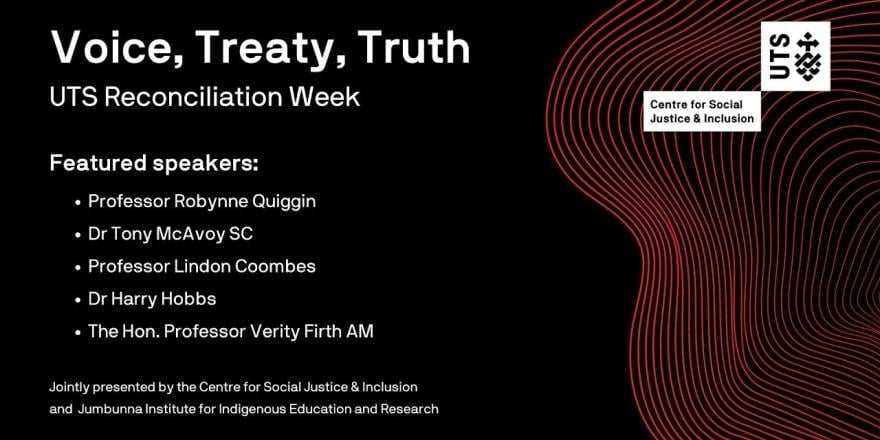
During National Reconciliation Week 2023, Dr Tony McAvoy SC, Professor Robynne Quiggin, Professor Lindon Coombes and Dr Harry Hobbs joined The Hon. Professor Verity Firth AM to discuss the Uluru Statement from the Heart principles, implications of constitutional reform, and how we can create a more just, equitable and reconciled country for all. 

If you are interested in hearing about future events, please contact events.socialjustice@uts.edu.au

Jointly hosted by the Centre for Social Justice & Inclusion and Jumbunna Institute for Indigenous Education and Research.  

Recognition and observance for Indigenous sovereignty means understanding weve got law systems of our own. We operate according to our ancient lore and there needs to be some accommodation of our sovereignty if the country is to live, act, and go forward in a respectful manner. Dr Tony McAvoy SC

We are culture people. We are governance people. When our place was invaded and we were faced with overwhelming force, we began doing what any people will do, which is try to negotiate a petition. We use those mechanisms to come to try and come to a place where this country this nation state and us can recognise each other as distinct peoples in this place. Professor Robynne Quiggin

No matter how smart, strategic, well-organised, and passionate we are, we're disempowered. And I'm sick of getting beat. Not because they're better than us but because they have more power than us. Professor Lindon Coombes

The Voice will only work if it has political and moral strength. The only way it can get that is if we as the Australian people tell the Government and tell the Parliament to treat it with the seriousness it deserves. Dr Harry Hobbs

Speakers

Dr Tony McAvoy SC is a Native title, treaties and truth-telling specialist and Wirdi man from the Central Queensland area. He is a barrister and Australia’s first Indigenous Senior Counsel. Tony is currently Co-Senior Counsel Assisting the Yoorrook Justice Commission in Victoria, and in 2016–17 was Co-Senior Counsel Assisting the Don Dale Royal Commission. Tony is part of the Referendum Working Group, was an Acting Part-Time Commissioner of the NSW Land and Environment Court (2011–2013) and was Acting Northern Territory Treaty Commissioner (2021–2022). 

Professor Robynne Quiggin is Pro Vice-Chancellor (Indigenous Leadership and Engagement) at UTS. Robynne is a Wiradyuri lawyer who has worked on legal and policy issues of relevance to Aboriginal and Torres Strait Islander peoples, including business, investment, financial services, consumer issues, human rights, governance, rights to culture, heritage, and the arts. 

Professor Lindon Coombes is Industry Professor and Director at Jumbunna Institute for Indigenous Education and Research at UTS. Lindon is a descendant of the Yuallaraay people of northwest NSW and has worked in Aboriginal Affairs in a range of positions, including Director at PwC Indigenous Consulting, CEO of the National Congress of Australia’s First Peoples, and CEO of Tranby Aboriginal College in Glebe. 

Dr Harry Hobbs is an experienced constitutional and human rights lawyer working at the forefront of academic research and legal and political debate about Indigenous-State treaty-making and constitutional recognition. Prior to joining UTS, Harry worked in the Parliamentary Joint Committee of Human Rights, the ACT Human Rights Commission, and as the Legal Research Officer at the High Court of Australia. 

The Hon. Professor Verity Firth AM is Pro Vice-Chancellor (Social Justice and Inclusion) at UTS. She served as Minister for Education and Training in New South Wales (2008–2011) and NSW Minister for Women (2007–2009). After leaving office, Verity was the Chief Executive of the Public Education Foundation. 

The Voice to Parliament

Learn more about the Voice, Treaty and Truth-telling, what it means for the country, and the history and activism behind the movement. 

View resources.

Share