

• Posted on 24 Apr 2023
  • 54-minute read

Wales was the first country to pass a Well-being of Future Generations Act in 2015. The Act demands long-term solutions to the country’s biggest challenges to improve the country’s social, economic, environmental, and cultural wellbeing.  

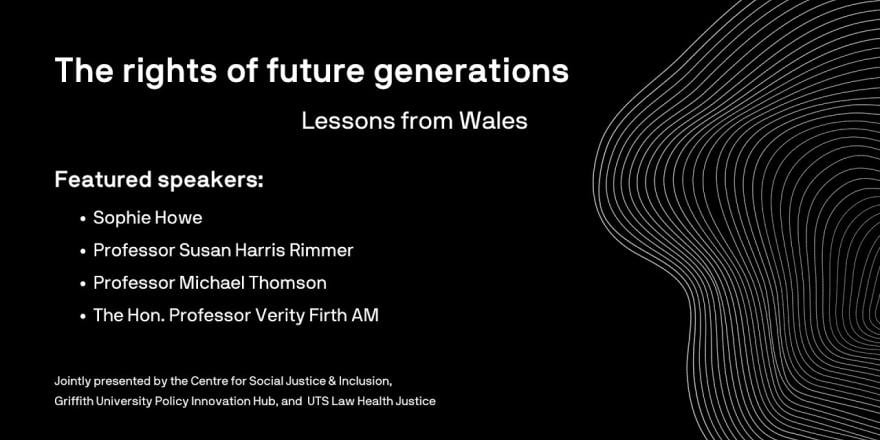
Sophie Howe, the first ever Welsh Future Generations Commissioner (2016–2023), joined Professor Susan Harris Rimmer, Professor Michael Thomson and The Hon. Professor Verity Firth AM to discuss how the Act offers a framework for high-profile interventions in Wales and how embedding a future generations approach could create a more equitable and sustainable Australia.
L2-w5jt43qo

Descriptive transcript

Thank you very much for joining us at today's event.

Before I begin, I'd of course like to acknowledge that where I'm meeting is on the land of the Gadigal people of the Eora Nation. This land was never ceded. It was, is, and always will be Aboriginal land. I want to pay respects to the Elders past, present and emerging and acknowledge them as traditional custodians of knowledge for the land on which this university is built. For those of you also out there in the cyberverse, feel free to also acknowledge the land upon which you are meeting us today.

My name is Verity Firth. I'm the Pro Vice-Chancellor of Social Justice and Inclusion here at UTS. It is my extreme pleasure today—I think this is going to be a fascinating conversation. I'm joined by the distinguished Sophie Howe, the former and first ever Future Generations Commissioner for Wales. I'm also delighted to have Professor Susan Harris Rimmer and Professor Michael Thomson here as well, and I'll introduce them all properly in just a moment.

So in terms of today's discussion, Wales was the first country to pass a Wellbeing of Future Generations Act in 2015. In seven short years, the Act has demanded long-term solutions to the country's biggest challenges to improve the country's social, economic, environmental and cultural wellbeing. We're really delighted and honoured to be joined today by Sophie Howe, who was described by The Guardian as the world's first Minister of the Unborn. During her time as Commissioner, Sophie led high-profile interventions in education reform, climate change, transport planning, and challenged the government and others to demonstrate how they are taking into account the needs of future generations. We're really looking forward to hearing from Sophie's insights and some of the other lessons she learned in driving these innovations. We're obviously keen to see that these innovations could perhaps be adopted in Australia.

But first, I'd like to introduce Professor Susan Harris Rimmer and Professor Michael Thomson, who are going to give us some context of the work that has been done and is being done to embed a future generations approach to policy in Australia. Professor Susan Harris Rimmer is the Director of the Griffith University Policy Innovation Hub, which helps policymakers solve policy problems through evidence-based collaboration with multidisciplinary experts. She is the founder of EveryGen, which is a coalition of multidisciplinary policy experts collaborating to create an equitable, just, and transformative path towards intergenerational justice. Over to you, Susan.

Hello. It's really lovely to see you all online. I live and work on Jagera and Turrbal lands in Queensland, but I'm from Coonabarabran and I pay my respects to the Elders of the Wiradjuri people, where I grew up and where I'm from. I am delighted to be with you.

I wanted to just quickly introduce you and my colleague Michael, tell you about his work, but just in terms of the EveryGen project. I'm a human rights lawyer by training and a transitional justice scholar, so I'm very interested in thinking about how Australia makes large transitions, one of which is around the Voice to Parliament, which we're all thinking about very hard, but also in the human rights community, we're facing such intense challenges around climate change adaptation that is rights promoting and rights compliant, which is simply not going to happen on the trajectory that we're on.

We're also very interested in issues around a right to a healthy environment and influencing the new parliamentary inquiry into the National Human Rights Framework, which so many of us have been working on for so many decades without quite getting to that spot of having Australia protect human rights at a Commonwealth level. But we have had some success in Victoria, the ACT and Queensland. So we're looking at multi-jurisdictional approaches.

Our research looked at all the different ways different jurisdictions had thought about future generations. A lot of countries around the world have some constitutional protections. Some of them think about future generations in terms of just natural resources or environmental resources. Some think about the rights of young people in a more considered way, especially as stakeholders. But when our research really did focus on the Welsh model, we thought that's a country that's got it going on because it also has machinery of government that we want.

What we want is to influence the culture of the Australian public service in the same way that we wanted human rights legislation to influence the practice of policymaking. So we also want a future generations approach to influence culture in departments and policymaking, and that's what the Welsh model offers, as well as quite a high level of transparency and social dialogue built into the model.

That's why we partnered with our lovely friends at the Centre for Policy Development here in Sydney. We brought out Sophie to inspire us all and to start a national conversation, whilst being respectful of the Voice dialogue that's going on at the moment. Our ultimate goal with our group—our EveryGen group has people from other universities, people from the tech industry, environmental experts, education experts for that future skills agenda, and a whole lot of young people on our group. We're working with the new Parliamentary Friendship Group for Future Generations that has just been created in Australia, chaired by Sophie Scamps from the Teals and Bridget Archer, and we're trying to influence parliamentary inquiry at the moment. So that's where we're at.

But the long-term vision is serious law reform, so that's why we're so thrilled to talk to the people in this group and we're also thrilled to start sharing more research agendas. We know there's lots of interesting work going on at a range of universities in Australia and we're really interested in cross-fertilisation, so a very collaborative space. That's all from me. I'll just pass on to Michael.

I'll just quickly introduce you, Michael, because I want to give your bio to the audience so they know how good you are. Professor Michael Thomson is a Professor of Law at UTS and the University of Leeds. At UTS, he is the Director of the faculty's research centre, Law, Health, Justice. He is also Convenor of the Women's and Children's Health Collaborative within Insight, the university's new health institute. His research spans health law, children's rights and legal and political theory. His current research with Beth Goldblatt explores how to legislate for future generations. Over to you, Michael.

Thank you very much, Verity, and thank you to the two of you as well. We are sitting in the law school on the campus. I suppose I should start with how we have started to engage with questions of future generations within the law, and it's a mixed picture.

We've recently joined the ranks of countries from around the world where we've seen climate change litigation engaged as an attempt to protect future generations. In the Sharma case in 2021, we had eight young people who brought an action arguing that in deciding whether to approve a coal mine extension in New South Wales, the Federal Minister for the Environment should be forced to bear in mind the health of future generations as she made her decision, and to take on board the catastrophic effects that carbon can have for future generations through climate change.

The judge who heard the case in the first instance agreed with these eight amazing young people, and while the world applauded the result, the Minister then, of course, appealed. The finding was overturned in March of 2022. Whilst this hasn't reached our highest court, it is agreed by many that the door is still open for climate change litigation in Australia.

So, whilst this avenue has been closed down for now, it's still a potential. While this is all going on, academic work, of course, is still taking place. That includes Susan's important EveryGen project.

In Law, Health, Justice here at UTS—and Verity has already mentioned this—my colleague Beth Goldblatt and I have come to these questions from our shared interest in health, the environment, and, importantly, inequalities. This doesn't reflect the Welsh experience as well, which we both want to see adopted in Australia, but in many other ways where future generations are discussed in the literature, there is, we would argue, a lack of appropriate attention to this question of inequalities. So, inequality is only really recognised on one plane: it's between now and the future—an idea that there is an inequality between the way we live now and the way people will live in a much depleted future.

What we want to argue is that we need to attend to inequalities now and social injustices now in order to reach a more just future—not just a liveable future, but one where inequality is much more reduced.

We're foregrounding the idea of inequality in three interconnected ways. First, we start with the need to address inequalities that are experienced now by our communities and populations. Secondly, we're also making a strong argument that we need to acknowledge the fact that planetary threats that we're all very aware of will compound and deepen existing inequalities. So those who are most disadvantaged now will be most disadvantaged in the future, probably, unfortunately, more so. We see this in climate change, as we saw with the IPCC report in 2022, that those most affected by climate change are those who are the poorest populations and the poorest nations.

Finally, we believe that we have to address the fact that many contemporary social inequalities are caused in part by historically rooted inequalities and harms. This includes the historic practices of colonialism in its different forms that have caused enduring and intergenerational harms. We argue that we must repair the past if we are to have this more just future.

Beth and I are addressing this through the lens of health inequalities and the pursuit of health justice. Thank you.

Wonderful. So I just want to further introduce Sophie and explain the purpose of why we were so interested in bringing Sophie out. We're basically inspired by the work that they've done.

Just for a bit of context, Wales created the Wellbeing and Future Generations Act seven years ago. Sophie was the first Commissioner and she's just finished her term, so she's able to give a very frank and fearless assessment of that period.

So I thought we might start, if that's alright, Sophie, with a bit of a discussion about what the motivations were, the genesis of the idea. I particularly love that it all started with the concept of sustainable development and the environment minister. It would be lovely if you could tell us a little bit more about that.

I also wanted to tell people—Sophie has an amazing CV—but one of the things I think is really interesting is that you were the youngest ever elected local councillor in Wales. So she's adopting this work as a Future Generations Commissioner as someone who strived for leadership at a very young age and experienced what it's like to lead as a very young person. I think that's very informative to your worldview. So we might start there. Take us back to the beginning, Sophie.

OK, thank you. And yes, Sue's right, I started my career—well, let's say I started my life in a part of Wales, part of our capital city, which is what we describe as a deprived area, often in the headlines for the wrong reasons. Huge amounts of inequality, worklessness, high rates of teenage pregnancy, all those sorts of things. First in my family to go to university. Passionate about changing the lot of the people that I grew up with so that where you're born shouldn't determine your future, but increasingly what we're talking about here is when you're born shouldn't negatively determine your future.

So I was elected at the age of 21, with that as my sort of passion and mission. I've worked in or around political environments for a number of years. I am not a politician now. I've been into rehabilitation and I'm now clean! (Laughter.) But I am still passionate about how do we drive change, and so the role of the first Future Generations Commissioner for me was an unprecedented opportunity to be able to do that.

So how did it come about? Well, I'll give a little brief history of the sort of devolution context of Wales. The Government of Wales and the Parliament of Wales was established in 1999 following a successful referendum to devolve power to Wales. The Government of Wales Act, which established the government and the parliament (or the Assembly as it was called then, the Senedd as it's called now), actually had a clause in it which said that sustainable development should be a central organising principle of the government.

So that's a kind of lofty ambition and a good thing to have in law. What did it mean in practice? Absolutely nothing. The best that we really saw from that was the environment minister would bring a report to the Senedd once a year telling the Senedd, or the Assembly then, stuff that was vaguely happening, vaguely connected to sustainable development.

It was very difficult to get the buy-in and the real focus from the economy minister, the housing minister, the transport minister. It was very much seen as the domain of the environment minister.

We had one particular environment minister back in around 2009, a longstanding minister. She'd been education minister, Senedd business minister and various other things, but a passionate environmentalist. She became the environment minister. Often, as these things happen, this was around about 2010 where in Westminster, Labour lost the election and a new Conservative-Lib Dem coalition were created.

It's also important to say Labour have always run the government in Wales back from 1999. They have always been left of centre. The first or the second First Minister talked about—even when Labour was in power in Westminster—a clear red water between the policies of Labour in Westminster and Labour in Wales. So much more progressive generally, and I think that has a big significance in terms of our ability to do some of these progressive things.

So political opportunism: the UK government, previously under Labour, had established a non-statutory Sustainable Development Commission, a kind of advisory body to the government, and the new Conservative and Lib Dem coalition abolished that non-statutory Sustainable Development Commission, which led Jane Davidson, the minister in question in Wales, to say—particularly because Wales always likes to have this clear red water between itself and Westminster—"Ah, not only will we not abolish our non-statutory Sustainable Development Commission; we will put it on a statutory footing. We will also be more specific in that legislation about what we mean by 'sustainable development' being a central organising principle for government, but also make it a central organising principle for the whole public sector in Wales."

She then got a commitment from the then First Minister to put that in as an election pledge for the next election. She then retired from government. So the new government were left with this thing—the baby, if you like, of Jane Davidson—not really knowing what it was that they had signed up to, just that one line: "We will legislate for sustainable development."

These things can go two ways, can't they? Either that means that no one picks it up, nothing really happens, or there's a kind of absence and a vacuum and bright and brilliant people come in and fill that vacuum. Fortuitously in Wales, that is what happened. A bright team of civil servants looking at what might be possible; a big push from civil society, seeing the potential of this one line as an election pledge, which translated into a program for government; and a push for that to trigger, because the government didn't know what exactly it should mean, a national dialogue with the citizens of Wales, which was called "The Wales We Want."

So we posed the question to the citizens of Wales: what is the Wales you want to leave behind to your children, your grandchildren and future generations to come? And those citizens of Wales came up with what eventually became our seven long-term wellbeing goals, looking at what they said, what was happening at an international level with the UN Sustainable Development Goals, and bringing that down and localising that into our seven wellbeing goals, which is the vision that our country has set out for Wales.

That is absolutely fascinating. So you had a process, I suppose, of community engagement, participatory processes, that developed these seven goals. So what are the seven goals of the Future Generations Act?

Their titles are probably nothing that you might not expect to see: a prosperous Wales; a resilient Wales (and that's about ecological resilience, enhancing, restoring, maintaining nature and ecosystems); a healthier Wales (which is about physical and mental health and wellbeing, maximising the conditions within which those mental and physical health and wellbeing can thrive); a Wales of cohesive communities—safe, attractive, well-connected, vibrant communities; a more equal Wales; a Wales of vibrant culture and thriving Welsh language; and a globally responsible Wales.

I just want to pick out then a couple of those to perhaps give a little bit more detail. First off, you might note, if you come from a knowledge base around sustainable development, we talk about sustainable development generally as a three-legged stool: it's about social, economic and environmental sustainability and wellbeing. We have a four-legged chair, if you like, in Wales because we have that addition of culture—our culture, our heritage, our language—and that, I think, is an important addition and has actually been quite transformative in and of itself.

The other thing that was quite interesting is we started off with six wellbeing goals, and through the passage of the Act in Parliament, the goal of a globally responsible Wales was added in. This is really recognising, of course, that, as Michael describes, the things that we do in Wales, as a small nation but predominantly in the global north, have these generally terrible knock-on consequences to poorer people in the global south.

The other really interesting thing is the goal of a prosperous Wales, and I think this is the statutory definition of a prosperous Wales: a productive, innovative and low-carbon society, one which uses resources efficiently and proportionately, including acting on climate change, and which develops a well-educated population with the skills to enable them to access decent work. So it's not a catchy definition but it is a really exciting definition of prosperity—one, because of what it doesn't reference (GDP); two, because it firmly puts prosperity in Wales within the context of planetary boundaries; it focuses on skills; and it focuses on giving our population access to decent work or fair work, not just any old work.

So those are the kind of goals. The duties on all of our main public institutions, starting with 44 public institutions—all of our local councils, our health boards who are responsible for running all of our national health care system and services in Wales, our national organisations like our environment agency, our public health agency, our national parks, and then significantly the Welsh government itself—they must set objectives which maximise their contribution to all seven of those wellbeing goals. That means every one of those organisations must work beyond their traditional boundaries, if you like. The number of bodies covered has now gone up from 44 to 50 public institutions in Wales, with this vision for Wales being the objectives that they all must seek to achieve.

That sounds incredible, but I imagine that there must have been—like, that's great, you've set the vision, these 44-plus institutions/organisations now need to be meeting that vision. How on earth do you keep them accountable in policy decision making?

Yes, so there's the challenge. On accountability, perhaps I'll just outline another important part of the Act which relates back to that accountability, because there's the vision for Wales through those seven wellbeing goals, and the law then sets out this sort of toolkit, if you like, of how then do we work, how do we need to work differently in government and public service delivery and so on, to deliver those goals. It sets out five ways of working. Our public institutions must demonstrate how they have considered the long-term impact of the things they are thinking of doing and the long-term in terms of how they set objectives to maximise their contribution to all of those seven wellbeing goals. They must seek to prevent problems from occurring or from getting worse. They must integrate their actions—these are duties to recognise, one, the positive potential connections between each of those wellbeing goals. We're not going to achieve our goal of a healthier Wales, for example, if the planet crashes and burns because we'll all die. We're not going to achieve the goal of a more prosperous Wales with access to decent work because there are no jobs on a dead planet. Equally, we're not going to achieve our goal of a more equal Wales if we don't address the issues around health inequality that exist in Wales. So that duty to think of things in an integrated way. Then duties to collaborate—so to work together—and there are specific new structures that are established by the law to require public institutions to do that, something called public services boards in each of our local authority areas or regions, and also to work together across the public sector but also with the voluntary sector and private sector, and then to involve citizens—and note that word is "involve", not engage, consult. "Involve" is a deeper sense of co-production.

And then it establishes an independent Future Generations Commissioner. My job, I describe it often as both coach and referee. So powers to advise and support the institutions on steps they should take to meet the wellbeing goals and then duties to monitor and assess. The overarching purpose of the Future Generations Commissioner is to be the guardian of the interests of the future generations of Wales and to encourage and monitor and assess the extent to which public bodies are taking account of the long term. But it also provides accountability mechanisms via the Auditor-General for Wales. The Commissioner's duties are primarily related to the goals. Auditor-General is about the ways of working and, throughout the approach that the audit office take to their audits of public bodies, their performance audits, they are looking at how those five ways of working have been applied and then there are particular mechanisms in the legislation, i.e., I provide advice to the auditor, for example, on how he conducts and how he meets his duties.

That is really interesting. I love the way you describe the role as "coach and referee", because that is exactly what you have described. So you're the first Commissioner. You've established the role. What were the unexpected challenges that emerged that you might not have thought about at the time or, in that frame, the unexpected opportunities that emerged that may not have been predicted?

I don't know if these were unexpected but I think they were unappreciated in terms of the scale of the challenge. So, first of all, this is a piece of law and, by definition, I suppose, laws require people to do particular things. Our public bodies have to set wellbeing objectives which maximise the contribution to all of the goals. They have to establish public service board infrastructure. They have to undertake wellbeing assessments. The Welsh government have to publish a Future Trends report, which all of the rest of the public sector can use and so on. I suppose those of you who are listening who might have had some experience of working in government or the public sector will probably appreciate—because I think this is a universal issue—the public sector love a bit of bureaucracy. They love a plan, a strategy. They think that once they've written their plan or strategy, that their work here is done, and so what we saw in those early years where they were in a very comfortable space of meeting the bureaucratic requirements of the Act—they were setting wellbeing objectives, they were going through the motions. They weren't actually doing anything differently; they were just using wellbeing words to describe what they were already doing and they thought, "Well, there we are. That's all done." Hence, the importance of the Commissioner to come in and challenge and say, "Not good enough." We also had some issues around people redefining the wellbeing goals, so you would see lots of decision reports talking about, "Well, we need to build this road because we're meeting the goal of a prosperous Wales." Wrong, because the goal of a prosperous Wales is prosperity within planetary boundaries and so building a road is not the answer to that, and there's a really good case study, which was the first major test of the Act in that regard.

Issues around the goal of a resilient Wales, just some of the terminology—so unpicking all sorts of things from resilience being about, from a social services perspective, people were saying, "We're meeting the goal of a resilient Wales because we're building resilience in mental health." Well, that's good but that's not the goal of a resilient Wales because this is about ecological resilience. I saw people saying, "We've set up an emergency services resilience forum so therefore we're meeting the goal of a resilient Wales." No, not correct. Lots of things like that.

The two biggest challenges I would say is this is a law but actually it's the biggest cultural change program that Wales has ever seen. It requires completely different mindsets. It requires us to unpick the way in which career civil servants, public service officials—before you even get to the politicians—are thinking about the way that they do their work. They have grown up in a system where they've been rewarded on the basis of how they've managed their individual department rather than taking a system-wide approach. They've been brought up in a system where managing your budget within a year cycle rather than looking to the long term is what you do. So unpicking all that was hugely challenging just to get that mindset shift. And even more challenging when everything that had come before the Future Generations Act really was in conflict with it. So, you know, we want you to plan for the long term but here's your annual budget; we want you to work across boundaries but we can't quite understand the governance and audit of this so we're just going to hold you individually accountable; we want you to involve citizens but we've stripped away all the resources during austerity that you actually have to do that work. So all of that was hugely challenging—unpicking that system of old, which was a barrier, as well as inspiring people within the system to have this kind of mindset shift.

Yes. I think that idea of that complete cultural change across the— I think that's absolutely spot on. How interesting. I'm going to go to some of the questions from the audience now because there's a lot of really good questions and I want to have time to actually ask them. The one that has the most votes—here I am, I'm on the side of democracy here—is from Michelle at ACOSS, who says, "Australia has the second lowest rate of income support in the OECD; how do you see this impacting future generations?"

Well, I would say if you were taking a wellbeing lens to that, as we are required to do in Wales, it would be hard to justify that in the context of taking a long-term approach to improving people's physical and mental health. We know that the biggest determinant of life expectancy is about income security. Thirty-five percent of what makes a difference between whether you live or die young, according to the World Health Organisation, is about income security. It would be very difficult to show how we were meeting the goal of a more equal Wales or a more equal Australia on the basis of that continuing to be the case. If you applied both a long-term and preventative lens to that, as we are required to do in Wales, what you will find is that if you invest earlier on in improving that situation, that is likely to pay for itself through reductions in health care admissions, improved educational attainment, improved economic output and so on and so on. So actually taking that long-term view, it's a no-brainer that you would invest in tackling poverty.

One of the responses now in Wales—our devolved settlement means that we don't have responsibility for welfare reform or welfare policy. We have responsibility, however, for a number of related fields: health, social care, equality, education, housing and so on. But one of the things that we are doing in Wales, which was as a result of the Future Generations Act and was seen as kind of completely impossible just four or five years ago, is we're having the first government-supported trial of a universal basic income.

The reason that we're doing that is because exactly of what I just described—because investing in taking people out of poverty pays long-term dividends.

That's really interesting. So you're doing that on top of what—welfare payments still coming from Westminster?

So initially the pilot—the U bit of a universal basic income—is not where I want it to be, because the basic income pilot is targeted towards young people leaving the state care system, a hugely important population and deserving population, and probably a group which are likely to see some significant impact. So they are currently receiving £1,600 a month of unconditional income over a two-year period, and we've got a big evaluation wrapped around that to see what the outcomes of that are, whether we can, you know, whether the case is made for extending that further.

That's really interesting. The next question is from Lexie Randall Lestrange and hers is about housing. "Access to affordable, secure, appropriate housing in Australia is undermining many people's capacity for a life of basic wellbeing. What can we learn from Wales in terms of housing frameworks to support health and social justice?"

So, the way in which the Act works is that it should both be the underpinning and overarching framework for government and our other public institutions to both decide what they're going to do—how they're going to prioritise investment policy initiatives and so on—and they should choose to do the things which make the biggest contribution across all of the wellbeing goals. So there is a very good case to make that housing is one of these areas. In fact, when I first started as Commissioner, I did a big involvement exercise saying, "What are the things, the policy areas, that if we got them right, would make the biggest contribution across each of those seven wellbeing goals?" and housing was one of those areas, because connections to how we build it in terms of carbon, the cohesive communities, the health of the nation, the equality aspects and so on and so on. The government have had a big focus on housing but we still have the same challenges. We have social housing infrastructure in Wales and we've seen big additional resources going into that social housing infrastructure. However, here's an interesting sort of example of how the Act starts being implied in its entirety: the government decided the "what"—housing, as people need housing, build more houses—was a good thing to do. They're absolutely right. Commitment in the manifesto, in the election documentation and program for government, for the government to build 20,000 new affordable homes in Wales—a population of three million people, 20,000 new affordable homes. Good. However, the Act doesn't just apply to what you do; it applies to how you go about doing it. So we could build 20,000 affordable homes, that

If you are interested in hearing about future events, please contact events.socialjustice@uts.edu.au

Jointly hosted by the Centre of Social Justice & Inclusion, Griffith University Policy Innovation Hub and UTS Law Health Justice.  

The statutory definition of a prosperous Wales is a productive, innovative, and low carbon society, one which uses resources efficiently and proportionately. This definition is an exciting one because it firmly puts prosperity in Wales within the context of planetary boundaries, and it focuses on skills and giving our population access to decent or fair work. Sophie Howe

We dont know what the future generations want but we want them to have choice and options. The goal is to make sure than an element of choice is preserved and try to create as many pathways so that future generations have as much agency as possible. Professor Susan Harris Rimmer

We must attend to the fact that past, current, and future inequalities are not divisible and that a fair future is only possible if we repair the past and address the present. Professor Michael Thomson

Speakers

Sophie Howe was appointed as the first Future Generations Commissioner for Wales in 2016. Her role was to act as a guardian for the interests of future generations in Wales, and to support the public bodies listed in the Well-being of Future Generations (Wales) Act 2015 to work towards achieving the wellbeing goals. Prior to this, Sophie was the first Deputy Police and Crime Commissioner for South Wales and the only woman to lead in this role in the country.  

Professor Susan Harris Rimmer is the Director of the Griffith University Policy Innovation Hub, which helps policymakers solve policy problems through evidence-based collaboration with multidisciplinary experts. She is the founder of EveryGen, a coalition of multidisciplinary policy experts collaborating to create an equitable, just, and transformative path towards intergenerational justice. 

Professor Michael Thomson is Professor of Law at UTS and the University of Leeds. At UTS he is the Director of the Faculty’s research centre: Law Health Justice. He is also Convenor of the Women & Children’s Health Collaborative within INSIGHT, the university’s new health institute. His research spans health law, children’s rights, and legal and political theory. His current research with Professor Beth Goldblatt explores how to legislate for future generations. 

Share