

- Posted on 22 Jun 2021
- 45-minute read
What lessons can we learn from those ‘radicals’ that bravely fought for change?
The sixties are remembered as an era of protest, free love and civil disobedience. Modern Australian society, and many of the rights we now take for granted, took shape during this time.
People found their voices and their power – then used them.
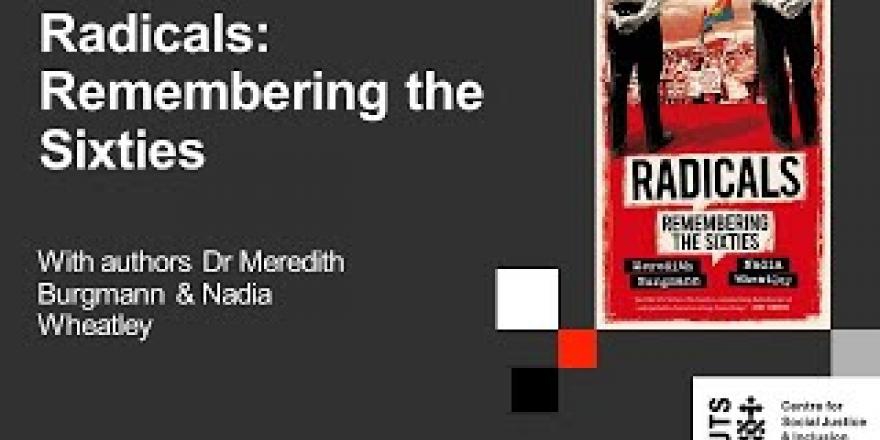
In this session, Dr Meredith Burgmann and Nadia Wheatley joined Verity Firth in discussion on the significance of the sixties, and the lessons we can learn from those ‘radicals’ that bravely fought for change.
If you are interested in hearing about future events, please contact events.socialjustice@uts.edu.au.
Meredith and Nadia's book, Radicals: Remembering the Sixties, is available now.
There were things about the sixties that were terrible. We had a shocking government that was doing the most dreadful, paternalistic and colonial things. But the fact that it was so terrible is why the 'radicals' happened. Whether we're rose coloured about the movement it certainly changed a lot of things. Dr Meredith Burgmann
Speakers
Dr Meredith Burgmann was an industrial relations academic at Macquarie University for twenty years and later a Labor parliamentarian and President of the NSW Legislative Council. She was the first woman President of UASA (later NTEU). On retirement she was elected President of the Australian Council for International Development. She has written or co-written books on misogyny, the Green Bans and ASIO.
Nadia Wheatley is a full-time writer whose work ranges from the classic picture book My Place (illustrated by Donna Rawlins) to the biography The Life and Myth of Charmian Clift (Age Book of the Year, Non-fiction, 2001; NSW Premier’s History Award, 2002). Nadia’s memoir Her Mother’s Daughter won the Nib Award in 2019.