

- Posted on 28 May 2021
- 44-minute read
Reconciliation Week 2021: More than a word: Reconciliation takes action
The National Apology to the Stolen Generations finally happened on 13 February 2008, following a surging grassroots movement and the Bringing Them Home report. It signified ‘a new page’ for Australia’s future, and committed to not repeating the injustices and approaches of the past.
Yet Aboriginal and Torres Strait Islander children are being removed from their families, community, and culture at increasing rates – higher today than at any other time in Australian history. They are over 11 times more likely to be removed than non-Indigenous children, representing 41% of the population in out-of-home care, despite making up only 6% of the total population of children in Australia.
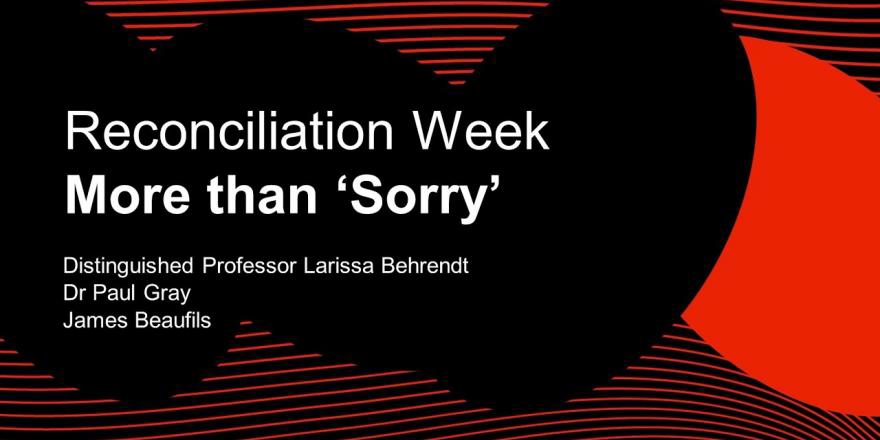
In this session Distinguished Professor Larissa Behrendt, Dr Paul Gray and James Beaufils discuss what action needs to be taken to end the removal of Indigenous children from their families, communities and culture.
The topics in this discussion may cause sadness or distress – if you need support, please contact one of the free 24/7 services available.
Jointly presented by the UTS Jumbunna Institute for Indigenous Education and Research, the Centre for Social Justice & Inclusion, and the Faculty of Law.
If you are interested in hearing about future events, please contact events.socialjustice@uts.edu.au.
These are systems that, as a society, we built and that we maintain. They're maintained by our governments in our name, so we've got to take responsibility for them if we want them to be different, if we want the outcomes to be different, then we have to tell our representatives to change them and we have to make sure that they do. Dr Paul Gray
These are systems that, as a society, we built and that we maintain. They're maintained by our governments in our name, so we've got to take responsibility for them if we want them to be different, if we want the outcomes to be different, then we have to tell our representatives to change them and we have to make sure that they do. Dr Paul Gray
I think best interest is something Paul has mentioned before in terms of outcomes, but what is best interest? Whose best interest is at heart? I think that ambiguity around best interest, around kin and kinship, needs further work and further understanding made and information developed around those terms. James Beaufils
Throughout the conversation, Paul and James offered their advice for taking action in this area:
- Visit the Family Matters website and support their campaign for change and call for a national commissioner.
- Follow Aboriginal organisations and peak bodies in your area. Stand beside them and demand that as a society, we do better.
- Listen to Indigenous communities and families who lead the way in this space. Understand their experiences and the challenges facing the child protection system.
Speakers
Distinguished Professor Larissa Behrendt is Associate Dean (Indigenous Research) at UTS and the Director of Research at the Jumbunna Institute. She is a lawyer, and an award-winning writer and filmmaker. Larissa is Chair of the Cathy Freeman Foundation, a Trustee of the Australian Museum, a board member of the Sydney Community Fund and member of the Metropolitan Local Aboriginal Land Council, and the host of Speaking Out on ABC Radio National.
Dr Paul Gray is a Wiradjuri man from NSW and leads the Indigenous child protection hub at the UTS Jumbunna Institute for Indigenous Education and Research. Paul has previously worked with the NSW Department of Communities and Justice, and as the Executive Leader of Strategy, Policy and Evidence at AbSec, the Aboriginal child protection peak organisation in NSW.
James Beaufils is a research fellow and PhD candidate at the UTS Jumbunna Institute for Indigenous Education and Research and the Faculty of Law. He is a Gundungurra man from the Pejar area and Kanak from New Caledonia and is now working closely with Aboriginal children’s organisations on his doctoral thesis exploring the experiences of Aboriginal people in out-of-home care.