• Posted on 8 Nov 2023
  • 46-minute read

Today, 49.6 million people live in modern slavery. Only 1 in 5 victims in Australia are identified, meaning 80% do not get the support they need.

Australia’s initial response to modern slavery strongly focused on criminal justice outcomes and was not informed by the voices and experiences of survivors.

Governments and policymakers have often missed the opportunity to learn from survivors, and have not recognised them as experts in their own experiences. But there is growing recognition that anti-slavery efforts must be more systematically survivor-informed.

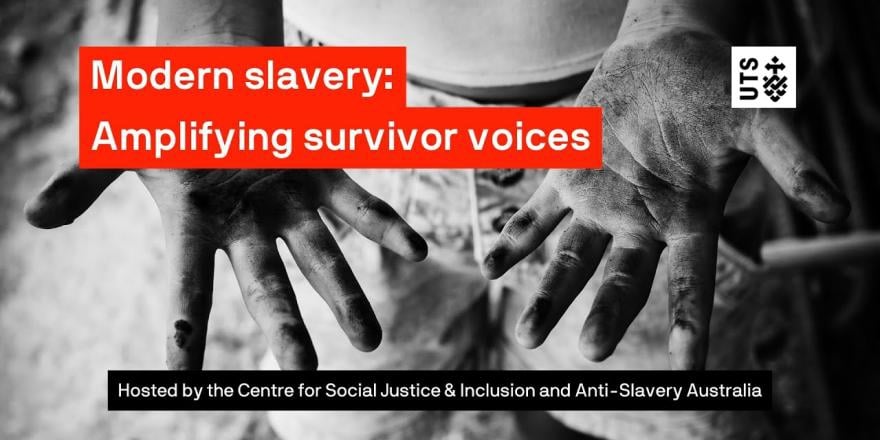
Helena Hassani, Habiba, Professor Jennifer Burn AM, and Dr Jacqueline Nelson joined Verity Firth to discuss how a survivor-led approach can help combat modern slavery through meaningful, ethical and trauma-informed engagement.

Content warning: Topics discussed in this webinar may evoke strong feelings, thoughts, and memories. If you experience any of these, please take a break and reach out to a trusted friend, family, or professional. You can also call 1800 RESPECT or any of the services listed in the resources below.
gyNke8jdk1w

Descriptive transcript

Thank you, everyone, for joining us here today at today's event.

Firstly, I'd like to acknowledge that, for those of us in Australia, we are all on traditional lands of First Nations people. This land was never ceded. I want to particularly acknowledge the Gadigal people of the Eora Nation, which is the country that owns the land upon which this university is built, and I want to particularly pay respect to Elders past and present for their custodianship of knowledge of the land upon which this university is built. I also want to acknowledge the traditional custodians of the country where all of you are joining us from.

My name's Verity Firth. I'm the Pro-Vice-Chancellor of Social Justice and Inclusion at UTS. It's my real pleasure to be hosting today's event on Modern Slavery: Amplifying Survivor Voices. We're joined by a great team of speakers: Helena Hassani, Habiba, Professor Jennifer Burn and Dr Jacqueline Nelson, and I'll introduce each of them properly in just a moment.

I'd like to advise that topics discussed in this webinar may evoke strong feelings, thoughts and memories. If you experience any of these, please take a break and reach out to a trusted friend, family or professional. We will post a list of free and confidential counselling services in the chat now.

So on to today's discussion. 49.6 million people worldwide live in modern slavery. Slavery is often hidden in homes, restaurants, farms and building sites. What is common to all of these is that someone is being exploited and controlled.

In Australia, over 1,900 people are victims of modern slavery, but only one in five victims are identified, meaning 80% do not get the support that they need. The modern slavery offences referred to the Australian Federal Police in 2021–2022 included forced marriage, sexual exploitation, forced labour, human trafficking and trafficking in children.

Australia's initial response to modern slavery strongly focused on criminal justice outcomes and was not informed by the voices and experiences of survivors. Governments and policymakers have often missed the opportunity to learn from survivors and have not recognised them as expert in their own experiences. But there is now growing recognition that anti-slavery efforts must be more systematically survivor-informed. In today's discussion, you'll hear how a survivor-led approach can help combat modern slavery through meaningful, ethical and trauma-informed engagement.

It's now my honour to properly welcome and introduce each of our panellists.

Helena Hassani is a human rights advocate and campaigner for the prevention of child and forced marriage and family violence. This year, she was a delegate to the United Nations for the annual tripartite consultations on resettlement in Geneva and continues to work and advocate for the rights of girls and women. Helena is also a poet and writes poems on forced marriage and issues related to violence against women and girls. Welcome, Helena.

Habiba works in the child protection industry and has lived experience of forced marriage. She is of Pakistani heritage and was raised in Australia. Habiba has extensive experience in the community services sector. She is passionate about raising awareness about the options available for those experiencing forced marriage. Welcome, Habiba.

Professor Jennifer Burn is the Director of Anti-Slavery Australia at UTS. She has over 20 years of research and practice experience in human trafficking, slavery and forced marriage. She served as the interim Anti-Slavery Commissioner for New South Wales from 2018 to 2020. At Anti-Slavery Australia, Jennifer's current policy drive is to establish a national compensation scheme for victims and survivors of modern slavery. Welcome, Jennifer.

And last but not least, Dr Jacqueline Nelson is a research fellow on the Speak Now project at Anti-Slavery Australia. Speak Now explores a range of issues relating to forced marriage prevention, such as the role of frontline workers, young people managing pressure to marry and navigating family relationships. Jacqueline is a sociologist whose previous research has examined difficult conversations within families, responses to racism and public policy responses to social issues. Welcome, Jacqueline.

So now to my panel, I'm going to start with a question to all of you. I might come first to you, Habiba, if that's all right, but the question to all of you is: modern slavery can feel invisible in Australia in 2023 and some people may be totally unaware of it. Can each of you share some insight into the state of modern slavery in Australia? And Habiba, over to you.

HABIBA: Thanks, Verity. Hi, everyone. I think that with modern slavery in Australia, it's often seen as an un-Australian issue and there's a large lack of awareness around what that looks like around the world, but then again here in Australia. Usually if you're affected, that's when you're aware of it and know or realise or recognise it as an Australian issue.

I feel like there's a big taboo around discussing modern slavery. Usually they're quite difficult conversations to have within the household, but also to address, and then within the community services sector or sectors that are trying to manage the difficulties and the complexities around it, often there's a lack of information or a lack of awareness around how to tackle those issues.

As you said earlier, 80% of people aren't getting the support they need, so people aren't feeling comfortable, confident or don't know where to go to speak about modern slavery or if they're affected by it. So we can't expect to know how to deal with the issue if it's not being spoken about.

VERITY FIRTH: Helena, what do you think about the state of modern slavery in Australia?

HELENA HASSANI: I think I would echo with what Habiba has said and also I do think that modern slavery seems to be very invisible in Australia and there are so many myths about modern slavery and forced marriage that it doesn't happen in Australia, but it actually happens behind closed doors. What is important is raising awareness around this issue and talking about this is really critical in this area. But also, if we ask the right questions and use the correct tools, then we know the extent of the practice of modern slavery taking place in Australia, including forced marriage.

VERITY FIRTH: Jennifer?

PROF. JENNIFER BURN: Thanks, Verity. Well, modern slavery is a new way of describing serious criminal exploitation of people. It includes the crimes and human rights abuses of slavery, trafficking, forced labour, and in 2013, forced marriage was included as a criminal offence in Australia. We know in Australia that people are exploited in multiple settings, including in private homes, in domestic servitude, in forced marriage. They're exploited in agriculture, in factories and hospitality. But thinking about forced marriage, this is a form of modern slavery, but it is also a human rights abuse and a form of gender-based violence. As you've said, modern slavery is often invisible and this means that people affected are often not recognised as people with rights and they don't get the help that they need. From a policy perspective, at a national and a state level, there is a need for increased awareness raising in the community and a complementary need for better support and protection frameworks. Thanks, Verity.

VERITY FIRTH: Thanks, Jennifer. And Jacqueline?

DR JACQUELINE NELSON: So my expertise, I guess, is in forced marriage as a specific form of modern slavery and like everyone has mentioned, it's really hard to know just how common forced marriage is. We do know that of the modern slavery cases that get reported to the Australian Federal Police, forced marriage is the most common form and about half of the reports that go to the AFP relate to forced marriage. There's also lots of misconceptions about modern slavery—what it is, who experiences modern slavery—and I think we've got to be really careful around these types of misconceptions. I think there's a risk that we can perpetuate racist stereotypes and also if we have a picture in our heads about who experiences modern slavery, that can make it harder to identify it when it happens in a way that maybe we weren't expecting or to someone that we didn't think would experience what we call modern slavery.

One thing, in terms of the stereotypes that we might kind of dispel around forced marriage, we know that it's experienced by Australian citizens, residents and also those on temporary visas. It's mostly women and girls who experience forced marriage, but it can affect people of any age, gender or sexuality. We always emphasise that forced marriage is not inherent to any one particular culture, religion or region of the world, so the people that we support who are in or at risk of forced marriage come from a really diverse range of cultural groups and religious backgrounds as well. Forced marriage is not condoned by any of the world's major religions, and we also always say that there are lots of different types of marriage practices and ways that people make decisions about marriage, whether they're more individual or more collective. What's critical across these different practices is whether or not consent is present.

VERITY FIRTH: That's really interesting that half of the complaints to the Federal Police are forced marriage.

Helena and Habiba, you recently released an eight-episode podcast and its name, so that people can look it up, is Speak Now: About Forced Marriage in Australia. It's part of the Speak Now project that Jacqueline is helping to lead at Anti-Slavery Australia. Can you both tell us your motivations about producing the podcast, what you found in the process of producing the podcast and what you hope to achieve with the process? Habiba, do you want to go first?

HABIBA: Sure, thanks, Verity. I guess before I go into that, it's important to highlight that I've had lived experience of forced marriage and that was a driving motivator for why I stepped into this space in the first place. That lived experience included me going back to my home country and being forced to meet with someone that I didn't want to marry. It wasn't something that I wanted to engage in but felt a lot of pressure to do so and didn't feel like I had much of a choice. When I experienced that, I began to notice that there were a lot of people around me that were having a similar experience and so there was that shared experience within my community. I felt like it was almost my responsibility to speak more about it and to help create a platform where people can start to understand what this looks like. Kind of like what Jacqueline said, sometimes we have an idea of who we think would be impacted by it, but I saw women in my community who I thought were strong, independent and fierce who also were experiencing forced marriage. So I had a preconceived idea of what that looked like until people started sharing their stories with me. So I guess what I would like to achieve is not only creating that platform where we're starting to share knowledge and lived experience and the truth about what that looks like here in Australia, but also hope that other people will begin to start that conversation within their community and feel empowered to speak out about the issue that we're facing and start to help others and support others to find their way out of these negative experiences.

VERITY FIRTH: It's really interesting what you say about creating that safe space for people's stories to come forward and that you didn't quite realise how much it was going on until you created that space.

HABIBA: Absolutely.

VERITY FIRTH: Helena, how did you feel about the podcasting project and what do you hope to achieve?

HELENA HASSANI: Thanks, Verity, and thanks, Habiba. I think that personal experience is really strong in terms of what I will be talking about. So my motivations are to actually raise awareness in Australia that forced marriage is happening here and to challenge the myths and misconceptions that Dr Jacqueline just mentioned before—that a lot of professionals and Australian people think it is not happening here, it's not an Australian issue, but in fact it happens. I hope that through these podcasts, we raise awareness that it happens to Australian people, Australian citizens and people of diverse communities and residence status. We also want everyone to listen, to know more about the issue, learn more about this issue, and to those who are suffering in silence, we want them to listen and to seek support for themselves. Now, what we hope to achieve is these podcasts are very rich podcasts with people with lived experience. We have got expertise in the field, professional perspectives, which will actually assist professionals, community members, survivors and any other people who are interested in learning more about this issue. I would really highly encourage everyone interested in learning more to go to the My Blue Sky website and look at the information available there and check out the podcasts. We will post the link to My Blue Sky website and the podcasts in our chat. So it's really rich for everyone.

VERITY FIRTH: And on that point, and I'll come back to you now, Helena, what are the mechanisms and support systems that are available to help people escape forced marriage? That was my first bit of the question. So what are the actual mechanisms that do exist and, importantly, what's needed to prevent forced marriage from happening in the first place?

HELENA HASSANI: Thank you, Verity. So support services—as you would know, My Blue Sky is a great resource and support service available for both professionals and people who are experiencing, and it's available in many, many different languages, in case people have language as a barrier. You can read information, you can seek support in your own language. So that is really a national support service. Then we have got Australian Red Cross, the NTTP support, and that requires a referral from the AFP, which is available in all states, and they provide different sorts of supports, case management and referral to other services. But also there is a really critical need to provide safe space for people for disclosures. We need to provide both mental and physical safe spaces for people to provide the disclosures and understand the complexities associated with their experience. Once we develop a really good understanding of the situation with a trauma-informed lens, we can guide the client or the victim-survivors with the most appropriate support for the client at the time of disclosure and we can empower them to choose what is the best support for them. We need to bring a lot of changes to the way that we are approaching, the way that we are addressing forced marriage and it doesn't happen overnight, but we can actually work together with community members, with support services, to address this issue and implement the right mechanism or support services which is very friendly and trauma-informed for everyone who needs to come forward and get that support.

VERITY FIRTH: And Habiba, what support services do you think are particularly good, though recognising what Helena is saying about it's almost like support services are built for individuals, their individual circumstances. But I'd be interested in your opinion around that as well as what can we do to prevent forced marriage taking place in the first place?

HABIBA: Sure. So I think support services—what makes them good is a good question. I think it's when, as Helena said, they are individual, they don't just slap a bandaid on fixing the problem and apply the same thing to every individual person. It's important to hear from the individual that's experiencing it, but also their family. A loss of family is a big contributor to forced marriage and the issue as a whole and it can create a lot of disjointedness for the person that's experiencing it. So it's really important to ensure everyone is on board, or whoever can be, and you put the voice of the person experiencing forced marriage at the forefront to ensure that we're providing that holistic support, understanding where they're coming from, what kind of gaps there are within their life and the issues that they're experiencing and where we can support as a whole. We know that there are an array of support systems and listening carefully and understanding the individual is most important. When I was experiencing forced marriage, I did utilise some of the support systems, but some of them don't work and we know that. I think that's really important to understand why we started the research in the first place as a part of the Speak Now project, and having seen where some of that research has gone is really helping us to understand where to next and it's going to help prevent more of those issues taking place in the first place. So yes, ensuring that we put that research in place, we're hearing from those experiencing these issues and their families as well.

VERITY FIRTH: And Helena, on prevention, what are your views?

HELENA HASSANI: I think on prevention, prevention is really hard and complicated. So prevention refers to the very early stages of forced marriage before anything has happened or taken place with the families. I think at times of prevention, at times it is almost impossible. It's not possible. But we want to be confident that we have tried our best to prevent it, but you can't prevent everything, unfortunately, from happening. But people are experts in their own situation, so they understand the dynamics and the risks associated with prevention or avoiding the forced marriage. Our role is to empower the client and then let them make that decision for themselves. You may think that empowering young people is enough to prevent forced marriage, but prevention requires work with families as well, like Habiba mentioned, and families play a critical role in prevention. So we need to work in a holistic way with families, young people, services together if we want to prevent it from happening and when working with families, we are always needing to continually assess the safety and the risks associated with it.

VERITY FIRTH: So Jennifer, last year you co-authored a report. The report's name is Beyond Storytelling: Towards Survivor-Informed Responses to Modern Slavery and this report charts the push, which is being led by survivors, to engage with survivors in meaningful, ethical and trauma-informed ways to improve responses to modern slavery. Can you give us some of your key insights and findings from this report?

PROF. JENNIFER BURN: Yes, thanks, Verity. First, I just might say that the research that Frances Simmons and I did in the Beyond Storytelling report was happening at the same time we were developing the Speak Now project and really you can see that the engagement of the whole team—and you've heard from us today in the webinar—has really informed and strengthened the research and in some ways it's a perfect example of how critical it is to engage people across the board, those with lived experience, experts and others. But just going back to the report Beyond Storytelling, we found in our research that too often survivors have been considered powerless victims, but now there is an increasing recognition that survivors have much to contribute and they are rights holders and they are entitled to participate in decisions and opportunities that affect them. To develop the research, we interviewed survivors in Australia and overseas and one of the people we interviewed was Dr Minh Dang from Survivor Alliance, and she said that "survivors understand the benefit of sharing some aspects of the story to raise awareness, however, our experience in slavery is not the only nor the primary topic that we want to discuss", and she went on to say that survivors want to engage in policy development, program design, to lead organisations. This push in Australia has been documented in multiple ways, including in the National Action Plan to Combat Modern Slavery, where there is a strategic priority to develop a victim and survivor empowerment and engagement strategy. We know through our research that it can be very difficult to engage with survivors in a way that is meaningful and ethical, but fundamentally survivors should have a meaningful opportunity that is not tokenistic, an opportunity to participate, to engage and to lead. Importantly, survivors shouldn't be taken for granted. They should be recognised for their expertise and they should be paid for their time and expertise. So we have seen at Speak Now at Anti-Slavery Australia at UTS that there are really good research outcomes and policy outcomes that happen when survivors are included in our day-to-day work and activities and, reflecting this, our team here includes people with lived experience. So just summing up, survivors should be centred in any activity that affects them. Engagement with survivors should be open and fair and transparent. Survivors should have the information that they need to understand the full context of the proposed activity and consent in an informed way. But we've found at Anti-Slavery Australia that some survivors choose not to engage publicly, preferring rather to contribute in other less public ways, and we can tap into the resource in multiple ways. And just finally, Verity, thinking about our role in the university, we can foster diversity and encourage participation and facilitate access to education and we can positively support survivors in the work that we do at the university. Thank you.

VERITY FIRTH: I think that's a particularly pertinent point about paying too. You know, this is real expertise. You wouldn't ask an expert to provide you with a report without thinking of remunerating them. Why would you expect that of survivors as well?

Jacqueline, so you're with Anti-Slavery's national project Speak Now. It's a pretty wide-ranging project seeking to prevent forced marriage and other forms of modern slavery through education, awareness raising, collaboration, and so forth. Tell us about it and what is the approach and what are some of the outcomes from the project?

DR JACQUELINE NELSON: Thanks, Verity. So Speak Now kind of emerged out of observations made by our Anti-Slavery Australia's legal practice that alongside the legal response that we provide, we also need a kind of stronger social response, so more preventative activities as well, because what people want in terms of outcomes is really, really diverse and wide-ranging, so the supports available need to reflect that. For some people, that means a legal pathway, for other people it means something different. So the diverse needs and wishes of survivors is something that we're interested in working at ensuring that we're supporting. In terms of our approach to working with survivors in the project, we came up with a set of key principles that guide us in the Speak Now project and two of these are particularly relevant. One is centring people with lived experience, and hopefully you can see in the podcast that there's been an opportunity to do that there. I just reiterate what Jen said about meaningful, trauma-informed opportunities for leadership and involvement. We've tried to do that at each stage of the process. This goes well with our commitment to participatory and collaborative design processes, so those two things have gone hand in hand. One of the ways we're trying to keep ourselves accountable to those principles is we've built them into our monitoring and evaluation framework. We're lucky to have someone on the project who's really excellent in this area and so it means we're always monitoring and reflecting on our progress. I think the recognition of the importance of survivor leadership, survivor engagement is new and so we're learning as we go. We're reflecting on what's happening and we're trying to share our learnings with the sector because it is a sector-wide move to acknowledge the importance of survivor leadership in this area.

In terms of outcomes, as you said, it's a very big, ambitious project, but a couple of the things that we've focused on have been awareness raising. We've talked about people not being aware that modern slavery is something that happens in Australia. I always make reference to some really excellent research that our colleagues Frances Simmons and Grace Wong did and they showed that people who've experienced forced marriage really strongly remember what happens when they first disclose to a frontline worker—what the response was, how they reacted. So we know that that first response that people get can be really critical in terms of determining what happens afterwards. So that sort of research and our own work with people with lived experience has directed us towards awareness raising with frontline workers. We've been working across health professionals, people in youth and child services, settlement workers, people in schools. We've tried to engage with a really wide range of frontline workers and educate them about identifying and responding in a culturally appropriate and trauma-informed way if they do come across this issue. One thing that we've developed is, based on our collaboration with frontline workers, we've developed a frontline worker guide which is available on our website and we just finished a big awareness raising effort. We did 39 training sessions around Australia to raise awareness amongst 1,300 frontline workers and community members about this issue. So that's one of the big outcomes of the project.

Just one more, because I don't want to take up too much time. We've done some peer research. Another observation that people have made is that there's a real lack of research that's co-designed or co-produced with survivors of modern slavery and we did some research that went some way towards addressing that gap. Over the last few years, I've been working with a group of young people connected to affected communities and they've worked as research assistants or peer researchers and we've co-designed and conducted research that's aimed at preventing forced marriage. We've looked at the pressures that young people experience around marriage and relationships and they went off and designed focus group questions, ran focus groups and then we've co-analysed the data and we're writing that up together. We're starting to explore these different methods that we can use to work with young people to raise awareness of forced marriage and generate conversation about how to navigate pressures and seek support. I think using that kind of youth-led research method really did lead us to different insights. If I had gone out by myself and tried to do this project, we really did allow for perspectives from those people who are affected by forced marriage to come through. So that's been really, really useful.

VERITY FIRTH: I think your training too—training 1,300 frontline workers, that's pretty significant, especially if, as you say, it's that first response that people really remember and that potentially might mean that they seek further assistance. So I think that's pretty impactful work.

So we're going to go to the questions that I've got now coming up in the Q&A box. As I said before, I basically tend to go on which questions have the most upvotes. But I will quickly ask a question from Sharon Chung about whether or not My Blue Sky can assist with people who are overseas for various reasons, but usually live in Australia and they're experiencing issues related to forced marriage. Are there resources or assistance or support that My Blue Sky can give in those circumstances? Who would like to answer on that?

PROF. JENNIFER BURN: Well, I might start off with that one, but Helena and Habiba might also like to contribute. The website mybluesky.org.au is really an access point for support and one of the unique things about that website is that it includes a chat box that's actually staffed by real people—they're not bots, they're legally trained people at Anti-Slavery Australia—so any person can contact us using the chat box, but there are other ways that we can be contacted as well. So yes, we can help a person, an Australian who is overseas, and we do do that work. A lot of that work is around safe repatriation back to Australia and we do that by working with government agencies, such as DFAT, sometimes the Passports Office, sometimes the AFP, but with community agencies as well to try to secure support for safe return home.

HABIBA: Yes, so My Blue Sky was one of the services I used when I was experiencing forced marriage and there are so many misconceptions and one of them was if someone took my passport or ripped it up, I wouldn't be able to come back and that was information that I could find on the website. So it's really great for helping to provide that sense of security. I did tap into that SMS function as well and that was really helpful being able to speak to someone that wasn't a bot and they checked in as well when I hadn't responded to see whether I wanted to go through with any of the options that they had provided. So that was really great.

VERITY FIRTH: That's excellent. The next question from the audience is from Lucia Smith and she says: what are some more common and harmful myths or misconceptions surrounding modern slavery in Australia that have either been debunked or need to be debunked alongside the racial stereotyping that was mentioned earlier, and how do we go about shifting these misconceptions? Who would like to have a go at that question from Lucia?

HELENA HASSANI: I'm happy to go. Yes, I think I did mention very briefly on that that there are a lot of myths and misconceptions around forced marriage—it doesn't happen to Australians, it only takes place in migrant communities and it's practised in the communities from CALD backgrounds—but let me put it this way: no one is actually immune from forced marriage and it affects everyone. It doesn't matter what your gender is, what your age is, it impacts anyone. Now, I think how we can address this is by challenging these myths and misconceptions and if we hear anyone saying that it's not an Australian issue, it's an immigrant issue, let's challenge that and let's correct these misconceptions that, yes, it happens to Australians too. The majority of the cases are unfortunately coming from some of the communities. However, those are also Australians and they have got the same rights as someone who was born in Australia and raised in Australia. We're talking about humanity and we talk about people's lives and the risks that are associated to that person and them not choosing to be in that situation. So by challenging this conversation, we are actually promoting changes—long-term changes in our communities, in our societies—and everyone is responsible in their own capacity to challenge these and actually be part of a bigger change.

DR JACQUELINE NELSON: If I could just briefly add to that as well because we did hear from frontline workers about some of these sort of misconceptions and myths and big ones were it's a family issue and something that I shouldn't get involved in, and the other kind of one was that it's a cultural issue and this is how marriage works within this particular community. So I think it's that line of awareness raising without stigmatising particular groups and that's why I think community-led and survivor-led prevention really needs to be supported.

VERITY FIRTH: And your point you made earlier about no major religion supports forced marriage, right?

DR JACQUELINE NELSON: Yes.

VERITY FIRTH: So Irene says that when she was doing some previous training with Red Cross she heard that there's never been any convictions for perpetrators of modern slavery. "This can be discouraging for victims and I was wondering what the organisations are doing to advocate in this area" and is that true, has there never been any convictions?

PROF. JENNIFER BURN: I might start off with that one. There have been convictions for some of the offences in the Commonwealth Criminal Code around slavery, servitude, forced labour and trafficking. Th

If you are interested in hearing about future events, please contact events.socialjustice@uts.edu.au

There's a big taboo around discussing modern slavery. They're quite difficult conversations to have within the household, the community services sector, or sectors that are trying to manage the difficulties and the complexities around it. – Habiba

There’s lots of misconceptions about modern slavery - what it is and who experiences it. Forced marriage is not inherent to any culture, religion, or region of the world. We know that it's experienced by Australian citizens, residents, and those on temporary visas. It's also mostly women and girls who experience forced marriage. But it can affect people of any age, gender or sexuality. – Dr Jacqueline Nelson

We need to provide both mental and physical safe spaces for people to disclose their experience. Once we develop a good understanding of the situation through a trauma-informed lens, we can guide the client or the victim survivors and empower them to choose the best support. – Helena Hassani

Centring the survivor is critical. We need to ensure that all the processes are open and transparent, and that the survivor has an opportunity to give informed consent. It can be a complicated and long process laying the groundwork for engagement with people with lived experience, but we need to put the time in to make sure we get the processes right. – Professor Jennifer Burn AM

Speakers

Helena Hassani is a human rights advocate and campaigner for the prevention of child and forced marriage and family violence. She was a delegate to the United Nations for the Annual Tripartite Consultations on Resettlement (ATCR) 2023 in Geneva and continues to work and advocate for the rights of girls and women. Helena is also a poet and writes poems on forced marriage and issues related to violence against women and girls.

Habiba works in the Child Protection Industry and has lived experience of forced marriage. She is of Pakistani heritage and was raised in Australia. Habiba has extensive experience in the community services sector. She is passionate about raising awareness about the options available for those experiencing forced marriage.

Professor Jennifer Burn AM is the Founding Director of Anti-Slavery Australia at UTS. She has over 20 years of research and practice experience in human trafficking, slavery and forced marriage. She served as the Interim Anti-Slavery Commissioner for NSW from 2018 to 2020. At Anti-Slavery Australia, Jennifer’s current policy drive is to establish a national compensation scheme for victims and survivors of modern slavery. 

Dr Jacqueline Nelson is a Research Fellow on the Speak Now project at Anti-Slavery Australia. Speak Now explores a range of issues relating to forced marriage prevention, such as the role of front-line workers, young people managing pressure to marry, and navigating family relationships. Jacqueline is a sociologist whose previous research has examined difficult conversations within families, responses to racism, and public policy responses to social issues.

Resources


Share